The US dollar hit a near six-month high against the Canadian dollar, with Societe Generale bullish on further upside.
2026-06-11 16:47:25
On Thursday (June 11) during the Asian session, the US dollar rose against the Canadian dollar, currently trading around 1.3970, a new high in nearly six months.
Analysts at Societe Generale point out that the USD/CAD pair has broken through key technical resistance and is poised for further gains. Factors such as the Bank of Canada's expected decision to maintain interest rates at 2.25%, the widening yield spread between the US and Canadian dollars, a bullish external reversal in the USD/CAD exchange rate, and a weakening correlation between the Canadian dollar and oil prices all suggest that the Canadian dollar may underperform.
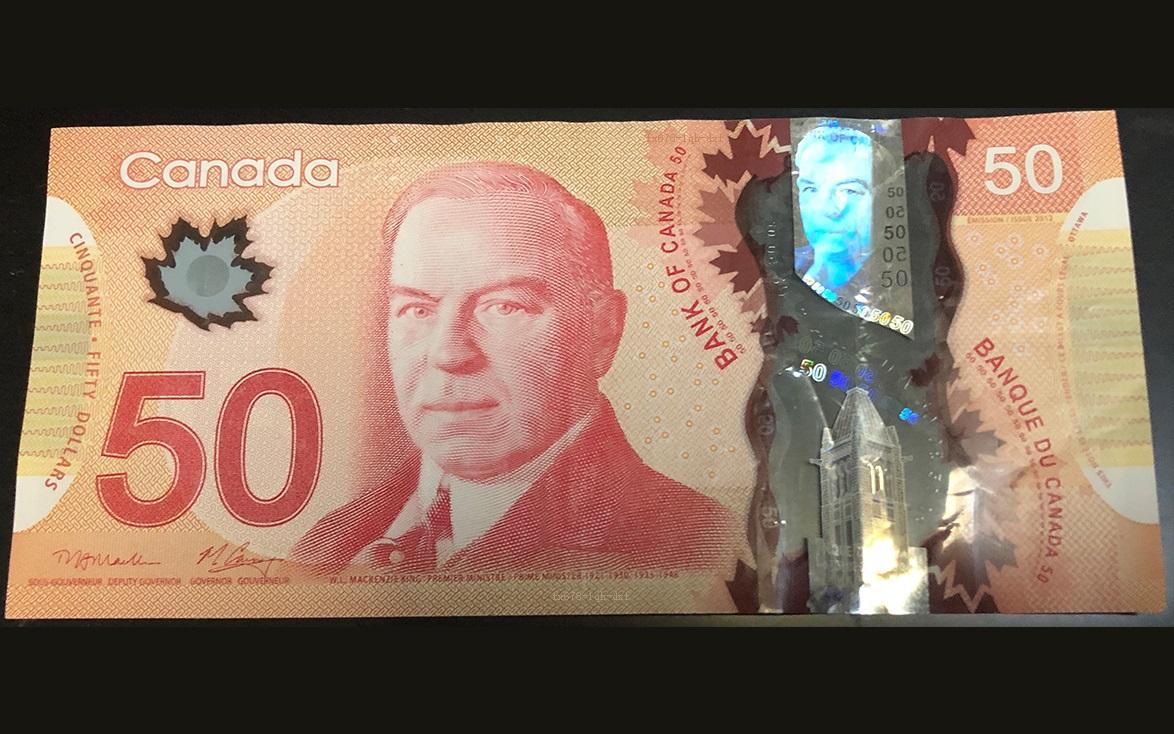
Analysts point out that the Bank of Canada is expected to keep its policy rate unchanged at 2.25%, a level at the lower end of the neutral range. The Canadian economy has entered a technical recession after contracting for two consecutive quarters, and core inflation also slowed to 2.1% in April.
Policymakers have previously stated their reluctance to overinterpret recent weak economic data. Last week's strong jobs report provided ample justification for Governor Macklem to maintain a neutral policy stance.
Multiple surveys indicate that interest rates are likely to remain unchanged throughout 2026. Assuming other factors remain constant (such as oil prices), this could be a source of potential weakness for the Canadian dollar. Yesterday's bullish external reversal in the USD/CAD pair could signal further weakness in the Canadian dollar, potentially even an overcorrection towards the 1.40 level. Meanwhile, the yield spread between two-year US Treasury bonds and Canadian bonds has widened significantly to approximately 125 basis points, providing further support for the US dollar.
Analysts point out that the 30-day correlation between the Canadian dollar and WTI crude oil has turned negative, while its correlation with gold is strengthening, which further amplifies the downward pressure on the Canadian dollar.
As a major crude oil exporter, Canada's dollar typically exhibits a positive correlation with oil prices—rising oil prices mean increased export revenue and improved terms of trade, leading to a strengthening of the Canadian dollar. However, this long-standing stable relationship is currently reversing. While WTI crude oil prices have recently continued to rise, briefly exceeding $92 per barrel, the Canadian dollar has not benefited; instead, it has weakened against the US dollar.
The current reversal of the correlation suggests that other factors are indeed driving the Canadian dollar's movement. The most prominent is the divergence in monetary policy between the US and Canada: the Federal Reserve remains firmly committed to maintaining high interest rates, while the Bank of Canada has paused rate hikes, keeping rates unchanged at 2.25%, due to the economy entering a technical recession and core inflation slowing to 2.1%. The interest rate differential between the two countries continues to widen, with the spread between two-year US Treasury yields and Canadian Treasury yields widening to approximately 125 basis points. This makes US dollar assets more attractive, leading to a continued capital outflow from the Canadian dollar to the US dollar.
Furthermore, the increasing correlation between the Canadian dollar and gold is also noteworthy. Gold prices have recently come under pressure, with spot gold falling to around $4070. The positive correlation between the Canadian dollar and gold means that a weakening gold price will further drag down the Canadian dollar. Overall, rising oil prices are unlikely to offset the dual pressures of widening interest rate differentials and falling gold prices, and the short-term outlook for the Canadian dollar remains bearish. Unless the Bank of Canada releases hawkish signals or the USD/USD interest rate differential narrows significantly, the Canadian dollar is likely to continue its weak trend against the US dollar.
The USD/CAD pair is in a strong uptrend on the daily chart, having currently reached a new high of 1.3970, indicating strong bullish momentum. The moving average system is also in a bullish alignment, with the short-term 20-day moving average (MA20) turning upwards and the long-term 200-day moving average (MA200) providing support, making the overall support level quite solid.
In terms of technical indicators, the MACD red bars continue to expand, and the DIFF and DEA lines are diverging upwards, indicating strong bullish momentum; the RSI indicator has entered the overbought zone (approximately 73.79), suggesting some downward pressure in the short term.
At key price levels, the upper resistance is at the 1.40 psychological level, while the lower support is at the 1.3900 level and the previous high near 1.3966.
In summary, the USD/CAD pair shows a clear short-term bullish trend, but the overbought RSI may trigger a slight pullback. The recommended strategy is to buy on dips. If the pullback holds above the 1.3900 support level, the upward trend is likely to continue; otherwise, it may enter a period of consolidation.
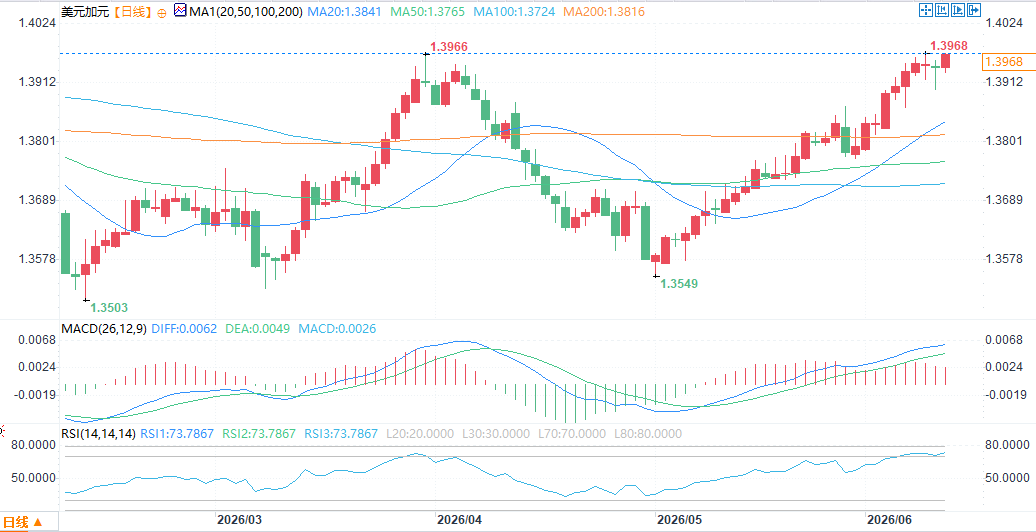
(USD/CAD daily chart, source: EasyForex)
At 16:40 Beijing time on June 11, the USD/CAD exchange rate was 1.3969/70.
Analysts at Societe Generale point out that the USD/CAD pair has broken through key technical resistance and is poised for further gains. Factors such as the Bank of Canada's expected decision to maintain interest rates at 2.25%, the widening yield spread between the US and Canadian dollars, a bullish external reversal in the USD/CAD exchange rate, and a weakening correlation between the Canadian dollar and oil prices all suggest that the Canadian dollar may underperform.
The Bank of Canada paused interest rate hikes, and interest rate differentials supported the US dollar.
Analysts point out that the Bank of Canada is expected to keep its policy rate unchanged at 2.25%, a level at the lower end of the neutral range. The Canadian economy has entered a technical recession after contracting for two consecutive quarters, and core inflation also slowed to 2.1% in April.
Policymakers have previously stated their reluctance to overinterpret recent weak economic data. Last week's strong jobs report provided ample justification for Governor Macklem to maintain a neutral policy stance.
Multiple surveys indicate that interest rates are likely to remain unchanged throughout 2026. Assuming other factors remain constant (such as oil prices), this could be a source of potential weakness for the Canadian dollar. Yesterday's bullish external reversal in the USD/CAD pair could signal further weakness in the Canadian dollar, potentially even an overcorrection towards the 1.40 level. Meanwhile, the yield spread between two-year US Treasury bonds and Canadian bonds has widened significantly to approximately 125 basis points, providing further support for the US dollar.
The Canadian dollar's correlation with crude oil has turned negative, while its correlation with gold has strengthened.
Analysts point out that the 30-day correlation between the Canadian dollar and WTI crude oil has turned negative, while its correlation with gold is strengthening, which further amplifies the downward pressure on the Canadian dollar.
As a major crude oil exporter, Canada's dollar typically exhibits a positive correlation with oil prices—rising oil prices mean increased export revenue and improved terms of trade, leading to a strengthening of the Canadian dollar. However, this long-standing stable relationship is currently reversing. While WTI crude oil prices have recently continued to rise, briefly exceeding $92 per barrel, the Canadian dollar has not benefited; instead, it has weakened against the US dollar.
The current reversal of the correlation suggests that other factors are indeed driving the Canadian dollar's movement. The most prominent is the divergence in monetary policy between the US and Canada: the Federal Reserve remains firmly committed to maintaining high interest rates, while the Bank of Canada has paused rate hikes, keeping rates unchanged at 2.25%, due to the economy entering a technical recession and core inflation slowing to 2.1%. The interest rate differential between the two countries continues to widen, with the spread between two-year US Treasury yields and Canadian Treasury yields widening to approximately 125 basis points. This makes US dollar assets more attractive, leading to a continued capital outflow from the Canadian dollar to the US dollar.
Furthermore, the increasing correlation between the Canadian dollar and gold is also noteworthy. Gold prices have recently come under pressure, with spot gold falling to around $4070. The positive correlation between the Canadian dollar and gold means that a weakening gold price will further drag down the Canadian dollar. Overall, rising oil prices are unlikely to offset the dual pressures of widening interest rate differentials and falling gold prices, and the short-term outlook for the Canadian dollar remains bearish. Unless the Bank of Canada releases hawkish signals or the USD/USD interest rate differential narrows significantly, the Canadian dollar is likely to continue its weak trend against the US dollar.
Technical Analysis
The USD/CAD pair is in a strong uptrend on the daily chart, having currently reached a new high of 1.3970, indicating strong bullish momentum. The moving average system is also in a bullish alignment, with the short-term 20-day moving average (MA20) turning upwards and the long-term 200-day moving average (MA200) providing support, making the overall support level quite solid.
In terms of technical indicators, the MACD red bars continue to expand, and the DIFF and DEA lines are diverging upwards, indicating strong bullish momentum; the RSI indicator has entered the overbought zone (approximately 73.79), suggesting some downward pressure in the short term.
At key price levels, the upper resistance is at the 1.40 psychological level, while the lower support is at the 1.3900 level and the previous high near 1.3966.
In summary, the USD/CAD pair shows a clear short-term bullish trend, but the overbought RSI may trigger a slight pullback. The recommended strategy is to buy on dips. If the pullback holds above the 1.3900 support level, the upward trend is likely to continue; otherwise, it may enter a period of consolidation.
(USD/CAD daily chart, source: EasyForex)
At 16:40 Beijing time on June 11, the USD/CAD exchange rate was 1.3969/70.
- Risk Warning and Disclaimer
- The market involves risk, and trading may not be suitable for all investors. This article is for reference only and does not constitute personal investment advice, nor does it take into account certain users’ specific investment objectives, financial situation, or other needs. Any investment decisions made based on this information are at your own risk.