Brent crude futures fell more than 2%, with profit-taking dominating the market.
2026-06-11 16:46:40
On Thursday (June 11) during the European session, Brent crude oil futures prices fell to around $92.50 per barrel, a drop of more than 2%.
Despite renewed conflict between the United States and Iran, traders opted to lock in earlier profits, causing oil prices to retreat from their intraday highs.
However, analysts point out that given the continued geopolitical tensions, the downside potential for oil prices may be limited.

The United States launched a new wave of military strikes against Iran on Wednesday, raising market concerns that a war with Iran could disrupt energy supplies for an extended period. U.S. Central Command stated that the U.S. military "has initiated additional defensive strikes against multiple targets within Iran, as directed by the Commander-in-Chief," in response to "Iran's unprovoked and ongoing acts of aggression."
This marks the first large-scale U.S. military operation against targets inside Iran since the brief ceasefire agreement reached between the two sides in early April. Pentagon officials revealed that the targets included missile launch sites and drone storage facilities controlled by the Iranian Revolutionary Guard, aimed at weakening its ability to continue attacking neighboring countries and sea lanes.
On Thursday, Bahrain, Jordan, and Kuwait intercepted Iranian missiles and drones targeting U.S. military facilities, indicating that the conflict has spread to a wider region, according to media reports. The involvement of these three Gulf states signifies an expansion of the conflict—previously, they had attempted to maintain neutrality in the confrontation between Iran and the United States.
Military analysts point out that the forced involvement of neighboring countries in defensive operations signifies a rapid deterioration in the security situation around the Strait of Hormuz. Any attack on the region's oil infrastructure could directly impact approximately one-fifth of the world's oil shipping routes.
This development may limit the downside potential of WTI oil prices to some extent. Although traders opted to take profits after the earlier rise, causing oil prices to pull back to around $93.50 in the short term, the substantial escalation of geopolitical risks will continue to remind the market that the threat of supply disruptions has not subsided.
If the conflict spreads further to oil-producing areas or key shipping routes, oil prices could regain upward momentum at any time.
U.S. crude oil inventories continued to decline last week, providing fundamental support for oil prices.
According to the latest report from the U.S. Energy Information Administration (EIA), U.S. crude oil inventories fell by 7.228 million barrels in the week ending June 5. This decline far exceeded market expectations of 4 million barrels, and although slightly lower than the previous week's drop of 7.974 million barrels, it marked the fifth consecutive week of inventory declines.
Since the beginning of May, U.S. crude oil inventories have decreased by more than 30 million barrels, marking the fastest rate of inventory reduction this year.
The unexpected decline in inventory is driven by the continued rise in refinery operating rates and steady growth in export demand.
Data shows that the U.S. refinery utilization rate rose to 95.5% last week, the highest level this year, indicating that the arrival of the summer travel season is driving demand for refined petroleum products such as gasoline and diesel.
Meanwhile, U.S. crude oil exports remained at a high level of over 4 million barrels per day, and the enthusiasm of European and Asian buyers for purchasing light, low-sulfur crude oil did not diminish significantly despite high oil prices.
In terms of absolute inventory levels, current U.S. commercial crude oil inventories have fallen below 420 million barrels, the lowest point since 2024, and about 5% lower than the five-year average for the same period. The continued tightening of inventories means that the market's ability to buffer against any supply-side shocks is weakening. Even without considering the risk of escalating tensions in the Middle East, the tight fundamentals themselves are sufficient to support oil prices.
Analysts point out that as long as inventories continue to decline, it will be difficult for WTI crude oil prices to experience a sustained deep correction. Any decline caused by profit-taking or changes in risk appetite could attract new buying.
While geopolitical tensions and declining inventories are typically seen as positive factors, the market opted for profit-taking after the previous rally, reflecting investor caution at current price levels. Since the end of May, WTI crude oil prices have risen by more than 15%, and Brent crude even briefly broke through the $95 mark, accumulating substantial unrealized profits for some speculative long positions. In the absence of further strong catalysts, these funds chose to lock in profits, which is the main technical reason for the current pullback.
Looking at the positioning data, net long positions in the crude oil futures market have recently risen to a three-month high, indicating some crowded trading characteristics. If oil prices show signs of stalling at high levels, concentrated liquidation of long positions could amplify the pullback. Furthermore, investors are reassessing the true impact of geopolitical risks—although the US-Iran conflict continues to escalate, there has been no substantial disruption to oil transport through the Strait of Hormuz so far, and the actual supply-side impact remains at the level of expectation.
It is worth noting that if the situation in the Middle East escalates further, such as with a direct attack on oil infrastructure or a substantial blockade of the Strait of Hormuz, oil prices may quickly regain upward momentum and even challenge the psychological threshold of $100.
Conversely, if the US and Iran resume indirect negotiations in the near future, or if the scope of the conflict is effectively controlled, market sentiment will tend to ease, and the risk premium previously priced in may be further squeezed out, and oil prices may continue their downward trend, falling to the $85 to $87 range.
In the short term, oil prices will remain highly volatile amid a tug-of-war between geopolitical risks and profit-taking pressures.
Brent crude oil is currently in a high-level consolidation phase with a slight downward bias on the daily chart. Prices have retreated from the previous high of $119.45 and have recently been fluctuating around $92.50, breaking below the 20-day and 50-day moving averages (MA20 and MA50). The short-term trend is weak, but it remains supported by the 100-day moving average (MA100).
The key support level is $89.53; a break below this level would lead to a test of $86.04. The resistance level is in the $98-$101 range.
Current prices are under pressure from short-term moving averages, resulting in weak rebounds and an overall weak and volatile trend. Continued range-bound trading is likely in the short term; the effectiveness of the $90 support level should be monitored. A break below this level would open up further downside potential.
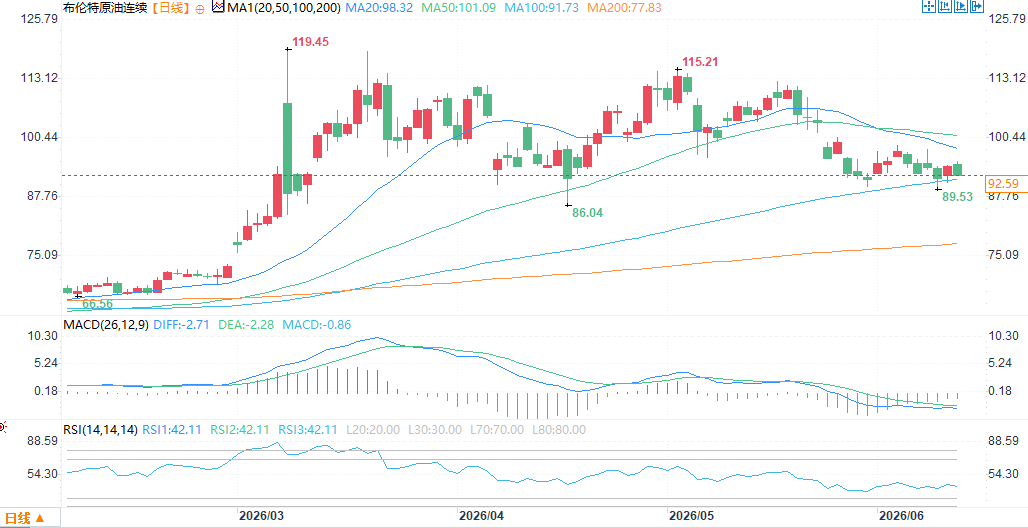
(Brent crude oil futures daily chart, source: FX678)
At 16:06 Beijing time on June 11, Brent crude oil futures were trading at $92.53 per barrel.
Despite renewed conflict between the United States and Iran, traders opted to lock in earlier profits, causing oil prices to retreat from their intraday highs.
However, analysts point out that given the continued geopolitical tensions, the downside potential for oil prices may be limited.
The US-Iran conflict escalates again, and concerns about supply disruptions persist.
The United States launched a new wave of military strikes against Iran on Wednesday, raising market concerns that a war with Iran could disrupt energy supplies for an extended period. U.S. Central Command stated that the U.S. military "has initiated additional defensive strikes against multiple targets within Iran, as directed by the Commander-in-Chief," in response to "Iran's unprovoked and ongoing acts of aggression."
This marks the first large-scale U.S. military operation against targets inside Iran since the brief ceasefire agreement reached between the two sides in early April. Pentagon officials revealed that the targets included missile launch sites and drone storage facilities controlled by the Iranian Revolutionary Guard, aimed at weakening its ability to continue attacking neighboring countries and sea lanes.
On Thursday, Bahrain, Jordan, and Kuwait intercepted Iranian missiles and drones targeting U.S. military facilities, indicating that the conflict has spread to a wider region, according to media reports. The involvement of these three Gulf states signifies an expansion of the conflict—previously, they had attempted to maintain neutrality in the confrontation between Iran and the United States.
Military analysts point out that the forced involvement of neighboring countries in defensive operations signifies a rapid deterioration in the security situation around the Strait of Hormuz. Any attack on the region's oil infrastructure could directly impact approximately one-fifth of the world's oil shipping routes.
This development may limit the downside potential of WTI oil prices to some extent. Although traders opted to take profits after the earlier rise, causing oil prices to pull back to around $93.50 in the short term, the substantial escalation of geopolitical risks will continue to remind the market that the threat of supply disruptions has not subsided.
If the conflict spreads further to oil-producing areas or key shipping routes, oil prices could regain upward momentum at any time.
US crude oil inventories fell more than expected, with fundamentals providing support.
U.S. crude oil inventories continued to decline last week, providing fundamental support for oil prices.
According to the latest report from the U.S. Energy Information Administration (EIA), U.S. crude oil inventories fell by 7.228 million barrels in the week ending June 5. This decline far exceeded market expectations of 4 million barrels, and although slightly lower than the previous week's drop of 7.974 million barrels, it marked the fifth consecutive week of inventory declines.
Since the beginning of May, U.S. crude oil inventories have decreased by more than 30 million barrels, marking the fastest rate of inventory reduction this year.
The unexpected decline in inventory is driven by the continued rise in refinery operating rates and steady growth in export demand.
Data shows that the U.S. refinery utilization rate rose to 95.5% last week, the highest level this year, indicating that the arrival of the summer travel season is driving demand for refined petroleum products such as gasoline and diesel.
Meanwhile, U.S. crude oil exports remained at a high level of over 4 million barrels per day, and the enthusiasm of European and Asian buyers for purchasing light, low-sulfur crude oil did not diminish significantly despite high oil prices.
In terms of absolute inventory levels, current U.S. commercial crude oil inventories have fallen below 420 million barrels, the lowest point since 2024, and about 5% lower than the five-year average for the same period. The continued tightening of inventories means that the market's ability to buffer against any supply-side shocks is weakening. Even without considering the risk of escalating tensions in the Middle East, the tight fundamentals themselves are sufficient to support oil prices.
Analysts point out that as long as inventories continue to decline, it will be difficult for WTI crude oil prices to experience a sustained deep correction. Any decline caused by profit-taking or changes in risk appetite could attract new buying.
Short-term pullback does not change the overall pattern; bullish and bearish factors are intertwined.
While geopolitical tensions and declining inventories are typically seen as positive factors, the market opted for profit-taking after the previous rally, reflecting investor caution at current price levels. Since the end of May, WTI crude oil prices have risen by more than 15%, and Brent crude even briefly broke through the $95 mark, accumulating substantial unrealized profits for some speculative long positions. In the absence of further strong catalysts, these funds chose to lock in profits, which is the main technical reason for the current pullback.
Looking at the positioning data, net long positions in the crude oil futures market have recently risen to a three-month high, indicating some crowded trading characteristics. If oil prices show signs of stalling at high levels, concentrated liquidation of long positions could amplify the pullback. Furthermore, investors are reassessing the true impact of geopolitical risks—although the US-Iran conflict continues to escalate, there has been no substantial disruption to oil transport through the Strait of Hormuz so far, and the actual supply-side impact remains at the level of expectation.
It is worth noting that if the situation in the Middle East escalates further, such as with a direct attack on oil infrastructure or a substantial blockade of the Strait of Hormuz, oil prices may quickly regain upward momentum and even challenge the psychological threshold of $100.
Conversely, if the US and Iran resume indirect negotiations in the near future, or if the scope of the conflict is effectively controlled, market sentiment will tend to ease, and the risk premium previously priced in may be further squeezed out, and oil prices may continue their downward trend, falling to the $85 to $87 range.
In the short term, oil prices will remain highly volatile amid a tug-of-war between geopolitical risks and profit-taking pressures.
Technical Analysis
Brent crude oil is currently in a high-level consolidation phase with a slight downward bias on the daily chart. Prices have retreated from the previous high of $119.45 and have recently been fluctuating around $92.50, breaking below the 20-day and 50-day moving averages (MA20 and MA50). The short-term trend is weak, but it remains supported by the 100-day moving average (MA100).
The key support level is $89.53; a break below this level would lead to a test of $86.04. The resistance level is in the $98-$101 range.
Current prices are under pressure from short-term moving averages, resulting in weak rebounds and an overall weak and volatile trend. Continued range-bound trading is likely in the short term; the effectiveness of the $90 support level should be monitored. A break below this level would open up further downside potential.
(Brent crude oil futures daily chart, source: FX678)
At 16:06 Beijing time on June 11, Brent crude oil futures were trading at $92.53 per barrel.
- Risk Warning and Disclaimer
- The market involves risk, and trading may not be suitable for all investors. This article is for reference only and does not constitute personal investment advice, nor does it take into account certain users’ specific investment objectives, financial situation, or other needs. Any investment decisions made based on this information are at your own risk.