The 0.70 level has become a "meat grinder": Will Australian dollar bulls be completely buried?
2026-06-11 19:57:39
On Thursday, June 11th, the market focus regarding the Australian dollar against the US dollar was not on the stabilization of the exchange rate, but rather on whether the 0.7000 level would transform from short-term support into a medium-term dividing line. Currently, the Australian dollar is trading around 0.6995 against the US dollar, close to the flat line, having previously touched a low of around 0.6987. On the daily chart, the price is near the lower Bollinger Band at 0.6997, and the MACD remains in negative expansion territory, indicating that the rebound is more of a technical pause than a relief of trend pressure.

The U.S. Consumer Price Index (CPI) rose 0.5% month-over-month in May, and 4.2% year-over-year. The core index rose 0.2% month-over-month and 2.9% year-over-year. Key figures include a 23.5% year-over-year increase in the energy index and a 40.5% year-over-year increase in gasoline prices, with energy contributing over 60% of the total monthly increase. While this data was not significantly higher than expected, it was also insufficient to support a return to easing expectations; the market is more likely to interpret it as evidence that the Federal Reserve needs to maintain restrictive interest rates.
The Federal Reserve's meeting on June 16-17 will release new economic projections, with forward guidance being more important than the interest rate decision itself. If the policy stance shifts from a previous easing bias to a greater emphasis on inflation risks, the US dollar index, even with short-term fluctuations, may maintain strong interest rate support. For the Australian dollar against the US dollar, the pressure from the US dollar is not simply safe-haven buying, but rather a combination of pressure from short-term interest rate pricing, energy inflation, and policy expectations.
The Reserve Bank of Australia (RBA) raised the cash rate by 25 basis points to 4.35% in May, but the meeting minutes showed that one of the nine members supported keeping the rate unchanged, and most members believed that financial conditions were likely already constrained after the rate hike, requiring observation of the Middle East conflict and the reactions of households and businesses. This statement implies that while the policy rate is high, the threshold for further rate hikes is also rising.
More importantly, local data is beginning to undermine the Australian dollar's relative yield story. Seasonally adjusted employment fell by 18,600 to 14,737,400 in April, the unemployment rate rose to 4.5%, and the number of unemployed increased by 33,000 to 692,500. This data doesn't mean the job market is collapsing, but rather that the Reserve Bank of Australia's trade-off between inflation and growth is becoming more complex, and the Australian dollar's response to interest rate differentials is becoming asymmetrical.
From a daily chart perspective, the Australian dollar against the US dollar has been trending downwards since its previous high of 0.7277. The recent rebound only reached around 0.7200 before breaking below the middle Bollinger Band and approaching the lower band. Currently, the Bollinger middle band is at 0.7145, the upper band is at 0.7294, and the lower band is at 0.6997. The price is trading near the lower band, indicating that the upward movement is not a converging move but rather a defensive test of the lower trendline.
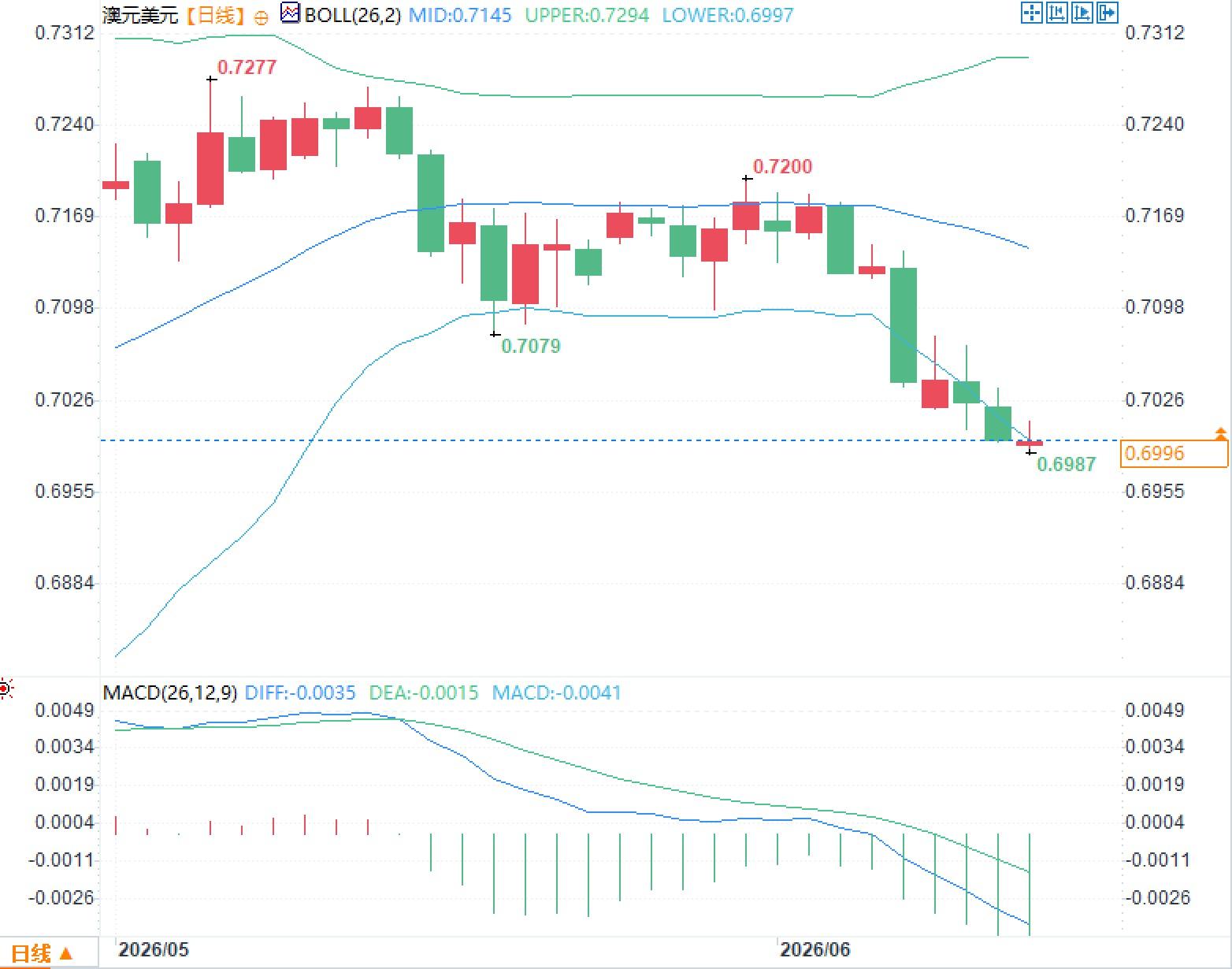
The Australian dollar remains below its 20-day moving average of 0.7107 against the US dollar, with a dense resistance zone forming between 0.7057 and 0.7110. This, coupled with the expanding negative MACD indicator, suggests that the current structure resembles a low-level consolidation after a decline, rather than a valid reversal.
Brent crude oil closed at $92 a barrel on June 11, down 3% from the previous day but still 32.67% higher than a year ago. High oil prices are not a one-sided positive for the Australian dollar. On the one hand, the Australian dollar has resource attributes; on the other hand, rising energy prices will compress household purchasing power, increase business costs, and put pressure on global risk appetite. For the foreign exchange market, the latter is more dominant at this stage.
Therefore, the core issue surrounding the Australian dollar against the US dollar has shifted from "whose interest rate is higher" to "whose policy path is more credible." US inflation remains above the Federal Reserve's target, limiting room for policy easing; while the Reserve Bank of Australia has already raised interest rates, employment and activity data have cast doubt on the sustainability of further tightening. As long as this divergence persists, the battle around 0.7000 will not only be a technical level contest, but also a reassessment of the risk premium for the Australian dollar in macroeconomic pricing.
Question 1: Why is the Australian dollar being closely watched at 0.7000 against the US dollar?
A: The 0.7000 level simultaneously represents a psychological key level, the lower Bollinger Band, and a recent area of concentrated lows. If the price fails to break out of this area for an extended period, it indicates insufficient support below, and any rebound is likely to be suppressed by the moving average and previous trading volume.
Question 2: Why did the US CPI, which met expectations, still suppress the Australian dollar?
A: Meeting expectations does not mean interest rate pressures have disappeared. Energy inflation remains high, and core inflation has not yet returned to its comfort zone. The market will continue to focus on whether the Federal Reserve will strengthen its restrictive stance.
Question 3: Why did the Reserve Bank of Australia's interest rate hikes fail to provide significant support for the Australian dollar?
A: Exchange rates are determined by marginal changes. The cash rate has reached 4.35%, but the unemployment rate has risen to 4.5%, reducing the certainty of further policy tightening. As a result, the yield advantage of the Australian dollar is offset by concerns about growth.
On the dollar side: Inflation is not out of control, but the narrative of policy easing has been compressed.
The U.S. Consumer Price Index (CPI) rose 0.5% month-over-month in May, and 4.2% year-over-year. The core index rose 0.2% month-over-month and 2.9% year-over-year. Key figures include a 23.5% year-over-year increase in the energy index and a 40.5% year-over-year increase in gasoline prices, with energy contributing over 60% of the total monthly increase. While this data was not significantly higher than expected, it was also insufficient to support a return to easing expectations; the market is more likely to interpret it as evidence that the Federal Reserve needs to maintain restrictive interest rates.
The Federal Reserve's meeting on June 16-17 will release new economic projections, with forward guidance being more important than the interest rate decision itself. If the policy stance shifts from a previous easing bias to a greater emphasis on inflation risks, the US dollar index, even with short-term fluctuations, may maintain strong interest rate support. For the Australian dollar against the US dollar, the pressure from the US dollar is not simply safe-haven buying, but rather a combination of pressure from short-term interest rate pricing, energy inflation, and policy expectations.
Australian Dollar: High interest rates have not automatically translated into exchange rate support.
The Reserve Bank of Australia (RBA) raised the cash rate by 25 basis points to 4.35% in May, but the meeting minutes showed that one of the nine members supported keeping the rate unchanged, and most members believed that financial conditions were likely already constrained after the rate hike, requiring observation of the Middle East conflict and the reactions of households and businesses. This statement implies that while the policy rate is high, the threshold for further rate hikes is also rising.
More importantly, local data is beginning to undermine the Australian dollar's relative yield story. Seasonally adjusted employment fell by 18,600 to 14,737,400 in April, the unemployment rate rose to 4.5%, and the number of unemployed increased by 33,000 to 692,500. This data doesn't mean the job market is collapsing, but rather that the Reserve Bank of Australia's trade-off between inflation and growth is becoming more complex, and the Australian dollar's response to interest rate differentials is becoming asymmetrical.
Technical Analysis: 0.7000 is not a regular integer, but rather a compression point in the price movement structure.
From a daily chart perspective, the Australian dollar against the US dollar has been trending downwards since its previous high of 0.7277. The recent rebound only reached around 0.7200 before breaking below the middle Bollinger Band and approaching the lower band. Currently, the Bollinger middle band is at 0.7145, the upper band is at 0.7294, and the lower band is at 0.6997. The price is trading near the lower band, indicating that the upward movement is not a converging move but rather a defensive test of the lower trendline.
The Australian dollar remains below its 20-day moving average of 0.7107 against the US dollar, with a dense resistance zone forming between 0.7057 and 0.7110. This, coupled with the expanding negative MACD indicator, suggests that the current structure resembles a low-level consolidation after a decline, rather than a valid reversal.
Fundamental Theme: Energy shocks are changing the traditional pricing of the Australian dollar.
Brent crude oil closed at $92 a barrel on June 11, down 3% from the previous day but still 32.67% higher than a year ago. High oil prices are not a one-sided positive for the Australian dollar. On the one hand, the Australian dollar has resource attributes; on the other hand, rising energy prices will compress household purchasing power, increase business costs, and put pressure on global risk appetite. For the foreign exchange market, the latter is more dominant at this stage.
Therefore, the core issue surrounding the Australian dollar against the US dollar has shifted from "whose interest rate is higher" to "whose policy path is more credible." US inflation remains above the Federal Reserve's target, limiting room for policy easing; while the Reserve Bank of Australia has already raised interest rates, employment and activity data have cast doubt on the sustainability of further tightening. As long as this divergence persists, the battle around 0.7000 will not only be a technical level contest, but also a reassessment of the risk premium for the Australian dollar in macroeconomic pricing.
Frequently Asked Questions
Question 1: Why is the Australian dollar being closely watched at 0.7000 against the US dollar?
A: The 0.7000 level simultaneously represents a psychological key level, the lower Bollinger Band, and a recent area of concentrated lows. If the price fails to break out of this area for an extended period, it indicates insufficient support below, and any rebound is likely to be suppressed by the moving average and previous trading volume.
Question 2: Why did the US CPI, which met expectations, still suppress the Australian dollar?
A: Meeting expectations does not mean interest rate pressures have disappeared. Energy inflation remains high, and core inflation has not yet returned to its comfort zone. The market will continue to focus on whether the Federal Reserve will strengthen its restrictive stance.
Question 3: Why did the Reserve Bank of Australia's interest rate hikes fail to provide significant support for the Australian dollar?
A: Exchange rates are determined by marginal changes. The cash rate has reached 4.35%, but the unemployment rate has risen to 4.5%, reducing the certainty of further policy tightening. As a result, the yield advantage of the Australian dollar is offset by concerns about growth.
- Risk Warning and Disclaimer
- The market involves risk, and trading may not be suitable for all investors. This article is for reference only and does not constitute personal investment advice, nor does it take into account certain users’ specific investment objectives, financial situation, or other needs. Any investment decisions made based on this information are at your own risk.