Gold fell to a six-month low: Hawkish expectations from the Federal Reserve and a stronger dollar exerted downward pressure.
2026-06-11 23:13:30
On Thursday (June 11), spot gold (XAU/USD) fell to a six-month low during the US trading session, erasing all of its year-to-date gains. Expectations of a hawkish Federal Reserve policy, a stronger dollar, and technical selling pressure combined to force bulls to exit the market and remain on the sidelines.
Gold prices held steady around $4,080 during the session; the intraday low touched $4,023, a new low since November 2025.
High interest rates overshadow gold's safe-haven appeal
The US-Iran conflict is testing gold's traditional safe-haven status, with the US dollar becoming the market's preferred safe-haven asset. The situation in the Middle East continues to escalate, but since the start of the conflict at the end of February, gold prices have fallen by about 25%; from the historical high of nearly $5,600 reached in January, the decline is nearly 27%.
The main reason for this round of sell-off is the reversal of market expectations for interest rates: the Middle East war has driven up oil prices, exacerbated inflation concerns, and forced major central banks (especially the Federal Reserve) to tighten monetary policy and even consider raising interest rates.
US inflation has nearly doubled since the start of the war: it was 2.4% in January before the war, and rose to 4.2% in May, a new high since April 2023.
Data released on Thursday showed that the U.S. Producer Price Index (PPI) rose 6.5% year-on-year in May, up from 5.7% in April and the expected 6.4%; the core PPI remained flat at 4.9%, lower than the expected 5.4%.
Market expectations have changed dramatically: In early 2026, the market expected the Federal Reserve to cut interest rates at least twice; now, traders are betting that the Federal Reserve may raise interest rates this year.
Gold is often seen as a hedge against inflation, but high interest rates diminish its appeal—gold is interest-free, while interest-bearing assets such as bonds are more competitive.
Are short sellers still in control?
From a technical perspective, after gold prices broke below the 200-day simple moving average, the bears gained the upper hand.
This week, Iran shot down a US Apache helicopter, reigniting conflict in the Middle East and dimming hopes for a short-term reconciliation; the market is concerned about the long-term disruption to shipping in the Strait of Hormuz.
US President Trump posted on the social media platform TruthSocial on Thursday that the United States would "severely strike" Iran that evening and seize Iran's Kharg Island and other oil facilities.
The US Dollar Index (DXY) has held above the 100 mark, approaching its highest level since early April; the index measures the exchange rate of the US dollar against six major currencies.
With persistent macroeconomic headwinds and a continued strengthening of the US dollar, gold still faces the risk of further decline.
Technical Analysis: Oversold signals are emerging, but the trend remains bearish.
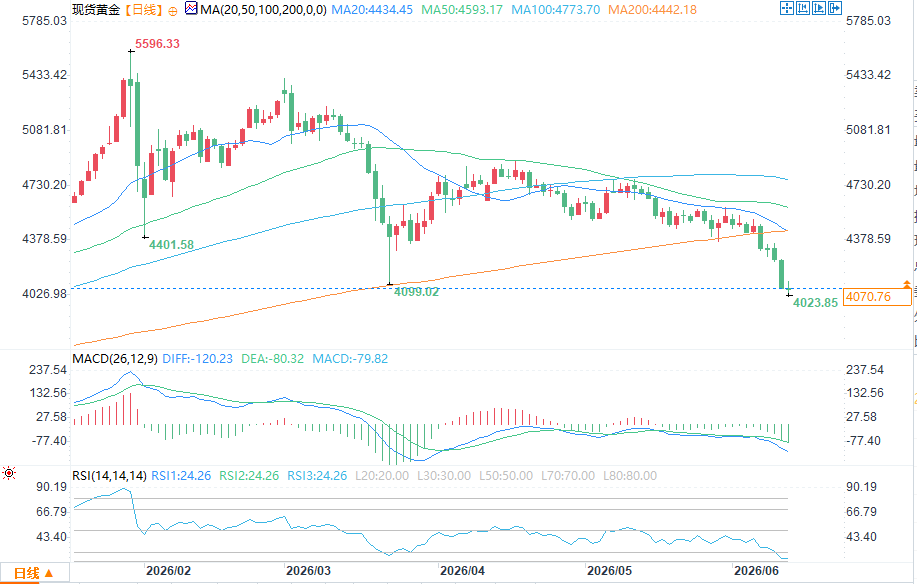
(Spot gold daily chart source: FX678)
Spot gold continued its downward trend, with prices well below the 200-day, 100-day, 50-day, and 20-day moving averages, forming a dense supply resistance zone above.
The daily RSI reading is 24.26, which has entered the severely oversold zone. In the MACD indicator, the DIFF line (-120.23) is below the DEA line (-80.32), and the MACD histogram (-79.82) remains negative, indicating that although the downward momentum has been released, there is still no clear reversal signal.
On the resistance level, the first resistance is at $4442.18, near the 200-day moving average. Subsequent key resistance levels are the 20-day moving average ($4434.45), the 50-day moving average ($4593.17), and the 100-day moving average ($4773.70). These levels are expected to suppress any rebound. On the support level, the intraday low of $4023.85 and the psychological level of $4000 provide immediate support. A break below these levels could see gold prices fall further to the $3900 level.
Gold prices held steady around $4,080 during the session; the intraday low touched $4,023, a new low since November 2025.
High interest rates overshadow gold's safe-haven appeal
The US-Iran conflict is testing gold's traditional safe-haven status, with the US dollar becoming the market's preferred safe-haven asset. The situation in the Middle East continues to escalate, but since the start of the conflict at the end of February, gold prices have fallen by about 25%; from the historical high of nearly $5,600 reached in January, the decline is nearly 27%.
The main reason for this round of sell-off is the reversal of market expectations for interest rates: the Middle East war has driven up oil prices, exacerbated inflation concerns, and forced major central banks (especially the Federal Reserve) to tighten monetary policy and even consider raising interest rates.
US inflation has nearly doubled since the start of the war: it was 2.4% in January before the war, and rose to 4.2% in May, a new high since April 2023.
Data released on Thursday showed that the U.S. Producer Price Index (PPI) rose 6.5% year-on-year in May, up from 5.7% in April and the expected 6.4%; the core PPI remained flat at 4.9%, lower than the expected 5.4%.
Market expectations have changed dramatically: In early 2026, the market expected the Federal Reserve to cut interest rates at least twice; now, traders are betting that the Federal Reserve may raise interest rates this year.
Gold is often seen as a hedge against inflation, but high interest rates diminish its appeal—gold is interest-free, while interest-bearing assets such as bonds are more competitive.
Are short sellers still in control?
From a technical perspective, after gold prices broke below the 200-day simple moving average, the bears gained the upper hand.
This week, Iran shot down a US Apache helicopter, reigniting conflict in the Middle East and dimming hopes for a short-term reconciliation; the market is concerned about the long-term disruption to shipping in the Strait of Hormuz.
US President Trump posted on the social media platform TruthSocial on Thursday that the United States would "severely strike" Iran that evening and seize Iran's Kharg Island and other oil facilities.
The US Dollar Index (DXY) has held above the 100 mark, approaching its highest level since early April; the index measures the exchange rate of the US dollar against six major currencies.
With persistent macroeconomic headwinds and a continued strengthening of the US dollar, gold still faces the risk of further decline.
Technical Analysis: Oversold signals are emerging, but the trend remains bearish.
(Spot gold daily chart source: FX678)
Spot gold continued its downward trend, with prices well below the 200-day, 100-day, 50-day, and 20-day moving averages, forming a dense supply resistance zone above.
The daily RSI reading is 24.26, which has entered the severely oversold zone. In the MACD indicator, the DIFF line (-120.23) is below the DEA line (-80.32), and the MACD histogram (-79.82) remains negative, indicating that although the downward momentum has been released, there is still no clear reversal signal.
On the resistance level, the first resistance is at $4442.18, near the 200-day moving average. Subsequent key resistance levels are the 20-day moving average ($4434.45), the 50-day moving average ($4593.17), and the 100-day moving average ($4773.70). These levels are expected to suppress any rebound. On the support level, the intraday low of $4023.85 and the psychological level of $4000 provide immediate support. A break below these levels could see gold prices fall further to the $3900 level.
- Risk Warning and Disclaimer
- The market involves risk, and trading may not be suitable for all investors. This article is for reference only and does not constitute personal investment advice, nor does it take into account certain users’ specific investment objectives, financial situation, or other needs. Any investment decisions made based on this information are at your own risk.