A chart shows that continued weakness in Capesize freight rates has dragged down the Baltic Dry Index to a more than one-month low.
2026-06-11 22:42:15
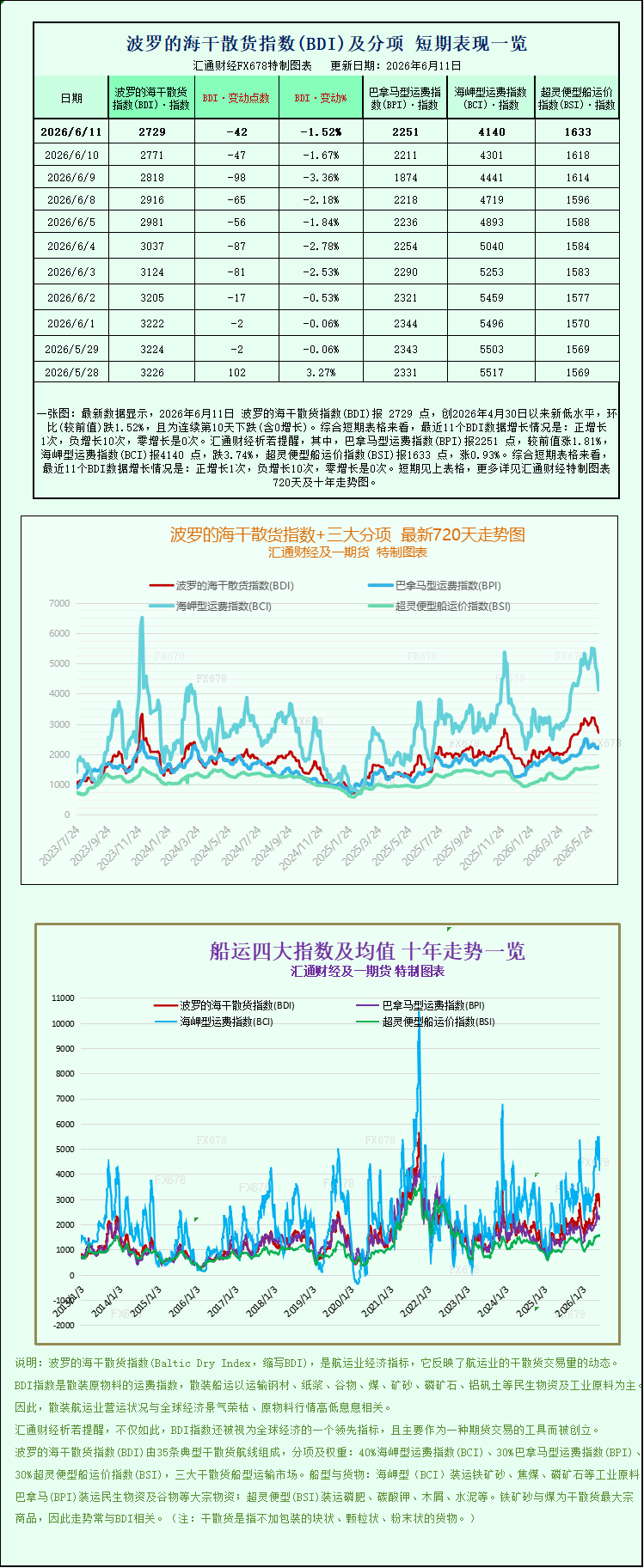
Latest data shows that the Baltic Dry Index (BDI) was at 2729 points on June 11, 2026, a new low since April 30, 2026, down 1.52% month-on-month, marking the 10th consecutive day of decline (including zero growth). Looking at the short-term charts, the recent 11 BDI data points show: 1 positive increase, 10 negative increases, and 0 zero increases. Specifically, the Panamax Freight Index (BPI) was at 2251 points, up 1.81% from the previous value; the Capesize Freight Index (BCI) was at 4140 points, down 3.74%; and the Supramax Freight Index (BSI) was at 1633 points, up 0.93%. For detailed 720-day and 10-year trend charts of the Baltic Dry Index and its three main sub-indices, please refer to the specially designed charts.
The international dry bulk shipping market has continued to weaken recently. Dragged down by a sharp decline in freight rates for the main Capesize (Capesize) vessels, the Baltic Dry Index continued its downward trend on Thursday, hitting a new low in over a month. As a key indicator of the global dry bulk shipping market, this index primarily monitors the fluctuations in freight rates for various dry bulk commodities such as iron ore, coal, and grains, directly reflecting the supply and demand dynamics of global dry bulk shipping trade.
Data shows that the Baltic Dry Index, which tracks freight rates for the three major vessel types—Capemax, Panamax, and Supramax—fell sharply by 42 points on the day, a drop of 1.5%, closing at 2729 points. This was the lowest closing level in more than a month since May 1 this year, indicating significant pressure on the market.
The Capesize vessel market, which had previously supported the index, experienced a significant cooling, becoming a major factor dragging down the overall market. The Baltic Capesize Index plummeted 161 points in a single day, a drop of 3.7%, closing at 4140 points, with the weakness continuing to spread. Correspondingly, market profitability data also declined in tandem. The spot freight rate index for Capesize vessels, which mainly carry 150,000-ton deadweight vessels and primarily transport bulk raw materials such as iron ore and thermal coal, saw its average daily earnings fall sharply by $1456, with the latest average daily earnings dropping to $34048, further shrinking shipowners' profit margins.
Industry analysts indicate that the core reason for the sharp drop in Capesize freight rates stems from weak demand in the upstream commodity market. International iron ore futures prices also declined on Thursday, primarily driven by persistently weak demand and sluggish purchasing intentions from downstream steel mills. Even with a temporary increase in seaborne iron ore shipments, it was insufficient to offset the weak demand, directly leading to a decline in premiums for ocean-going iron ore shipping orders and a continued drop in freight rates. Furthermore, changes in global trade policies have also disrupted market sentiment. The implementation of anti-dumping measures related to steel and iron ore by the UK and India has triggered instability in the regional trade landscape, increasing cautious sentiment among market participants and further suppressing expectations for a recovery in the dry bulk shipping market.
In stark contrast to the sharp decline in the Capesize vessel market, the market for small and medium-tonnage vessels remained relatively stable, exhibiting a structurally differentiated trend. Data shows that the Panamax index bucked the trend, rising 40 points, or 1.8%, to close at 2251 points, continuing its slight recovery. This vessel type primarily operates with a deadweight tonnage of 60,000 to 70,000 tons, mainly transporting commodities such as coal and grains. The average daily earnings of corresponding spot vessels increased by $358, reaching a new daily average of $20,255, achieving increased revenue against the market downturn.
The market for smaller Supramax vessels also saw a slight upward trend, with the Supramax index rising 15 points, or 0.9%, to 1633 points. Overall, the current dry bulk shipping market exhibits a clear structural trend. Large raw material carriers continue to weaken due to drag from industrial demand, while small and medium-sized bulk carriers are showing stronger performance supported by grain and regional coal trade. The market is characterized by a significant divergence between hot and cold sectors.
The international dry bulk shipping market has continued to weaken recently. Dragged down by a sharp decline in freight rates for the main Capesize (Capesize) vessels, the Baltic Dry Index continued its downward trend on Thursday, hitting a new low in over a month. As a key indicator of the global dry bulk shipping market, this index primarily monitors the fluctuations in freight rates for various dry bulk commodities such as iron ore, coal, and grains, directly reflecting the supply and demand dynamics of global dry bulk shipping trade.
Data shows that the Baltic Dry Index, which tracks freight rates for the three major vessel types—Capemax, Panamax, and Supramax—fell sharply by 42 points on the day, a drop of 1.5%, closing at 2729 points. This was the lowest closing level in more than a month since May 1 this year, indicating significant pressure on the market.
The Capesize vessel market, which had previously supported the index, experienced a significant cooling, becoming a major factor dragging down the overall market. The Baltic Capesize Index plummeted 161 points in a single day, a drop of 3.7%, closing at 4140 points, with the weakness continuing to spread. Correspondingly, market profitability data also declined in tandem. The spot freight rate index for Capesize vessels, which mainly carry 150,000-ton deadweight vessels and primarily transport bulk raw materials such as iron ore and thermal coal, saw its average daily earnings fall sharply by $1456, with the latest average daily earnings dropping to $34048, further shrinking shipowners' profit margins.
Industry analysts indicate that the core reason for the sharp drop in Capesize freight rates stems from weak demand in the upstream commodity market. International iron ore futures prices also declined on Thursday, primarily driven by persistently weak demand and sluggish purchasing intentions from downstream steel mills. Even with a temporary increase in seaborne iron ore shipments, it was insufficient to offset the weak demand, directly leading to a decline in premiums for ocean-going iron ore shipping orders and a continued drop in freight rates. Furthermore, changes in global trade policies have also disrupted market sentiment. The implementation of anti-dumping measures related to steel and iron ore by the UK and India has triggered instability in the regional trade landscape, increasing cautious sentiment among market participants and further suppressing expectations for a recovery in the dry bulk shipping market.
In stark contrast to the sharp decline in the Capesize vessel market, the market for small and medium-tonnage vessels remained relatively stable, exhibiting a structurally differentiated trend. Data shows that the Panamax index bucked the trend, rising 40 points, or 1.8%, to close at 2251 points, continuing its slight recovery. This vessel type primarily operates with a deadweight tonnage of 60,000 to 70,000 tons, mainly transporting commodities such as coal and grains. The average daily earnings of corresponding spot vessels increased by $358, reaching a new daily average of $20,255, achieving increased revenue against the market downturn.
The market for smaller Supramax vessels also saw a slight upward trend, with the Supramax index rising 15 points, or 0.9%, to 1633 points. Overall, the current dry bulk shipping market exhibits a clear structural trend. Large raw material carriers continue to weaken due to drag from industrial demand, while small and medium-sized bulk carriers are showing stronger performance supported by grain and regional coal trade. The market is characterized by a significant divergence between hot and cold sectors.
- Risk Warning and Disclaimer
- The market involves risk, and trading may not be suitable for all investors. This article is for reference only and does not constitute personal investment advice, nor does it take into account certain users’ specific investment objectives, financial situation, or other needs. Any investment decisions made based on this information are at your own risk.