The pound faces high volatility next week: three major catalysts – employment, inflation, and the Bank of England's policy decision – will be released in quick succession.
2026-06-12 16:38:34
On Friday (June 12) during the European session, the pound fell slightly against the dollar, currently trading around 1.3410.
Despite GDP figures meeting expectations, the reality of economic contraction still puts some pressure on the pound.
The UK Office for National Statistics reported that the economy contracted by 0.1% month-on-month in April, in line with market expectations. This contraction was mainly due to consumers and businesses anticipating that the Middle East conflict would push up future prices, leading them to make purchases in advance in March (when the economy grew by 0.3%), resulting in a decline in demand in April.
Industrial output was flat month-on-month in April, compared with a 0.2% decline in the previous month, but slightly below market expectations of a 0.1% increase. This data indicates that the industrial sector, which accounts for a large share of the UK economy, remains stagnant. The weakness in industrial output is mainly due to the combined pressure of high energy costs and weak external demand. The conflict in the Middle East has driven up gas and electricity prices, significantly increasing production costs in energy-intensive industries, forcing some companies to reduce production or even suspend operations. Furthermore, the slowdown in economic growth among major European trading partners has weakened external order demand, further dragging down industrial output.
Meanwhile, manufacturing output unexpectedly rose 0.4% month-on-month in April, compared to market expectations of a 0.2% decline. This positive sign was mainly driven by strong performance in sub-sectors such as automobile manufacturing and pharmaceuticals. Some manufacturers were able to maintain their production pace in April after making advance purchases of raw materials in March. In addition, the recent depreciation of the pound has provided export-oriented manufacturers with a price advantage, which has helped boost overseas orders.
Unexpected growth in manufacturing output provided some support for the pound, indicating that some sectors of the UK economy remain resilient. However, the stagnation in industrial output reflects continued pressure on overall economic growth. The positive signals from manufacturing are insufficient to reverse the overall economic weakness, and the UK economy remained sluggish at the start of the second quarter.
The manufacturing sector is far smaller than the overall industrial sector, and its growth is unlikely to offset the drag from other sectors. Markets are focused on more economic data to be released next week to assess the true health of the UK economy. If the services PMI and retail sales data also show weakness, the Bank of England may face greater pressure to cut interest rates.
Next week, the British pound is expected to experience high volatility, with three key catalysts set to emerge.
First, there's the UK employment data for the three months to April. This report will reveal the tightness of the labor market, including key indicators such as the unemployment rate, wage growth, and changes in the number of employed people.
Secondly, the UK Consumer Price Index for May will be closely watched, with the market closely monitoring whether inflation remains high, especially the performance of services inflation and core CPI.
The third major catalyst, and the most significant trigger, is the Bank of England's monetary policy statement. The central bank's guidance on the path of interest rates will determine the short-term direction of the pound.
The market will focus on any changes in the voting results, Governor Bailey's press conference remarks, and the central bank's latest assessment of the inflation outlook and economic growth. Any signals that exceed expectations could trigger significant volatility in the pound.
If inflation remains high and the labor market remains tight, the Bank of England may be forced to maintain a hawkish stance to support the pound; conversely, if economic data weakens further, expectations of interest rate cuts may rise, putting pressure on the pound.
Therefore, the short-term trend of the pound will depend on the gap between the actual performance of these three sets of data and market expectations, as well as how the central bank balances the dilemma between "fighting inflation" and "stabilizing growth".
Meanwhile, the dollar rebounded after falling on Thursday as traders remained skeptical about a near-term deal between the US and Iran. Despite Trump's statement that "discussions and final points have been approved by all relevant parties in terms of concepts and details" and that "the signing time and place will be announced soon," markets remained cautious. The dollar index is currently up 0.15% to around 99.80.
Analysts point out that Trump has made similar promises multiple times before but has failed to deliver, and coupled with Iran's denial of a final agreement, market optimism regarding the prospects for peace is waning. Continued geopolitical uncertainty is providing safe-haven support for the US dollar. If an agreement is delayed, the dollar may benefit further; if an unexpected agreement is reached, a rebound in risk appetite could put downward pressure on the dollar.
The GBP/USD pair is currently trading within a range on the daily chart, with bullish and bearish forces relatively even. The price is fluctuating around the 1.3400 level, with short-term moving averages intertwined, offering little directional guidance. Key resistance lies near the previous high of 1.3657, while support is near the previous low of 1.3159. The current price is hovering around various moving averages, indicating intense competition between bulls and bears.
In terms of indicators, the MACD indicator's DIFF and DEA lines are intertwined near the zero axis, with a slight increase in the green bars, indicating neither strong bullish nor bearish momentum. The RSI indicator is around 47, within the neutral range, with no obvious overbought or oversold signals at present.
In summary, the British pound and US dollar currently lack a clear trend direction and are generally maintaining a range-bound trading pattern. Short-term price fluctuations are influenced by both moving averages and horizontal levels, with relatively clear resistance above and support below.
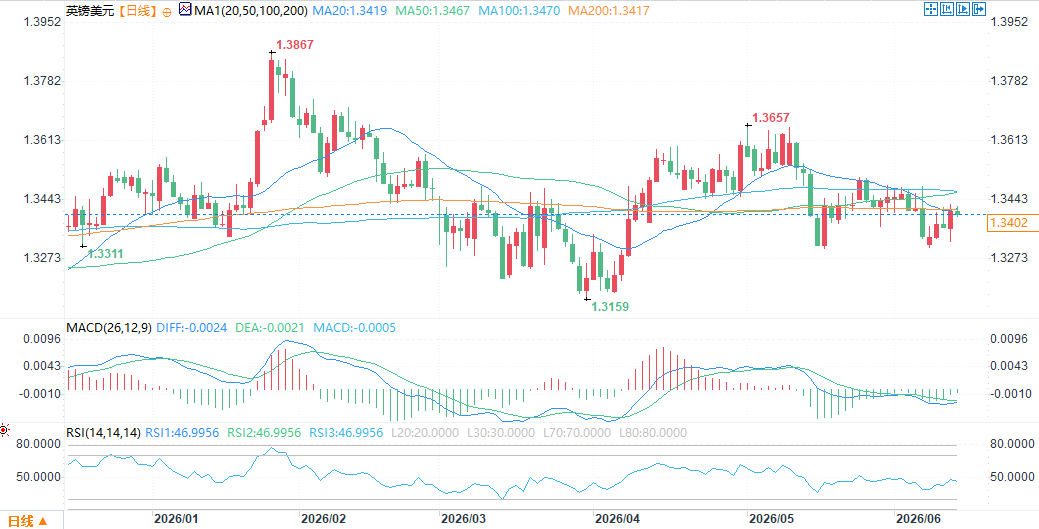
(GBP/USD daily chart, source: FX678)
At 16:28 Beijing time on June 12, the British pound was trading at 1.3411/12 against the US dollar.
Despite GDP figures meeting expectations, the reality of economic contraction still puts some pressure on the pound.
The UK Office for National Statistics reported that the economy contracted by 0.1% month-on-month in April, in line with market expectations. This contraction was mainly due to consumers and businesses anticipating that the Middle East conflict would push up future prices, leading them to make purchases in advance in March (when the economy grew by 0.3%), resulting in a decline in demand in April.
Data divergence between industrial and manufacturing sectors
Industrial output was flat month-on-month in April, compared with a 0.2% decline in the previous month, but slightly below market expectations of a 0.1% increase. This data indicates that the industrial sector, which accounts for a large share of the UK economy, remains stagnant. The weakness in industrial output is mainly due to the combined pressure of high energy costs and weak external demand. The conflict in the Middle East has driven up gas and electricity prices, significantly increasing production costs in energy-intensive industries, forcing some companies to reduce production or even suspend operations. Furthermore, the slowdown in economic growth among major European trading partners has weakened external order demand, further dragging down industrial output.
Meanwhile, manufacturing output unexpectedly rose 0.4% month-on-month in April, compared to market expectations of a 0.2% decline. This positive sign was mainly driven by strong performance in sub-sectors such as automobile manufacturing and pharmaceuticals. Some manufacturers were able to maintain their production pace in April after making advance purchases of raw materials in March. In addition, the recent depreciation of the pound has provided export-oriented manufacturers with a price advantage, which has helped boost overseas orders.
Unexpected growth in manufacturing output provided some support for the pound, indicating that some sectors of the UK economy remain resilient. However, the stagnation in industrial output reflects continued pressure on overall economic growth. The positive signals from manufacturing are insufficient to reverse the overall economic weakness, and the UK economy remained sluggish at the start of the second quarter.
The manufacturing sector is far smaller than the overall industrial sector, and its growth is unlikely to offset the drag from other sectors. Markets are focused on more economic data to be released next week to assess the true health of the UK economy. If the services PMI and retail sales data also show weakness, the Bank of England may face greater pressure to cut interest rates.
Key events next week: employment, inflation and the Bank of England's decision.
Next week, the British pound is expected to experience high volatility, with three key catalysts set to emerge.
First, there's the UK employment data for the three months to April. This report will reveal the tightness of the labor market, including key indicators such as the unemployment rate, wage growth, and changes in the number of employed people.
Secondly, the UK Consumer Price Index for May will be closely watched, with the market closely monitoring whether inflation remains high, especially the performance of services inflation and core CPI.
The third major catalyst, and the most significant trigger, is the Bank of England's monetary policy statement. The central bank's guidance on the path of interest rates will determine the short-term direction of the pound.
The market will focus on any changes in the voting results, Governor Bailey's press conference remarks, and the central bank's latest assessment of the inflation outlook and economic growth. Any signals that exceed expectations could trigger significant volatility in the pound.
If inflation remains high and the labor market remains tight, the Bank of England may be forced to maintain a hawkish stance to support the pound; conversely, if economic data weakens further, expectations of interest rate cuts may rise, putting pressure on the pound.
Therefore, the short-term trend of the pound will depend on the gap between the actual performance of these three sets of data and market expectations, as well as how the central bank balances the dilemma between "fighting inflation" and "stabilizing growth".
The dollar rebounded as markets questioned the prospects of a US-Iran deal.
Meanwhile, the dollar rebounded after falling on Thursday as traders remained skeptical about a near-term deal between the US and Iran. Despite Trump's statement that "discussions and final points have been approved by all relevant parties in terms of concepts and details" and that "the signing time and place will be announced soon," markets remained cautious. The dollar index is currently up 0.15% to around 99.80.
Analysts point out that Trump has made similar promises multiple times before but has failed to deliver, and coupled with Iran's denial of a final agreement, market optimism regarding the prospects for peace is waning. Continued geopolitical uncertainty is providing safe-haven support for the US dollar. If an agreement is delayed, the dollar may benefit further; if an unexpected agreement is reached, a rebound in risk appetite could put downward pressure on the dollar.
Technical Analysis
The GBP/USD pair is currently trading within a range on the daily chart, with bullish and bearish forces relatively even. The price is fluctuating around the 1.3400 level, with short-term moving averages intertwined, offering little directional guidance. Key resistance lies near the previous high of 1.3657, while support is near the previous low of 1.3159. The current price is hovering around various moving averages, indicating intense competition between bulls and bears.
In terms of indicators, the MACD indicator's DIFF and DEA lines are intertwined near the zero axis, with a slight increase in the green bars, indicating neither strong bullish nor bearish momentum. The RSI indicator is around 47, within the neutral range, with no obvious overbought or oversold signals at present.
In summary, the British pound and US dollar currently lack a clear trend direction and are generally maintaining a range-bound trading pattern. Short-term price fluctuations are influenced by both moving averages and horizontal levels, with relatively clear resistance above and support below.
(GBP/USD daily chart, source: FX678)
At 16:28 Beijing time on June 12, the British pound was trading at 1.3411/12 against the US dollar.
- Risk Warning and Disclaimer
- The market involves risk, and trading may not be suitable for all investors. This article is for reference only and does not constitute personal investment advice, nor does it take into account certain users’ specific investment objectives, financial situation, or other needs. Any investment decisions made based on this information are at your own risk.