Is a US-Iran framework agreement about to be finalized? Oil prices may experience a rollercoaster ride of "confirmation-denial" before the Geneva summit.
2026-06-12 17:55:05
On Friday, June 12, Brent crude oil trading continued to retreat from its high geopolitical premium. The latest price for the Brent crude oil futures contract was around $86.37 per barrel, with a daily low of $85.80 per barrel. The price was close to the lower Bollinger Band at $84.97 per barrel, while the middle Bollinger Band was at $98.99 per barrel. The MACD remained in negative territory, indicating that the risk premium previously driven by the risk of disruption in the Strait of Hormuz is being rapidly reassessed.

This round of crude oil price declines is not simply due to weakening demand, but rather a sharp reversal in pricing of supply risks. Reports indicate that a framework agreement between the US and Iran regarding the reopening of the Strait of Hormuz, extending the ceasefire, and lifting some port blockades is nearing completion, likely in the form of a memorandum of understanding rather than a final agreement. Some diplomatic channels suggest the signing may take place in Geneva, around the time of the G7 summit, but Iran has publicly stated that no final conclusion has been reached, indicating that the market is trading on "improved probabilities" rather than "event outcomes."
For traders, the key is not whether the news is optimistic enough, but how much of an extreme disruption premium was previously priced in. The Strait of Hormuz has long been considered the most sensitive variable in the crude oil supply chain; any expectation of resumption of navigation would directly compress the risk premium for longer-term contracts and cause near-term contracts to shift from conflict premiums to repricing based on inventory, refinery operating rates, and spot discounts. Trump recently stated that an agreement could be signed soon and that the Strait would reopen, but Iran still emphasizes that "no final conclusion has been reached." This discrepancy in wording means that oil prices will continue to fluctuate around the three variables of confirmation, denial, and delay in the short term.
From a technical chart perspective, Brent crude oil has been steadily declining from its high of around $115.21 per barrel on the daily chart. The June rebound failed to regain the Bollinger Middle Band, and the price subsequently traded near the lower band, with the latest low of $85.80 per barrel approaching the lower Bollinger Band at $84.97 per barrel. The Bollinger Middle Band has fallen to $98.99 per barrel, indicating that the moving average system over the past 26 trading days is still trending downwards. Even if a technical rebound occurs, the price will first face resistance from the moving average.
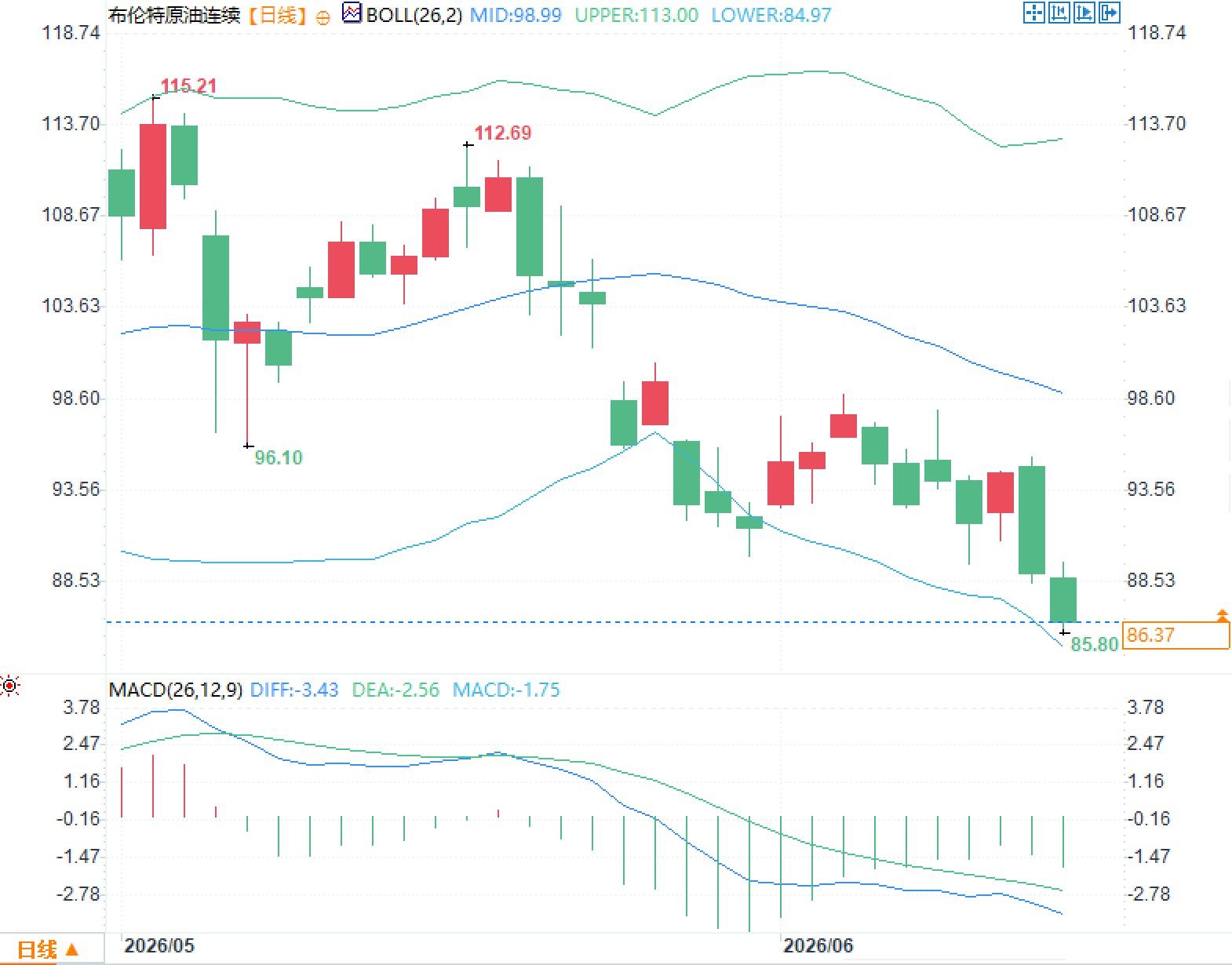
On the MACD front, the DIFF is -3.43, the DEA is -2.56, and the histogram is approximately -1.75. The negative range has not yet significantly converged, indicating that momentum remains weak. If news continues to signal the resumption of flights, oil prices may continue to test low-level trading volumes; if signing is delayed or implementation details are repeatedly discussed, geopolitical premiums may be re-established. In other words, current oil prices are caught between a "valuation pullback due to the cooling of events" and "incomplete recovery of actual supply," and volatility will not immediately disappear due to price declines.
The fundamentals have not fully eased. The latest weekly report from the U.S. Energy Information Administration shows that for the week ending May 29, U.S. commercial crude oil inventories fell by approximately 8 million barrels, refinery utilization rose to 94.7%, and net crude oil imports decreased by 249,000 barrels per day. The combination of declining inventories, high refinery utilization, and falling imports means that even with a decline in macroeconomic risk premiums, low inventory levels still provide support in the spot market.
More importantly, there is a physical time lag in supply chain recovery. A May report by the International Energy Agency estimated that, assuming a gradual recovery of strait traffic from June, global oil supply in 2026 could still be 3.9 million barrels per day less than previously expected, falling to approximately 102.2 million barrels per day. In other words, while the agreement is expected to reduce the panic premium in prices, it cannot immediately make up for the logistical mismatches, shipping delays, and inventory depletion accumulated over the past few months.
From a term structure perspective, the market will focus on three key issues: first, whether the resumption of navigation in the Strait of Hormuz will cover tanker, refined oil, and liquefied energy transport; second, the pace of recovery of throughput at blocked ports; and third, whether Iranian exports will return to the market in a verifiable manner. If these variables are merely written into the framework document rather than implemented immediately, oil prices, after an initial drop in response to the news, may shift towards testing actual commodity flows.
The divergence on the demand side is widening. In its June report, OPEC lowered its 2026 global oil demand growth forecast to 970,000 barrels per day, marking the second consecutive downward revision, but its assessment remains more optimistic than that of the U.S. Energy Information Administration and the International Energy Agency. The International Energy Agency's April report, however, projected an average decrease of 80,000 barrels per day in global oil demand by 2026, reflecting the dampening effect of high oil prices, shipping disruptions, and reduced end-user fuel affordability on consumption.
This divergence is crucial for pricing. If the resumption of flights to and from the Strait of Hormuz proceeds smoothly while demand expectations continue to be revised downwards, oil prices may converge towards costs and inventory levels. However, if the resumption of flights is not implemented smoothly, inventories continue to decline, and fuel consumption remains high during the summer, then a smooth break below $85/barrel may not be feasible. The current market action appears to be a preemptive removal of extreme risk premiums rather than a confirmation that supply and demand have already eased.
With the Hormuz forecast shifting, the core of crude oil pricing has moved from "supply disruption" to "reopening."
This round of crude oil price declines is not simply due to weakening demand, but rather a sharp reversal in pricing of supply risks. Reports indicate that a framework agreement between the US and Iran regarding the reopening of the Strait of Hormuz, extending the ceasefire, and lifting some port blockades is nearing completion, likely in the form of a memorandum of understanding rather than a final agreement. Some diplomatic channels suggest the signing may take place in Geneva, around the time of the G7 summit, but Iran has publicly stated that no final conclusion has been reached, indicating that the market is trading on "improved probabilities" rather than "event outcomes."
For traders, the key is not whether the news is optimistic enough, but how much of an extreme disruption premium was previously priced in. The Strait of Hormuz has long been considered the most sensitive variable in the crude oil supply chain; any expectation of resumption of navigation would directly compress the risk premium for longer-term contracts and cause near-term contracts to shift from conflict premiums to repricing based on inventory, refinery operating rates, and spot discounts. Trump recently stated that an agreement could be signed soon and that the Strait would reopen, but Iran still emphasizes that "no final conclusion has been reached." This discrepancy in wording means that oil prices will continue to fluctuate around the three variables of confirmation, denial, and delay in the short term.
Technically, the price has entered the lower resistance zone, and the trend signal has not yet been fully corrected.
From a technical chart perspective, Brent crude oil has been steadily declining from its high of around $115.21 per barrel on the daily chart. The June rebound failed to regain the Bollinger Middle Band, and the price subsequently traded near the lower band, with the latest low of $85.80 per barrel approaching the lower Bollinger Band at $84.97 per barrel. The Bollinger Middle Band has fallen to $98.99 per barrel, indicating that the moving average system over the past 26 trading days is still trending downwards. Even if a technical rebound occurs, the price will first face resistance from the moving average.
On the MACD front, the DIFF is -3.43, the DEA is -2.56, and the histogram is approximately -1.75. The negative range has not yet significantly converged, indicating that momentum remains weak. If news continues to signal the resumption of flights, oil prices may continue to test low-level trading volumes; if signing is delayed or implementation details are repeatedly discussed, geopolitical premiums may be re-established. In other words, current oil prices are caught between a "valuation pullback due to the cooling of events" and "incomplete recovery of actual supply," and volatility will not immediately disappear due to price declines.
Inventory and refinery constraints limit the downward slope; supply recovery will not happen overnight.
The fundamentals have not fully eased. The latest weekly report from the U.S. Energy Information Administration shows that for the week ending May 29, U.S. commercial crude oil inventories fell by approximately 8 million barrels, refinery utilization rose to 94.7%, and net crude oil imports decreased by 249,000 barrels per day. The combination of declining inventories, high refinery utilization, and falling imports means that even with a decline in macroeconomic risk premiums, low inventory levels still provide support in the spot market.
More importantly, there is a physical time lag in supply chain recovery. A May report by the International Energy Agency estimated that, assuming a gradual recovery of strait traffic from June, global oil supply in 2026 could still be 3.9 million barrels per day less than previously expected, falling to approximately 102.2 million barrels per day. In other words, while the agreement is expected to reduce the panic premium in prices, it cannot immediately make up for the logistical mismatches, shipping delays, and inventory depletion accumulated over the past few months.
From a term structure perspective, the market will focus on three key issues: first, whether the resumption of navigation in the Strait of Hormuz will cover tanker, refined oil, and liquefied energy transport; second, the pace of recovery of throughput at blocked ports; and third, whether Iranian exports will return to the market in a verifiable manner. If these variables are merely written into the framework document rather than implemented immediately, oil prices, after an initial drop in response to the news, may shift towards testing actual commodity flows.
With demand expectations diverging, the price of oil will depend on the race between the speed of supply recovery and the resilience of demand.
The divergence on the demand side is widening. In its June report, OPEC lowered its 2026 global oil demand growth forecast to 970,000 barrels per day, marking the second consecutive downward revision, but its assessment remains more optimistic than that of the U.S. Energy Information Administration and the International Energy Agency. The International Energy Agency's April report, however, projected an average decrease of 80,000 barrels per day in global oil demand by 2026, reflecting the dampening effect of high oil prices, shipping disruptions, and reduced end-user fuel affordability on consumption.
This divergence is crucial for pricing. If the resumption of flights to and from the Strait of Hormuz proceeds smoothly while demand expectations continue to be revised downwards, oil prices may converge towards costs and inventory levels. However, if the resumption of flights is not implemented smoothly, inventories continue to decline, and fuel consumption remains high during the summer, then a smooth break below $85/barrel may not be feasible. The current market action appears to be a preemptive removal of extreme risk premiums rather than a confirmation that supply and demand have already eased.
- Risk Warning and Disclaimer
- The market involves risk, and trading may not be suitable for all investors. This article is for reference only and does not constitute personal investment advice, nor does it take into account certain users’ specific investment objectives, financial situation, or other needs. Any investment decisions made based on this information are at your own risk.