With US PPI surging to 6.5% and the Bank of Canada holding rates steady, can the USD/CAD pair break through 1.40?
2026-06-12 16:37:53
On Friday (June 12) during the Asian session, the US dollar rose against the Canadian dollar, currently trading around 1.3985.
This trend was mainly driven by strong U.S. inflation data.
Meanwhile, the market is closely watching the progress of the US-Iran peace agreement.
The preliminary reading of the University of Michigan Consumer Sentiment Index for June will be released later.
Data released on Thursday showed that the U.S. Producer Price Index (PPI) rose more than expected in May, marking the largest annual increase in three and a half years, mainly driven by the Middle East conflict pushing up energy product costs. Specifically, the PPI rose 6.5% year-on-year, higher than April's 5.7% and the market expectation of 6.4%; it rose 1.1% month-on-month, far exceeding the expected 0.7%. Energy prices were the main driver, with the energy sub-index rising 5.2% month-on-month in May, contributing nearly half of the overall increase.
At the same time, food prices and service costs remained firm, with the core PPI rising 4.8% year-on-year, indicating that inflationary pressures are spreading from the energy sector to a wider range of areas.
John Ryding, chief economic advisor at Brean Capital, said: “The Fed has deviated significantly from its inflation target far more than its employment target. The PPI report should further reinforce the views of those on the Federal Open Market Committee who believe that a rate hike may be necessary later this year.”
Ryding further pointed out that the market's previous optimistic expectations for a continued decline in inflation have been shattered by two consecutive sets of strong inflation data (CPI returning above 4% and PPI hitting a three-and-a-half-year high). If inflation data continues to be stubborn in the coming months, the Federal Reserve may be forced to tighten its policy stance again, rather than "pausing rate hikes and then waiting and seeing" as the market had previously expected.
It's worth noting that PPI data is generally considered a leading indicator of CPI, as price increases on the production side ultimately translate into higher prices on the consumption side. This means that CPI may continue to face upward pressure in the coming months. The market's pricing in a 25 basis point rate hike in December has risen from about 14% a month ago to 43%, reflecting a rapidly increasing expectation among investors that the Federal Reserve will maintain high interest rates.
Trump said on Thursday that the US and Iran could sign a peace agreement as early as this weekend, reopening the Strait of Hormuz to shipping. Speaking to reporters in the Oval Office, he said the two sides had reached an agreement on the framework and the final document could be signed soon. However, Iran quickly countered that no final decision had been reached on an agreement.
Iran's official news agency Fars reported that Supreme Leader Ayatollah Khamenei did not approve the US proposal, and key issues, including passage rights in the Strait of Hormuz and frozen funds, remain unresolved. Significant differences remain between the two sides on core issues, and tensions in the Middle East persist, with uncertainty remaining high.
According to media reports, the U.S. military intercepted and shot down two Iranian one-way attack drones near the Strait of Hormuz on Thursday after Iran attempted to target merchant ships passing through the waterway. This marks the second direct military clash between the two sides in the Persian Gulf region this week.
Previously, Iranian forces intercepted an uncoordinated oil tanker attempting to pass through the strategic waterway, highlighting its firm stance on the right of way in the strait. A Pentagon spokesperson stated that the U.S. military will "continue to protect freedom of navigation in the region" and warned Iran against further provocations.
The Iranian Islamic Revolutionary Guard Corps issued a statement declaring that the country is stronger than ever and prepared to respond to any act of aggression with a "decisive, immediate, painful, and regrettable response." This strong statement indicates that despite ongoing diplomatic negotiations, the military standoff between the two sides has not eased but rather shows signs of escalation.
Analysts point out that as long as the two sides cannot reach a compromise on core issues such as control of the Strait of Hormuz and the lifting of sanctions, the peace agreement will be difficult to truly implement, and market optimism may be reversed at any time by new conflict news.
Regarding the Canadian dollar, the Bank of Canada decided on Wednesday, as expected, to keep its key interest rate unchanged, stating that there is currently little evidence that rising energy prices are driving broad-based inflation. This marks the fifth consecutive time the Bank of Canada has kept its benchmark interest rate at 2.25%.
The central bank stated explicitly: "To date, there is insufficient evidence to suggest that high energy prices have been widely transmitted to other consumer prices. The Governing Council will continue to ignore the short-term impact of the war on overall inflation, but will not allow rising energy prices to develop into persistent inflation."
However, Bank of Canada Governor Macklem reiterated that the central bank would not hesitate to raise interest rates to control inflation if necessary. In a press conference, he stated that the current coexistence of weak economic growth and rising inflation presents a dilemma for monetary policy—raising rates could further drag down economic growth, while lowering rates could increase the risk of prolonged high inflation. Maintaining interest rates is a way to balance these risks.
Macklem also provided clear scenario guidance: if the Middle East conflict continues and energy prices begin to trigger widespread inflation, a series of interest rate hikes may be necessary; while if the United States imposes new major trade restrictions on Canada, interest rate cuts may be necessary to support economic growth.
Analysts point out that the Bank of Canada's stance contrasts sharply with that of the Federal Reserve—the latter is facing pressure to raise interest rates due to renewed inflation, with the market pricing in a 43% probability of a Fed rate hike in December; while the Bank of Canada remains on hold due to weak economic conditions (first-quarter GDP unexpectedly contracted by 0.1%) and moderate core inflation (the lowest in more than five years).
This policy divergence is one of the key factors supporting the USD/CAD exchange rate, with the widening interest rate differential between the two countries making dollar assets more attractive. Furthermore, the Bank of Canada stated that "financial conditions have eased since the April Monetary Policy Report," specifically mentioning the Canadian dollar's depreciation, suggesting a relatively tolerant attitude towards the weakening of the Canadian dollar, which further weakened the support for the Canadian dollar.
The USD/CAD pair is currently in a strong upward channel on the daily chart, with a clear short-term bullish trend. Key support lies near the previous high of 1.3966, while there is no clear strong resistance above, suggesting further upside potential.
In terms of indicators, the MACD indicator's DIFF line is running above the DEA line, and the red bars continue to expand, indicating strong bullish momentum. The RSI indicator is at 74.5, approaching the overbought zone, so caution is advised regarding the risk of a pullback from these high levels.
In summary, the USD/CAD pair is currently in a clear bullish trend, with the price steadily rising along the moving average, and the short-term strong momentum remains unchanged. However, the overbought RSI signal suggests a potential technical correction, increasing the risk of chasing the price higher. The recommended trading strategy is to follow the trend and be bullish, focusing on support levels at the moving average and previous highs. If support holds, the bullish trend is likely to continue; if a clear pullback signal appears, it is advisable to wait for the correction before considering entry.
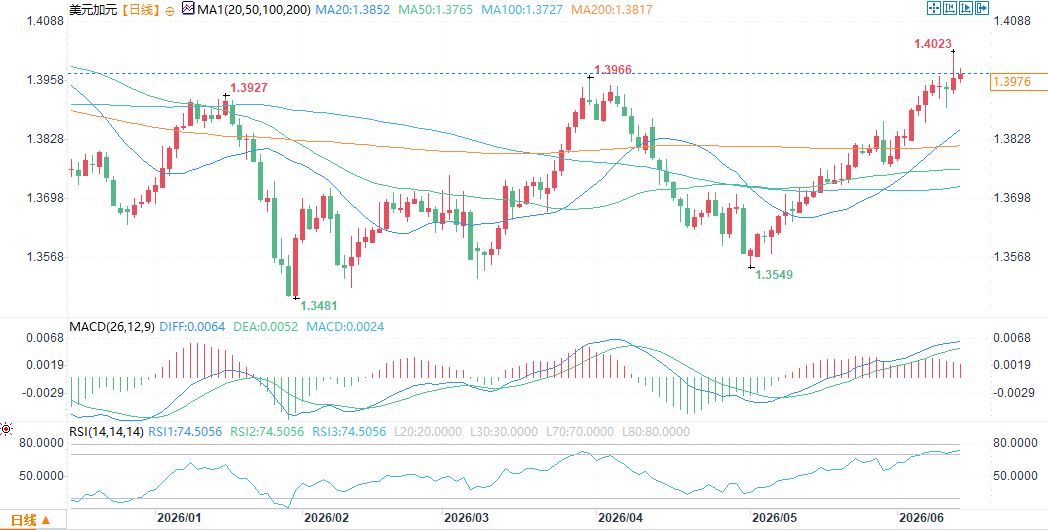
(USD/CAD daily chart, source: EasyForex)
Overall, the USD/CAD pair is currently supported by multiple factors: better-than-expected US PPI data strengthened expectations of a Fed rate hike, providing upward momentum for the dollar; the outlook for the US-Iran agreement remains uncertain, and while geopolitical risks have not completely dissipated, they have not yet put downward pressure on the dollar; the Bank of Canada's decision to keep interest rates unchanged and its wait-and-see attitude on inflation transmission leaves the Canadian dollar without support.
In the short term, if the US-Iran agreement fails to be reached or the situation escalates again, the US dollar may benefit further from safe-haven demand; if an agreement is reached, oil prices may fall, and the Canadian dollar may come under pressure due to declining energy prices.
At 16:14 Beijing time on June 12, the US dollar was trading at 1.3985/86 against the Canadian dollar.
This trend was mainly driven by strong U.S. inflation data.
Meanwhile, the market is closely watching the progress of the US-Iran peace agreement.
The preliminary reading of the University of Michigan Consumer Sentiment Index for June will be released later.
US PPI saw its biggest increase in three and a half years, fueling expectations of an interest rate hike.
Data released on Thursday showed that the U.S. Producer Price Index (PPI) rose more than expected in May, marking the largest annual increase in three and a half years, mainly driven by the Middle East conflict pushing up energy product costs. Specifically, the PPI rose 6.5% year-on-year, higher than April's 5.7% and the market expectation of 6.4%; it rose 1.1% month-on-month, far exceeding the expected 0.7%. Energy prices were the main driver, with the energy sub-index rising 5.2% month-on-month in May, contributing nearly half of the overall increase.
At the same time, food prices and service costs remained firm, with the core PPI rising 4.8% year-on-year, indicating that inflationary pressures are spreading from the energy sector to a wider range of areas.
John Ryding, chief economic advisor at Brean Capital, said: “The Fed has deviated significantly from its inflation target far more than its employment target. The PPI report should further reinforce the views of those on the Federal Open Market Committee who believe that a rate hike may be necessary later this year.”
Ryding further pointed out that the market's previous optimistic expectations for a continued decline in inflation have been shattered by two consecutive sets of strong inflation data (CPI returning above 4% and PPI hitting a three-and-a-half-year high). If inflation data continues to be stubborn in the coming months, the Federal Reserve may be forced to tighten its policy stance again, rather than "pausing rate hikes and then waiting and seeing" as the market had previously expected.
It's worth noting that PPI data is generally considered a leading indicator of CPI, as price increases on the production side ultimately translate into higher prices on the consumption side. This means that CPI may continue to face upward pressure in the coming months. The market's pricing in a 25 basis point rate hike in December has risen from about 14% a month ago to 43%, reflecting a rapidly increasing expectation among investors that the Federal Reserve will maintain high interest rates.
The prospects for a US-Iran agreement remain uncertain, and geopolitical risks persist.
Trump said on Thursday that the US and Iran could sign a peace agreement as early as this weekend, reopening the Strait of Hormuz to shipping. Speaking to reporters in the Oval Office, he said the two sides had reached an agreement on the framework and the final document could be signed soon. However, Iran quickly countered that no final decision had been reached on an agreement.
Iran's official news agency Fars reported that Supreme Leader Ayatollah Khamenei did not approve the US proposal, and key issues, including passage rights in the Strait of Hormuz and frozen funds, remain unresolved. Significant differences remain between the two sides on core issues, and tensions in the Middle East persist, with uncertainty remaining high.
According to media reports, the U.S. military intercepted and shot down two Iranian one-way attack drones near the Strait of Hormuz on Thursday after Iran attempted to target merchant ships passing through the waterway. This marks the second direct military clash between the two sides in the Persian Gulf region this week.
Previously, Iranian forces intercepted an uncoordinated oil tanker attempting to pass through the strategic waterway, highlighting its firm stance on the right of way in the strait. A Pentagon spokesperson stated that the U.S. military will "continue to protect freedom of navigation in the region" and warned Iran against further provocations.
The Iranian Islamic Revolutionary Guard Corps issued a statement declaring that the country is stronger than ever and prepared to respond to any act of aggression with a "decisive, immediate, painful, and regrettable response." This strong statement indicates that despite ongoing diplomatic negotiations, the military standoff between the two sides has not eased but rather shows signs of escalation.
Analysts point out that as long as the two sides cannot reach a compromise on core issues such as control of the Strait of Hormuz and the lifting of sanctions, the peace agreement will be difficult to truly implement, and market optimism may be reversed at any time by new conflict news.
The Bank of Canada kept interest rates unchanged, focusing on inflation transmission.
Regarding the Canadian dollar, the Bank of Canada decided on Wednesday, as expected, to keep its key interest rate unchanged, stating that there is currently little evidence that rising energy prices are driving broad-based inflation. This marks the fifth consecutive time the Bank of Canada has kept its benchmark interest rate at 2.25%.
The central bank stated explicitly: "To date, there is insufficient evidence to suggest that high energy prices have been widely transmitted to other consumer prices. The Governing Council will continue to ignore the short-term impact of the war on overall inflation, but will not allow rising energy prices to develop into persistent inflation."
However, Bank of Canada Governor Macklem reiterated that the central bank would not hesitate to raise interest rates to control inflation if necessary. In a press conference, he stated that the current coexistence of weak economic growth and rising inflation presents a dilemma for monetary policy—raising rates could further drag down economic growth, while lowering rates could increase the risk of prolonged high inflation. Maintaining interest rates is a way to balance these risks.
Macklem also provided clear scenario guidance: if the Middle East conflict continues and energy prices begin to trigger widespread inflation, a series of interest rate hikes may be necessary; while if the United States imposes new major trade restrictions on Canada, interest rate cuts may be necessary to support economic growth.
Analysts point out that the Bank of Canada's stance contrasts sharply with that of the Federal Reserve—the latter is facing pressure to raise interest rates due to renewed inflation, with the market pricing in a 43% probability of a Fed rate hike in December; while the Bank of Canada remains on hold due to weak economic conditions (first-quarter GDP unexpectedly contracted by 0.1%) and moderate core inflation (the lowest in more than five years).
This policy divergence is one of the key factors supporting the USD/CAD exchange rate, with the widening interest rate differential between the two countries making dollar assets more attractive. Furthermore, the Bank of Canada stated that "financial conditions have eased since the April Monetary Policy Report," specifically mentioning the Canadian dollar's depreciation, suggesting a relatively tolerant attitude towards the weakening of the Canadian dollar, which further weakened the support for the Canadian dollar.
Technical Analysis
The USD/CAD pair is currently in a strong upward channel on the daily chart, with a clear short-term bullish trend. Key support lies near the previous high of 1.3966, while there is no clear strong resistance above, suggesting further upside potential.
In terms of indicators, the MACD indicator's DIFF line is running above the DEA line, and the red bars continue to expand, indicating strong bullish momentum. The RSI indicator is at 74.5, approaching the overbought zone, so caution is advised regarding the risk of a pullback from these high levels.
In summary, the USD/CAD pair is currently in a clear bullish trend, with the price steadily rising along the moving average, and the short-term strong momentum remains unchanged. However, the overbought RSI signal suggests a potential technical correction, increasing the risk of chasing the price higher. The recommended trading strategy is to follow the trend and be bullish, focusing on support levels at the moving average and previous highs. If support holds, the bullish trend is likely to continue; if a clear pullback signal appears, it is advisable to wait for the correction before considering entry.
(USD/CAD daily chart, source: EasyForex)
Conclusion: The contrast between the strong US dollar and the weak Canadian dollar suggests that the USD/CAD exchange rate still has room to rise in the short term.
Overall, the USD/CAD pair is currently supported by multiple factors: better-than-expected US PPI data strengthened expectations of a Fed rate hike, providing upward momentum for the dollar; the outlook for the US-Iran agreement remains uncertain, and while geopolitical risks have not completely dissipated, they have not yet put downward pressure on the dollar; the Bank of Canada's decision to keep interest rates unchanged and its wait-and-see attitude on inflation transmission leaves the Canadian dollar without support.
In the short term, if the US-Iran agreement fails to be reached or the situation escalates again, the US dollar may benefit further from safe-haven demand; if an agreement is reached, oil prices may fall, and the Canadian dollar may come under pressure due to declining energy prices.
At 16:14 Beijing time on June 12, the US dollar was trading at 1.3985/86 against the Canadian dollar.
- Risk Warning and Disclaimer
- The market involves risk, and trading may not be suitable for all investors. This article is for reference only and does not constitute personal investment advice, nor does it take into account certain users’ specific investment objectives, financial situation, or other needs. Any investment decisions made based on this information are at your own risk.