Oil prices plunge 4% after US-Iran memorandum of understanding reveals sanctions lifted.
2026-06-12 16:50:00
Recently, former US President Trump has made high-profile signals of reaching a ceasefire agreement with Iran. Coupled with the core terms of the draft memorandum of understanding between the US and Iran disclosed by Iran's Mehr News Agency, this series of developments affecting the geopolitical landscape is causing violent fluctuations in the global crude oil trading market.
This three-month-long conflict between the US and Iran has not only fueled widespread discontent among the American public, but has also continued to disrupt international oil prices and the crude oil trade order by blocking key global energy transport routes and restricting Iranian crude oil exports.
The newly revealed memo provides a clearer framework for anticipating the future direction of the crude oil market.
As a core hub for global crude oil shipping, the Strait of Hormuz previously handled approximately 20% of the world's oil supply transportation.
Since the outbreak of the conflict, Iran's effective blockade of the Strait of Hormuz has resulted in a cumulative reduction of more than 1 billion barrels in global crude oil supply. Brent crude oil prices have risen by about 50% compared to pre-war levels, and aviation fuel prices in Asia and Europe have surged by 163% and 138% respectively.
For Asian economies that are highly dependent on this shipping route, more than 90% of Japan's crude oil imports and about 70% of South Korea's crude oil demand are directly affected, and the global manufacturing supply chain is also facing a chain reaction due to the shortage of petrochemical raw materials.
The memorandum explicitly includes "reopening the Strait of Hormuz" as a core component, meaning that this "fatal obstacle" is expected to be completely removed, becoming the biggest source of bullish expectations for the crude oil market.
According to Iran's Mehr News Agency, the memorandum of understanding drafted by the US and Iran includes three key commitments and several energy-related deregulation measures, precisely addressing the core contradictions in the current crude oil market.
The U.S. pledged to lift sanctions on Iran, withdraw troops from the region, and lift the maritime blockade. The memorandum also includes the reopening of the Strait of Hormuz, the lifting of oil sanctions, and the unfreezing of Iranian funds.
These provisions are of great significance to crude oil trading: lifting oil sanctions will allow Iranian crude oil to regain access to the global market, unfreezing funds will provide financial support for the restoration of Iranian crude oil production and export facilities, and the lifting of the maritime blockade and the reopening of the Strait of Hormuz will completely eliminate geopolitical risks in crude oil transportation.
When Trump announced on Thursday that the US and Iran were expected to reach an agreement by the end of the week, he did not disclose specific terms, but emphasized that the agreement was "very strong" and mentioned that he would send Vice President Pence to the signing ceremony.
To push the agreement to go through, Trump had previously threatened to escalate military strikes and planned to seize Iran's key Hag Island oil facilities. As Iran's largest crude oil export terminal, Hag Island has a processing capacity of over 7 million barrels per day and handles more than 90% of Iran's crude oil exports. Its normal operation will be the core support for the recovery of Iran's crude oil exports.
Despite the positive signals from the memorandum, the final implementation of the agreement still faces multiple uncertainties.
Iran's Mehr News Agency explicitly stated that the draft is still pending finalization by the relevant authorities, and subsequent final negotiations will focus on nuclear and economic issues, without involving discussions of Iran's missile program.
This means that the progress of negotiations on the nuclear issue will be a key variable in whether the agreement can take effect.
Previously, Trump had repeatedly signaled that an agreement was near, but had not delivered. Although the market's expectations were raised this time due to the terms of the memorandum, it remained cautious.
An Iranian Foreign Ministry spokesperson previously responded that while mediation efforts are underway, details regarding the end of the conflict have not yet been finalized.
Ali Vaez, director of Iran affairs at the International Crisis Group, pointed out that Trump's tough threats are actually a way for him to seek a "decent exit," both to show a tough stance to domestic hawk voters and to end this unpopular conflict as soon as possible. However, subsequent negotiations on nuclear and economic issues may still be subject to setbacks.
From the perspective of the crude oil trading market, if the memorandum is ultimately implemented, it will completely reshape the global crude oil supply and demand pattern.
In the short term, the reopening of the Strait of Hormuz and the lifting of oil sanctions will rapidly increase global crude oil supply, suppressing the persistently high geopolitical risk premium, and international oil prices may see a 5%-10% correction.
In the long run, the full recovery of Iran's crude oil production capacity will be a key variable. According to the International Energy Agency, within six months of the agreement, Iran's oil production may rise from the current 2.5 million barrels per day to 3.8 million barrels per day, and within a year it is expected to recover to the pre-sanctions level of 4.5 million barrels per day. The release of a large amount of idle capacity will break the current tight balance in the crude oil market and exert continuous downward pressure on oil prices.
However, if subsequent negotiations on the nuclear issue break down and the agreement fails to take effect, market risks will quickly reverse.
Shipping attacks in the Persian Gulf region may intensify, the Strait of Hormuz remains blocked, and Iranian crude oil exports are restricted. Oil prices may face a surge of more than 15%, forcing a readjustment of global crude oil trade routes. Regions in Europe and Asia that rely on Middle Eastern crude oil will face even more severe energy shortages.
The upcoming G7 summit in the French Alps will be a crucial window into this shift in the oil market, with Trump planning to finalize an agreement before the summit to gain the upper hand in negotiations with allies.
Previously, the US and Europe had significant differences on the issue of the war in Iraq. Countries such as Britain and France criticized the US for launching the conflict without consultation, while also expressing dissatisfaction with the war for driving up oil prices and damaging the global economy.
In addition to discussing issues such as price caps on Russian crude oil, the core of the G7 member states' competition at this summit will be the reconstruction of the energy market, adjustments to crude oil trade routes, and the stabilization of global oil prices should a US-Iran agreement be reached.
Many European countries are highly dependent on imports of crude oil from the Middle East. The implementation of the US-Iran agreement will alleviate their energy supply pressure, but it may also trigger a global drop in oil prices, impacting their domestic oil industry. Therefore, the G7 summit may discuss coordinated measures to address the crude oil market.
Goldman Sachs cited strong growth in crude oil supply and continued weak demand as factors that lowered its 2027 Brent crude oil price forecast, while also warning that oil prices may remain highly volatile under different geopolitical scenarios.
This US investment bank recently projected that Brent crude oil prices will reach $80 per barrel in 2027, but maintained its forecast of an average Brent crude oil price of $90 per barrel in the fourth quarter of 2026.
The bank also pointed out that there are upside risks to oil prices: if the disruption to shipping in the Strait of Hormuz lasts longer than expected, under a scenario of heightened geopolitical risks, the average price of Brent crude oil at the end of 2026 may be slightly higher than $110 per barrel.
For crude oil trading participants, there are six key variables to watch closely: first, the progress of the finalization of the US-Iran memorandum; second, the progress of negotiations on nuclear and economic issues; third, the specific timetable for the reopening of the Strait of Hormuz; fourth, the pace of recovery of Iranian crude oil exports; fifth, the coordinated energy policy that may be introduced at the G7 summit; and sixth, the subsequent interactions between Israel and Iran.
With the release of the memorandum's terms and Trump's determination to push for an agreement, market expectations for a short-term breakthrough have increased. However, uncertainties surrounding nuclear negotiations and the trust deficit between Iran and the United States could still trigger market volatility.
Traders need to be wary of the risk of a rebound in oil prices after supply expectations are met, and at the same time, prepare for the risk of a breakdown in the agreement. They should closely monitor the real-time progress of various key variables in order to cope with the changing oil market under this geopolitical and energy economic game.
From a technical perspective, the area around 79 is a major support level for oil prices, representing a Fibonacci retracement level and a location with significant trading volume. It is unlikely to be reached, but once touched, a rebound is highly probable. Optimistic oil bulls may have already begun to position themselves in batches around this level.
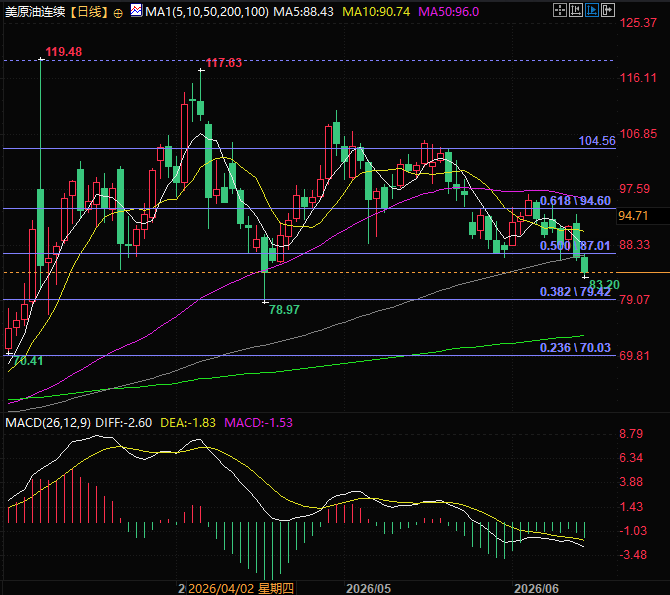
(WTI crude oil futures daily chart, source: EasyForex)
At 16:48 Beijing time, WTI crude oil futures were trading at $83.82 per barrel.
Sources say that $24 billion in Iranian funds will be unfrozen during the 60-day negotiations.
This three-month-long conflict between the US and Iran has not only fueled widespread discontent among the American public, but has also continued to disrupt international oil prices and the crude oil trade order by blocking key global energy transport routes and restricting Iranian crude oil exports.
The newly revealed memo provides a clearer framework for anticipating the future direction of the crude oil market.
The Strait of Hormuz blockade: a "fatal bottleneck" to global oil supply.
As a core hub for global crude oil shipping, the Strait of Hormuz previously handled approximately 20% of the world's oil supply transportation.
Since the outbreak of the conflict, Iran's effective blockade of the Strait of Hormuz has resulted in a cumulative reduction of more than 1 billion barrels in global crude oil supply. Brent crude oil prices have risen by about 50% compared to pre-war levels, and aviation fuel prices in Asia and Europe have surged by 163% and 138% respectively.
For Asian economies that are highly dependent on this shipping route, more than 90% of Japan's crude oil imports and about 70% of South Korea's crude oil demand are directly affected, and the global manufacturing supply chain is also facing a chain reaction due to the shortage of petrochemical raw materials.
The memorandum explicitly includes "reopening the Strait of Hormuz" as a core component, meaning that this "fatal obstacle" is expected to be completely removed, becoming the biggest source of bullish expectations for the crude oil market.
Core terms of the agreement: Triple commitments + energy deregulation, directly addressing key pain points in crude oil trading.
According to Iran's Mehr News Agency, the memorandum of understanding drafted by the US and Iran includes three key commitments and several energy-related deregulation measures, precisely addressing the core contradictions in the current crude oil market.
The U.S. pledged to lift sanctions on Iran, withdraw troops from the region, and lift the maritime blockade. The memorandum also includes the reopening of the Strait of Hormuz, the lifting of oil sanctions, and the unfreezing of Iranian funds.
These provisions are of great significance to crude oil trading: lifting oil sanctions will allow Iranian crude oil to regain access to the global market, unfreezing funds will provide financial support for the restoration of Iranian crude oil production and export facilities, and the lifting of the maritime blockade and the reopening of the Strait of Hormuz will completely eliminate geopolitical risks in crude oil transportation.
When Trump announced on Thursday that the US and Iran were expected to reach an agreement by the end of the week, he did not disclose specific terms, but emphasized that the agreement was "very strong" and mentioned that he would send Vice President Pence to the signing ceremony.
To push the agreement to go through, Trump had previously threatened to escalate military strikes and planned to seize Iran's key Hag Island oil facilities. As Iran's largest crude oil export terminal, Hag Island has a processing capacity of over 7 million barrels per day and handles more than 90% of Iran's crude oil exports. Its normal operation will be the core support for the recovery of Iran's crude oil exports.
The agreement's implementation remains uncertain: details are yet to be finalized, and the market is wary of the "boy who cried wolf" risk.
Despite the positive signals from the memorandum, the final implementation of the agreement still faces multiple uncertainties.
Iran's Mehr News Agency explicitly stated that the draft is still pending finalization by the relevant authorities, and subsequent final negotiations will focus on nuclear and economic issues, without involving discussions of Iran's missile program.
This means that the progress of negotiations on the nuclear issue will be a key variable in whether the agreement can take effect.
Previously, Trump had repeatedly signaled that an agreement was near, but had not delivered. Although the market's expectations were raised this time due to the terms of the memorandum, it remained cautious.
An Iranian Foreign Ministry spokesperson previously responded that while mediation efforts are underway, details regarding the end of the conflict have not yet been finalized.
Ali Vaez, director of Iran affairs at the International Crisis Group, pointed out that Trump's tough threats are actually a way for him to seek a "decent exit," both to show a tough stance to domestic hawk voters and to end this unpopular conflict as soon as possible. However, subsequent negotiations on nuclear and economic issues may still be subject to setbacks.
Two Market Perspectives: Extreme Oil Price Scenarios Under Agreement and Failure
From the perspective of the crude oil trading market, if the memorandum is ultimately implemented, it will completely reshape the global crude oil supply and demand pattern.
In the short term, the reopening of the Strait of Hormuz and the lifting of oil sanctions will rapidly increase global crude oil supply, suppressing the persistently high geopolitical risk premium, and international oil prices may see a 5%-10% correction.
In the long run, the full recovery of Iran's crude oil production capacity will be a key variable. According to the International Energy Agency, within six months of the agreement, Iran's oil production may rise from the current 2.5 million barrels per day to 3.8 million barrels per day, and within a year it is expected to recover to the pre-sanctions level of 4.5 million barrels per day. The release of a large amount of idle capacity will break the current tight balance in the crude oil market and exert continuous downward pressure on oil prices.
However, if subsequent negotiations on the nuclear issue break down and the agreement fails to take effect, market risks will quickly reverse.
Shipping attacks in the Persian Gulf region may intensify, the Strait of Hormuz remains blocked, and Iranian crude oil exports are restricted. Oil prices may face a surge of more than 15%, forcing a readjustment of global crude oil trade routes. Regions in Europe and Asia that rely on Middle Eastern crude oil will face even more severe energy shortages.
G7 Summit: US-EU Energy Rivalry and Coordinated Responses to the Oil Market
The upcoming G7 summit in the French Alps will be a crucial window into this shift in the oil market, with Trump planning to finalize an agreement before the summit to gain the upper hand in negotiations with allies.
Previously, the US and Europe had significant differences on the issue of the war in Iraq. Countries such as Britain and France criticized the US for launching the conflict without consultation, while also expressing dissatisfaction with the war for driving up oil prices and damaging the global economy.
In addition to discussing issues such as price caps on Russian crude oil, the core of the G7 member states' competition at this summit will be the reconstruction of the energy market, adjustments to crude oil trade routes, and the stabilization of global oil prices should a US-Iran agreement be reached.
Many European countries are highly dependent on imports of crude oil from the Middle East. The implementation of the US-Iran agreement will alleviate their energy supply pressure, but it may also trigger a global drop in oil prices, impacting their domestic oil industry. Therefore, the G7 summit may discuss coordinated measures to address the crude oil market.
Institutions have lowered their oil price forecasts, but long-term risks remain.
Goldman Sachs cited strong growth in crude oil supply and continued weak demand as factors that lowered its 2027 Brent crude oil price forecast, while also warning that oil prices may remain highly volatile under different geopolitical scenarios.
This US investment bank recently projected that Brent crude oil prices will reach $80 per barrel in 2027, but maintained its forecast of an average Brent crude oil price of $90 per barrel in the fourth quarter of 2026.
The bank also pointed out that there are upside risks to oil prices: if the disruption to shipping in the Strait of Hormuz lasts longer than expected, under a scenario of heightened geopolitical risks, the average price of Brent crude oil at the end of 2026 may be slightly higher than $110 per barrel.
Summary and Technical Analysis:
For crude oil trading participants, there are six key variables to watch closely: first, the progress of the finalization of the US-Iran memorandum; second, the progress of negotiations on nuclear and economic issues; third, the specific timetable for the reopening of the Strait of Hormuz; fourth, the pace of recovery of Iranian crude oil exports; fifth, the coordinated energy policy that may be introduced at the G7 summit; and sixth, the subsequent interactions between Israel and Iran.
With the release of the memorandum's terms and Trump's determination to push for an agreement, market expectations for a short-term breakthrough have increased. However, uncertainties surrounding nuclear negotiations and the trust deficit between Iran and the United States could still trigger market volatility.
Traders need to be wary of the risk of a rebound in oil prices after supply expectations are met, and at the same time, prepare for the risk of a breakdown in the agreement. They should closely monitor the real-time progress of various key variables in order to cope with the changing oil market under this geopolitical and energy economic game.
From a technical perspective, the area around 79 is a major support level for oil prices, representing a Fibonacci retracement level and a location with significant trading volume. It is unlikely to be reached, but once touched, a rebound is highly probable. Optimistic oil bulls may have already begun to position themselves in batches around this level.
(WTI crude oil futures daily chart, source: EasyForex)
At 16:48 Beijing time, WTI crude oil futures were trading at $83.82 per barrel.
- Risk Warning and Disclaimer
- The market involves risk, and trading may not be suitable for all investors. This article is for reference only and does not constitute personal investment advice, nor does it take into account certain users’ specific investment objectives, financial situation, or other needs. Any investment decisions made based on this information are at your own risk.