Gold Trading Alert: Gold prices surged nearly $100 at one point, as the historic US-Iran reconciliation ignited global markets; oil prices plummeted by over 5%.
2026-06-15 07:37:26
On Monday (June 15) in early Asian trading, spot gold opened higher and continued to rise. As of 7:30 AM, it had risen as much as 2.18% to $4308.91 per ounce, a near one-week high. This was due to the peace agreement reached between the US and Iran, which caused international oil prices to plummet by more than 5% to a more than two-month low. Inflation concerns eased significantly, slightly dampening expectations of a Fed rate hike this year. The US dollar index weakened sharply, providing upward momentum for gold prices. Currently, spot gold has retreated slightly to around $4285 per ounce.
Early on June 15th, Beijing time, both the Prime Minister of Pakistan and US President Trump announced that the US and Iran had reached an agreement. Trump stated that he approved free passage through the Strait of Hormuz and authorized the immediate lifting of the US naval blockade against Iran. Iran's Deputy Foreign Minister also confirmed that the text of the US-Iran memorandum of understanding had been finalized and would be formally signed in Switzerland this Friday (June 19th).
The US dollar index fluctuated and fell on Monday, dropping as much as 0.38% to 99.42, a new low since June 5. US crude oil opened nearly 5% lower, briefly touching $80.25 per barrel, a new low since April 17.
Just when everyone thought the Middle East situation would remain deadlocked, Pakistani Prime Minister Shahbaz dropped a bombshell in the early hours of June 15th, Beijing time. He excitedly announced that after several rounds of intensive consultations, the United States of America and the Islamic Republic of Iran had reached a peace agreement. Almost simultaneously, US President Trump confirmed the news and revealed more key details. Trump stated that this agreement, which he called a "great deal," would bring peace and security to the entire region, and the most notable clauses included granting free passage through the Strait of Hormuz and authorizing the immediate lifting of the US naval blockade against Iran.
Iran quickly followed up with confirmation. Iranian Deputy Foreign Minister Gharibabadi explicitly stated that the text of the agreement, titled the "Islamabad Memorandum of Understanding," had been finalized, and the formal signing ceremony was scheduled for this Friday in Switzerland. Starting from the morning of June 15th local time, two major events will immediately take effect: first, a permanent and immediate end to the war on all fronts, including the Lebanese front; and second, the complete lifting of the US naval blockade against Iran. Iran's commitments will begin to be fulfilled after the agreement is formally signed this Friday.
This agreement was no accident. According to the New York Times, citing Iranian officials, Iran had previously planned a large-scale military strike against Israel in response to the Israeli airstrikes on Beirut, the capital of Lebanon. It was Trump's intervention through a third-party mediated dialogue, urging Iran to exercise restraint, that ultimately prevented this imminent regional war. In short, this peace agreement not only defused the direct confrontation between the US and Iran but also objectively prevented a military conflict that could have engulfed the entire Middle East.
The most direct and severe impact of the US-Iran reconciliation on financial markets was first reflected in the crude oil market. On Monday morning in Asian trading, US crude oil futures opened sharply lower by nearly 5%, briefly touching $80.25 per barrel, a new low in more than two months since April 17. This precipitous drop in international oil prices was not accidental; it was underpinned by solid fundamental logic.
The Strait of Hormuz, a vital chokepoint for global oil transportation, previously faced severe disruptions due to the US-Iran standoff and maritime blockade. Now, Trump has clearly stated that the Strait of Hormuz will reopen for oil transport after the agreement is signed on Friday, allowing oil and gas to flow freely to the region and the world once again. This signifies a rapid decline in the geopolitical risk premium for global oil supply, and millions of barrels of Iranian crude oil are expected to return to the international market. This sharp reduction in supply-side pressure has directly led to a significant correction in oil prices.
The plunge in oil prices has triggered a repricing of the inflation outlook in the market. For over a year, rising energy prices have been a significant driver of global inflation. The US Producer Price Index (PPI) rose more than expected in May, and the consumer inflation rate jumped to over 4%. However, with the sharp drop in oil prices in a short period, market concerns about future inflationary pressures have cooled significantly. This weakening of inflation expectations has directly influenced investors' judgments on the Federal Reserve's monetary policy path. Since inflation may no longer be as stubborn as previously thought, the necessity for the Fed to continue raising interest rates has naturally decreased.
The traditional negative correlation between gold and the US dollar has been fully demonstrated in this round of market movements. With the US-Iran peace agreement reached and oil prices falling sharply, the US dollar index fluctuated lower on Monday, dropping as much as 0.38% to 99.42, a new low since June 5th. The logical chain behind the dollar's weakening is also clearly discernible.
First, cooling inflation expectations have weakened expectations of a Federal Reserve rate hike. According to the CME Group's FedWatch tool, traders currently expect a 60% probability of a US rate hike before December. While this figure remains high, it has significantly decreased compared to previous levels. The market is reassessing the likelihood of the Fed tightening monetary policy in the coming months. If the Fed does slow its rate hikes due to easing inflationary pressures, or even maintains rates unchanged, the yield advantage of the dollar will be weakened, and funds will naturally flow out of dollar assets.
Secondly, the easing of geopolitical risks has also reduced the demand for the US dollar as a safe-haven asset to some extent. For a long time, the US dollar, as the world's primary reserve currency and safe-haven asset, has been sought after whenever international tensions rise. Now, with the US and Iran moving from confrontation to reconciliation, the fuse of the Middle East powder keg has been defused, and market risk aversion has significantly cooled, which has objectively reduced the demand for the US dollar.
As a dollar-denominated asset, gold naturally exhibits a seesaw effect with the dollar. When the dollar depreciates, the same amount of dollars can buy less gold, forcing gold prices to rise to reflect their true value. Therefore, a significant weakening of the dollar index provides strong upward momentum for gold prices.
Looking back at last week's gold market, gold prices did not perform as well as expected. Although gold prices rose slightly by 0.15% to close at $4,216.83 per ounce on Friday, from a weekly perspective, gold has fallen for the second consecutive week, with a cumulative decline of 2.56%. The main reason dragging down gold prices was market concerns about the Federal Reserve's interest rate hikes.
As a non-interest-bearing asset, the cost of holding gold is closely related to interest rate levels. When interest rates rise, the opportunity cost of holding gold increases because investors can simply deposit their funds in banks or buy bonds to obtain risk-free returns. Conversely, when interest rates are low or expectations of rate hikes weaken, gold's attractiveness increases significantly. For some time now, the persistent shadow of the Federal Reserve's interest rate hikes has loomed over the gold market, suppressing the potential for gold price increases.
The recent peace agreement between the US and Iran, through a complete transmission chain of suppressing oil prices, alleviating inflation, and weakening expectations of interest rate hikes, is now removing the heaviest shackles from gold. Market focus has shifted to the upcoming Federal Reserve policy meeting on June 16-17, which will be the first meeting chaired by the new Chairman, Warsh. Although the market widely expects the Fed to maintain interest rates, Warsh's wording and statements at the press conference will provide important clues about the future policy path.
Iranian Deputy Foreign Minister Gharibabadi, in announcing the agreement, revealed a crucial detail: during the 60-day final negotiation period, Iran's missile program and support for resistance groups were completely excluded from the negotiation agenda. This means that Iran's core security interests were fully guaranteed, thus making the foundation of the agreement more solid. At the same time, the United States and its allies are required to submit a reconstruction aid package to Iran totaling no less than $300 billion. This is not only a significant economic commitment but also reflects the United States' firm determination to promote peace.
While the US-Iran peace agreement has provided a much-needed boost to the gold market, investors must be aware that the global financial markets will face a real test in the coming week. A flurry of monetary policy decisions from major central banks are scheduled, and any unexpected hawkish signals could put downward pressure on gold prices.
The Federal Reserve's FOMC meeting is undoubtedly of paramount importance. Chairman Warsh's first press conference will be the focus of all traders' attention. The market will scrutinize every word he utters, attempting to glean clues about the future path of interest rates. If Warsh expresses continued concern about inflation, or hints that further rate hikes are still possible if inflation rebounds, then gold's upward momentum may encounter resistance.
Besides the Federal Reserve, the Bank of Japan, the Reserve Bank of Australia, the Swiss National Bank, and the Bank of England will also announce their respective monetary policy decisions. Against the backdrop of coordinated global central bank action, any unexpected tightening by a major central bank could trigger a chain reaction. Especially after the joint statement issued by the leaders of the UK, France, Germany, and Italy welcoming the US-Iran agreement and reiterating the importance of freedom of navigation in the Strait of Hormuz, the monetary policy stance of Europe also warrants close attention.
On the economic data front, key indicators such as US May retail sales, new home starts, and building permits will be released soon. Strong economic data could reignite expectations of interest rate hikes, while weak data could further solidify speculation about a pause in rate increases. In addition, Thursday's Philadelphia Fed manufacturing survey and weekly jobless claims data will provide the market with real-time clues about the state of the US economy.
It is important to note that although the US and Iran have reached a peace agreement, the regional situation is not entirely without uncertainty. Israeli Prime Minister Netanyahu has made it clear to Trump that Israel is not bound by the Lebanon provisions of the US-Iran agreement, the Israel Defense Forces will not withdraw from Lebanon, will continue to maintain their existing positions, and will continue military operations against Hezbollah. This means that peace in the Middle East remains conditional and limited, and the risk of localized conflict has not completely disappeared.
In summary, the US-Iran peace agreement is undoubtedly the biggest variable influencing the current gold market. Gold prices have gained strong upward momentum through a complete chain of events: plummeting oil prices, cooling inflation expectations, diminished interest rate hike expectations, and a weakening dollar. The gradual unfreezing of Iran's $24 billion in frozen assets, with half of the funds to be transferred to Iran before negotiations begin, signifies a substantial easing of sanctions. Simultaneously, Iran's reaffirmation of its adherence to the Treaty on the Non-Proliferation of Nuclear Weapons and its commitment not to develop nuclear weapons lay the foundation for a final resolution to the nuclear issue.
However, investors must also recognize that gold prices have retreated somewhat after their rapid surge, indicating that the market is still digesting the profound impact of this historic event. The upcoming Federal Reserve meeting, central bank decisions, and a flurry of economic data releases will all significantly influence gold's short-term price movements.
From a longer-term perspective, the reconciliation between the US and Iran signifies a profound shift in the global geopolitical landscape, with the long-standing tensions in the Middle East potentially easing fundamentally. This is undoubtedly a major boon for the global economy and financial markets. However, for gold, the weakening of its safe-haven demand may, to some extent, offset the benefits brought by a weakening dollar and easing expectations of interest rate hikes. Whether gold prices can hold above the $4,300 mark, or even break through further upwards, depends on the final outcome of the interplay of these multiple forces. The gold market is writing a new chapter, and the beginning of this chapter is undoubtedly full of drama and imagination.
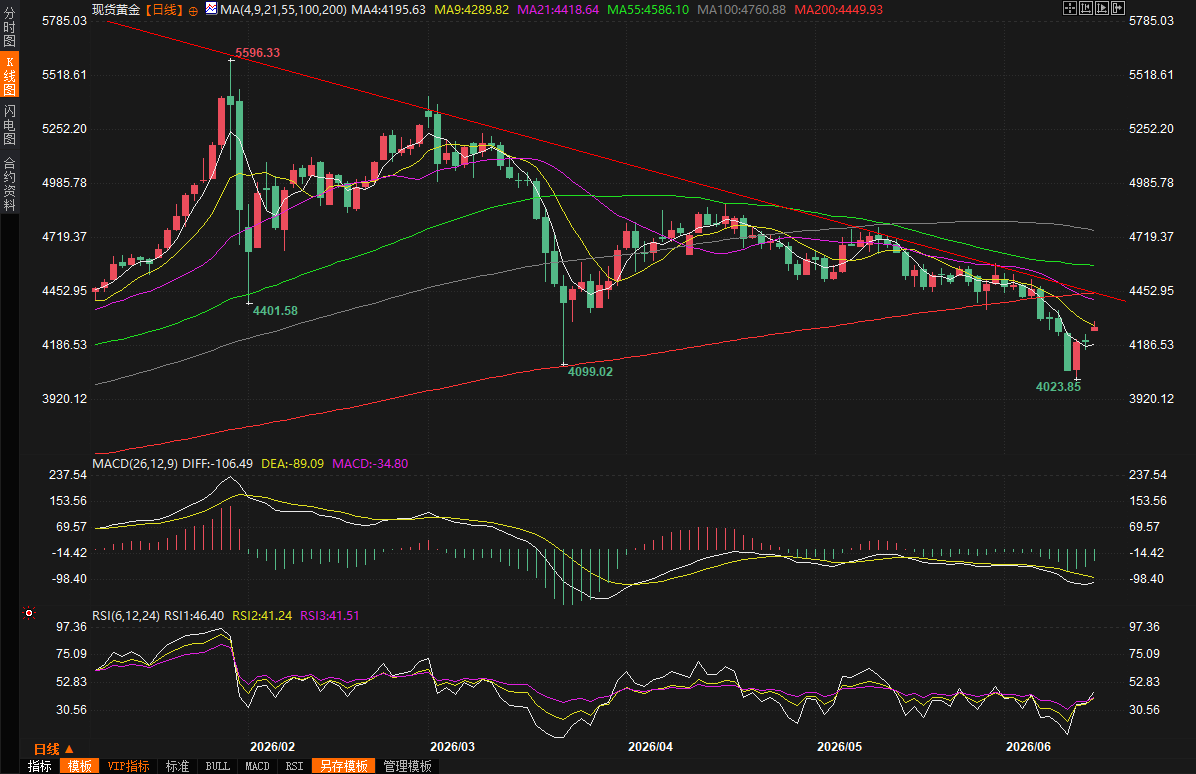
(Spot gold daily chart, source: FX678)
At 07:35 Beijing time, spot gold was trading at $4238.83 per ounce.
Early on June 15th, Beijing time, both the Prime Minister of Pakistan and US President Trump announced that the US and Iran had reached an agreement. Trump stated that he approved free passage through the Strait of Hormuz and authorized the immediate lifting of the US naval blockade against Iran. Iran's Deputy Foreign Minister also confirmed that the text of the US-Iran memorandum of understanding had been finalized and would be formally signed in Switzerland this Friday (June 19th).
The US dollar index fluctuated and fell on Monday, dropping as much as 0.38% to 99.42, a new low since June 5. US crude oil opened nearly 5% lower, briefly touching $80.25 per barrel, a new low since April 17.
I. A Black Swan Event: The US and Iran Reach a Peace Agreement
Just when everyone thought the Middle East situation would remain deadlocked, Pakistani Prime Minister Shahbaz dropped a bombshell in the early hours of June 15th, Beijing time. He excitedly announced that after several rounds of intensive consultations, the United States of America and the Islamic Republic of Iran had reached a peace agreement. Almost simultaneously, US President Trump confirmed the news and revealed more key details. Trump stated that this agreement, which he called a "great deal," would bring peace and security to the entire region, and the most notable clauses included granting free passage through the Strait of Hormuz and authorizing the immediate lifting of the US naval blockade against Iran.
Iran quickly followed up with confirmation. Iranian Deputy Foreign Minister Gharibabadi explicitly stated that the text of the agreement, titled the "Islamabad Memorandum of Understanding," had been finalized, and the formal signing ceremony was scheduled for this Friday in Switzerland. Starting from the morning of June 15th local time, two major events will immediately take effect: first, a permanent and immediate end to the war on all fronts, including the Lebanese front; and second, the complete lifting of the US naval blockade against Iran. Iran's commitments will begin to be fulfilled after the agreement is formally signed this Friday.
This agreement was no accident. According to the New York Times, citing Iranian officials, Iran had previously planned a large-scale military strike against Israel in response to the Israeli airstrikes on Beirut, the capital of Lebanon. It was Trump's intervention through a third-party mediated dialogue, urging Iran to exercise restraint, that ultimately prevented this imminent regional war. In short, this peace agreement not only defused the direct confrontation between the US and Iran but also objectively prevented a military conflict that could have engulfed the entire Middle East.
II. Oil Price Collapse and Cooling Inflation Expectations: The First Logic Behind Gold Price Increases
The most direct and severe impact of the US-Iran reconciliation on financial markets was first reflected in the crude oil market. On Monday morning in Asian trading, US crude oil futures opened sharply lower by nearly 5%, briefly touching $80.25 per barrel, a new low in more than two months since April 17. This precipitous drop in international oil prices was not accidental; it was underpinned by solid fundamental logic.
The Strait of Hormuz, a vital chokepoint for global oil transportation, previously faced severe disruptions due to the US-Iran standoff and maritime blockade. Now, Trump has clearly stated that the Strait of Hormuz will reopen for oil transport after the agreement is signed on Friday, allowing oil and gas to flow freely to the region and the world once again. This signifies a rapid decline in the geopolitical risk premium for global oil supply, and millions of barrels of Iranian crude oil are expected to return to the international market. This sharp reduction in supply-side pressure has directly led to a significant correction in oil prices.
The plunge in oil prices has triggered a repricing of the inflation outlook in the market. For over a year, rising energy prices have been a significant driver of global inflation. The US Producer Price Index (PPI) rose more than expected in May, and the consumer inflation rate jumped to over 4%. However, with the sharp drop in oil prices in a short period, market concerns about future inflationary pressures have cooled significantly. This weakening of inflation expectations has directly influenced investors' judgments on the Federal Reserve's monetary policy path. Since inflation may no longer be as stubborn as previously thought, the necessity for the Fed to continue raising interest rates has naturally decreased.
III. A weakening US dollar: an accelerator for gold price increases
The traditional negative correlation between gold and the US dollar has been fully demonstrated in this round of market movements. With the US-Iran peace agreement reached and oil prices falling sharply, the US dollar index fluctuated lower on Monday, dropping as much as 0.38% to 99.42, a new low since June 5th. The logical chain behind the dollar's weakening is also clearly discernible.
First, cooling inflation expectations have weakened expectations of a Federal Reserve rate hike. According to the CME Group's FedWatch tool, traders currently expect a 60% probability of a US rate hike before December. While this figure remains high, it has significantly decreased compared to previous levels. The market is reassessing the likelihood of the Fed tightening monetary policy in the coming months. If the Fed does slow its rate hikes due to easing inflationary pressures, or even maintains rates unchanged, the yield advantage of the dollar will be weakened, and funds will naturally flow out of dollar assets.
Secondly, the easing of geopolitical risks has also reduced the demand for the US dollar as a safe-haven asset to some extent. For a long time, the US dollar, as the world's primary reserve currency and safe-haven asset, has been sought after whenever international tensions rise. Now, with the US and Iran moving from confrontation to reconciliation, the fuse of the Middle East powder keg has been defused, and market risk aversion has significantly cooled, which has objectively reduced the demand for the US dollar.
As a dollar-denominated asset, gold naturally exhibits a seesaw effect with the dollar. When the dollar depreciates, the same amount of dollars can buy less gold, forcing gold prices to rise to reflect their true value. Therefore, a significant weakening of the dollar index provides strong upward momentum for gold prices.
IV. Cooling Interest Rate Hike Expectations: Gold is shedding its heaviest shackles.
Looking back at last week's gold market, gold prices did not perform as well as expected. Although gold prices rose slightly by 0.15% to close at $4,216.83 per ounce on Friday, from a weekly perspective, gold has fallen for the second consecutive week, with a cumulative decline of 2.56%. The main reason dragging down gold prices was market concerns about the Federal Reserve's interest rate hikes.
As a non-interest-bearing asset, the cost of holding gold is closely related to interest rate levels. When interest rates rise, the opportunity cost of holding gold increases because investors can simply deposit their funds in banks or buy bonds to obtain risk-free returns. Conversely, when interest rates are low or expectations of rate hikes weaken, gold's attractiveness increases significantly. For some time now, the persistent shadow of the Federal Reserve's interest rate hikes has loomed over the gold market, suppressing the potential for gold price increases.
The recent peace agreement between the US and Iran, through a complete transmission chain of suppressing oil prices, alleviating inflation, and weakening expectations of interest rate hikes, is now removing the heaviest shackles from gold. Market focus has shifted to the upcoming Federal Reserve policy meeting on June 16-17, which will be the first meeting chaired by the new Chairman, Warsh. Although the market widely expects the Fed to maintain interest rates, Warsh's wording and statements at the press conference will provide important clues about the future policy path.
Iranian Deputy Foreign Minister Gharibabadi, in announcing the agreement, revealed a crucial detail: during the 60-day final negotiation period, Iran's missile program and support for resistance groups were completely excluded from the negotiation agenda. This means that Iran's core security interests were fully guaranteed, thus making the foundation of the agreement more solid. At the same time, the United States and its allies are required to submit a reconstruction aid package to Iran totaling no less than $300 billion. This is not only a significant economic commitment but also reflects the United States' firm determination to promote peace.
V. Risk Events in the Coming Week: Gold Bulls Should Remain Vigilant
While the US-Iran peace agreement has provided a much-needed boost to the gold market, investors must be aware that the global financial markets will face a real test in the coming week. A flurry of monetary policy decisions from major central banks are scheduled, and any unexpected hawkish signals could put downward pressure on gold prices.
The Federal Reserve's FOMC meeting is undoubtedly of paramount importance. Chairman Warsh's first press conference will be the focus of all traders' attention. The market will scrutinize every word he utters, attempting to glean clues about the future path of interest rates. If Warsh expresses continued concern about inflation, or hints that further rate hikes are still possible if inflation rebounds, then gold's upward momentum may encounter resistance.
Besides the Federal Reserve, the Bank of Japan, the Reserve Bank of Australia, the Swiss National Bank, and the Bank of England will also announce their respective monetary policy decisions. Against the backdrop of coordinated global central bank action, any unexpected tightening by a major central bank could trigger a chain reaction. Especially after the joint statement issued by the leaders of the UK, France, Germany, and Italy welcoming the US-Iran agreement and reiterating the importance of freedom of navigation in the Strait of Hormuz, the monetary policy stance of Europe also warrants close attention.
On the economic data front, key indicators such as US May retail sales, new home starts, and building permits will be released soon. Strong economic data could reignite expectations of interest rate hikes, while weak data could further solidify speculation about a pause in rate increases. In addition, Thursday's Philadelphia Fed manufacturing survey and weekly jobless claims data will provide the market with real-time clues about the state of the US economy.
It is important to note that although the US and Iran have reached a peace agreement, the regional situation is not entirely without uncertainty. Israeli Prime Minister Netanyahu has made it clear to Trump that Israel is not bound by the Lebanon provisions of the US-Iran agreement, the Israel Defense Forces will not withdraw from Lebanon, will continue to maintain their existing positions, and will continue military operations against Hezbollah. This means that peace in the Middle East remains conditional and limited, and the risk of localized conflict has not completely disappeared.
Conclusion:
In summary, the US-Iran peace agreement is undoubtedly the biggest variable influencing the current gold market. Gold prices have gained strong upward momentum through a complete chain of events: plummeting oil prices, cooling inflation expectations, diminished interest rate hike expectations, and a weakening dollar. The gradual unfreezing of Iran's $24 billion in frozen assets, with half of the funds to be transferred to Iran before negotiations begin, signifies a substantial easing of sanctions. Simultaneously, Iran's reaffirmation of its adherence to the Treaty on the Non-Proliferation of Nuclear Weapons and its commitment not to develop nuclear weapons lay the foundation for a final resolution to the nuclear issue.
However, investors must also recognize that gold prices have retreated somewhat after their rapid surge, indicating that the market is still digesting the profound impact of this historic event. The upcoming Federal Reserve meeting, central bank decisions, and a flurry of economic data releases will all significantly influence gold's short-term price movements.
From a longer-term perspective, the reconciliation between the US and Iran signifies a profound shift in the global geopolitical landscape, with the long-standing tensions in the Middle East potentially easing fundamentally. This is undoubtedly a major boon for the global economy and financial markets. However, for gold, the weakening of its safe-haven demand may, to some extent, offset the benefits brought by a weakening dollar and easing expectations of interest rate hikes. Whether gold prices can hold above the $4,300 mark, or even break through further upwards, depends on the final outcome of the interplay of these multiple forces. The gold market is writing a new chapter, and the beginning of this chapter is undoubtedly full of drama and imagination.
(Spot gold daily chart, source: FX678)
At 07:35 Beijing time, spot gold was trading at $4238.83 per ounce.
- Risk Warning and Disclaimer
- The market involves risk, and trading may not be suitable for all investors. This article is for reference only and does not constitute personal investment advice, nor does it take into account certain users’ specific investment objectives, financial situation, or other needs. Any investment decisions made based on this information are at your own risk.