As expectations of a Bank of Japan interest rate hike rise and the dollar index falls, the dollar/yen exchange rate remains volatile at high levels.
2026-06-15 11:19:45
On Monday during Asian trading hours, the USD/JPY pair traded in a narrow range around 160.20. With the US and Iran reaching a peace framework to end their nearly four-month-long military conflict, market risk appetite improved significantly, safe-haven flows shifted, and the US dollar index generally declined, providing some support for the yen.
The United States and Iran have reached a framework agreement on ending the conflict, lifting the naval blockade against Iran, and restoring navigation in the Strait of Hormuz. Meanwhile, Britain, France, Germany, and Italy have stated their readiness to lift some sanctions if Iran takes appropriate measures regarding its nuclear program. The easing of tensions in the Middle East has reduced market concerns about energy supply disruptions and further inflation, thus diminishing the safe-haven appeal of the US dollar.
However, market caution has not completely dissipated. US President Donald Trump stated that the US might resume military action if Iran fails to reach a final nuclear agreement. This implies that uncertainty remains regarding the current peace framework, and any stalled negotiations or renewed geopolitical tensions could reignite demand for safe-haven assets.
Market analysts believe the US dollar may continue its mild correction in the coming trading days, while some risk-sensitive currencies, including the Japanese yen, are expected to receive some support, but the likelihood of significant short-term volatility is low. This week, market focus will shift to the interest rate decisions of the Federal Reserve and the Bank of Japan. The market widely expects the Fed to maintain its current interest rate at this meeting, continuing to monitor the impact of previous energy price fluctuations and inflation changes on the economy. Investors will also pay close attention to the statements of the new Fed Chairman, Kevin Warsh, regarding the future path of monetary policy, seeking clues about future rate cuts or further tightening.
Meanwhile, the Bank of Japan is expected to raise its policy rate again on Tuesday. The market has largely priced in this rate hike, anticipating a rise to 1.0%, the highest level since 1995. Market surveys suggest the Bank of Japan may further raise rates to 1.25% in the fourth quarter. If the Bank of Japan releases a more hawkish policy signal, the yen is expected to receive further support, thus putting downward pressure on the USD/JPY exchange rate.
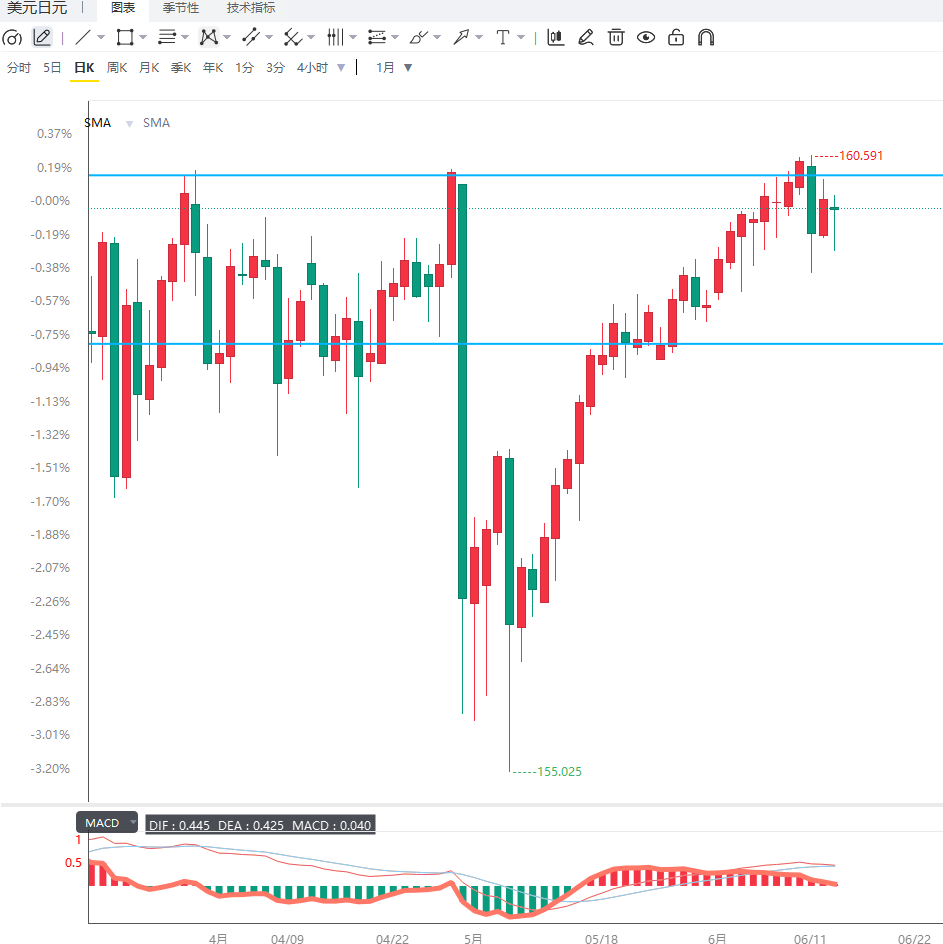
From a daily chart perspective, the USD/JPY pair has maintained a high level of consolidation after its strong breakout above the 160 level, and the overall upward trend remains intact. The area around 160 is currently a key battleground between bulls and bears. If the exchange rate can hold above this level, it may further test the resistance areas of 161.50 and 163.00. However, a break below the key support level of 159.00 could trigger short-term profit-taking and a further decline to around 157.50.
From a 4-hour chart perspective, the USD/JPY pair's short-term momentum has slowed, forming a consolidation pattern above 160. Short-term moving averages are beginning to flatten, indicating a weakening of bullish momentum, but overall, no clear reversal signal has yet emerged. If the Bank of Japan releases a stronger hawkish signal after raising interest rates, the exchange rate may retrace towards the 159.00 area; conversely, if the Federal Reserve maintains its hawkish stance, USD/JPY still has a chance to retest the 160.50 to 161.50 area.
Editor's Summary : The emergence of a US-Iran peace framework has reduced the safe-haven demand for the US dollar, weakening the short-term upward momentum of the USD/JPY exchange rate. However, as the Federal Reserve is likely to maintain high interest rates for an extended period, and the Bank of Japan, while entering a rate hike cycle, maintains a relatively loose overall policy, the interest rate differential between the US dollar and the yen remains the core factor influencing the exchange rate. This week's interest rate decisions from the two major central banks will be crucial in determining the next phase of the USD/JPY exchange rate movement. Investors should pay close attention to the Bank of Japan's policy guidance after its rate hike and the Federal Reserve's latest assessment of the future interest rate path.
The United States and Iran have reached a framework agreement on ending the conflict, lifting the naval blockade against Iran, and restoring navigation in the Strait of Hormuz. Meanwhile, Britain, France, Germany, and Italy have stated their readiness to lift some sanctions if Iran takes appropriate measures regarding its nuclear program. The easing of tensions in the Middle East has reduced market concerns about energy supply disruptions and further inflation, thus diminishing the safe-haven appeal of the US dollar.
However, market caution has not completely dissipated. US President Donald Trump stated that the US might resume military action if Iran fails to reach a final nuclear agreement. This implies that uncertainty remains regarding the current peace framework, and any stalled negotiations or renewed geopolitical tensions could reignite demand for safe-haven assets.
Market analysts believe the US dollar may continue its mild correction in the coming trading days, while some risk-sensitive currencies, including the Japanese yen, are expected to receive some support, but the likelihood of significant short-term volatility is low. This week, market focus will shift to the interest rate decisions of the Federal Reserve and the Bank of Japan. The market widely expects the Fed to maintain its current interest rate at this meeting, continuing to monitor the impact of previous energy price fluctuations and inflation changes on the economy. Investors will also pay close attention to the statements of the new Fed Chairman, Kevin Warsh, regarding the future path of monetary policy, seeking clues about future rate cuts or further tightening.
Meanwhile, the Bank of Japan is expected to raise its policy rate again on Tuesday. The market has largely priced in this rate hike, anticipating a rise to 1.0%, the highest level since 1995. Market surveys suggest the Bank of Japan may further raise rates to 1.25% in the fourth quarter. If the Bank of Japan releases a more hawkish policy signal, the yen is expected to receive further support, thus putting downward pressure on the USD/JPY exchange rate.
From a daily chart perspective, the USD/JPY pair has maintained a high level of consolidation after its strong breakout above the 160 level, and the overall upward trend remains intact. The area around 160 is currently a key battleground between bulls and bears. If the exchange rate can hold above this level, it may further test the resistance areas of 161.50 and 163.00. However, a break below the key support level of 159.00 could trigger short-term profit-taking and a further decline to around 157.50.
From a 4-hour chart perspective, the USD/JPY pair's short-term momentum has slowed, forming a consolidation pattern above 160. Short-term moving averages are beginning to flatten, indicating a weakening of bullish momentum, but overall, no clear reversal signal has yet emerged. If the Bank of Japan releases a stronger hawkish signal after raising interest rates, the exchange rate may retrace towards the 159.00 area; conversely, if the Federal Reserve maintains its hawkish stance, USD/JPY still has a chance to retest the 160.50 to 161.50 area.
Editor's Summary : The emergence of a US-Iran peace framework has reduced the safe-haven demand for the US dollar, weakening the short-term upward momentum of the USD/JPY exchange rate. However, as the Federal Reserve is likely to maintain high interest rates for an extended period, and the Bank of Japan, while entering a rate hike cycle, maintains a relatively loose overall policy, the interest rate differential between the US dollar and the yen remains the core factor influencing the exchange rate. This week's interest rate decisions from the two major central banks will be crucial in determining the next phase of the USD/JPY exchange rate movement. Investors should pay close attention to the Bank of Japan's policy guidance after its rate hike and the Federal Reserve's latest assessment of the future interest rate path.
- Risk Warning and Disclaimer
- The market involves risk, and trading may not be suitable for all investors. This article is for reference only and does not constitute personal investment advice, nor does it take into account certain users’ specific investment objectives, financial situation, or other needs. Any investment decisions made based on this information are at your own risk.