A ceasefire between the US and Iran ignited bullish sentiment in gold, but the real test will come on Friday.
2026-06-15 17:10:19
On Monday (June 15), spot gold opened higher and continued its rebound during the Asian and European sessions, currently trading up 2.9% around 4340.
After several rounds of intensive consultations, the United States and Iran formally finalized a peace agreement early Monday morning. The core contents include a permanent ceasefire, the resumption of navigation in the Strait of Hormuz, and negotiations on outstanding issues such as the Iranian nuclear issue within 60 days.
This breakthrough led to a decline in energy costs and real interest rates, igniting bullish sentiment in gold and equities globally. However, the US and Iran have differing views on the agreement, with significant discrepancies in their proposed content. Cross-Strait passage can only be implemented after the agreement is finalized and signed on Friday . Meanwhile, uncertainties surrounding Israel remain. As a result, the overall market rally has remained restrained.
As a key mediator, Pakistan was the first to officially announce the agreement's implementation. Prime Minister Sharif stated that the US and Iran had agreed to an "immediate and permanent ceasefire on all fronts (including Lebanon)." The formal signing ceremony is scheduled for June 19 (Friday) in Switzerland , and the agreement will be signed in electronic form.
The negotiating team from Qatar, the other mediator, left Tehran after 17 hours of intensive consultations. The parties will hold preparatory meetings separately in Doha this week to lay the foundation for subsequent technical negotiations .
US Vice President Vance revealed that the White House is still finalizing the attendees, with himself planning to attend and President Trump possibly attending in person; while the Iranian representative has not yet been finalized.
As US President Trump celebrated his 80th birthday with a UFC event at the White House, he announced the news via social media: "Congratulations to everyone!"
He emphasized that the agreement will bring real peace and security to the region, and that this historic breakthrough comes after attempts by several US presidents had all ended in failure.
Trump formally approved unconditional access to the Strait of Hormuz, simultaneously lifting the U.S. Navy's maritime blockade against Iran—a countermeasure against Iran's control of the key waterway. However, he added that access to the strait would only officially begin after the agreement was signed on Friday.
U.S. Energy Secretary Wright revealed that the Strait of Hormuz currently transports 7 million barrels of oil and fuel per day, only half of what it was before the war, and no Iranian crude oil is currently passing through. If the agreement is successfully implemented, all products will be able to pass freely through the Persian Gulf.
If negotiations break down, the U.S. military will restore the shipping route (by military force), and the U.S. will not impose an oil export ban to curb oil prices.
Iranian Deputy Foreign Minister Gharibabadi confirmed via state television that the text of the agreement has been finalized, emphasizing that Iran's compliance is contingent on its formal signing on Friday, and that the agreement was reached after consultations with Qatar.
The Secretariat of Iran's Supreme National Security Council announced that all fronts of the war "immediately and permanently cease from that evening," and that the US maritime blockade "is immediately and completely lifted."
However, Iran also sent a strong signal. The Ministry of Foreign Affairs clearly stated that if Israel's actions endanger regional peace and stability, both the US and Israel must bear full responsibility. At the same time, it strongly condemned Israel's airstrike on the southern outskirts of Beirut on Sunday, pointing out that the attack caused civilian casualties in Lebanon and was a serious violation of the ceasefire agreement.
The Iranian Deputy Foreign Minister further stated that if Iran discovers that the other party has violated the agreement, it will take corresponding measures on its own initiative, demonstrating its firm stance in safeguarding its own rights and interests.
Although an agreement appears to have been reached, it still faces multiple challenges.
As a coalition participant, Israel insists on unrestricted military action against Hezbollah in southern Lebanon and has expanded its operations to areas it has not ventured into for 25 years. Israeli sources revealed that during a phone call between Israeli Prime Minister Netanyahu and US President Trump on June 14, Netanyahu made it clear that Israel does not believe it will be bound by the Lebanese-related clauses in a potential US-Iran agreement, a view shared by the Israeli Security Minister.
Divides have also emerged within the United States. Republican Senator Lindsey Graham expressed concern that there were discrepancies in the interpretation of the agreement between Iran and the United States, directly accusing Vance of being the "mastermind behind the agreement." Democratic Senator Meeks, on the other hand, stated that Congress would fulfill its oversight responsibility for the agreement, emphasizing that "war cannot change the Iranian regime."
The 60-day window for negotiations on the Iranian nuclear issue set out in the agreement has attracted much attention—the relevant terms of the 2015 Iran nuclear agreement took several years to reach, and Trump's unilateral withdrawal from the agreement during his first term was a major trigger for this conflict.
Iran still possesses a ballistic missile arsenal and enough highly enriched uranium to manufacture several nuclear bombs. The issue of enriched uranium is a major topic of discussion in the subsequent 60-day ceasefire agreement between the US and Iran.
As Bessant previously stated, any losses incurred by Iran against U.S. allies in the Gulf region would be compensated using funds withdrawn from Iranian accounts. Any passage fees paid to the Straits Authority would also be offset by funds drawn from its accounts, meaning the U.S. is unlikely to accept strait fees.
The signing of the agreement between the US and Iran has brought positive developments, including the setting of a final signing date and preparatory meetings before the signing.
As mentioned in previous articles, Iran needs the US to lift the blockade because its oil wells are running out of storage and its foreign exchange earnings are severely insufficient. The US needs an agreement that will satisfy voters before the midterm elections, and whether Iran can make enough concessions is key.
Meanwhile, because the peace agreement includes a permanent ceasefire and provides a 60-day window for nuclear talks, the US and Iran can keep the Strait of Hormuz open without discussing the nuclear issue.
This greatly reduces the difficulty of successfully signing the agreement. Moreover, as mentioned in previous articles, Iran can control the Strait of Hormuz and global energy prices through its domestic missile deployments. This is a geographical advantage of the country. If it can obtain enough benefits, there is a possibility of compromise on the nuclear issue.
Meanwhile, if the agreement is signed as scheduled, inflation concerns will subside significantly, and the possibility of a short-term interest rate hike by the Federal Reserve will be directly eliminated.
However, given the differing views between the US and Iran regarding the agreement, and the uncertainty surrounding whether a compromise can be reached, coupled with Israel's assertion that the US-Iran agreement will not affect its military operations, which in turn directly impact the signing of the US-Iran peace agreement, there is a demand for profit-taking amid the current significant rebound in gold prices. Furthermore, gold prices may fluctuate before the agreement is signed.
Technical Analysis: Spot gold has broken through the lower trendline of the descending channel and is expected to continue its rebound. Current support is at the lower trendline of the descending channel and 4250, with a rebound target around 4440, which is also the upper trendline of the descending channel.
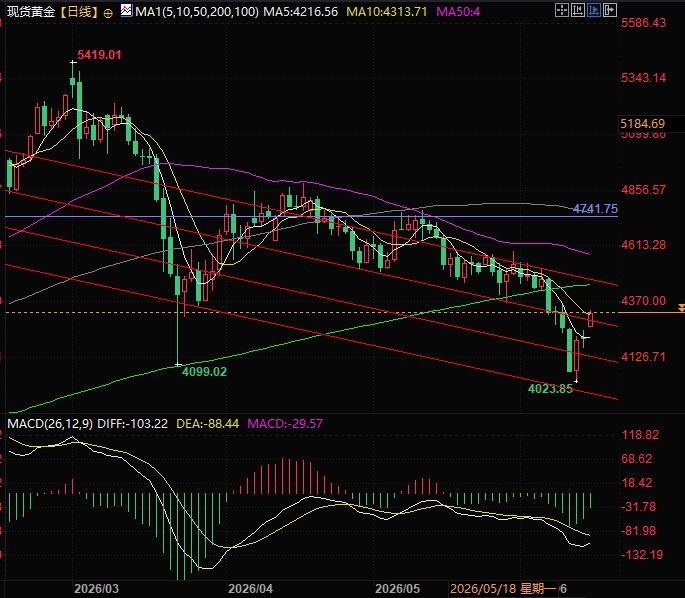
(Spot gold daily chart, source: FX678)
At 17:03 Beijing time, spot gold was trading at $4,337 per ounce.
After several rounds of intensive consultations, the United States and Iran formally finalized a peace agreement early Monday morning. The core contents include a permanent ceasefire, the resumption of navigation in the Strait of Hormuz, and negotiations on outstanding issues such as the Iranian nuclear issue within 60 days.
This breakthrough led to a decline in energy costs and real interest rates, igniting bullish sentiment in gold and equities globally. However, the US and Iran have differing views on the agreement, with significant discrepancies in their proposed content. Cross-Strait passage can only be implemented after the agreement is finalized and signed on Friday . Meanwhile, uncertainties surrounding Israel remain. As a result, the overall market rally has remained restrained.
Negotiation and Preparation: Signing Details and Preliminary Arrangements
As a key mediator, Pakistan was the first to officially announce the agreement's implementation. Prime Minister Sharif stated that the US and Iran had agreed to an "immediate and permanent ceasefire on all fronts (including Lebanon)." The formal signing ceremony is scheduled for June 19 (Friday) in Switzerland , and the agreement will be signed in electronic form.
The negotiating team from Qatar, the other mediator, left Tehran after 17 hours of intensive consultations. The parties will hold preparatory meetings separately in Doha this week to lay the foundation for subsequent technical negotiations .
US Vice President Vance revealed that the White House is still finalizing the attendees, with himself planning to attend and President Trump possibly attending in person; while the Iranian representative has not yet been finalized.
US statement: Trump officially announces free passage across the Strait.
As US President Trump celebrated his 80th birthday with a UFC event at the White House, he announced the news via social media: "Congratulations to everyone!"
He emphasized that the agreement will bring real peace and security to the region, and that this historic breakthrough comes after attempts by several US presidents had all ended in failure.
Trump formally approved unconditional access to the Strait of Hormuz, simultaneously lifting the U.S. Navy's maritime blockade against Iran—a countermeasure against Iran's control of the key waterway. However, he added that access to the strait would only officially begin after the agreement was signed on Friday.
U.S. Energy Secretary Wright revealed that the Strait of Hormuz currently transports 7 million barrels of oil and fuel per day, only half of what it was before the war, and no Iranian crude oil is currently passing through. If the agreement is successfully implemented, all products will be able to pass freely through the Persian Gulf.
If negotiations break down, the U.S. military will restore the shipping route (by military force), and the U.S. will not impose an oil export ban to curb oil prices.
Iran's position: Confirming the agreement while sending a strong signal
Iranian Deputy Foreign Minister Gharibabadi confirmed via state television that the text of the agreement has been finalized, emphasizing that Iran's compliance is contingent on its formal signing on Friday, and that the agreement was reached after consultations with Qatar.
The Secretariat of Iran's Supreme National Security Council announced that all fronts of the war "immediately and permanently cease from that evening," and that the US maritime blockade "is immediately and completely lifted."
However, Iran also sent a strong signal. The Ministry of Foreign Affairs clearly stated that if Israel's actions endanger regional peace and stability, both the US and Israel must bear full responsibility. At the same time, it strongly condemned Israel's airstrike on the southern outskirts of Beirut on Sunday, pointing out that the attack caused civilian casualties in Lebanon and was a serious violation of the ceasefire agreement.
The Iranian Deputy Foreign Minister further stated that if Iran discovers that the other party has violated the agreement, it will take corresponding measures on its own initiative, demonstrating its firm stance in safeguarding its own rights and interests.
Multiple challenges: internal divisions and unresolved core issues
Although an agreement appears to have been reached, it still faces multiple challenges.
As a coalition participant, Israel insists on unrestricted military action against Hezbollah in southern Lebanon and has expanded its operations to areas it has not ventured into for 25 years. Israeli sources revealed that during a phone call between Israeli Prime Minister Netanyahu and US President Trump on June 14, Netanyahu made it clear that Israel does not believe it will be bound by the Lebanese-related clauses in a potential US-Iran agreement, a view shared by the Israeli Security Minister.
Divides have also emerged within the United States. Republican Senator Lindsey Graham expressed concern that there were discrepancies in the interpretation of the agreement between Iran and the United States, directly accusing Vance of being the "mastermind behind the agreement." Democratic Senator Meeks, on the other hand, stated that Congress would fulfill its oversight responsibility for the agreement, emphasizing that "war cannot change the Iranian regime."
The 60-day window for negotiations on the Iranian nuclear issue set out in the agreement has attracted much attention—the relevant terms of the 2015 Iran nuclear agreement took several years to reach, and Trump's unilateral withdrawal from the agreement during his first term was a major trigger for this conflict.
Iran still possesses a ballistic missile arsenal and enough highly enriched uranium to manufacture several nuclear bombs. The issue of enriched uranium is a major topic of discussion in the subsequent 60-day ceasefire agreement between the US and Iran.
As Bessant previously stated, any losses incurred by Iran against U.S. allies in the Gulf region would be compensated using funds withdrawn from Iranian accounts. Any passage fees paid to the Straits Authority would also be offset by funds drawn from its accounts, meaning the U.S. is unlikely to accept strait fees.
Summary and Technical Analysis:
The signing of the agreement between the US and Iran has brought positive developments, including the setting of a final signing date and preparatory meetings before the signing.
As mentioned in previous articles, Iran needs the US to lift the blockade because its oil wells are running out of storage and its foreign exchange earnings are severely insufficient. The US needs an agreement that will satisfy voters before the midterm elections, and whether Iran can make enough concessions is key.
Meanwhile, because the peace agreement includes a permanent ceasefire and provides a 60-day window for nuclear talks, the US and Iran can keep the Strait of Hormuz open without discussing the nuclear issue.
This greatly reduces the difficulty of successfully signing the agreement. Moreover, as mentioned in previous articles, Iran can control the Strait of Hormuz and global energy prices through its domestic missile deployments. This is a geographical advantage of the country. If it can obtain enough benefits, there is a possibility of compromise on the nuclear issue.
Meanwhile, if the agreement is signed as scheduled, inflation concerns will subside significantly, and the possibility of a short-term interest rate hike by the Federal Reserve will be directly eliminated.
However, given the differing views between the US and Iran regarding the agreement, and the uncertainty surrounding whether a compromise can be reached, coupled with Israel's assertion that the US-Iran agreement will not affect its military operations, which in turn directly impact the signing of the US-Iran peace agreement, there is a demand for profit-taking amid the current significant rebound in gold prices. Furthermore, gold prices may fluctuate before the agreement is signed.
Technical Analysis: Spot gold has broken through the lower trendline of the descending channel and is expected to continue its rebound. Current support is at the lower trendline of the descending channel and 4250, with a rebound target around 4440, which is also the upper trendline of the descending channel.
(Spot gold daily chart, source: FX678)
At 17:03 Beijing time, spot gold was trading at $4,337 per ounce.
- Risk Warning and Disclaimer
- The market involves risk, and trading may not be suitable for all investors. This article is for reference only and does not constitute personal investment advice, nor does it take into account certain users’ specific investment objectives, financial situation, or other needs. Any investment decisions made based on this information are at your own risk.