The plunge in oil prices helped push gold prices above $4,350; analysts say the gold recovery is not yet complete.
2026-06-16 01:07:56
On Monday (June 15), the gold market was boosted by sustained buying, with gold prices surging more than 3% in early North American trading, marking the largest single-day percentage gain since early February this year. Spot gold was quoted at $4,338.87 per ounce, up 2.89%.

The core trigger for this gold price surge was the easing of geopolitical tensions in the Middle East. Market news indicated that the United States and Iran would sign a peace agreement this Friday, ending months of conflict in the Middle East. This positive news directly led to a sharp drop in international oil prices, falling below $80 per barrel, effectively alleviating global inflationary pressures. Market expectations of easing inflation provided key support for the gold price rebound.
Risk Concerns: Multiple factors constrain gold prices, leaving it vulnerable to downside risks.
Despite a significant rebound in gold prices from last week's low of $4,000 per ounce, several industry analysts have warned that gold has not yet fully emerged from its correction phase, and the current recovery is not stable and still faces multiple constraints and risks.
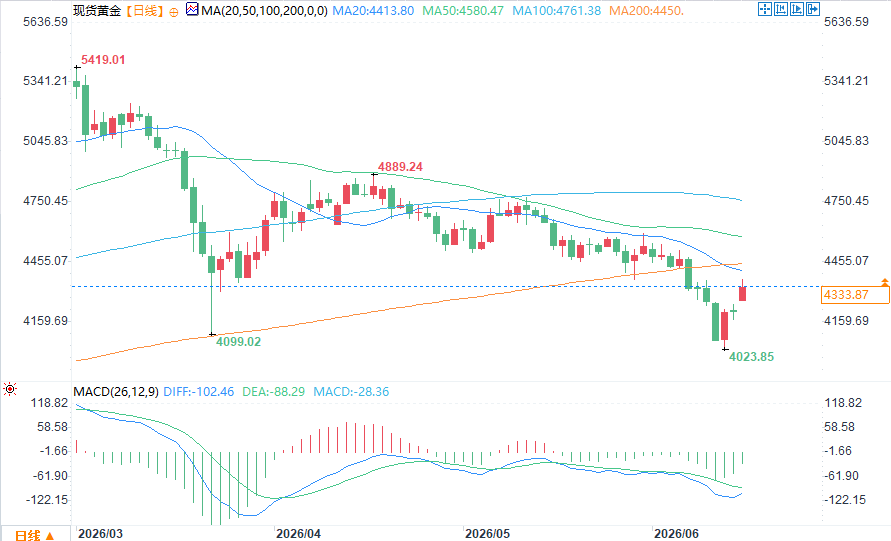
(Spot gold daily chart source: FX678)
From a technical perspective, gold prices are currently still below the 200-day moving average, and the medium-term downward pressure has not yet been relieved. Market strategist Michelle Schneider stated that if gold prices hold the key support level of $4,000, investors can consider making small long positions. However, for the market to truly stabilize and strengthen, gold prices need to firmly establish themselves above the 200-day moving average level of $4,450 per ounce.
Geopolitical uncertainty is another major core risk. David Morrison, senior market analyst at Trade Nation, points out that although gold held key psychological levels and completed its first rebound, uncertainties remain before the formal signing of a US-Iran peace agreement. If the agreement is delayed, market risk aversion will fluctuate, and gold prices will likely fall back to test the $4,000 support level.
Meanwhile, inflationary pressures remain a significant factor suppressing gold prices in the short term. The market has already priced in an expected interest rate hike at the end of the year; the combination of high inflation and these expectations continues to limit gold's upside potential, making a complete reversal of the weak trend unlikely in the short term.
Market Outlook: Significant technical resistance; Federal Reserve policy becomes a key indicator.
Analysts generally believe that gold's further rise faces multiple technical obstacles, and its direction will be highly dependent on the latest policy statements from the Federal Reserve. Nick Cowley, an analyst at Salomon Global, points out that the primary short-term resistance for gold is the 50-day simple moving average at $4,581 per ounce. A break above this level would target the next key resistance at the secondary high of $4,773 per ounce reached on May 12th. Only a decisive break above these two key resistance levels could allow gold to begin a sustained upward trend.
The policy stance of the newly appointed Federal Reserve Chairman, Kevin Warsh, has become the core focus of the market. If Warsh signals easing, acknowledging the deflationary effects of the peace agreement and weakening expectations of interest rate hikes, it will provide a second boost to gold prices, pushing them further upward. Conversely, if the Fed maintains its tightening stance, the gold rally may quickly come to an end.
Several institutions remain cautious about the medium- to long-term outlook for gold. TD Securities stated that the market will still be pricing in interest rate hikes at the beginning of 2027, the tight supply and demand situation in the energy market has not fundamentally improved, and the inflationary risks from oil prices persist. Therefore, the current rebound in precious metals may be temporary. Societe Generale maintained a neutral short-term outlook for gold, pointing out that global oil inventories are low and restocking is slow. Even if the Middle East conflict ends, the risks of oil price volatility and inflationary pressures will persist for a long time. Coupled with persistently high real yields, this continues to suppress gold's safe-haven and inflation-hedging attributes, significantly limiting the upside potential of gold prices.
The core trigger for this gold price surge was the easing of geopolitical tensions in the Middle East. Market news indicated that the United States and Iran would sign a peace agreement this Friday, ending months of conflict in the Middle East. This positive news directly led to a sharp drop in international oil prices, falling below $80 per barrel, effectively alleviating global inflationary pressures. Market expectations of easing inflation provided key support for the gold price rebound.
Risk Concerns: Multiple factors constrain gold prices, leaving it vulnerable to downside risks.
Despite a significant rebound in gold prices from last week's low of $4,000 per ounce, several industry analysts have warned that gold has not yet fully emerged from its correction phase, and the current recovery is not stable and still faces multiple constraints and risks.
(Spot gold daily chart source: FX678)
From a technical perspective, gold prices are currently still below the 200-day moving average, and the medium-term downward pressure has not yet been relieved. Market strategist Michelle Schneider stated that if gold prices hold the key support level of $4,000, investors can consider making small long positions. However, for the market to truly stabilize and strengthen, gold prices need to firmly establish themselves above the 200-day moving average level of $4,450 per ounce.
Geopolitical uncertainty is another major core risk. David Morrison, senior market analyst at Trade Nation, points out that although gold held key psychological levels and completed its first rebound, uncertainties remain before the formal signing of a US-Iran peace agreement. If the agreement is delayed, market risk aversion will fluctuate, and gold prices will likely fall back to test the $4,000 support level.
Meanwhile, inflationary pressures remain a significant factor suppressing gold prices in the short term. The market has already priced in an expected interest rate hike at the end of the year; the combination of high inflation and these expectations continues to limit gold's upside potential, making a complete reversal of the weak trend unlikely in the short term.
Market Outlook: Significant technical resistance; Federal Reserve policy becomes a key indicator.
Analysts generally believe that gold's further rise faces multiple technical obstacles, and its direction will be highly dependent on the latest policy statements from the Federal Reserve. Nick Cowley, an analyst at Salomon Global, points out that the primary short-term resistance for gold is the 50-day simple moving average at $4,581 per ounce. A break above this level would target the next key resistance at the secondary high of $4,773 per ounce reached on May 12th. Only a decisive break above these two key resistance levels could allow gold to begin a sustained upward trend.
The policy stance of the newly appointed Federal Reserve Chairman, Kevin Warsh, has become the core focus of the market. If Warsh signals easing, acknowledging the deflationary effects of the peace agreement and weakening expectations of interest rate hikes, it will provide a second boost to gold prices, pushing them further upward. Conversely, if the Fed maintains its tightening stance, the gold rally may quickly come to an end.
Several institutions remain cautious about the medium- to long-term outlook for gold. TD Securities stated that the market will still be pricing in interest rate hikes at the beginning of 2027, the tight supply and demand situation in the energy market has not fundamentally improved, and the inflationary risks from oil prices persist. Therefore, the current rebound in precious metals may be temporary. Societe Generale maintained a neutral short-term outlook for gold, pointing out that global oil inventories are low and restocking is slow. Even if the Middle East conflict ends, the risks of oil price volatility and inflationary pressures will persist for a long time. Coupled with persistently high real yields, this continues to suppress gold's safe-haven and inflation-hedging attributes, significantly limiting the upside potential of gold prices.
- Risk Warning and Disclaimer
- The market involves risk, and trading may not be suitable for all investors. This article is for reference only and does not constitute personal investment advice, nor does it take into account certain users’ specific investment objectives, financial situation, or other needs. Any investment decisions made based on this information are at your own risk.