Spot silver suddenly surged, and behind the $71 mark lies a larger pricing shift.
2026-06-15 21:59:42
On Monday, June 15th, spot silver traded around $71 per ounce during the North American session, with a daily increase of nearly 4.5%. The Bollinger Band middle line was at $74.866 per ounce, the upper line at $87.297 per ounce, and the lower line at $62.435 per ounce. The US dollar index was around 99.5 and had fallen from the previous trading day, indicating that the precious metals pricing environment has shifted back to being driven by both a weak dollar and interest rate expectation repricing.
De-escalating geopolitical tensions have lowered crude oil premiums and reduced tail risks of inflation. Consequently, the market has revised down some tightening expectations. The weakening dollar and marginal decrease in real interest rate pressures have become key variables for silver's renewed upward movement.
This means that silver's current resilience stems from two factors: first, its precious metal attributes are being revalued in a weak dollar environment; and second, its industrial metal attributes are being activated simultaneously as risk assets recover. Compared to gold, silver is more sensitive to growth and liquidity expectations, making it more prone to high-beta rebounds in a combination of falling oil prices and a declining dollar index.
However, the easing of conflict does not mean the complete disappearance of uncertainty. The text of the relevant US-Iran agreement has not yet been fully released, and sporadic reports of tension persist in some regions. The market still discounts the pace of energy corridor reopening. Therefore, silver has not completely lost its demand for diversification, but rather is forming a new balance between "cooling down of safe-haven demand" and "improved liquidity."
The US dollar index traded around 99.5 during the day, down from the previous trading day. The weaker dollar directly reduced the cost of holding silver for non-dollar funds, which is an important background for the short-term strength of spot silver. Market anticipation for this week's Federal Reserve meeting has clearly intensified.
For silver, the US dollar is not a single variable, but rather a comprehensive reflection of global liquidity, real interest rates, and risk appetite. When the dollar weakens along with falling oil prices, the market reassesses future inflationary pressures and the path of policy interest rates, easing valuation pressures on precious metals. If the dollar's weakness stems from improved risk appetite, silver tends to be more resilient than gold; if the dollar's weakness arises from growth concerns, silver's industrial attributes may limit its gains.
The current situation is closer to the former scenario. Falling energy prices have improved inflation expectations, while stronger equity assets have improved risk appetite, thus providing double support for silver. However, silver is not a one-sided beneficiary. Once the dollar index stabilizes around the time of the Fed meeting, or real interest rates rise, funds chasing prices above $70 will face higher volatility costs.
From the daily chart, silver fell from a high of $89.344/oz, hitting a low of $61.478/oz before rebounding to around $71. The current price has climbed back into the short-term low range, but remains below the Bollinger Band middle line at $74.866/oz, indicating that the rebound has corrected the oversold condition but has not yet completed a trend reversal.
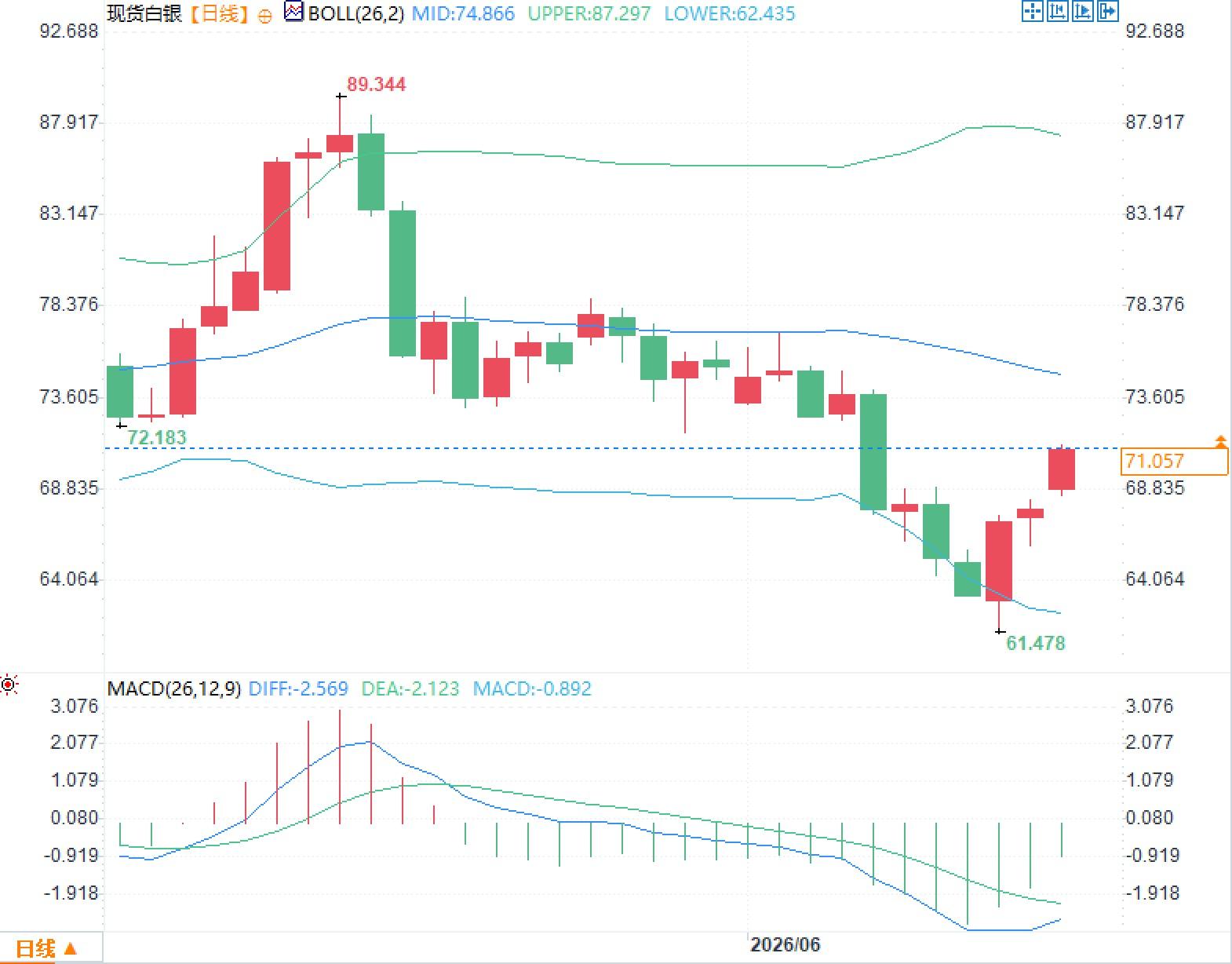
The lower Bollinger Band is around $62.435/oz, after which the price broke below and quickly recovered, indicating that short sellers have clearly taken profits after the release of selling pressure at lower levels. However, the middle band is still trending downwards, reflecting that the average pressure from the past period has not been fully digested. In other words, the price action around $71 is more like a pullback after a deep dive, rather than a confirmed start to a new trend expansion.
Regarding the MACD, the DIFF is -2.569, the DEA is -2.123, and the histogram is -0.892, all still below the zero line. Although the negative bars show signs of convergence, a clear medium-term bullish structure has not yet formed. For professional traders, this combination means that the market has switched from an extremely weak state to a recovery state, but it has not yet given sufficient confirmation of a continuing trend.
This week, market focus is on the Federal Reserve meeting. The official schedule shows that the June meeting is one of the regular policy meetings of the year; the minutes of the April meeting showed that the target range for the federal funds rate remained unchanged, and the interest rate on reserves remained at 3.65%. The market widely expects this meeting to likely maintain the unchanged interest rate range, with the key focus on the policy statement, economic projections, and changes in the wording regarding inflation stickiness.
For silver, the meeting's outcome is perhaps less important than the wording. If the Federal Reserve emphasizes that inflation remains under pressure, real interest rate expectations may rise, limiting silver's upside potential; conversely, if policy communication leans towards observing data and avoiding excessive tightening, the dollar and real yields may continue to decline, providing a more solid foundation for a silver rebound.
The market has already partially priced in the expectation of "unchanged interest rates and increased flexibility in the future." Therefore, what truly affects prices is whether funds will continue to hold highly volatile precious metal assets after the meeting. The risk for silver lies in its excessive sensitivity to easing expectations; if the data or wording is unfavorable, the pullback is usually faster than that of gold.
The core of the silver rebound is not safe-haven demand, but rather a shift in pricing factors.
De-escalating geopolitical tensions have lowered crude oil premiums and reduced tail risks of inflation. Consequently, the market has revised down some tightening expectations. The weakening dollar and marginal decrease in real interest rate pressures have become key variables for silver's renewed upward movement.
This means that silver's current resilience stems from two factors: first, its precious metal attributes are being revalued in a weak dollar environment; and second, its industrial metal attributes are being activated simultaneously as risk assets recover. Compared to gold, silver is more sensitive to growth and liquidity expectations, making it more prone to high-beta rebounds in a combination of falling oil prices and a declining dollar index.
However, the easing of conflict does not mean the complete disappearance of uncertainty. The text of the relevant US-Iran agreement has not yet been fully released, and sporadic reports of tension persist in some regions. The market still discounts the pace of energy corridor reopening. Therefore, silver has not completely lost its demand for diversification, but rather is forming a new balance between "cooling down of safe-haven demand" and "improved liquidity."
The US dollar index fell to around 99.5, amplifying the exchange rate sensitivity of silver.
The US dollar index traded around 99.5 during the day, down from the previous trading day. The weaker dollar directly reduced the cost of holding silver for non-dollar funds, which is an important background for the short-term strength of spot silver. Market anticipation for this week's Federal Reserve meeting has clearly intensified.
For silver, the US dollar is not a single variable, but rather a comprehensive reflection of global liquidity, real interest rates, and risk appetite. When the dollar weakens along with falling oil prices, the market reassesses future inflationary pressures and the path of policy interest rates, easing valuation pressures on precious metals. If the dollar's weakness stems from improved risk appetite, silver tends to be more resilient than gold; if the dollar's weakness arises from growth concerns, silver's industrial attributes may limit its gains.
The current situation is closer to the former scenario. Falling energy prices have improved inflation expectations, while stronger equity assets have improved risk appetite, thus providing double support for silver. However, silver is not a one-sided beneficiary. Once the dollar index stabilizes around the time of the Fed meeting, or real interest rates rise, funds chasing prices above $70 will face higher volatility costs.
Technical analysis suggests that the rebound has not yet fully reversed the medium-term resistance.
From the daily chart, silver fell from a high of $89.344/oz, hitting a low of $61.478/oz before rebounding to around $71. The current price has climbed back into the short-term low range, but remains below the Bollinger Band middle line at $74.866/oz, indicating that the rebound has corrected the oversold condition but has not yet completed a trend reversal.
The lower Bollinger Band is around $62.435/oz, after which the price broke below and quickly recovered, indicating that short sellers have clearly taken profits after the release of selling pressure at lower levels. However, the middle band is still trending downwards, reflecting that the average pressure from the past period has not been fully digested. In other words, the price action around $71 is more like a pullback after a deep dive, rather than a confirmed start to a new trend expansion.
Regarding the MACD, the DIFF is -2.569, the DEA is -2.123, and the histogram is -0.892, all still below the zero line. Although the negative bars show signs of convergence, a clear medium-term bullish structure has not yet formed. For professional traders, this combination means that the market has switched from an extremely weak state to a recovery state, but it has not yet given sufficient confirmation of a continuing trend.
The Federal Reserve meeting is the valve for the next phase of volatility.
This week, market focus is on the Federal Reserve meeting. The official schedule shows that the June meeting is one of the regular policy meetings of the year; the minutes of the April meeting showed that the target range for the federal funds rate remained unchanged, and the interest rate on reserves remained at 3.65%. The market widely expects this meeting to likely maintain the unchanged interest rate range, with the key focus on the policy statement, economic projections, and changes in the wording regarding inflation stickiness.
For silver, the meeting's outcome is perhaps less important than the wording. If the Federal Reserve emphasizes that inflation remains under pressure, real interest rate expectations may rise, limiting silver's upside potential; conversely, if policy communication leans towards observing data and avoiding excessive tightening, the dollar and real yields may continue to decline, providing a more solid foundation for a silver rebound.
The market has already partially priced in the expectation of "unchanged interest rates and increased flexibility in the future." Therefore, what truly affects prices is whether funds will continue to hold highly volatile precious metal assets after the meeting. The risk for silver lies in its excessive sensitivity to easing expectations; if the data or wording is unfavorable, the pullback is usually faster than that of gold.
- Risk Warning and Disclaimer
- The market involves risk, and trading may not be suitable for all investors. This article is for reference only and does not constitute personal investment advice, nor does it take into account certain users’ specific investment objectives, financial situation, or other needs. Any investment decisions made based on this information are at your own risk.