The Reserve Bank of Australia kept interest rates unchanged at 4.35%, and the Australian dollar fell under pressure as the hawkish stance was maintained.
2026-06-16 15:25:33
The Reserve Bank of Australia (RBA) announced its June interest rate decision on Tuesday, maintaining the official cash rate at 4.35%, in line with market expectations. This pause in rate hikes marks the first policy halt after three consecutive 25-basis-point increases. The policy committee unanimously supported keeping the rate unchanged, but emphasized that current inflation remains above the target range, and future policy direction will depend on economic data and changes in inflation risks.
Reserve Bank of Australia (RBA) Governor Bullock stated at a subsequent press conference that the latest economic data was generally in line with the central bank's expectations. Recent news regarding the Middle East peace agreement helped alleviate energy supply concerns, but it was too early to judge whether the cooling housing market would help reduce inflation. She emphasized that the RBA was not considering further interest rate hikes, but remained prepared to take necessary action should inflationary pressures re-emerge.
Data shows that Australia's economic growth has shown signs of slowing. First-quarter GDP growth was only 0.3%, lower than market expectations of 0.5% and significantly lower than the previous quarter's 0.9%. Meanwhile, the unemployment rate rose to 4.5% in April, a high in recent years, indicating a gradually cooling labor market. However, the Reserve Bank of Australia believes the labor market remains tight, and current wage and service sector price pressures may slow the decline in inflation.
On the inflation front, Australia's consumer price index (CPI) slowed to 0.4% month-on-month in April, and the annual inflation rate fell to 4.2% from 4.6%, but remained significantly above the central bank's target range. The Reserve Bank of Australia (RBA) noted that while short-term inflation expectations have declined, it will take time for global energy supply issues to fully resolve, and the impact of previous oil price increases may continue to transmit to the economy. Therefore, the central bank remains vigilant about the upside risks to inflation.
Market expectations for further interest rate hikes by the Reserve Bank of Australia (RBA) have cooled significantly. With slowing economic activity and the increasing impact of high interest rates on household spending, the market anticipates the RBA may maintain stable interest rates for an extended period. However, as Bullock has not completely ruled out further tightening, the RBA's overall stance remains hawkish.
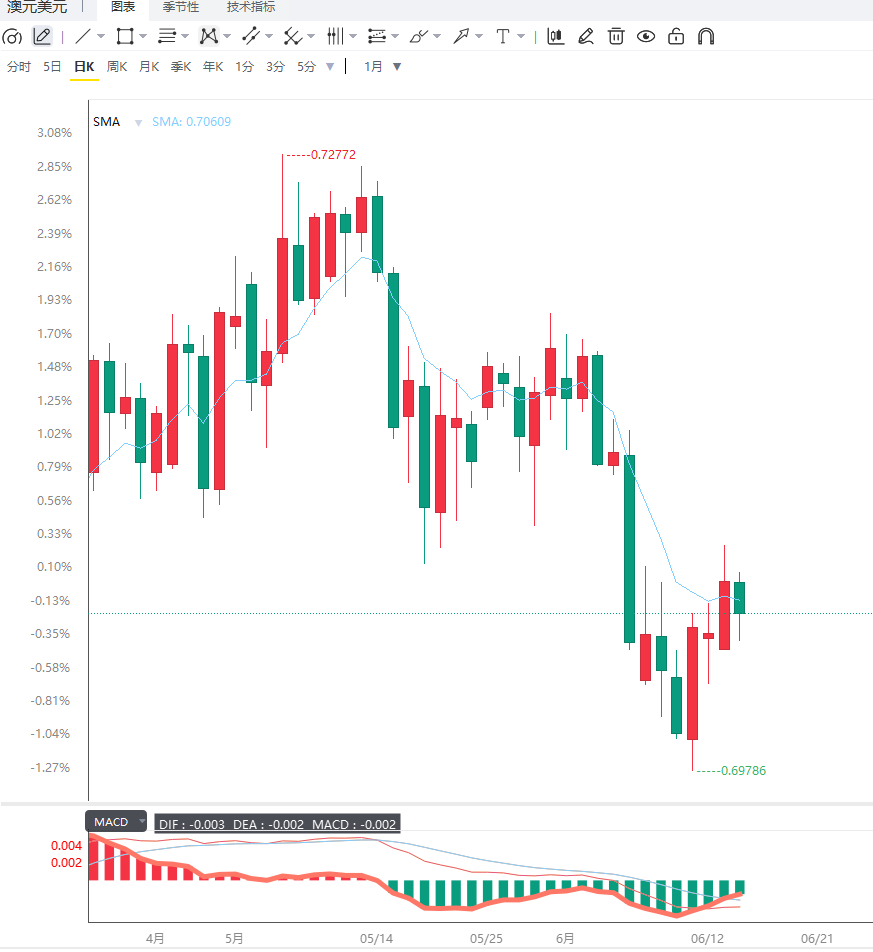
In the foreign exchange market, the Australian dollar weakened against the US dollar after the interest rate decision was announced, falling to around 0.7055. The US dollar performed relatively strongly throughout the day, and the market awaited the latest interest rate decision from the Federal Reserve and guidance from new Chairman Kevin Warsh on the future path of monetary policy, which further limited the Australian dollar's upside potential.
From a daily chart perspective, the Australian dollar has experienced a significant decline against the US dollar and is currently undergoing a technical rebound, testing a key moving average area. The 14-day Relative Strength Index (RSI) has rebounded from oversold territory but remains in a weak zone, indicating that bearish momentum has not completely subsided. If the exchange rate can effectively break through the resistance at 0.7084 near the 100-day moving average, it is expected to further test the moving average resistance areas near 0.7116 and 0.7143. On the downside, watch for key support near the 200-day moving average at 0.6844; a break below this level could open up further downside potential.
From a 4-hour chart perspective, the Australian dollar against the US dollar is currently influenced by the Reserve Bank of Australia's pause in interest rate hikes and the strengthening US dollar, resulting in a generally volatile and corrective trend. Technical indicators suggest that the short-term rebound momentum has weakened. If it cannot effectively hold above 0.7143, the market may still face downward pressure. Conversely, if the Federal Reserve releases dovish signals, a decline in the US dollar could help the Australian dollar regain upward momentum. Investors should focus on the Federal Reserve's policy decision and subsequent changes in Australian inflation and employment data in the short term.
Editor's Summary : The Reserve Bank of Australia's decision to keep interest rates unchanged signifies a policy observation phase, but does not declare the end of the rate hike cycle. Persistently above-target inflation still allows the central bank to reserve the possibility of further action. With economic growth slowing and signs of a cooling job market, the RBA will need to find a balance between controlling inflation and avoiding an excessive economic slowdown. In the short term, the Australian dollar's performance will depend not only on the RBA's subsequent policy stance but also on the Federal Reserve's interest rate path, the performance of the US dollar, and changes in global risk sentiment.
Reserve Bank of Australia (RBA) Governor Bullock stated at a subsequent press conference that the latest economic data was generally in line with the central bank's expectations. Recent news regarding the Middle East peace agreement helped alleviate energy supply concerns, but it was too early to judge whether the cooling housing market would help reduce inflation. She emphasized that the RBA was not considering further interest rate hikes, but remained prepared to take necessary action should inflationary pressures re-emerge.
Data shows that Australia's economic growth has shown signs of slowing. First-quarter GDP growth was only 0.3%, lower than market expectations of 0.5% and significantly lower than the previous quarter's 0.9%. Meanwhile, the unemployment rate rose to 4.5% in April, a high in recent years, indicating a gradually cooling labor market. However, the Reserve Bank of Australia believes the labor market remains tight, and current wage and service sector price pressures may slow the decline in inflation.
On the inflation front, Australia's consumer price index (CPI) slowed to 0.4% month-on-month in April, and the annual inflation rate fell to 4.2% from 4.6%, but remained significantly above the central bank's target range. The Reserve Bank of Australia (RBA) noted that while short-term inflation expectations have declined, it will take time for global energy supply issues to fully resolve, and the impact of previous oil price increases may continue to transmit to the economy. Therefore, the central bank remains vigilant about the upside risks to inflation.
Market expectations for further interest rate hikes by the Reserve Bank of Australia (RBA) have cooled significantly. With slowing economic activity and the increasing impact of high interest rates on household spending, the market anticipates the RBA may maintain stable interest rates for an extended period. However, as Bullock has not completely ruled out further tightening, the RBA's overall stance remains hawkish.
In the foreign exchange market, the Australian dollar weakened against the US dollar after the interest rate decision was announced, falling to around 0.7055. The US dollar performed relatively strongly throughout the day, and the market awaited the latest interest rate decision from the Federal Reserve and guidance from new Chairman Kevin Warsh on the future path of monetary policy, which further limited the Australian dollar's upside potential.
From a daily chart perspective, the Australian dollar has experienced a significant decline against the US dollar and is currently undergoing a technical rebound, testing a key moving average area. The 14-day Relative Strength Index (RSI) has rebounded from oversold territory but remains in a weak zone, indicating that bearish momentum has not completely subsided. If the exchange rate can effectively break through the resistance at 0.7084 near the 100-day moving average, it is expected to further test the moving average resistance areas near 0.7116 and 0.7143. On the downside, watch for key support near the 200-day moving average at 0.6844; a break below this level could open up further downside potential.
From a 4-hour chart perspective, the Australian dollar against the US dollar is currently influenced by the Reserve Bank of Australia's pause in interest rate hikes and the strengthening US dollar, resulting in a generally volatile and corrective trend. Technical indicators suggest that the short-term rebound momentum has weakened. If it cannot effectively hold above 0.7143, the market may still face downward pressure. Conversely, if the Federal Reserve releases dovish signals, a decline in the US dollar could help the Australian dollar regain upward momentum. Investors should focus on the Federal Reserve's policy decision and subsequent changes in Australian inflation and employment data in the short term.
Editor's Summary : The Reserve Bank of Australia's decision to keep interest rates unchanged signifies a policy observation phase, but does not declare the end of the rate hike cycle. Persistently above-target inflation still allows the central bank to reserve the possibility of further action. With economic growth slowing and signs of a cooling job market, the RBA will need to find a balance between controlling inflation and avoiding an excessive economic slowdown. In the short term, the Australian dollar's performance will depend not only on the RBA's subsequent policy stance but also on the Federal Reserve's interest rate path, the performance of the US dollar, and changes in global risk sentiment.
- Risk Warning and Disclaimer
- The market involves risk, and trading may not be suitable for all investors. This article is for reference only and does not constitute personal investment advice, nor does it take into account certain users’ specific investment objectives, financial situation, or other needs. Any investment decisions made based on this information are at your own risk.