Why is the USD/JPY pair still holding above 160 despite the Bank of Japan raising interest rates to a 31-year high?
2026-06-16 17:34:47
On Tuesday, June 16, the USD/JPY pair remained near the 160 level after the Bank of Japan raised its policy rate by 0.25 percentage points to 1%, the highest level since 1995, but the yen failed to strengthen sustainably. Market reaction indicates that this rate hike was fully priced in, and the core factors determining exchange rate direction have shifted from "whether to raise rates" to the speed of interest rate differential convergence, energy input costs, and the intensity of policy communication.

The Bank of Japan passed a rate hike by a vote of 7 to 1, raising its target for the unsecured overnight call rate to 1%. This is an important step in the normalization of monetary policy, but it did not cause any unexpected shocks. Previous surveys showed that the vast majority of economists had already expected the rate to rise from 0.75% to 1%, and the USD/JPY exchange rate had also approached 160 again before the decision, indicating that short yen positions had not been significantly withdrawn due to expectations of a rate hike.
The immediate pricing of exchange rates depends on the difference between actual results and market expectations, not on the policy actions themselves. Although the Bank of Japan raised short-term interest rates, the target range for the US federal funds rate remained at 3.50% to 3.75%, with the nominal policy rate differential between the two still reaching 2.50 to 2.75 percentage points. Given that carry trade costs, forward points, and yields still clearly favor the US dollar, a single 25-basis-point rate hike is insufficient to reverse the holding logic of cross-border funds. The results of the Fed's June meeting have not yet been released, but market expectations for further easing this year have already cooled significantly, further weakening the path for the yen to passively appreciate through external interest rate cuts.
The Bank of Japan also announced that its government bond purchases will be reduced to approximately 2 trillion yen per month by early 2027, and will remain roughly stable at this level from April 2027, without further mechanical reductions. This arrangement implies that balance sheet normalization is not an indefinite process, but rather a shift from continuously reducing the amount of bonds to maintaining a stable supply of market liquidity.
This policy mix has a dual meaning. The interest rate hike reflects an intention to constrain inflation and exchange rate transmission, but halting further reductions in bond purchases lowers the risk of disorderly increases in long-term government bond yields. For the foreign exchange market, rising short-term interest rates benefit the yen, while the central bank's continued large-scale bond demand may suppress term premiums, limiting the upside potential for long-term yields. Unless the Japanese yield curve shows a more significant overall upward shift, the attractiveness of yen-denominated assets for international investment remains limited.
Policymakers have previously pointed out that around 1% may be close to the area where monetary stimulus begins to weaken, but the neutral interest rate cannot be directly observed and needs to be gradually verified through feedback from economic activity, prices, and financing conditions. This means that 1% is not a clear endpoint, but it may become a dividing line where subsequent decision-making becomes significantly more difficult.
The persistently weak yen exerts significant cost pressure on Japan, which is highly dependent on resource imports. Energy, food, and industrial raw materials are priced in foreign currencies, and currency depreciation will spill over into core prices through import prices, business procurement costs, and household bills. Even though crude oil prices have fallen somewhat after the preliminary agreement between the US and Iran, uncertainty remains regarding the passage of key shipping routes, and the energy risk premium has not completely disappeared.
This also explains why the Bank of Japan chose to raise interest rates despite constraints on growth. Its policy objective is not simply to support the exchange rate, but to prevent a weak yen and energy costs from creating sustained double-dip inflation. However, raising interest rates too quickly could suppress corporate financing, housing demand, and household consumption, thus the policy path is more likely to remain gradual.
S&P economist Harumi Taguchi recently stated that the Bank of Japan's basic stance remains unchanged, and it is likely to gradually raise interest rates at a pace of approximately once every six months, with the possibility of another rate adjustment within the year. Even if oil prices decline slightly, inflationary pressures may persist. The market implication of this assessment is that the policy direction leans towards normalization, but the timeframe is long, and it is insufficient to quickly eliminate interest rate differentials in the short term.
The area around 160 is also sensitive to policy intervention. The USD/JPY pair has returned to the zone that previously drew attention in forex trading, and the market needs to distinguish between price levels and the speed of volatility. Historical experience shows that single round number levels are not automatically triggered; unilateral acceleration, deteriorating liquidity, and concentrated speculative positions are usually more significant. Therefore, 160 is both a technical resistance level and the point where policy risk premiums re-enter the pricing system.
The daily chart shows that USD/JPY has been recovering from a low of 155.025, with a recent high of 160.591, and is currently consolidating around 160.3. The Bollinger Bands have a middle band at 159.432, an upper band at 161.008, and a lower band at 157.855. The price is above the middle band and close to the upper band, indicating a still relatively strong medium-term structure, but the upside potential has entered a volatility-constrained zone.
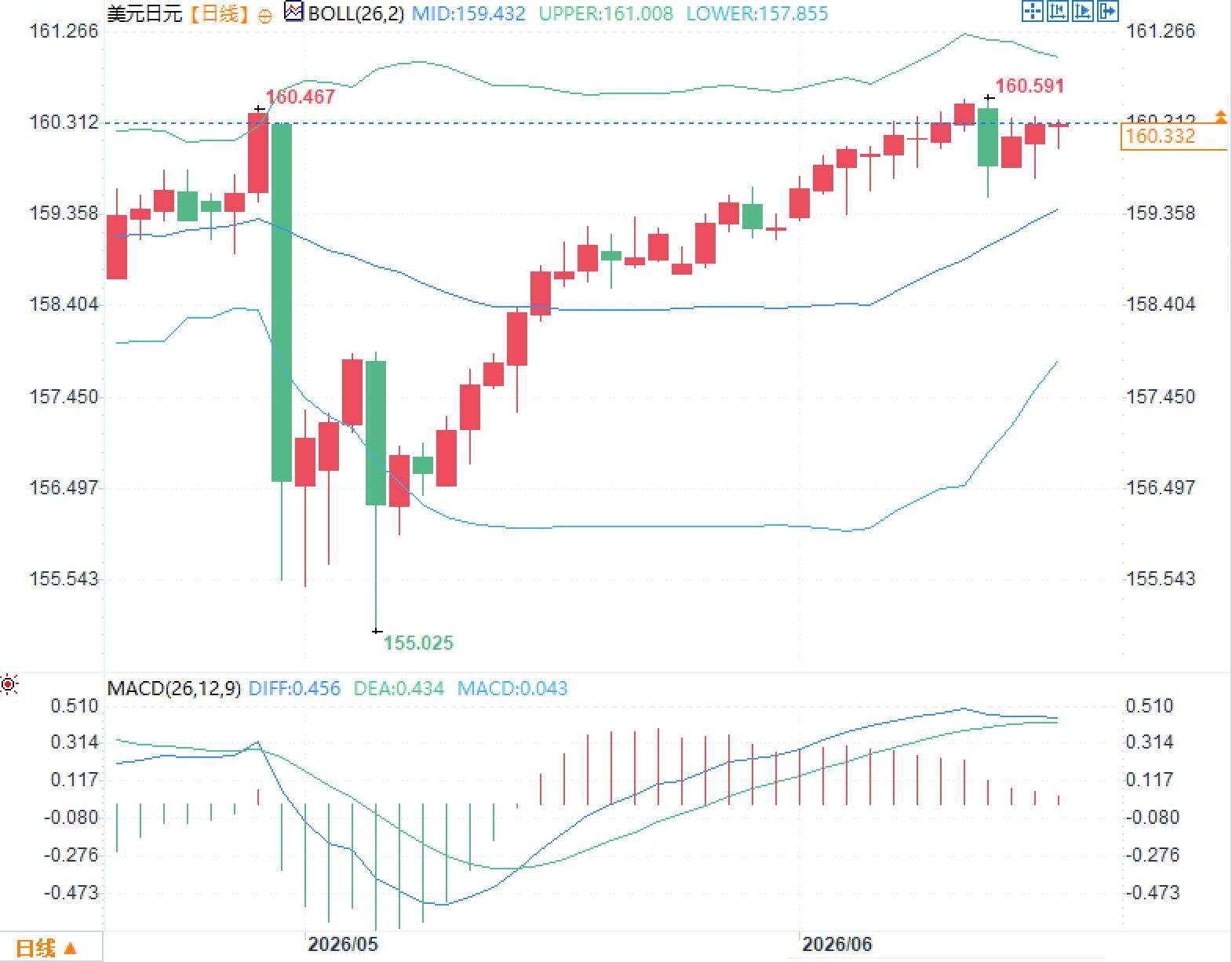
The MACD fast line is at 0.456, the slow line at 0.434, and the histogram at 0.043, all still above the zero line, but the histogram is shortening, reflecting that the upward trend has not been broken, but the marginal momentum is declining. The 160.59 to 161.01 area corresponds to both the recent high and the upper Bollinger Band, belonging to a concentrated pricing zone; the area around 159.43 is an important indicator of trend strength. If the price remains above 160 for an extended period without a corresponding rise in Japanese long-term yields, the market will continue to question the efficiency of the exchange rate transmission of interest rate hikes. Conversely, if exchange rate volatility increases significantly, the policy risk premium may quickly suppress the willingness to chase higher prices.
Why is the yen under pressure after the interest rate hike?
The Bank of Japan passed a rate hike by a vote of 7 to 1, raising its target for the unsecured overnight call rate to 1%. This is an important step in the normalization of monetary policy, but it did not cause any unexpected shocks. Previous surveys showed that the vast majority of economists had already expected the rate to rise from 0.75% to 1%, and the USD/JPY exchange rate had also approached 160 again before the decision, indicating that short yen positions had not been significantly withdrawn due to expectations of a rate hike.
The immediate pricing of exchange rates depends on the difference between actual results and market expectations, not on the policy actions themselves. Although the Bank of Japan raised short-term interest rates, the target range for the US federal funds rate remained at 3.50% to 3.75%, with the nominal policy rate differential between the two still reaching 2.50 to 2.75 percentage points. Given that carry trade costs, forward points, and yields still clearly favor the US dollar, a single 25-basis-point rate hike is insufficient to reverse the holding logic of cross-border funds. The results of the Fed's June meeting have not yet been released, but market expectations for further easing this year have already cooled significantly, further weakening the path for the yen to passively appreciate through external interest rate cuts.
The bond-buying arrangement sends a more complex signal than interest rates.
The Bank of Japan also announced that its government bond purchases will be reduced to approximately 2 trillion yen per month by early 2027, and will remain roughly stable at this level from April 2027, without further mechanical reductions. This arrangement implies that balance sheet normalization is not an indefinite process, but rather a shift from continuously reducing the amount of bonds to maintaining a stable supply of market liquidity.
This policy mix has a dual meaning. The interest rate hike reflects an intention to constrain inflation and exchange rate transmission, but halting further reductions in bond purchases lowers the risk of disorderly increases in long-term government bond yields. For the foreign exchange market, rising short-term interest rates benefit the yen, while the central bank's continued large-scale bond demand may suppress term premiums, limiting the upside potential for long-term yields. Unless the Japanese yield curve shows a more significant overall upward shift, the attractiveness of yen-denominated assets for international investment remains limited.
Policymakers have previously pointed out that around 1% may be close to the area where monetary stimulus begins to weaken, but the neutral interest rate cannot be directly observed and needs to be gradually verified through feedback from economic activity, prices, and financing conditions. This means that 1% is not a clear endpoint, but it may become a dividing line where subsequent decision-making becomes significantly more difficult.
Behind the 160 mark lies a tug-of-war between imported inflation and the risk of intervention.
The persistently weak yen exerts significant cost pressure on Japan, which is highly dependent on resource imports. Energy, food, and industrial raw materials are priced in foreign currencies, and currency depreciation will spill over into core prices through import prices, business procurement costs, and household bills. Even though crude oil prices have fallen somewhat after the preliminary agreement between the US and Iran, uncertainty remains regarding the passage of key shipping routes, and the energy risk premium has not completely disappeared.
This also explains why the Bank of Japan chose to raise interest rates despite constraints on growth. Its policy objective is not simply to support the exchange rate, but to prevent a weak yen and energy costs from creating sustained double-dip inflation. However, raising interest rates too quickly could suppress corporate financing, housing demand, and household consumption, thus the policy path is more likely to remain gradual.
S&P economist Harumi Taguchi recently stated that the Bank of Japan's basic stance remains unchanged, and it is likely to gradually raise interest rates at a pace of approximately once every six months, with the possibility of another rate adjustment within the year. Even if oil prices decline slightly, inflationary pressures may persist. The market implication of this assessment is that the policy direction leans towards normalization, but the timeframe is long, and it is insufficient to quickly eliminate interest rate differentials in the short term.
The area around 160 is also sensitive to policy intervention. The USD/JPY pair has returned to the zone that previously drew attention in forex trading, and the market needs to distinguish between price levels and the speed of volatility. Historical experience shows that single round number levels are not automatically triggered; unilateral acceleration, deteriorating liquidity, and concentrated speculative positions are usually more significant. Therefore, 160 is both a technical resistance level and the point where policy risk premiums re-enter the pricing system.
Technical analysis indicates the trend has not reversed, but momentum is converging.
The daily chart shows that USD/JPY has been recovering from a low of 155.025, with a recent high of 160.591, and is currently consolidating around 160.3. The Bollinger Bands have a middle band at 159.432, an upper band at 161.008, and a lower band at 157.855. The price is above the middle band and close to the upper band, indicating a still relatively strong medium-term structure, but the upside potential has entered a volatility-constrained zone.
The MACD fast line is at 0.456, the slow line at 0.434, and the histogram at 0.043, all still above the zero line, but the histogram is shortening, reflecting that the upward trend has not been broken, but the marginal momentum is declining. The 160.59 to 161.01 area corresponds to both the recent high and the upper Bollinger Band, belonging to a concentrated pricing zone; the area around 159.43 is an important indicator of trend strength. If the price remains above 160 for an extended period without a corresponding rise in Japanese long-term yields, the market will continue to question the efficiency of the exchange rate transmission of interest rate hikes. Conversely, if exchange rate volatility increases significantly, the policy risk premium may quickly suppress the willingness to chase higher prices.
- Risk Warning and Disclaimer
- The market involves risk, and trading may not be suitable for all investors. This article is for reference only and does not constitute personal investment advice, nor does it take into account certain users’ specific investment objectives, financial situation, or other needs. Any investment decisions made based on this information are at your own risk.