The Reserve Bank of Australia has paused interest rate hikes, but why did Bullock say that "further tightening cannot be ruled out"?
2026-06-16 16:25:02
On Tuesday (June 16) during the European session, the Australian dollar weakened slightly against the US dollar, currently trading around 0.7155, down about 0.15%.
The Reserve Bank of Australia (RBA) announced on Tuesday that it would keep the official cash rate unchanged at 4.35% following its June monetary policy meeting. This decision was in line with market expectations and marks the first pause in the RBA's three consecutive 25-basis-point rate hikes earlier this year.
Following the meeting, Governor Michel Block attended a press conference and answered questions from the media regarding the interest rate outlook and the economic situation.
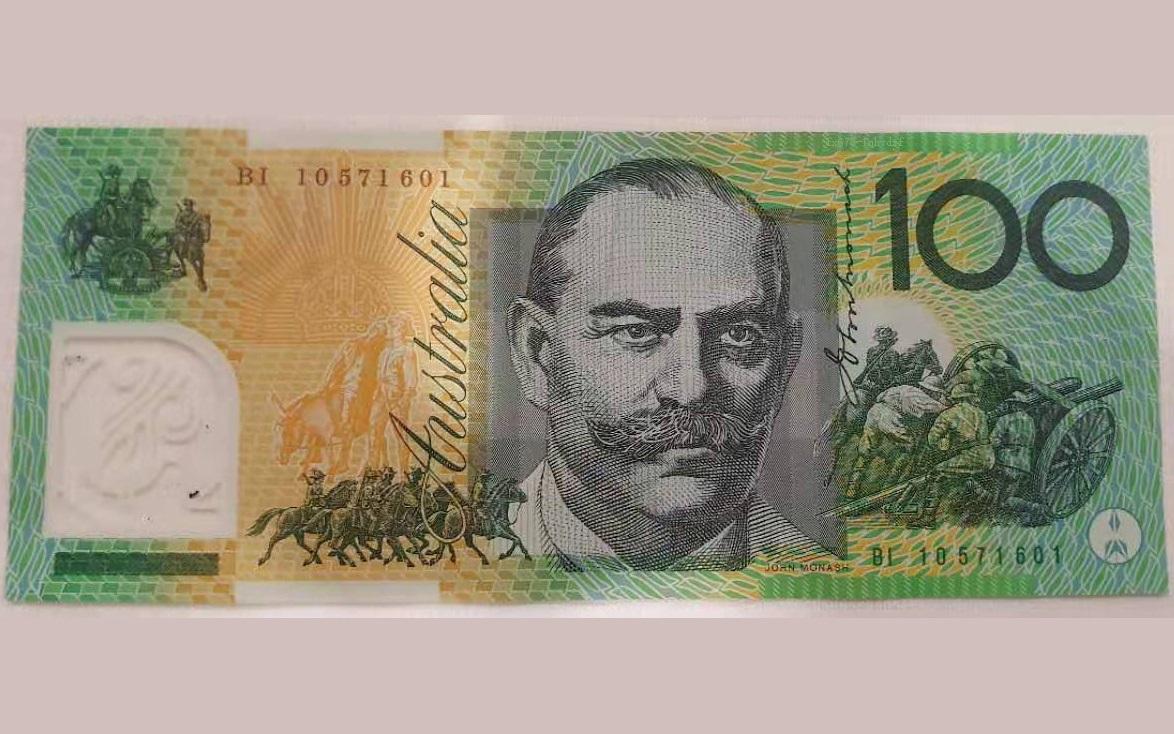
The Reserve Bank of Australia said in its policy statement that the decision to keep interest rates unchanged was unanimously approved.
The statement noted that the latest data shows that both overall and underlying inflation remain excessively high, and inflation is likely to remain high for an extended period. The Committee will continue to closely monitor data developments and continuously assess the economic outlook and risks to guide future policy decisions. While short-term inflation expectations have declined somewhat, they remain above levels seen at the beginning of the year.
The committee emphasized that it will take all necessary measures to achieve its inflation target and will not rule out further increases in the cash rate if necessary.
At the press conference, Block made several key statements regarding the interest rate outlook and the economic situation:
Regarding inflation, she emphasized that inflation remains too high, with significant monthly fluctuations, and more data is needed to determine the trend. Current oil price movements are largely in line with baseline forecasts, and the news of the Middle East peace agreement is welcome; however, the global oil supply issue still requires time to resolve, and energy prices and inflation continue to face upward pressure.
She made it clear that she did not rule out the possibility of further tightening of policies, but for this meeting, the option of raising interest rates was not included in the discussion.
Regarding the economic outlook, Block stated that further slowing demand is needed for inflation to fall, and only low and stable inflation can support trend-driven economic growth. She anticipates the economy will not contract this quarter, and the labor market will remain slightly tight, with an unemployment rate of 4.5% indicating a robust employment situation.
When asked whether the cooling of the real estate market would help policy regulation, Block said it was too early to judge whether this trend could substantially affect the policy path.
She noted that financial conditions have tightened after three rate hikes this year, and while the Committee remains concerned about inflation, the situation has improved. She reiterated that upside risks to inflation remain, and the Committee remains vigilant about this.
Overall, the Reserve Bank of Australia (RBA) has chosen to pause its observation period after three consecutive rate hikes to assess the lagged effects of previous tightening policies on the economy and inflation. However, Bullock's remarks sent a clear signal: inflation remains above target, the labor market remains tight, and further rate hikes cannot be ruled out. In the short term, the Australian dollar's exchange rate will be influenced by multiple factors, including domestic inflation data, global energy prices, and progress on the US-Iran agreement.
According to the daily chart of the Australian dollar against the US dollar, the exchange rate previously rose to a high of 0.7277 before fluctuating and falling back. Recently, it found support at a low of 0.6978. The current price has fallen below the short-term moving averages of MA20 and MA50, indicating that the medium-term upward trend has slowed down and short-term bearish forces are in control.
In terms of indicators, the MACD lines are in a death cross below the zero axis, continuously outputting a small amount of green bars, indicating that the bearish momentum continues slightly; the RSI value is 43.34, which is in the weak zone below the 50 midline, but has not entered the oversold zone of 30, indicating that there is still room for further decline.
From a technical perspective, 0.6978 is a key short-term support level, while the first resistance level is the 20-day moving average (MA20) at 0.7109, and the previous high of 0.7277 forms a strong medium-term resistance. The slight rebound following this decline is merely a technical correction after overselling and has not reversed the short-term downward trend.
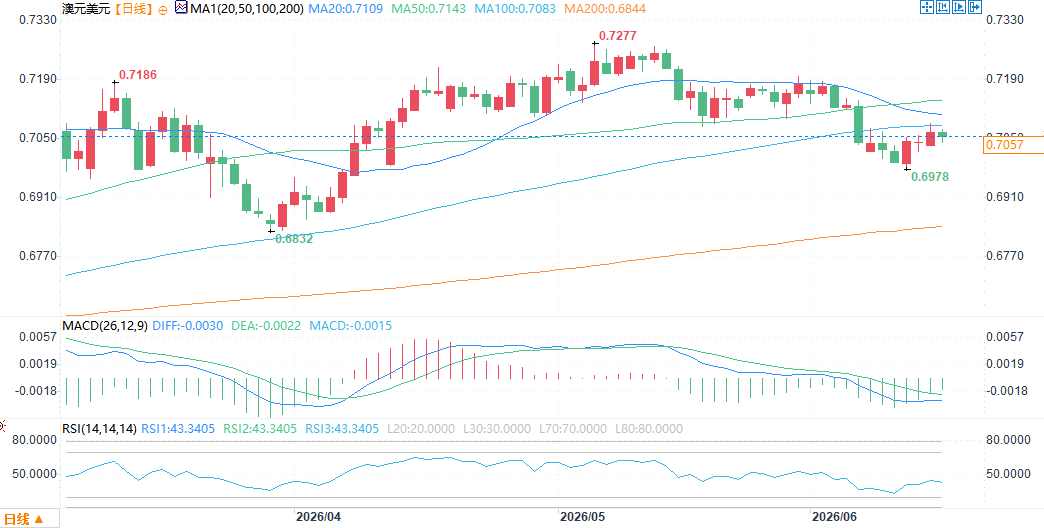
(AUD/USD daily chart, source: FX678)
At 15:15 Beijing time on June 16, the Australian dollar was trading at 0.7055/56 against the US dollar.
The Reserve Bank of Australia (RBA) announced on Tuesday that it would keep the official cash rate unchanged at 4.35% following its June monetary policy meeting. This decision was in line with market expectations and marks the first pause in the RBA's three consecutive 25-basis-point rate hikes earlier this year.
Following the meeting, Governor Michel Block attended a press conference and answered questions from the media regarding the interest rate outlook and the economic situation.
Interest Rate Decision: Unanimously voted to keep rates unchanged; inflation remains the focus.
The Reserve Bank of Australia said in its policy statement that the decision to keep interest rates unchanged was unanimously approved.
The statement noted that the latest data shows that both overall and underlying inflation remain excessively high, and inflation is likely to remain high for an extended period. The Committee will continue to closely monitor data developments and continuously assess the economic outlook and risks to guide future policy decisions. While short-term inflation expectations have declined somewhat, they remain above levels seen at the beginning of the year.
The committee emphasized that it will take all necessary measures to achieve its inflation target and will not rule out further increases in the cash rate if necessary.
Block's remarks: Interest rate hikes not ruled out; labor market remains tight.
At the press conference, Block made several key statements regarding the interest rate outlook and the economic situation:
Regarding inflation, she emphasized that inflation remains too high, with significant monthly fluctuations, and more data is needed to determine the trend. Current oil price movements are largely in line with baseline forecasts, and the news of the Middle East peace agreement is welcome; however, the global oil supply issue still requires time to resolve, and energy prices and inflation continue to face upward pressure.
She made it clear that she did not rule out the possibility of further tightening of policies, but for this meeting, the option of raising interest rates was not included in the discussion.
Regarding the economic outlook, Block stated that further slowing demand is needed for inflation to fall, and only low and stable inflation can support trend-driven economic growth. She anticipates the economy will not contract this quarter, and the labor market will remain slightly tight, with an unemployment rate of 4.5% indicating a robust employment situation.
Balancing the real estate market and policies: It's too early to say whether cooling down will alleviate the pressure.
When asked whether the cooling of the real estate market would help policy regulation, Block said it was too early to judge whether this trend could substantially affect the policy path.
She noted that financial conditions have tightened after three rate hikes this year, and while the Committee remains concerned about inflation, the situation has improved. She reiterated that upside risks to inflation remain, and the Committee remains vigilant about this.
The Reserve Bank of Australia has entered a wait-and-see mode, but the tightening trend has not subsided.
Overall, the Reserve Bank of Australia (RBA) has chosen to pause its observation period after three consecutive rate hikes to assess the lagged effects of previous tightening policies on the economy and inflation. However, Bullock's remarks sent a clear signal: inflation remains above target, the labor market remains tight, and further rate hikes cannot be ruled out. In the short term, the Australian dollar's exchange rate will be influenced by multiple factors, including domestic inflation data, global energy prices, and progress on the US-Iran agreement.
Technical Analysis
According to the daily chart of the Australian dollar against the US dollar, the exchange rate previously rose to a high of 0.7277 before fluctuating and falling back. Recently, it found support at a low of 0.6978. The current price has fallen below the short-term moving averages of MA20 and MA50, indicating that the medium-term upward trend has slowed down and short-term bearish forces are in control.
In terms of indicators, the MACD lines are in a death cross below the zero axis, continuously outputting a small amount of green bars, indicating that the bearish momentum continues slightly; the RSI value is 43.34, which is in the weak zone below the 50 midline, but has not entered the oversold zone of 30, indicating that there is still room for further decline.
From a technical perspective, 0.6978 is a key short-term support level, while the first resistance level is the 20-day moving average (MA20) at 0.7109, and the previous high of 0.7277 forms a strong medium-term resistance. The slight rebound following this decline is merely a technical correction after overselling and has not reversed the short-term downward trend.
(AUD/USD daily chart, source: FX678)
At 15:15 Beijing time on June 16, the Australian dollar was trading at 0.7055/56 against the US dollar.
- Risk Warning and Disclaimer
- The market involves risk, and trading may not be suitable for all investors. This article is for reference only and does not constitute personal investment advice, nor does it take into account certain users’ specific investment objectives, financial situation, or other needs. Any investment decisions made based on this information are at your own risk.