Why did gold prices rise even though the war is "over"?
2026-06-16 19:11:59
The peace agreement reached between the US and Iran should have put downward pressure on gold as a safe-haven asset, as easing geopolitical tensions typically suppress gold prices. However, the opposite has occurred, with gold prices climbing for the third consecutive day to $4,319, a new high since June 9th. This unusual performance is not due to the failure of traditional safe-haven logic, but rather the result of multiple new market forces, including a weakening dollar, lower oil prices easing inflation concerns, and institutional fund inflows. The upcoming Federal Reserve interest rate decision will ultimately determine whether this gold price rebound can be sustained.

The US and Iran have formally reached a peace agreement, and the Strait of Hormuz is about to reopen. According to conventional financial market logic, news of easing geopolitical tensions and a stabilizing situation should directly reduce market demand for safe-haven assets, pushing gold prices down. However, this market trend has completely defied convention, with gold prices suddenly surging several hundred points around June 15th, exhibiting a strong upward trend. This has left many investors puzzled: why has gold price risen instead of falling despite the receding geopolitical risks?
The peace agreement became a new catalyst for rising gold prices.
The fact that most investors were surprised by this gold price movement precisely demonstrates their keen market insight. The core of this gold price surge stems from a counterintuitive, contrarian market logic. In traditional trading, when war breaks out or geopolitical tensions escalate, market risk aversion rises, and gold, leveraging its safe-haven properties, experiences a significant price increase—this is the most classic pricing logic for gold.
However, this market trend completely reversed. The US-Iran peace agreement and the easing of geopolitical risks not only failed to suppress gold prices but instead became the core trigger for this round of strong gold price increases. This was not an abnormal market fluctuation, but rather the result of a complete chain reaction of macroeconomic events. The surface news of geopolitical peace, transmitted through layers of market variables, ultimately formed a fundamental support that was favorable for gold.
The chain reaction of changes in oil prices, inflation, and the Federal Reserve's expectations
1. Falling oil prices have completely alleviated market inflation concerns.
The US-Iran peace agreement has completely eliminated the risk of disruptions to Middle Eastern oil supplies, leading to a significant drop in international oil prices. As a key indicator of global inflation, the decline in energy prices has directly alleviated market concerns about imported inflation.
Prior to this, tensions in the Middle East had driven up energy prices, directly exacerbating inflationary pressures in the United States and creating market expectations of persistent high inflation. This forced the Federal Reserve to maintain its tight monetary policy, which was a core factor that had long suppressed gold prices. However, the oil price decline brought about by the peace agreement completely reversed this fundamental situation.
2. Interest rate hike expectations have cooled, and market policy predictions have been significantly adjusted.
In the past period, affected by the continuous rise in energy prices and the increase in inflationary pressure, the market generally expected that the new chairman of the Federal Reserve, Kevin Warsh, would release a tough monetary policy signal at this week's interest rate meeting. The probability of a rate hike in December once approached 70% according to market statistics, and the expectation of tightening continued to rise.
However, with the sharp decline in oil prices, energy-driven inflationary pressures quickly subsided, and market expectations for US inflation completely reversed, leading to a rapid adjustment in monetary policy expectations. Currently, the market's probability of a Fed rate hike this year has dropped significantly from nearly 70% to below 40%, while expectations for rate cuts are rising simultaneously, gradually easing the tightening policy expectations that have been suppressing gold prices.
3. A weaker dollar eases valuation pressure on gold assets.
The cooling of expectations for a Federal Reserve rate hike directly led to a decline in both the US dollar index and US Treasury yields. As a non-interest-bearing asset, gold faces significant holding cost pressures in a high-interest-rate, strong-dollar environment, which is the core reason for the continued slump in gold prices over the past two to three months.
The recent weakening of the US dollar and the decline in US Treasury yields have completely removed the long-term suppression of gold by high interest rates. At the same time, it has significantly reduced the cost of holding gold for non-US investors worldwide, leading to a rapid rebound in market demand for gold and providing solid fundamental support for the rise in gold prices.
Short covering amplifies gold price increases
Besides multiple positive factors in the macroeconomic fundamentals, the recent surge in gold prices was also driven by technical factors, with short covering further amplifying the upward trend. Looking back at previous price action, over the past two to three months, gold has fallen steadily from its high of nearly $5,600 at the beginning of the year, a cumulative drop of about 20%, reaching a low of around $4,100.
During the period of continuous decline in gold prices, a large number of hedge funds concentrated on establishing short positions at low levels, betting that gold prices would continue to decline. However, the recent rebound and continuous rise in gold prices directly triggered the stop-loss points of short-selling funds, forcing a large number of short sellers to buy back and close their positions. This resulted in a massive influx of new buying orders in the market, further pushing gold prices higher and creating a dual upward momentum driven by both "fundamental positive factors" and "technical and capital-driven factors."
The core essence of this round of gold price increases
In summary, this gold price surge is not based on the traditional geopolitical safe-haven logic, but rather on a corrective rebound in the market's reaction to the Federal Reserve's high-interest-rate policy. News of geopolitical peace unexpectedly removed the core reason for the Fed to continue raising rates, indirectly easing the valuation pressure on gold assets caused by high interest rates.
The complete market transmission logic is clear and progressive: the US-Iran peace agreement was reached → the risk of oil supply was eliminated and oil prices fell → market inflation expectations cooled → the probability of the Fed raising interest rates decreased significantly and the expectation of interest rate cuts increased → the US dollar and US Treasury yields fell → the pressure on gold was relieved and prices rebounded. This multi-step transmission ultimately led to this counterintuitive market trend.
Key Tests Ahead: Fed Decision and Key Technical Levels
This Wednesday, the Federal Reserve, under the chairmanship of new Chairman Kevin Warsh, will announce its latest interest rate decision, a crucial juncture in determining whether the current gold price rebound can continue. If the meeting signals the possibility of a rate cut this year, the upward logic for gold will be further strengthened, and gold prices are expected to continue their upward trend. However, if the Fed remains vigilant about inflation risks and releases hawkish signals, the current gold price rebound is likely to halt, and prices may fall rapidly. Therefore, the policy wording of the meeting and the guidance on the future path of monetary policy are the key focus for investors in the short term.
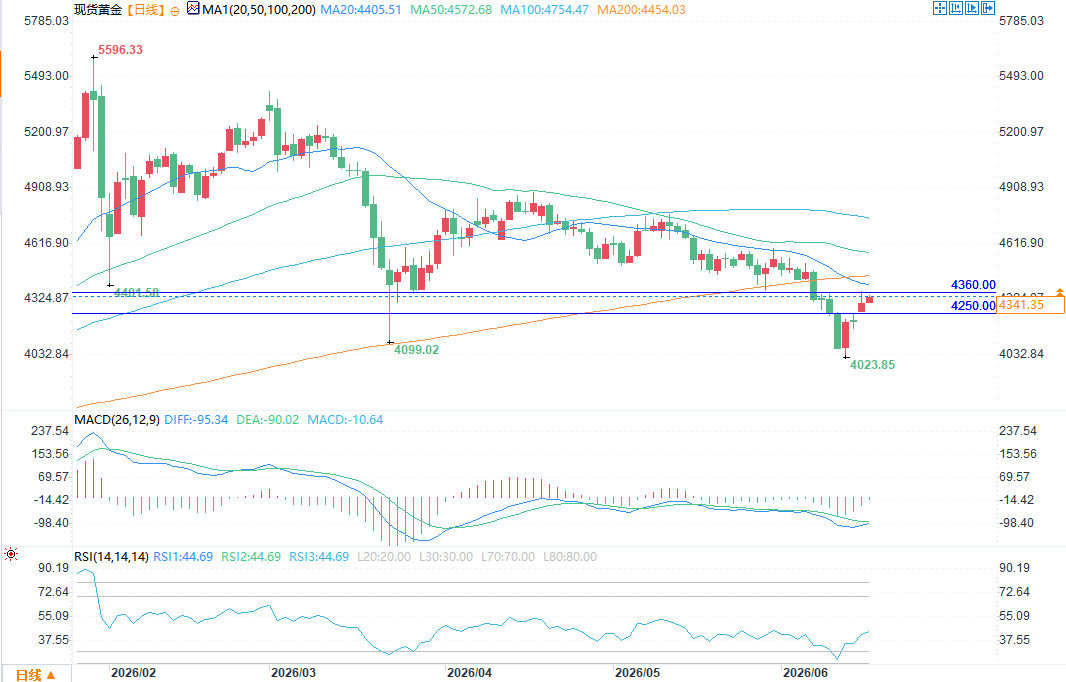
(Spot gold daily chart source: FX678)
From a technical perspective, gold prices are facing clear key resistance levels in the short term. The core resistance level is currently at $4360, with further resistance at $4420 after a break above this level. The core support level is at $4250, with deeper support at $4180. A break above this resistance zone would open up upward potential; conversely, a break below the support zone could signal the end of this rebound. The outcome of these key level breakouts will directly indicate the short-term trend.
Potential market risks
While the current gold price rebound has a clear macroeconomic and technical driving logic, multiple uncertainties remain in the market, and risk factors cannot be ignored. On the one hand, the actual implementation of the US-Iran peace agreement may fall short of expectations, and the speed of the recovery of Middle Eastern oil supply is uncertain, which may lead to repeated fluctuations in oil prices and disrupt inflation expectations. On the other hand, if the Federal Reserve meeting releases an unexpectedly hawkish signal, and monetary policy is expected to tighten again, gold prices may quickly give back the gains of this round.
Historical trends show that the recent months of volatile decline in gold prices clearly demonstrate the market's high sensitivity to changes in Federal Reserve policy expectations. Investors should avoid blindly chasing short-term gains and instead dynamically adjust their trading strategies based on macroeconomic data, policy developments, and geopolitical events. Strictly controlling position size and setting reasonable stop-loss and take-profit levels are crucial for coping with sudden market fluctuations and mitigating trading risks.
Overall, the recent rise in gold prices driven by geopolitical easing clearly demonstrates the contrarian logic of financial markets. The peace agreement led to lower oil prices, cooling inflation, and diminished expectations of interest rate hikes, coupled with short covering, all contributing to the gold price rebound. The upcoming Federal Reserve interest rate decision will be a key watershed moment for short-term market movements.
The US and Iran have formally reached a peace agreement, and the Strait of Hormuz is about to reopen. According to conventional financial market logic, news of easing geopolitical tensions and a stabilizing situation should directly reduce market demand for safe-haven assets, pushing gold prices down. However, this market trend has completely defied convention, with gold prices suddenly surging several hundred points around June 15th, exhibiting a strong upward trend. This has left many investors puzzled: why has gold price risen instead of falling despite the receding geopolitical risks?
The peace agreement became a new catalyst for rising gold prices.
The fact that most investors were surprised by this gold price movement precisely demonstrates their keen market insight. The core of this gold price surge stems from a counterintuitive, contrarian market logic. In traditional trading, when war breaks out or geopolitical tensions escalate, market risk aversion rises, and gold, leveraging its safe-haven properties, experiences a significant price increase—this is the most classic pricing logic for gold.
However, this market trend completely reversed. The US-Iran peace agreement and the easing of geopolitical risks not only failed to suppress gold prices but instead became the core trigger for this round of strong gold price increases. This was not an abnormal market fluctuation, but rather the result of a complete chain reaction of macroeconomic events. The surface news of geopolitical peace, transmitted through layers of market variables, ultimately formed a fundamental support that was favorable for gold.
The chain reaction of changes in oil prices, inflation, and the Federal Reserve's expectations
1. Falling oil prices have completely alleviated market inflation concerns.
The US-Iran peace agreement has completely eliminated the risk of disruptions to Middle Eastern oil supplies, leading to a significant drop in international oil prices. As a key indicator of global inflation, the decline in energy prices has directly alleviated market concerns about imported inflation.
Prior to this, tensions in the Middle East had driven up energy prices, directly exacerbating inflationary pressures in the United States and creating market expectations of persistent high inflation. This forced the Federal Reserve to maintain its tight monetary policy, which was a core factor that had long suppressed gold prices. However, the oil price decline brought about by the peace agreement completely reversed this fundamental situation.
2. Interest rate hike expectations have cooled, and market policy predictions have been significantly adjusted.
In the past period, affected by the continuous rise in energy prices and the increase in inflationary pressure, the market generally expected that the new chairman of the Federal Reserve, Kevin Warsh, would release a tough monetary policy signal at this week's interest rate meeting. The probability of a rate hike in December once approached 70% according to market statistics, and the expectation of tightening continued to rise.
However, with the sharp decline in oil prices, energy-driven inflationary pressures quickly subsided, and market expectations for US inflation completely reversed, leading to a rapid adjustment in monetary policy expectations. Currently, the market's probability of a Fed rate hike this year has dropped significantly from nearly 70% to below 40%, while expectations for rate cuts are rising simultaneously, gradually easing the tightening policy expectations that have been suppressing gold prices.
3. A weaker dollar eases valuation pressure on gold assets.
The cooling of expectations for a Federal Reserve rate hike directly led to a decline in both the US dollar index and US Treasury yields. As a non-interest-bearing asset, gold faces significant holding cost pressures in a high-interest-rate, strong-dollar environment, which is the core reason for the continued slump in gold prices over the past two to three months.
The recent weakening of the US dollar and the decline in US Treasury yields have completely removed the long-term suppression of gold by high interest rates. At the same time, it has significantly reduced the cost of holding gold for non-US investors worldwide, leading to a rapid rebound in market demand for gold and providing solid fundamental support for the rise in gold prices.
Short covering amplifies gold price increases
Besides multiple positive factors in the macroeconomic fundamentals, the recent surge in gold prices was also driven by technical factors, with short covering further amplifying the upward trend. Looking back at previous price action, over the past two to three months, gold has fallen steadily from its high of nearly $5,600 at the beginning of the year, a cumulative drop of about 20%, reaching a low of around $4,100.
During the period of continuous decline in gold prices, a large number of hedge funds concentrated on establishing short positions at low levels, betting that gold prices would continue to decline. However, the recent rebound and continuous rise in gold prices directly triggered the stop-loss points of short-selling funds, forcing a large number of short sellers to buy back and close their positions. This resulted in a massive influx of new buying orders in the market, further pushing gold prices higher and creating a dual upward momentum driven by both "fundamental positive factors" and "technical and capital-driven factors."
The core essence of this round of gold price increases
In summary, this gold price surge is not based on the traditional geopolitical safe-haven logic, but rather on a corrective rebound in the market's reaction to the Federal Reserve's high-interest-rate policy. News of geopolitical peace unexpectedly removed the core reason for the Fed to continue raising rates, indirectly easing the valuation pressure on gold assets caused by high interest rates.
The complete market transmission logic is clear and progressive: the US-Iran peace agreement was reached → the risk of oil supply was eliminated and oil prices fell → market inflation expectations cooled → the probability of the Fed raising interest rates decreased significantly and the expectation of interest rate cuts increased → the US dollar and US Treasury yields fell → the pressure on gold was relieved and prices rebounded. This multi-step transmission ultimately led to this counterintuitive market trend.
Key Tests Ahead: Fed Decision and Key Technical Levels
This Wednesday, the Federal Reserve, under the chairmanship of new Chairman Kevin Warsh, will announce its latest interest rate decision, a crucial juncture in determining whether the current gold price rebound can continue. If the meeting signals the possibility of a rate cut this year, the upward logic for gold will be further strengthened, and gold prices are expected to continue their upward trend. However, if the Fed remains vigilant about inflation risks and releases hawkish signals, the current gold price rebound is likely to halt, and prices may fall rapidly. Therefore, the policy wording of the meeting and the guidance on the future path of monetary policy are the key focus for investors in the short term.
(Spot gold daily chart source: FX678)
From a technical perspective, gold prices are facing clear key resistance levels in the short term. The core resistance level is currently at $4360, with further resistance at $4420 after a break above this level. The core support level is at $4250, with deeper support at $4180. A break above this resistance zone would open up upward potential; conversely, a break below the support zone could signal the end of this rebound. The outcome of these key level breakouts will directly indicate the short-term trend.
Potential market risks
While the current gold price rebound has a clear macroeconomic and technical driving logic, multiple uncertainties remain in the market, and risk factors cannot be ignored. On the one hand, the actual implementation of the US-Iran peace agreement may fall short of expectations, and the speed of the recovery of Middle Eastern oil supply is uncertain, which may lead to repeated fluctuations in oil prices and disrupt inflation expectations. On the other hand, if the Federal Reserve meeting releases an unexpectedly hawkish signal, and monetary policy is expected to tighten again, gold prices may quickly give back the gains of this round.
Historical trends show that the recent months of volatile decline in gold prices clearly demonstrate the market's high sensitivity to changes in Federal Reserve policy expectations. Investors should avoid blindly chasing short-term gains and instead dynamically adjust their trading strategies based on macroeconomic data, policy developments, and geopolitical events. Strictly controlling position size and setting reasonable stop-loss and take-profit levels are crucial for coping with sudden market fluctuations and mitigating trading risks.
Overall, the recent rise in gold prices driven by geopolitical easing clearly demonstrates the contrarian logic of financial markets. The peace agreement led to lower oil prices, cooling inflation, and diminished expectations of interest rate hikes, coupled with short covering, all contributing to the gold price rebound. The upcoming Federal Reserve interest rate decision will be a key watershed moment for short-term market movements.
- Risk Warning and Disclaimer
- The market involves risk, and trading may not be suitable for all investors. This article is for reference only and does not constitute personal investment advice, nor does it take into account certain users’ specific investment objectives, financial situation, or other needs. Any investment decisions made based on this information are at your own risk.