Warsh wants more flexible policy, but the bond market may first raise the risk premium.
2026-06-16 20:00:11
On Tuesday, June 16, the core variable in the global interest rate market shifted back to the Federal Reserve's communication framework itself. New Chairman Kevin Warsh will chair his first policy meeting since taking office (June 18, 2:00 AM). The market widely expects the policy rate to remain unchanged in the 3.50%-3.75% range. However, what truly influences US Treasury pricing is not a single interest rate decision, but rather whether the summary of economic projections, the post-meeting statement, and the press conference will enter a "slimming-down cycle."

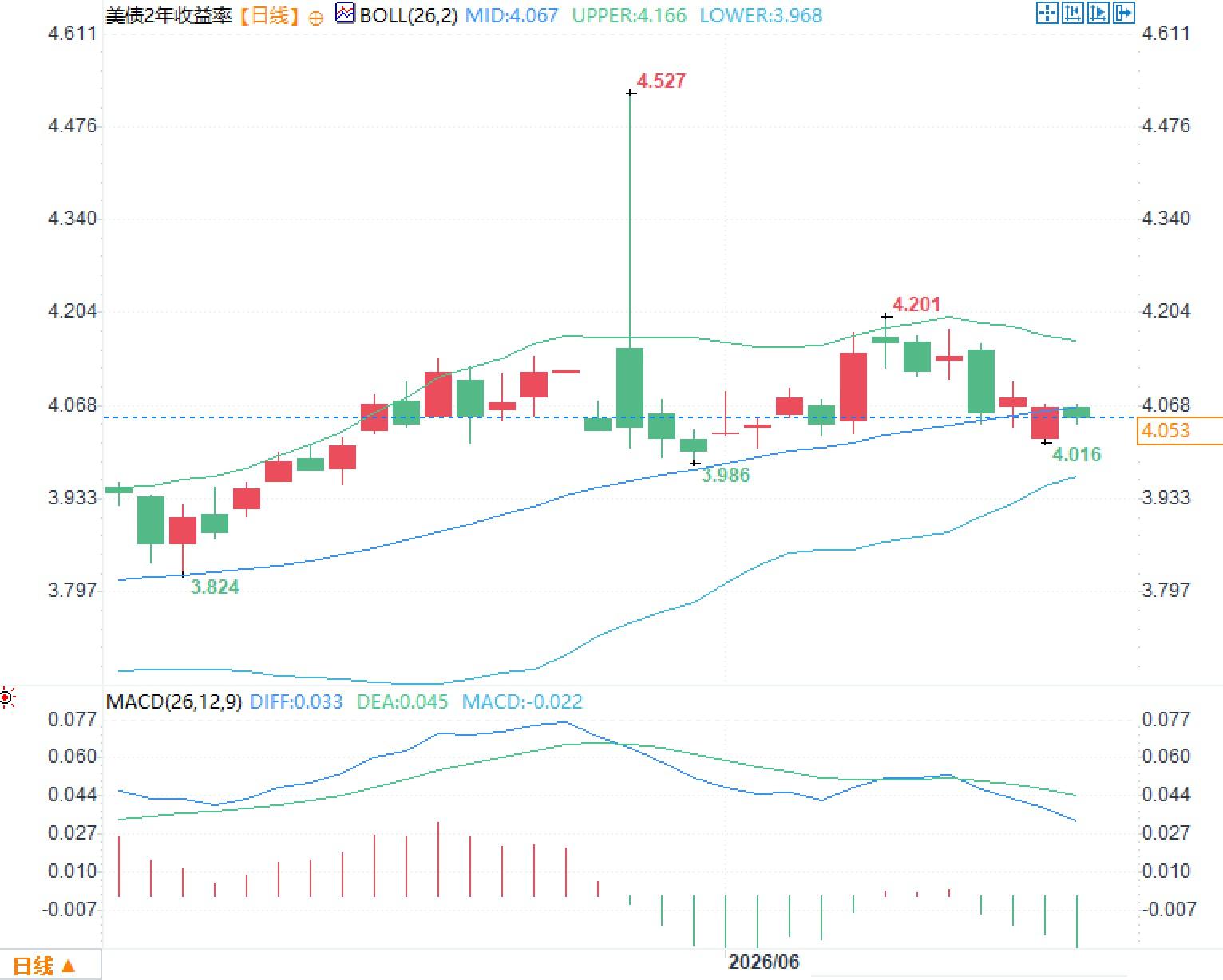
Currently, the yield on two-year US Treasury bonds is around 4.05%, and the yield on ten-year US Treasury bonds is around 4.44%-4.48%, with the yield curve maintaining a positive slope. The US dollar index is hovering around 99.55. The US Consumer Price Index rose 0.5% month-on-month in May, the unemployment rate was 4.3%, and non-farm payrolls increased by 172,000. This combination of data suggests that both sticky inflation and a slowing labor force exist, and the bond market remains highly sensitive to policy signals.
Over the past two decades, the Federal Reserve has gradually shifted its monetary policy from "outcome management" to "expectation management." Quarterly economic projections summaries, the dot plot, press conferences, and frequent speeches by officials collectively form the forward anchor of the yield curve. Warsh's policy preferences are clearly different. He recently criticized the Fed for providing too much policy roadmap and said policymakers are "speaking quite frequently." This suggests that the new framework may weaken explicit guidance on the future path of interest rates, instead preserving greater room for choice.
If the dot plot is removed or toned down, forward rate contracts will lose a highly modeled anchor. If the post-meeting statement is shorter, the market will be forced to glean more information from subtle wording adjustments, voting member disagreements, and the tone of the press conference. On the surface, policy flexibility increases; in actual trading, duration assets will need to reprice uncertainty, especially in the two- to five-year range.
The current US Treasury market doesn't lack directional narratives; what it lacks is visibility into the policy response function. The two-year yield remains above the policy rate ceiling, indicating the market hasn't completely ruled out the possibility of maintaining high interest rates for an extended period or even a return to tightening. The ten-year yield's above 4.4% reflects that inflation risk premiums, fiscal supply pressures, and term premiums have not been fully compressed. If Warsh weakens forward guidance, the first reaction is likely not a unilateral interest rate revaluation, but rather a renewed rise in the term structure and implied volatility of options.
Former FOMC Secretary William English recently cautioned that withdrawing communication must be done cautiously; too rapid a contraction could weaken policy effectiveness and lead to more unexpected decisions, triggering financial market volatility. This assessment hits the nail on the head. Transparency is not about making markets comfortable, but about making policy transmission more controllable. If the market cannot judge the Fed's changes in the weighting of inflation, employment, and financial conditions, the yield curve will tend to compensate for the information gap with a higher risk premium.
The 0.5% month-on-month inflation reading in May indicates that price pressures have not disappeared, especially given the potential for energy and service price fluctuations to spread, making it difficult for the Federal Reserve to stabilize the market with an aggressive easing narrative. However, the 4.3% unemployment rate and the 172,000 new non-farm payroll jobs also suggest that the labor market is no longer in a clearly overheated phase. The policy framework has thus entered a more difficult trading range: inflation does not allow for premature pronouncements of interest rate cuts, while employment does not support an unconditional strengthening of the tightening stance.
This is precisely the practical basis for Warsh's emphasis on maintaining flexibility. The problem is that there's a fine line between flexibility and ambiguity. If he only emphasizes "reliance on data" in a press conference without explaining what combination of data will change policy stance, the market will interpret this as a lack of transparency in the reaction function. Short-term interest rates will become more dependent on data-driven fluctuations, medium-term interest rates will be more sensitive to economic forecast gaps, and long-term interest rates will continue to be affected by the interplay of term premiums and supply pressures.
The problem with the dot plot is that it's not a commitment, yet it's often treated as one by the market. If Warsh pushes for simplification, it might reduce the risk of the Fed being held hostage by a single path in the short term, but it would also increase the market's reliance on probability distributions. In other words, the trading framework would shift from judging "where interest rates will go next" to judging "how wide the tail risk of the policy outcome is."
Currently, the yield on two-year US Treasury bonds is around 4.05%, and the yield on ten-year US Treasury bonds is around 4.44%-4.48%, with the yield curve maintaining a positive slope. The US dollar index is hovering around 99.55. The US Consumer Price Index rose 0.5% month-on-month in May, the unemployment rate was 4.3%, and non-farm payrolls increased by 172,000. This combination of data suggests that both sticky inflation and a slowing labor force exist, and the bond market remains highly sensitive to policy signals.
Over the past two decades, the Federal Reserve has gradually shifted its monetary policy from "outcome management" to "expectation management." Quarterly economic projections summaries, the dot plot, press conferences, and frequent speeches by officials collectively form the forward anchor of the yield curve. Warsh's policy preferences are clearly different. He recently criticized the Fed for providing too much policy roadmap and said policymakers are "speaking quite frequently." This suggests that the new framework may weaken explicit guidance on the future path of interest rates, instead preserving greater room for choice.
If the dot plot is removed or toned down, forward rate contracts will lose a highly modeled anchor. If the post-meeting statement is shorter, the market will be forced to glean more information from subtle wording adjustments, voting member disagreements, and the tone of the press conference. On the surface, policy flexibility increases; in actual trading, duration assets will need to reprice uncertainty, especially in the two- to five-year range.
The current US Treasury market doesn't lack directional narratives; what it lacks is visibility into the policy response function. The two-year yield remains above the policy rate ceiling, indicating the market hasn't completely ruled out the possibility of maintaining high interest rates for an extended period or even a return to tightening. The ten-year yield's above 4.4% reflects that inflation risk premiums, fiscal supply pressures, and term premiums have not been fully compressed. If Warsh weakens forward guidance, the first reaction is likely not a unilateral interest rate revaluation, but rather a renewed rise in the term structure and implied volatility of options.
Former FOMC Secretary William English recently cautioned that withdrawing communication must be done cautiously; too rapid a contraction could weaken policy effectiveness and lead to more unexpected decisions, triggering financial market volatility. This assessment hits the nail on the head. Transparency is not about making markets comfortable, but about making policy transmission more controllable. If the market cannot judge the Fed's changes in the weighting of inflation, employment, and financial conditions, the yield curve will tend to compensate for the information gap with a higher risk premium.
The 0.5% month-on-month inflation reading in May indicates that price pressures have not disappeared, especially given the potential for energy and service price fluctuations to spread, making it difficult for the Federal Reserve to stabilize the market with an aggressive easing narrative. However, the 4.3% unemployment rate and the 172,000 new non-farm payroll jobs also suggest that the labor market is no longer in a clearly overheated phase. The policy framework has thus entered a more difficult trading range: inflation does not allow for premature pronouncements of interest rate cuts, while employment does not support an unconditional strengthening of the tightening stance.
This is precisely the practical basis for Warsh's emphasis on maintaining flexibility. The problem is that there's a fine line between flexibility and ambiguity. If he only emphasizes "reliance on data" in a press conference without explaining what combination of data will change policy stance, the market will interpret this as a lack of transparency in the reaction function. Short-term interest rates will become more dependent on data-driven fluctuations, medium-term interest rates will be more sensitive to economic forecast gaps, and long-term interest rates will continue to be affected by the interplay of term premiums and supply pressures.
The problem with the dot plot is that it's not a commitment, yet it's often treated as one by the market. If Warsh pushes for simplification, it might reduce the risk of the Fed being held hostage by a single path in the short term, but it would also increase the market's reliance on probability distributions. In other words, the trading framework would shift from judging "where interest rates will go next" to judging "how wide the tail risk of the policy outcome is."
- Risk Warning and Disclaimer
- The market involves risk, and trading may not be suitable for all investors. This article is for reference only and does not constitute personal investment advice, nor does it take into account certain users’ specific investment objectives, financial situation, or other needs. Any investment decisions made based on this information are at your own risk.