Gold Trading Alert: Geopolitical Risks Plunge + Rate Hike Expectations Collapse – Has the Bull Market Resumed? Focus on Warsh's "Debut"
2026-06-17 07:05:24
The global gold market staged another strong rebound. On Tuesday (June 16), spot gold prices rose 0.5%, closing near $4,331.05 per ounce. The August US gold futures contract also rose, settling at $4,354.4. The preliminary peace agreement between the US and Iran not only pushed oil prices down sharply but also directly weakened market bets on a Federal Reserve rate hike this year, putting pressure on the dollar and continuing to provide opportunities for gold prices to rebound.
Over the past two trading days, the most crucial factor supporting the gold market has been the prospect of a preliminary agreement between the United States and Iran to end the Middle East conflict. This agreement, announced by US President Trump, extends the fragile ceasefire of April for another 60 days and, importantly, reopens the Strait of Hormuz—which had been effectively blocked by Iran since the US-Israel attacks in February. The Strait of Hormuz carries approximately one-fifth of global oil and liquefied natural gas trade, and its reopening is of great significance to the energy supply chain.
Details of the agreement are gradually emerging: Trump emphasized that the text explicitly prevents Tehran from acquiring nuclear weapons, and Iran can immediately sell oil after signing, receiving support from banking, transportation, and insurance services, while also attaching strict conditions, including the destruction of enriched materials and non-interference with freedom of navigation in the Strait of Hormuz. Iran views this as an important step towards resuming normal business, and the two sides will formally sign the agreement in Switzerland on Friday, immediately launching the next phase of negotiations focusing on thorny issues such as Iran's nuclear program. Although the conflict between Israel and Hezbollah in Lebanon remains uncertain, and a final comprehensive agreement has not yet been reached, the significant easing of geopolitical tensions in the short term is enough to change the market narrative.
David Meger, head of metals trading at High Ridge Futures, stated that the prospect of this agreement directly led to a chain reaction of lower short-term interest rates, lower energy prices, and a reduced likelihood of a later Fed rate hike. Brent crude futures consequently fell below $80 a barrel, hitting a new low since early March, plunging nearly 5% on Monday and continuing to fall nearly 5% on Tuesday. The decline in oil prices eased inflation concerns. Although analysts cautioned that import prices were still rising (up 1.9% month-on-month in May) and the inflation rate remained well above the Fed's 2% target, the direct downward pressure on energy costs provided strong support for gold. Gold no longer needs to rely solely on safe-haven demand; its anti-inflationary properties also shine brightly against the backdrop of a stabilizing macroeconomic environment.
Market attention is focused on this week's Federal Reserve interest rate decision, the first meeting since new Chairman Kevin Warsh took office. The market widely expects the Fed to keep interest rates unchanged at 3.50%-3.75%, but investors are more concerned about whether the policy statement will remove any mention of an accommodative stance, and Warsh's remarks at the press conference. The CME Group's FedWatch tool shows that the probability of a December rate hike has fallen from about 70% last week to around 60%, with federal funds futures pricing at a similar level of 59%.
Warsh's stance on reforming the Fed's communication methods is the biggest uncertainty. He has publicly criticized the dot plot and forward guidance, arguing that these tools limit decision-making flexibility and could lead the Fed to repeat the past mistake of "inflation is temporary." Most market observers expect that he may not submit his personal figures this time, breaking a roughly 14-year precedent. Experts such as Yale University professor Bill English believe that this could be the first step in Warsh's push for fundamental institutional change, but it could also trigger market speculation about a hawkish shift within the Fed or a communication vacuum.
Institutions such as BNP Paribas point out that even if oil prices fall back to pre-war levels, it will be difficult to completely curb inflationary pressures, and the neutral interest rate may have already moved upward. The break-even yield on 10-year TIPS is currently around 2.299%, suggesting that the market expects average inflation of about 2.3% over the next ten years. The coexistence of a weak housing market (a sharp 15.4% drop in new home starts in May) and rising import prices further highlights the complexity of the Fed's decision-making. Warsh's refusal to provide forward guidance could make this meeting a major test of communication strategy, and any hawkish signals will affect short-term gold price fluctuations.
Echoing the rise in gold prices, the dollar index fell 0.12% to 99.55 on Tuesday. U.S. Treasury yields also declined, with the 10-year yield at 4.424%, down 4.5 basis points; the two-year yield fell to 4.047%. The 20-year Treasury auction results were solid, but the overall bond market reflected investors' adjustments in expectations regarding geopolitical easing and Federal Reserve policy.
Despite lingering concerns about high energy prices and uncertainties surrounding the agreement's future negotiations on the Iranian nuclear issue and regional proxy support, a short-term recovery in risk appetite has significantly weakened the safe-haven appeal of the US dollar. Gold has thus received a dual boost: declining geopolitical risk premiums and lower real interest rate expectations further benefit non-interest-bearing assets.
In summary, this rebound in gold prices is the result of a convergence of fundamental and technical factors. Spot gold has risen for four consecutive trading days, indicating a recovery in bullish sentiment. The short-term optimism brought about by the US-Iran agreement provided a catalyst for gold's rise, but the temporary nature of the agreement (only a 60-day extension), the ongoing conflict between Israel and Hezbollah, and the difficulty of the next phase of nuclear negotiations all mean that geopolitical risks have not been completely eliminated. Oil prices will need several months to fully recover to normal supply levels, and inflationary pressures will not subside overnight.
The communication changes and policy signals from the new Federal Reserve Chairman will be the dominant variables in market volatility going forward. If Warsh's remarks lean towards caution or data-driven approaches, gold's safe-haven premium is likely to continue; conversely, if he displays a more hawkish stance, it may face downward pressure in the short term. However, in the medium to long term, the global uncertainty environment, geopolitical reshaping, and potential monetary policy flexibility still provide solid support for gold.
Investors should pay close attention to the details of the Federal Reserve's decision on Wednesday and Fed Chairman Warsh's press conference, the progress of the formal signing of the agreement between the US and Iran on Friday, and the dynamics of the oil market.
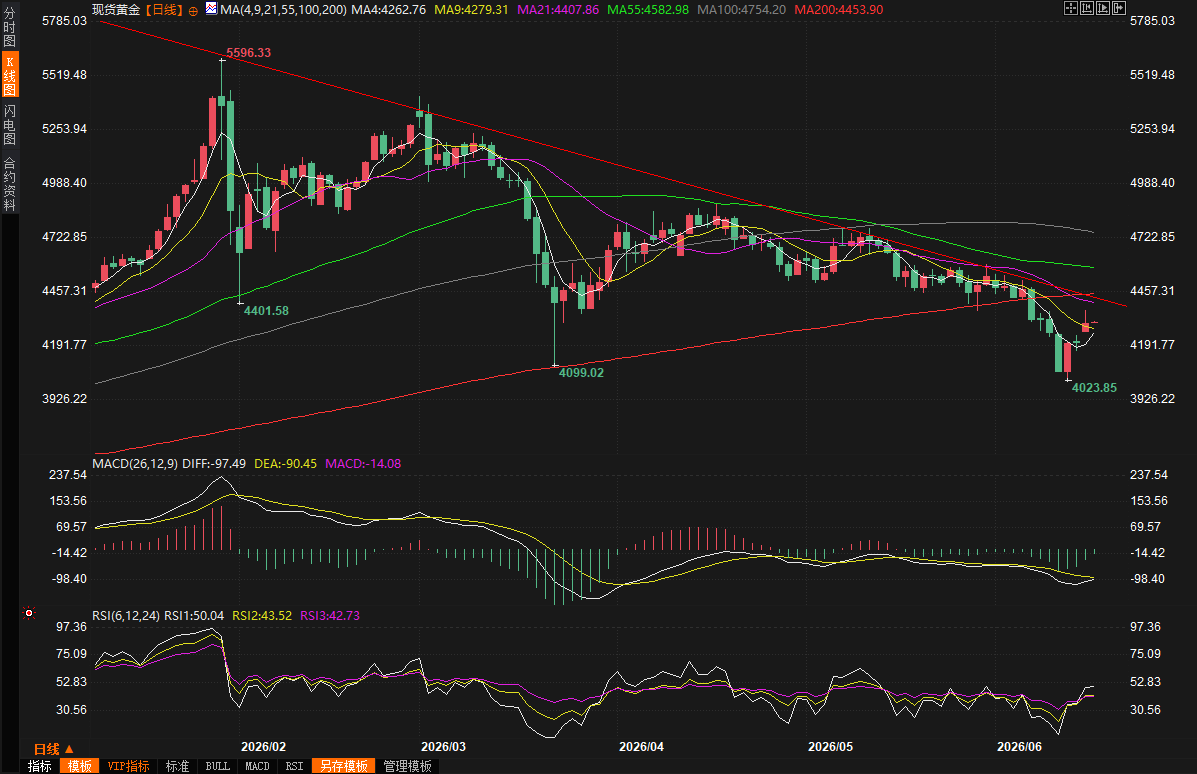
(Spot gold daily chart, source: FX678)
At 7:00 AM Beijing time, spot gold is trading at $4334.88 per ounce.
US-Iran peace agreement: Geopolitical risks plummet, energy prices and inflation expectations both ease.
Over the past two trading days, the most crucial factor supporting the gold market has been the prospect of a preliminary agreement between the United States and Iran to end the Middle East conflict. This agreement, announced by US President Trump, extends the fragile ceasefire of April for another 60 days and, importantly, reopens the Strait of Hormuz—which had been effectively blocked by Iran since the US-Israel attacks in February. The Strait of Hormuz carries approximately one-fifth of global oil and liquefied natural gas trade, and its reopening is of great significance to the energy supply chain.
Details of the agreement are gradually emerging: Trump emphasized that the text explicitly prevents Tehran from acquiring nuclear weapons, and Iran can immediately sell oil after signing, receiving support from banking, transportation, and insurance services, while also attaching strict conditions, including the destruction of enriched materials and non-interference with freedom of navigation in the Strait of Hormuz. Iran views this as an important step towards resuming normal business, and the two sides will formally sign the agreement in Switzerland on Friday, immediately launching the next phase of negotiations focusing on thorny issues such as Iran's nuclear program. Although the conflict between Israel and Hezbollah in Lebanon remains uncertain, and a final comprehensive agreement has not yet been reached, the significant easing of geopolitical tensions in the short term is enough to change the market narrative.
David Meger, head of metals trading at High Ridge Futures, stated that the prospect of this agreement directly led to a chain reaction of lower short-term interest rates, lower energy prices, and a reduced likelihood of a later Fed rate hike. Brent crude futures consequently fell below $80 a barrel, hitting a new low since early March, plunging nearly 5% on Monday and continuing to fall nearly 5% on Tuesday. The decline in oil prices eased inflation concerns. Although analysts cautioned that import prices were still rising (up 1.9% month-on-month in May) and the inflation rate remained well above the Fed's 2% target, the direct downward pressure on energy costs provided strong support for gold. Gold no longer needs to rely solely on safe-haven demand; its anti-inflationary properties also shine brightly against the backdrop of a stabilizing macroeconomic environment.
The Fed's decision is imminent on Wednesday: New Chairman Warsh's debut and the suspense surrounding the "dot plot".
Market attention is focused on this week's Federal Reserve interest rate decision, the first meeting since new Chairman Kevin Warsh took office. The market widely expects the Fed to keep interest rates unchanged at 3.50%-3.75%, but investors are more concerned about whether the policy statement will remove any mention of an accommodative stance, and Warsh's remarks at the press conference. The CME Group's FedWatch tool shows that the probability of a December rate hike has fallen from about 70% last week to around 60%, with federal funds futures pricing at a similar level of 59%.
Warsh's stance on reforming the Fed's communication methods is the biggest uncertainty. He has publicly criticized the dot plot and forward guidance, arguing that these tools limit decision-making flexibility and could lead the Fed to repeat the past mistake of "inflation is temporary." Most market observers expect that he may not submit his personal figures this time, breaking a roughly 14-year precedent. Experts such as Yale University professor Bill English believe that this could be the first step in Warsh's push for fundamental institutional change, but it could also trigger market speculation about a hawkish shift within the Fed or a communication vacuum.
Institutions such as BNP Paribas point out that even if oil prices fall back to pre-war levels, it will be difficult to completely curb inflationary pressures, and the neutral interest rate may have already moved upward. The break-even yield on 10-year TIPS is currently around 2.299%, suggesting that the market expects average inflation of about 2.3% over the next ten years. The coexistence of a weak housing market (a sharp 15.4% drop in new home starts in May) and rising import prices further highlights the complexity of the Fed's decision-making. Warsh's refusal to provide forward guidance could make this meeting a major test of communication strategy, and any hawkish signals will affect short-term gold price fluctuations.
A weaker dollar and a pullback in the bond market: Gold bulls benefit from macroeconomic resonance.
Echoing the rise in gold prices, the dollar index fell 0.12% to 99.55 on Tuesday. U.S. Treasury yields also declined, with the 10-year yield at 4.424%, down 4.5 basis points; the two-year yield fell to 4.047%. The 20-year Treasury auction results were solid, but the overall bond market reflected investors' adjustments in expectations regarding geopolitical easing and Federal Reserve policy.
Despite lingering concerns about high energy prices and uncertainties surrounding the agreement's future negotiations on the Iranian nuclear issue and regional proxy support, a short-term recovery in risk appetite has significantly weakened the safe-haven appeal of the US dollar. Gold has thus received a dual boost: declining geopolitical risk premiums and lower real interest rate expectations further benefit non-interest-bearing assets.
Outlook: The bullish logic for gold remains intact, but caution is warranted regarding uncertainties in the implementation of the agreement.
In summary, this rebound in gold prices is the result of a convergence of fundamental and technical factors. Spot gold has risen for four consecutive trading days, indicating a recovery in bullish sentiment. The short-term optimism brought about by the US-Iran agreement provided a catalyst for gold's rise, but the temporary nature of the agreement (only a 60-day extension), the ongoing conflict between Israel and Hezbollah, and the difficulty of the next phase of nuclear negotiations all mean that geopolitical risks have not been completely eliminated. Oil prices will need several months to fully recover to normal supply levels, and inflationary pressures will not subside overnight.
The communication changes and policy signals from the new Federal Reserve Chairman will be the dominant variables in market volatility going forward. If Warsh's remarks lean towards caution or data-driven approaches, gold's safe-haven premium is likely to continue; conversely, if he displays a more hawkish stance, it may face downward pressure in the short term. However, in the medium to long term, the global uncertainty environment, geopolitical reshaping, and potential monetary policy flexibility still provide solid support for gold.
Investors should pay close attention to the details of the Federal Reserve's decision on Wednesday and Fed Chairman Warsh's press conference, the progress of the formal signing of the agreement between the US and Iran on Friday, and the dynamics of the oil market.
(Spot gold daily chart, source: FX678)
At 7:00 AM Beijing time, spot gold is trading at $4334.88 per ounce.
- Risk Warning and Disclaimer
- The market involves risk, and trading may not be suitable for all investors. This article is for reference only and does not constitute personal investment advice, nor does it take into account certain users’ specific investment objectives, financial situation, or other needs. Any investment decisions made based on this information are at your own risk.