Gold is currently experiencing a short-term period of consolidation, but the foundation of its long-term bull market remains unshaken.
2026-06-17 09:33:18
Overall, gold has stabilized its gains after testing the key support level of $4,000 per ounce and is currently consolidating within a range.
Market funds flowed heavily into AI and semiconductor growth stocks, weakening short-term buying of gold. However, industry strategists clearly stated that the core logic supporting the long-term strength of gold prices has not disappeared . Subsequent Fed interest rate signals and the pace of gold purchases by central banks around the world will determine when gold prices will break out of the trading range.
Tom Bruce, macro investment strategist at Tanglewood Wealth Management, said he remains neutral on the short-term outlook for gold, but believes the medium- to long-term trend still has upward potential . He added that the current market environment is the most difficult to predict gold's direction in recent years.
At the beginning of this year, gold prices repeatedly hit record highs, mainly driven by two factors: diversified asset allocation by central banks and a large influx of speculative funds. The continued reduction of dollar-denominated assets and the increase in gold reserves by various countries directly pushed up gold prices; however, the market sentiment subsequently shifted significantly, with funds flowing into high-growth stocks such as artificial intelligence and semiconductors, greatly diminishing the previous drivers of gold's price increases.
Tom Bruce said, "The core forces that drove the gold price surge at the beginning of the year have left the market, and now the main driver of gold price fluctuations has returned to the traditional core indicator of interest rates."
As geopolitical risks gradually ease, gold buying remains weak, and gold prices are becoming increasingly sensitive to expectations of real interest rates. However, the strategist is not bearish on a deep decline, stating that the current market is in a consolidation phase due to portfolio adjustments, not the start of a new round of sharp drops. Gold prices have already digested multiple negative news items and successfully held the key technical support level of $4,000. Only a decisive break below this level would open up further downside potential.
The market's enthusiasm for going long on gold has clearly cooled down, but there has been no concentrated sell-off of precious metal holdings.
Tom Bruce's analysis suggests that most investors adopt a balanced approach, pursuing higher-performing equities while retaining their existing gold positions, rather than completely exiting the market. This portfolio structure limits the downside potential of gold prices, lacking the selling pressure for a one-sided decline, and is a key support level that has allowed gold prices to hold above $4,000. With a lack of new funds entering the market in the short term, gold prices are unlikely to experience a sustained upward trend, and range-bound trading will likely become the norm.
Despite a lackluster short-term market, multiple positive factors supporting gold prices in the medium to long term remain. Demand for safe-haven assets due to continued currency depreciation, expectations of declining real interest rates, and the potential for a renewed acceleration in central bank gold purchases after a period of slowdown all contribute to the foundation for a long-term bull market in gold.
Tom Bruce said, "Central banks' gold purchases have only slowed down temporarily. Once the scale of purchases increases again, gold prices will open up new upside potential. The resumption of large-scale buying by central banks is the most direct driving force for gold prices to return to record highs ."
Many countries around the world continue to reduce their reliance on dollar assets, and the long-term trend of reserving gold will not be reversed in the short term. Once central bank purchasing power rebounds, it will provide strong support for gold prices from the fundamentals.
The Federal Reserve's two-day policy meeting has officially begun, and the market is clearly divided on the direction of interest rate adjustments this year. Current pricing suggests that the probability of a rate hike or maintaining the current rate at the end of the year is roughly equal. Policy expectations directly constrain the short-term trend of gold, and the market has already fully priced in expectations of a tightening stance.
Tom Bruce said, "The probability of the Fed cutting interest rates this year is extremely low. Even if the current interest rate level is maintained throughout the year and no rate-cutting cycle is started, it is still a positive signal for gold."
Before clear interest rate guidance is provided, gold prices will continue to fluctuate within a range, and it will be difficult for them to break out of the trend.
In summary , gold prices are currently consolidating within a wide range, pressured by short-term capital outflows and interest rate uncertainty, with no concentrated selling pressure observed. The core demand for central bank gold purchases to hedge against currency depreciation remains unchanged in the medium to long term. Subsequent statements from the Federal Reserve and the pace of global central bank gold purchases will be key variables in breaking the current volatile pattern.
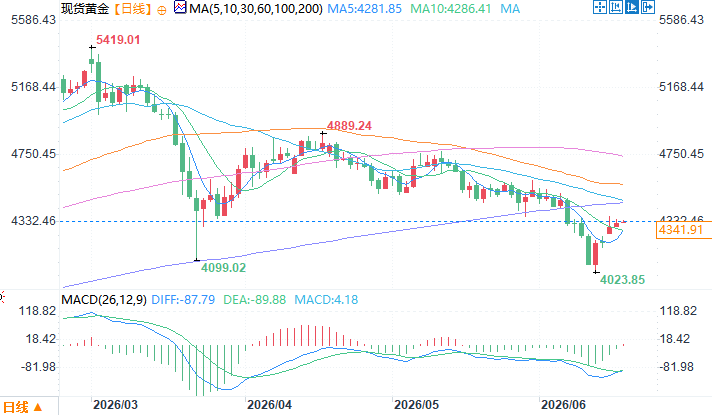
Spot gold daily chart source: EasyForex
At 9:32 AM Beijing time on June 17, spot gold was trading at $4338.85 per ounce.
Market funds flowed heavily into AI and semiconductor growth stocks, weakening short-term buying of gold. However, industry strategists clearly stated that the core logic supporting the long-term strength of gold prices has not disappeared . Subsequent Fed interest rate signals and the pace of gold purchases by central banks around the world will determine when gold prices will break out of the trading range.
Short-term capital outflows are suppressing gold prices, and the market has entered a consolidation and bottoming phase.
Tom Bruce, macro investment strategist at Tanglewood Wealth Management, said he remains neutral on the short-term outlook for gold, but believes the medium- to long-term trend still has upward potential . He added that the current market environment is the most difficult to predict gold's direction in recent years.
At the beginning of this year, gold prices repeatedly hit record highs, mainly driven by two factors: diversified asset allocation by central banks and a large influx of speculative funds. The continued reduction of dollar-denominated assets and the increase in gold reserves by various countries directly pushed up gold prices; however, the market sentiment subsequently shifted significantly, with funds flowing into high-growth stocks such as artificial intelligence and semiconductors, greatly diminishing the previous drivers of gold's price increases.
Tom Bruce said, "The core forces that drove the gold price surge at the beginning of the year have left the market, and now the main driver of gold price fluctuations has returned to the traditional core indicator of interest rates."
As geopolitical risks gradually ease, gold buying remains weak, and gold prices are becoming increasingly sensitive to expectations of real interest rates. However, the strategist is not bearish on a deep decline, stating that the current market is in a consolidation phase due to portfolio adjustments, not the start of a new round of sharp drops. Gold prices have already digested multiple negative news items and successfully held the key technical support level of $4,000. Only a decisive break below this level would open up further downside potential.
With no large-scale sell-off in the market, investors opted for a dual-track investment strategy.
The market's enthusiasm for going long on gold has clearly cooled down, but there has been no concentrated sell-off of precious metal holdings.
Tom Bruce's analysis suggests that most investors adopt a balanced approach, pursuing higher-performing equities while retaining their existing gold positions, rather than completely exiting the market. This portfolio structure limits the downside potential of gold prices, lacking the selling pressure for a one-sided decline, and is a key support level that has allowed gold prices to hold above $4,000. With a lack of new funds entering the market in the short term, gold prices are unlikely to experience a sustained upward trend, and range-bound trading will likely become the norm.
The long-term bullish logic remains intact, and central bank gold purchases are the strongest catalyst for price increases.
Despite a lackluster short-term market, multiple positive factors supporting gold prices in the medium to long term remain. Demand for safe-haven assets due to continued currency depreciation, expectations of declining real interest rates, and the potential for a renewed acceleration in central bank gold purchases after a period of slowdown all contribute to the foundation for a long-term bull market in gold.
Tom Bruce said, "Central banks' gold purchases have only slowed down temporarily. Once the scale of purchases increases again, gold prices will open up new upside potential. The resumption of large-scale buying by central banks is the most direct driving force for gold prices to return to record highs ."
Many countries around the world continue to reduce their reliance on dollar assets, and the long-term trend of reserving gold will not be reversed in the short term. Once central bank purchasing power rebounds, it will provide strong support for gold prices from the fundamentals.
The Federal Reserve's policy sets the tone for short-term gold price fluctuations.
The Federal Reserve's two-day policy meeting has officially begun, and the market is clearly divided on the direction of interest rate adjustments this year. Current pricing suggests that the probability of a rate hike or maintaining the current rate at the end of the year is roughly equal. Policy expectations directly constrain the short-term trend of gold, and the market has already fully priced in expectations of a tightening stance.
Tom Bruce said, "The probability of the Fed cutting interest rates this year is extremely low. Even if the current interest rate level is maintained throughout the year and no rate-cutting cycle is started, it is still a positive signal for gold."
Before clear interest rate guidance is provided, gold prices will continue to fluctuate within a range, and it will be difficult for them to break out of the trend.
In summary , gold prices are currently consolidating within a wide range, pressured by short-term capital outflows and interest rate uncertainty, with no concentrated selling pressure observed. The core demand for central bank gold purchases to hedge against currency depreciation remains unchanged in the medium to long term. Subsequent statements from the Federal Reserve and the pace of global central bank gold purchases will be key variables in breaking the current volatile pattern.
Spot gold daily chart source: EasyForex
At 9:32 AM Beijing time on June 17, spot gold was trading at $4338.85 per ounce.
- Risk Warning and Disclaimer
- The market involves risk, and trading may not be suitable for all investors. This article is for reference only and does not constitute personal investment advice, nor does it take into account certain users’ specific investment objectives, financial situation, or other needs. Any investment decisions made based on this information are at your own risk.