2.8%! Inflation hasn't fallen, and the pound hasn't risen—what's next for the Bank of England?
2026-06-17 16:21:40
Data released by the UK Office for National Statistics on Wednesday (June 17) showed that the Consumer Price Index (CPI) rose steadily at 2.8% year-on-year in May, unchanged from the previous month and well above the Bank of England's 2% inflation target. Core CPI rose 2.6% year-on-year, slightly higher than the previous 2.5% but lower than the expected 2.7%. On a month-on-month basis, CPI rose 0.2%, lower than the 0.7% increase in April and also below market expectations of 0.4%.
Following the data release, the pound fell slightly against the dollar, down about 0.05% on the day, trading around 1.3420.
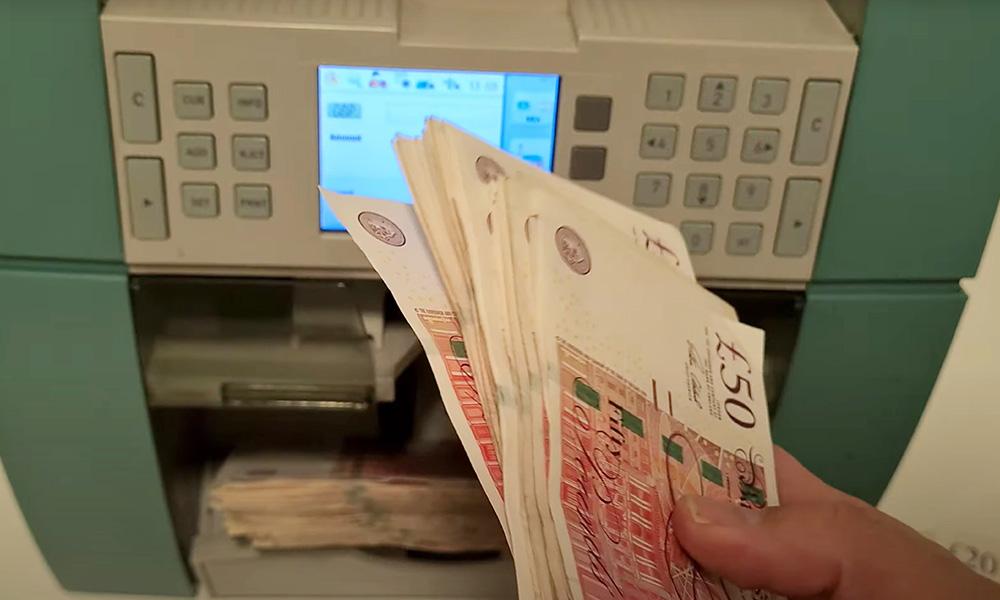
Data released by the UK Office for National Statistics on Wednesday showed that the annualized consumer price index (CPI) remained steady at 2.8% in May, unchanged from the previous month. This figure is still well above the Bank of England's 2% inflation target.
The core CPI (excluding volatile food and energy items) rose 2.6% year-on-year, up from 2.5% in April, but below the market expectation of 2.7%.
On a month-on-month basis, the CPI rose 0.2% in May, a significant slowdown from the 0.7% increase in April, and also below the market expectation of 0.4%.
Other details include the retail price index rising to 3.1% year-on-year from 3.0% in April; and the producer price index – input prices – rising 8.7% during the same period.
The UK CPI is a key indicator of consumer price inflation, reflecting changes in the prices households pay for goods and services. This data is one of the most important economic indicators for the pound sterling, as it plays a crucial role in the Bank of England's monetary policy decisions.
If inflation is higher than expected, it indicates strong price pressures in the economy, and traders may expect the Bank of England to keep interest rates at higher levels for a longer period or consider further rate hikes, which usually provides support for the pound.
If inflation is lower than expected, it may indicate that price pressures in the UK economy are easing, and the market may increase its bets on future interest rate cuts by the Bank of England, which usually puts pressure on the pound.
The data was generally in line with expectations, with the annual rate remaining stable but the month-on-month rate cooling, and core CPI slightly lower than expected but higher than the previous value. The mixed data signals resulted in a muted reaction from the pound, which weakened slightly.
The mixed signals from the combined inflation data have led institutions to give a clear assessment of the pound's future performance.
Goldman Sachs foreign exchange strategists believe that the pound will maintain a weak and volatile trend against the dollar in the short term, with a trading range of 1.3300-1.3650 expected over the next 1-3 months. The bank noted that while the UK's May CPI remained stable at 2.8% year-on-year, indicating that inflationary pressures are under control, the slowdown in economic growth momentum limits the Bank of England's policy space.
If Federal Reserve Chairman Warsh's debut brings hawkish signals, it will further boost the dollar and suppress the pound's performance. Goldman Sachs maintains its year-end 2026 target of around 1.32 for the pound against the dollar. Regarding geopolitical risks, uncertainty surrounding the interim US-Iran agreement and progress on the reopening of the Strait of Hormuz will continue to provide temporary support for the dollar's safe-haven demand.
Goldman Sachs suggests investors consider strategic long positions around 1.3350, but remains bullish on the relative strength of the US dollar overall. Without strong fundamental support, the pound is unlikely to see a sustained upward trend in the short term.
JPMorgan foreign exchange strategists stated that the pound/dollar exchange rate is neutral to slightly bearish in the medium term, with a 6-12 month target range of 1.3150-1.3400. The bank believes that the BoE is unlikely to ease significantly, while the Federal Reserve's policy is relatively more advantageous, which will widen the interest rate differential and negatively impact the pound.
If the Fed's dot plot at this meeting reflects a more hawkish stance, it will exacerbate downward pressure on the pound. Geopolitically, the ambiguity surrounding the US-Iran agreement and new G7 sanctions against Russia will continue to disrupt risk appetite.
JPMorgan Chase recommends a short-selling strategy, gradually building positions in the 1.3550-1.3650 range. Better-than-expected UK economic data could trigger a technical rebound, but the medium-term downtrend is unlikely to change.
According to the daily chart, the GBP/USD pair is currently trading near the 20-day moving average at 1.3419. The short, medium, and long-term moving averages are highly intertwined and converged, with the 20, 50, 100, and 200-day moving averages concentrated in the 1.3415-1.3474 range. The direction of the market has not yet become clear, and the pair is maintaining a wide-range oscillation pattern.
In terms of indicators, the MACD is running close to the zero axis, the DIFF and DEA are almost overlapping, the red and green momentum bars are weak, the bullish and bearish momentum are in a balanced state, and there is a lack of unilateral driving signals; the RSI is stable at 48.84, which is in the neutral range, neither entering the overbought nor touching the oversold range, and the strength of the bullish and bearish battle is even.
In terms of price structure, the previous high of 1.3657 forms a strong resistance level, while the key support level is the year's low of 1.3159, clearly defining the boundaries of the medium-term trading range. Short-term prices are under pressure below the 20-day moving average, indicating insufficient bullish momentum, which aligns with institutional predictions of a weak and range-bound trend. A breakout above the moving average convergence zone would target the resistance around 1.3600; conversely, a pullback would find support in the 1.33-1.3340 range. Overall, the market lacks a clear trend and is expected to continue its range-bound, weak consolidation in the short term.
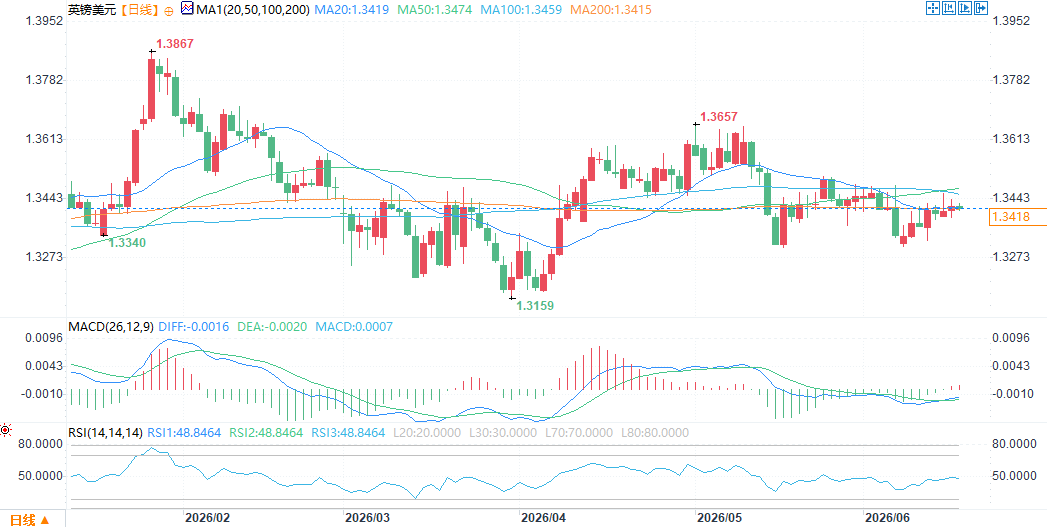
(GBP/USD daily chart, source: FX678)
At 16:18 Beijing time on June 17, the British pound was trading at 1.3410/11 against the US dollar.
Following the data release, the pound fell slightly against the dollar, down about 0.05% on the day, trading around 1.3420.
Data Analysis: Inflation Remains Stable but Well Above Target
Data released by the UK Office for National Statistics on Wednesday showed that the annualized consumer price index (CPI) remained steady at 2.8% in May, unchanged from the previous month. This figure is still well above the Bank of England's 2% inflation target.
The core CPI (excluding volatile food and energy items) rose 2.6% year-on-year, up from 2.5% in April, but below the market expectation of 2.7%.
On a month-on-month basis, the CPI rose 0.2% in May, a significant slowdown from the 0.7% increase in April, and also below the market expectation of 0.4%.
Other details include the retail price index rising to 3.1% year-on-year from 3.0% in April; and the producer price index – input prices – rising 8.7% during the same period.
What do inflation data mean for the pound sterling?
The UK CPI is a key indicator of consumer price inflation, reflecting changes in the prices households pay for goods and services. This data is one of the most important economic indicators for the pound sterling, as it plays a crucial role in the Bank of England's monetary policy decisions.
If inflation is higher than expected, it indicates strong price pressures in the economy, and traders may expect the Bank of England to keep interest rates at higher levels for a longer period or consider further rate hikes, which usually provides support for the pound.
If inflation is lower than expected, it may indicate that price pressures in the UK economy are easing, and the market may increase its bets on future interest rate cuts by the Bank of England, which usually puts pressure on the pound.
The data was generally in line with expectations, with the annual rate remaining stable but the month-on-month rate cooling, and core CPI slightly lower than expected but higher than the previous value. The mixed data signals resulted in a muted reaction from the pound, which weakened slightly.
Institutional Views
The mixed signals from the combined inflation data have led institutions to give a clear assessment of the pound's future performance.
Goldman Sachs foreign exchange strategists believe that the pound will maintain a weak and volatile trend against the dollar in the short term, with a trading range of 1.3300-1.3650 expected over the next 1-3 months. The bank noted that while the UK's May CPI remained stable at 2.8% year-on-year, indicating that inflationary pressures are under control, the slowdown in economic growth momentum limits the Bank of England's policy space.
If Federal Reserve Chairman Warsh's debut brings hawkish signals, it will further boost the dollar and suppress the pound's performance. Goldman Sachs maintains its year-end 2026 target of around 1.32 for the pound against the dollar. Regarding geopolitical risks, uncertainty surrounding the interim US-Iran agreement and progress on the reopening of the Strait of Hormuz will continue to provide temporary support for the dollar's safe-haven demand.
Goldman Sachs suggests investors consider strategic long positions around 1.3350, but remains bullish on the relative strength of the US dollar overall. Without strong fundamental support, the pound is unlikely to see a sustained upward trend in the short term.
JPMorgan foreign exchange strategists stated that the pound/dollar exchange rate is neutral to slightly bearish in the medium term, with a 6-12 month target range of 1.3150-1.3400. The bank believes that the BoE is unlikely to ease significantly, while the Federal Reserve's policy is relatively more advantageous, which will widen the interest rate differential and negatively impact the pound.
If the Fed's dot plot at this meeting reflects a more hawkish stance, it will exacerbate downward pressure on the pound. Geopolitically, the ambiguity surrounding the US-Iran agreement and new G7 sanctions against Russia will continue to disrupt risk appetite.
JPMorgan Chase recommends a short-selling strategy, gradually building positions in the 1.3550-1.3650 range. Better-than-expected UK economic data could trigger a technical rebound, but the medium-term downtrend is unlikely to change.
Technical Analysis: Short-term neutral to sideways trend
According to the daily chart, the GBP/USD pair is currently trading near the 20-day moving average at 1.3419. The short, medium, and long-term moving averages are highly intertwined and converged, with the 20, 50, 100, and 200-day moving averages concentrated in the 1.3415-1.3474 range. The direction of the market has not yet become clear, and the pair is maintaining a wide-range oscillation pattern.
In terms of indicators, the MACD is running close to the zero axis, the DIFF and DEA are almost overlapping, the red and green momentum bars are weak, the bullish and bearish momentum are in a balanced state, and there is a lack of unilateral driving signals; the RSI is stable at 48.84, which is in the neutral range, neither entering the overbought nor touching the oversold range, and the strength of the bullish and bearish battle is even.
In terms of price structure, the previous high of 1.3657 forms a strong resistance level, while the key support level is the year's low of 1.3159, clearly defining the boundaries of the medium-term trading range. Short-term prices are under pressure below the 20-day moving average, indicating insufficient bullish momentum, which aligns with institutional predictions of a weak and range-bound trend. A breakout above the moving average convergence zone would target the resistance around 1.3600; conversely, a pullback would find support in the 1.33-1.3340 range. Overall, the market lacks a clear trend and is expected to continue its range-bound, weak consolidation in the short term.
(GBP/USD daily chart, source: FX678)
At 16:18 Beijing time on June 17, the British pound was trading at 1.3410/11 against the US dollar.
- Risk Warning and Disclaimer
- The market involves risk, and trading may not be suitable for all investors. This article is for reference only and does not constitute personal investment advice, nor does it take into account certain users’ specific investment objectives, financial situation, or other needs. Any investment decisions made based on this information are at your own risk.