Goldman Sachs sharply lowers oil price forecasts; IEA warns of global oil surplus in 2027.
2026-06-17 17:50:03
Recent breakthroughs in US-Iran negotiations, with the draft interim agreement completely reversing market pessimism about tight Middle Eastern oil supply, have fueled expectations of a return to normalcy in the Strait of Hormuz. Goldman Sachs, a top international investment bank, has simultaneously lowered its medium- to long-term oil price targets, and the International Energy Agency (IEA) has updated its global supply and demand projections in its monthly report, clearly indicating a large-scale supply surplus in the oil market in 2027. This news has eased market concerns about inflation and brought further gains.
WTI crude oil prices continued to weaken on the market, but the decline slowed, and it is currently trading around 75.20, down slightly by 0.15%.
According to the disclosed draft of the interim agreement between the US and Iran, Iran could immediately resume crude oil exports;
Once the two sides complete negotiations on a permanent peace agreement regarding the Iranian nuclear issue, Iran will also receive an economic development support package totaling $300 billion.
According to the plan of both sides, a memorandum of understanding will be formally signed in Switzerland this Friday to finalize all the terms of the interim agreement and begin 60 days of in-depth negotiations, on the one hand to end the regional conflict that has lasted for months, and on the other hand to set strict constraints on Iran's nuclear activities.
According to sources, the United States circulated the full text of the interim agreement to its allies at the G7 summit in France, but neither Washington nor Tehran has released the official document to the public.
The months-long standoff had directly blocked the Strait of Hormuz , causing more than 14 million barrels of crude oil production capacity per day in the Middle East to be shut down, marking the largest crude oil supply disruption in global history. This temporary agreement is expected to completely resolve the current supply crisis.
Following news that the US and Iran might reopen the Strait of Hormuz, Goldman Sachs quickly updated its "Oil Analyst Report," significantly lowering its price forecasts for both Brent and WTI crude oil.
The bank lowered its target price for Brent crude oil in the fourth quarter of 2026 from $90 per barrel to $80 per barrel, and revised its forecast for the average price of Brent crude oil for the whole of 2027 down from $80 per barrel to $75 per barrel.
We have simultaneously lowered our WTI crude oil price forecast, predicting an average price of $75 per barrel in the fourth quarter of 2026 and $70 per barrel for the whole of 2027.
Goldman Sachs' core rationale for adjusting its strategy is that the reopening of the Strait of Hormuz will significantly accelerate the recovery of Middle Eastern crude oil supply, greatly alleviating market concerns about geopolitical supply.
The report clarifies that the original estimate for Persian Gulf crude oil exports to return to pre-war levels by the end of August has been moved forward to the end of July, shortening the overall recovery period by one month.
The recovery on the supply side may exceed the market's original baseline assumptions: OECD commercial crude oil inventories remained low this summer, and core Gulf oil-producing countries such as Saudi Arabia and the UAE had a strong desire to increase production. The actual increase in production may be higher than the baseline scenario of "restoring pre-war production capacity".
With the easing of US-Iran sanctions and the simultaneous rebound in Iranian crude oil production, the increase in global crude oil supply will be further amplified.
However, Goldman Sachs also cautioned that the oil market presents a two-way risk profile, and the supply recovery process is not without its uncertainties.
If armed conflict breaks out again in the Middle East, maritime shipping is attacked, or subsequent negotiations between the US and Iran break down, the normalization of Gulf oil exports will be delayed.
The bank has put forward two extreme scenarios: if shipping in the Strait of Hormuz is disrupted until 2027, Brent crude oil is expected to break through $130 per barrel by the end of 2026, and the average price in 2027 could reach $105 per barrel.
Conversely, if exports recover faster than expected, supply increases significantly, and global crude oil demand weakens, Brent crude oil prices may fall below $70 per barrel in the fourth quarter of 2026, and the average price in 2027 may drop below $60 per barrel.
Even with a forecast that the global crude oil supply surplus will reach 3.2 million barrels per day in 2027, Goldman Sachs still believes that oil prices have resilience at the bottom.
Continued strategic oil reserve purchases by various countries and the risk premium brought about by medium- and long-term geopolitical conflicts will continue to support oil prices, with Brent and WTI prices likely to trade close to their long-term fair value of $75 and $70 per barrel, respectively.
Coincidentally, the International Energy Agency (IEA) gave a supply and demand assessment that echoed Goldman Sachs's in its monthly oil market report released on Wednesday.
The IEA stated that the global oil market will first gradually absorb the supply shock caused by the Strait of Hormuz blockade and complete the capacity recovery, and will fully enter a period of deep oversupply in 2027.
For the first time, an institution has provided a comprehensive forecast of the oil market fundamentals for 2027, estimating that global crude oil supply could increase by 8 million barrels per day, while demand would only increase by 2 million barrels per day, clearly indicating a loose supply and demand situation.
The IEA believes that as long as the interim agreement between the US and Iran is stably implemented, crude oil production and exports in the Gulf region will steadily recover, and Iranian crude oil exports will be able to fully return to the global market after the US maritime blockade is lifted.
The large supply surplus in 2027 will actually provide an energy buffer window for countries: as countries around the world are adjusting their energy policies based on the current Middle East energy crisis, they can take advantage of this round of supply easing to replenish previously depleted commercial inventories or expand the scale of strategic oil reserves, thus strengthening the global energy security buffer.
Overall, the interim agreement between the US and Iran is the core turning point in this round of crude oil price movements. The high geopolitical premium previously priced in by the market has quickly faded, and institutions have simultaneously lowered their oil price expectations.
In the short term, the oil market faces downward pressure due to expectations of supply recovery, but three major factors—inventory replenishment, strategic reserve purchases, and geopolitical uncertainties—support the bottom of prices.
From a medium- to long-term perspective, it is a consensus among institutions that the global crude oil supply and demand will be loose in 2027, and the overall upside potential for oil prices will be significantly limited.
The subsequent market trend will continue to be anchored to three core variables: the progress of the US-Iran negotiations (especially whether the negotiations for a permanent agreement can proceed smoothly), the actual increase in production by Gulf oil-producing countries, and the strength of the global crude oil demand recovery. The dynamic changes of these three factors will directly determine the balance between the "resilient bottom" and the "oversupply pressure" of oil prices.
Technical Analysis: After failing to rebound from around 94.6 and confirming a downtrend, WTI oil prices broke through two key levels, 87 and 80.8. Currently, the decline is slowing down in front of the 200-day moving average and the previous important level of 70.
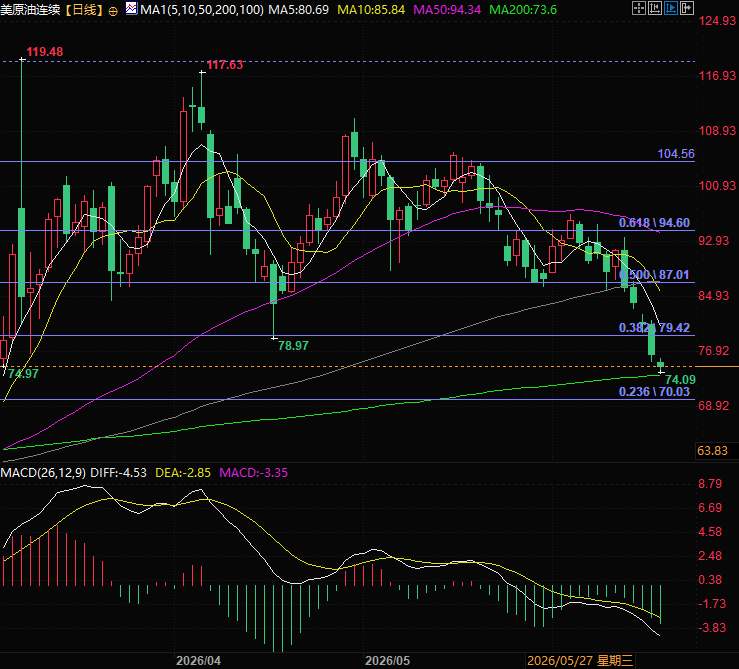
(WTI crude oil futures contract daily chart, source: FX678)
At 17:47 Beijing time, WTI crude oil futures were trading at $75.11 per barrel.
WTI crude oil prices continued to weaken on the market, but the decline slowed, and it is currently trading around 75.20, down slightly by 0.15%.
Breakthrough in US-Iran memorandum: Crude oil exports to resume immediately, $300 billion plan awaiting implementation.
According to the disclosed draft of the interim agreement between the US and Iran, Iran could immediately resume crude oil exports;
Once the two sides complete negotiations on a permanent peace agreement regarding the Iranian nuclear issue, Iran will also receive an economic development support package totaling $300 billion.
According to the plan of both sides, a memorandum of understanding will be formally signed in Switzerland this Friday to finalize all the terms of the interim agreement and begin 60 days of in-depth negotiations, on the one hand to end the regional conflict that has lasted for months, and on the other hand to set strict constraints on Iran's nuclear activities.
According to sources, the United States circulated the full text of the interim agreement to its allies at the G7 summit in France, but neither Washington nor Tehran has released the official document to the public.
The months-long standoff had directly blocked the Strait of Hormuz , causing more than 14 million barrels of crude oil production capacity per day in the Middle East to be shut down, marking the largest crude oil supply disruption in global history. This temporary agreement is expected to completely resolve the current supply crisis.
Goldman Sachs urgently lowers its oil price forecast: Supply recovery accelerates, risks present two-way exposure.
Following news that the US and Iran might reopen the Strait of Hormuz, Goldman Sachs quickly updated its "Oil Analyst Report," significantly lowering its price forecasts for both Brent and WTI crude oil.
The bank lowered its target price for Brent crude oil in the fourth quarter of 2026 from $90 per barrel to $80 per barrel, and revised its forecast for the average price of Brent crude oil for the whole of 2027 down from $80 per barrel to $75 per barrel.
We have simultaneously lowered our WTI crude oil price forecast, predicting an average price of $75 per barrel in the fourth quarter of 2026 and $70 per barrel for the whole of 2027.
Goldman Sachs' core rationale for adjusting its strategy is that the reopening of the Strait of Hormuz will significantly accelerate the recovery of Middle Eastern crude oil supply, greatly alleviating market concerns about geopolitical supply.
The report clarifies that the original estimate for Persian Gulf crude oil exports to return to pre-war levels by the end of August has been moved forward to the end of July, shortening the overall recovery period by one month.
The recovery on the supply side may exceed the market's original baseline assumptions: OECD commercial crude oil inventories remained low this summer, and core Gulf oil-producing countries such as Saudi Arabia and the UAE had a strong desire to increase production. The actual increase in production may be higher than the baseline scenario of "restoring pre-war production capacity".
With the easing of US-Iran sanctions and the simultaneous rebound in Iranian crude oil production, the increase in global crude oil supply will be further amplified.
However, Goldman Sachs also cautioned that the oil market presents a two-way risk profile, and the supply recovery process is not without its uncertainties.
If armed conflict breaks out again in the Middle East, maritime shipping is attacked, or subsequent negotiations between the US and Iran break down, the normalization of Gulf oil exports will be delayed.
The bank has put forward two extreme scenarios: if shipping in the Strait of Hormuz is disrupted until 2027, Brent crude oil is expected to break through $130 per barrel by the end of 2026, and the average price in 2027 could reach $105 per barrel.
Conversely, if exports recover faster than expected, supply increases significantly, and global crude oil demand weakens, Brent crude oil prices may fall below $70 per barrel in the fourth quarter of 2026, and the average price in 2027 may drop below $60 per barrel.
Even with a forecast that the global crude oil supply surplus will reach 3.2 million barrels per day in 2027, Goldman Sachs still believes that oil prices have resilience at the bottom.
Continued strategic oil reserve purchases by various countries and the risk premium brought about by medium- and long-term geopolitical conflicts will continue to support oil prices, with Brent and WTI prices likely to trade close to their long-term fair value of $75 and $70 per barrel, respectively.
IEA issues simultaneous warning of oversupply in 2027: Supply increases four times more than demand, global inventory replenishment window approaching.
Coincidentally, the International Energy Agency (IEA) gave a supply and demand assessment that echoed Goldman Sachs's in its monthly oil market report released on Wednesday.
The IEA stated that the global oil market will first gradually absorb the supply shock caused by the Strait of Hormuz blockade and complete the capacity recovery, and will fully enter a period of deep oversupply in 2027.
For the first time, an institution has provided a comprehensive forecast of the oil market fundamentals for 2027, estimating that global crude oil supply could increase by 8 million barrels per day, while demand would only increase by 2 million barrels per day, clearly indicating a loose supply and demand situation.
The IEA believes that as long as the interim agreement between the US and Iran is stably implemented, crude oil production and exports in the Gulf region will steadily recover, and Iranian crude oil exports will be able to fully return to the global market after the US maritime blockade is lifted.
The large supply surplus in 2027 will actually provide an energy buffer window for countries: as countries around the world are adjusting their energy policies based on the current Middle East energy crisis, they can take advantage of this round of supply easing to replenish previously depleted commercial inventories or expand the scale of strategic oil reserves, thus strengthening the global energy security buffer.
Summary and Technical Analysis:
Overall, the interim agreement between the US and Iran is the core turning point in this round of crude oil price movements. The high geopolitical premium previously priced in by the market has quickly faded, and institutions have simultaneously lowered their oil price expectations.
In the short term, the oil market faces downward pressure due to expectations of supply recovery, but three major factors—inventory replenishment, strategic reserve purchases, and geopolitical uncertainties—support the bottom of prices.
From a medium- to long-term perspective, it is a consensus among institutions that the global crude oil supply and demand will be loose in 2027, and the overall upside potential for oil prices will be significantly limited.
The subsequent market trend will continue to be anchored to three core variables: the progress of the US-Iran negotiations (especially whether the negotiations for a permanent agreement can proceed smoothly), the actual increase in production by Gulf oil-producing countries, and the strength of the global crude oil demand recovery. The dynamic changes of these three factors will directly determine the balance between the "resilient bottom" and the "oversupply pressure" of oil prices.
Technical Analysis: After failing to rebound from around 94.6 and confirming a downtrend, WTI oil prices broke through two key levels, 87 and 80.8. Currently, the decline is slowing down in front of the 200-day moving average and the previous important level of 70.
(WTI crude oil futures contract daily chart, source: FX678)
At 17:47 Beijing time, WTI crude oil futures were trading at $75.11 per barrel.
- Risk Warning and Disclaimer
- The market involves risk, and trading may not be suitable for all investors. This article is for reference only and does not constitute personal investment advice, nor does it take into account certain users’ specific investment objectives, financial situation, or other needs. Any investment decisions made based on this information are at your own risk.