Walsh's debut is about to ignite the market! Silver's safe-haven premium shifted overnight; how to position yourself in advance?
2026-06-17 20:13:22
On Wednesday, June 17th, spot silver was in a repricing phase after an upward correction. Two main external variables emerged: first, shipping risks related to the Strait of Hormuz have eased, with Brent crude falling back to $79.5/barrel and WTI crude falling back to $75.8/barrel, indicating a marginal easing of energy inflation pressures; second, the Federal Reserve's June interest rate meeting is approaching, with the market widely expecting the federal funds rate to remain in the 3.50% to 3.75% range, shifting the focus of precious metal pricing to the dot plot and policy wording. Spot silver is currently trading around $70/ounce, with little intraday volatility.
Over the past week, the core driver of spot silver was not a single commodity attribute, but rather the rapid switching between safe-haven premiums, energy prices, and real interest rates. Previously, disruptions to cross-strait shipping pushed up the risk premium for crude oil, and market concerns about energy costs being passed on to inflation further suppressed precious metal valuations, causing silver to break down. Subsequently, the White House signaled a de-escalation of the conflict and the resumption of air traffic, causing oil prices to fall from their highs and inflation expectations to cool in the short term, providing silver with the momentum for recovery.
This rebound does not equate to a re-establishment of a one-sided trend. Silver possesses both precious metal and industrial metal attributes. When energy risks decrease, safe-haven demand weakens, but if falling oil prices improve manufacturing cost expectations, industrial demand expectations will receive some support. Therefore, silver's current rise is not simply a matter of safe-haven asset price increases, but rather a market reassessment of whether "declining inflation is sufficient to lower real interest rates" and whether "demand recovery will, in turn, delay the Fed's easing measures."
The decision to keep interest rates unchanged at this meeting has already been fully priced in. The key impact lies in whether the policy statement removes any overly dovish language and the dot plot in the summary of economic projections. If the dot plot indicates a higher interest rate path in 2026 or 2027, silver will face upward pressure on real interest rates. If the long-term dot plot leaves room for rate cuts, the market will interpret this as the Fed's willingness to observe short-term inflationary disturbances, which will support silver's financial attributes.
Kevin Warsh assumed the chairmanship of the Federal Reserve on May 22 and also serves as chairman of the Federal Open Market Committee. This meeting is a crucial juncture for the market to observe his policy communication framework. Official Fed documents indicate that his term as chairman will run until May 21, 2030, and the committee has also listed his chairmanship. For traders, the marginal impact of the new chairman's first press conference lies not in a single hawkish or dovish statement, but in how he balances energy shocks, inflation stickiness, and employment elasticity.
From the daily chart, spot silver's previous high was 89.344, followed by a continuous decline and breaking below the Bollinger Middle Band, reaching a low of 61.478. The current price is around 70. Bollinger Band parameters show the Middle Band at 73.564, the Upper Band at 84.295, and the Lower Band at 62.833. The price remains below the Middle Band, indicating that the rebound has not yet reclaimed the medium-term moving average area.
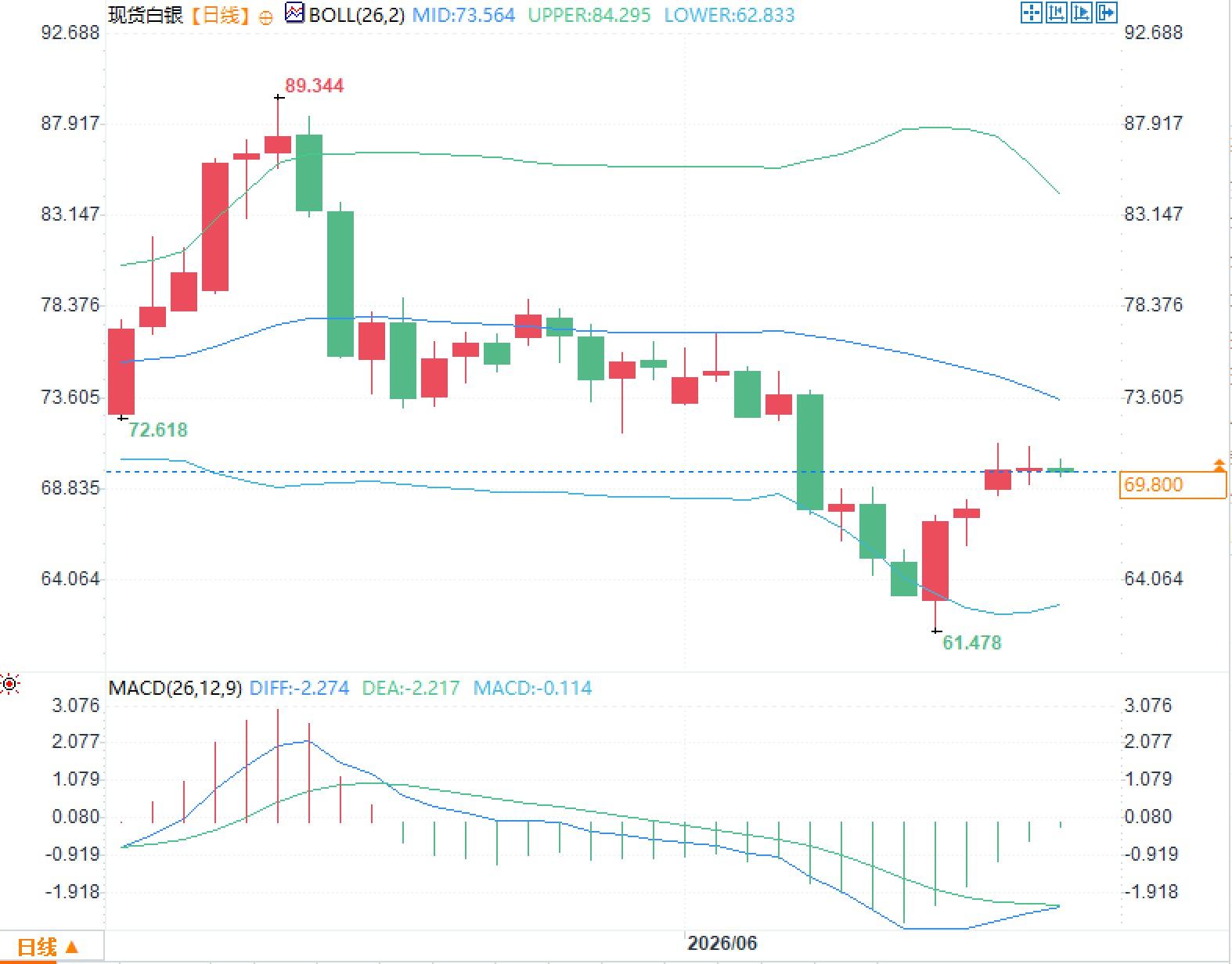
The MACD structure also indicates a correction rather than a strong reversal. In the chart, the DIFF is -2.274, the DEA is -2.217, and the histogram is -0.114. The convergence of negative values indicates weakening bearish momentum, but a stable positive expansion has not yet formed. In other words, after silver rebounded from its lows, the market has completed the first round of risk correction, but to reopen upside potential, the price still needs to rise above the middle band, accompanied by a simultaneous positive turn in momentum indicators. If the policy front releases stronger tightening signals, the previous support level of $61 to $63/ounce will re-enter the market's view; if expectations for long-term interest rates ease, the area around $73 to $74/ounce will become the core area to test the quality of the rebound.
The key difference between silver and gold lies in the higher proportion of industrial demand for silver, with photovoltaic, electrical, and electronic manufacturing sectors being more sensitive to price elasticity. As energy risks ease, cost pressures on the manufacturing sector decrease, which is conducive to a recovery in end-user demand expectations. However, on the other hand, if the de-escalation of conflicts leads to a renewed acceleration of global economic activity, the rebound in demand could further strengthen inflation stickiness, allowing the Federal Reserve to maintain relatively high interest rates for an extended period. This is currently the most complex macroeconomic paradox for silver: factors that benefit demand may not simultaneously benefit valuation multiples.
Reports in the oil market indicate that some tanker transport has resumed, but navigation and insurance risks have not yet fully normalized, and the market is divided on the speed of supply recovery. Other institutions predict that with the reopening of shipping routes and increased exports, the oil market may shift to a significant surplus in 2027, but a temporary shortage will still exist in 2026. For silver, if oil prices continue to decline in an orderly manner, it will help lower inflation expectations; if the recovery of shipping is slower than expected, fluctuating energy prices will again push up real interest rate volatility and amplify the intraday volatility of precious metals.
Macro narrative shift: Silver moves from a safe-haven premium to interest rate repricing
Over the past week, the core driver of spot silver was not a single commodity attribute, but rather the rapid switching between safe-haven premiums, energy prices, and real interest rates. Previously, disruptions to cross-strait shipping pushed up the risk premium for crude oil, and market concerns about energy costs being passed on to inflation further suppressed precious metal valuations, causing silver to break down. Subsequently, the White House signaled a de-escalation of the conflict and the resumption of air traffic, causing oil prices to fall from their highs and inflation expectations to cool in the short term, providing silver with the momentum for recovery.
This rebound does not equate to a re-establishment of a one-sided trend. Silver possesses both precious metal and industrial metal attributes. When energy risks decrease, safe-haven demand weakens, but if falling oil prices improve manufacturing cost expectations, industrial demand expectations will receive some support. Therefore, silver's current rise is not simply a matter of safe-haven asset price increases, but rather a market reassessment of whether "declining inflation is sufficient to lower real interest rates" and whether "demand recovery will, in turn, delay the Fed's easing measures."
The real variable at the Fed meeting: not the interest rate itself, but the long-term path.
The decision to keep interest rates unchanged at this meeting has already been fully priced in. The key impact lies in whether the policy statement removes any overly dovish language and the dot plot in the summary of economic projections. If the dot plot indicates a higher interest rate path in 2026 or 2027, silver will face upward pressure on real interest rates. If the long-term dot plot leaves room for rate cuts, the market will interpret this as the Fed's willingness to observe short-term inflationary disturbances, which will support silver's financial attributes.
Kevin Warsh assumed the chairmanship of the Federal Reserve on May 22 and also serves as chairman of the Federal Open Market Committee. This meeting is a crucial juncture for the market to observe his policy communication framework. Official Fed documents indicate that his term as chairman will run until May 21, 2030, and the committee has also listed his chairmanship. For traders, the marginal impact of the new chairman's first press conference lies not in a single hawkish or dovish statement, but in how he balances energy shocks, inflation stickiness, and employment elasticity.
Technical Structure: The rebound is still in the correction zone and the trend reversal has not yet been completed.
From the daily chart, spot silver's previous high was 89.344, followed by a continuous decline and breaking below the Bollinger Middle Band, reaching a low of 61.478. The current price is around 70. Bollinger Band parameters show the Middle Band at 73.564, the Upper Band at 84.295, and the Lower Band at 62.833. The price remains below the Middle Band, indicating that the rebound has not yet reclaimed the medium-term moving average area.
The MACD structure also indicates a correction rather than a strong reversal. In the chart, the DIFF is -2.274, the DEA is -2.217, and the histogram is -0.114. The convergence of negative values indicates weakening bearish momentum, but a stable positive expansion has not yet formed. In other words, after silver rebounded from its lows, the market has completed the first round of risk correction, but to reopen upside potential, the price still needs to rise above the middle band, accompanied by a simultaneous positive turn in momentum indicators. If the policy front releases stronger tightening signals, the previous support level of $61 to $63/ounce will re-enter the market's view; if expectations for long-term interest rates ease, the area around $73 to $74/ounce will become the core area to test the quality of the rebound.
Supply and demand logic: Industrial attributes limit the depth of decline and also limit disorderly price increases.
The key difference between silver and gold lies in the higher proportion of industrial demand for silver, with photovoltaic, electrical, and electronic manufacturing sectors being more sensitive to price elasticity. As energy risks ease, cost pressures on the manufacturing sector decrease, which is conducive to a recovery in end-user demand expectations. However, on the other hand, if the de-escalation of conflicts leads to a renewed acceleration of global economic activity, the rebound in demand could further strengthen inflation stickiness, allowing the Federal Reserve to maintain relatively high interest rates for an extended period. This is currently the most complex macroeconomic paradox for silver: factors that benefit demand may not simultaneously benefit valuation multiples.
Reports in the oil market indicate that some tanker transport has resumed, but navigation and insurance risks have not yet fully normalized, and the market is divided on the speed of supply recovery. Other institutions predict that with the reopening of shipping routes and increased exports, the oil market may shift to a significant surplus in 2027, but a temporary shortage will still exist in 2026. For silver, if oil prices continue to decline in an orderly manner, it will help lower inflation expectations; if the recovery of shipping is slower than expected, fluctuating energy prices will again push up real interest rate volatility and amplify the intraday volatility of precious metals.
- Risk Warning and Disclaimer
- The market involves risk, and trading may not be suitable for all investors. This article is for reference only and does not constitute personal investment advice, nor does it take into account certain users’ specific investment objectives, financial situation, or other needs. Any investment decisions made based on this information are at your own risk.