Gold Trading Alert: Warsh's "debut" shakes up US stocks, Fed's hawkish stance revealed, gold price's $4,200 defense line in danger?
2026-06-18 07:39:41
On Thursday (June 17), the global gold market experienced a breathtaking rollercoaster ride. Just before the Federal Reserve announced its interest rate decision, spot gold was firmly above $4,330, having accumulated gains of over 6% in the previous four trading days, with market sentiment generally optimistic. However, after new Federal Reserve Chairman Kevin Warsh made his "debut," everything instantly reversed—gold prices plummeted, falling by more than 2% to $4,219 per ounce at one point, ultimately closing at $4,257.60, a single-day drop of 1.7%. What exactly happened behind this plunge?
The Federal Reserve's decision to hold rates steady was largely expected by the market. The Fed announced on Wednesday that it would maintain its policy rate at 3.50% to 3.75%, marking the fourth consecutive day it has held rates unchanged. This decision itself was not surprising—strong U.S. job growth, a relatively low unemployment rate of 4.3%, and inflation well above the 2% target meant that most analysts had already anticipated the Fed keeping rates unchanged. What truly ignited the market was the summary of economic projections released alongside the rate decision, also known as the "dot plot."
The dot plot reveals a surprising "hawkish coup." The latest quarterly forecasts show that nine of the 19 Federal Reserve policymakers believe a rate hike is necessary this year, while only one member favors a rate cut. This contrasts sharply with the previous dot plot, where the median forecast was for a rate cut. Even more striking is that six of the nine officials supporting a rate hike expect at least two increases. The market reacted swiftly; the CME FedWatch tool showed that the market's expectation of a December rate hike jumped from 61% before the decision to 83%. The short-term interest rate futures market even suggests that the probability of a Fed rate hike as early as September is now higher than the probability of keeping rates unchanged.
Independent metals trader Tai Wong pinpointed the turning point in market sentiment: "Both the statement and the dot plot were hawkish, and Walsh did not refute it." This statement reveals the core logic behind the gold price crash—the market had expected the new chairman to release some dovish signals, but instead received a resounding hawkish slap in the face.
A statement that was only half a page long. Warsh quickly made his mark at the first meeting, pushing for consensus and issuing a significantly abridged policy statement. This concise statement reverted to the style of former Chairman Greenspan, drastically reducing the word count and removing all forward guidance on near-term policy actions. Thomas Simons, chief U.S. economist at Jefferies, commented: “The change in the policy statement is profound. After the global financial crisis, the statements became lengthy; now it’s returning to a communication style closer to the Greenspan era.”
At the press conference, Warsh stated bluntly, "I can't tell you what we're going to do next. The good news is, we'll have another meeting in six weeks." He also cautioned the market against overinterpreting the dot plot, calling the forecasts "written in pencil—the kind with a big eraser." However, this seemingly downplaying statement actually made the market focus more on the hawkish signals conveyed by the dot plot.
“Manager, not trustee.” Tai Wong summarized Warsh’s style shift in one sentence: “This is a new Federal Reserve—Wash is quick-witted, decisive, and energetic—he will be a manager, not a trustee. The message is: change is coming.”
At the press conference, Warsh announced a comprehensive review of the Federal Reserve's operations in several key policy areas, including its balance sheet, policy communication, data sources, productivity, employment, and inflation framework. These areas have been the focus of his criticism for years, reflecting his desire to reshape the Fed into a leaner, and even less transparent, institution.
Market observers particularly noted that Warsh twice stated that "he believes interest rates are only tightening in the housing sector"—making him appear more hawkish than his predecessor, Powell. With inflation still significantly above target, this statement is tantamount to announcing to the market that the door to interest rate hikes is open.
The "peace dividend" briefly boosted gold prices. Just days before the Federal Reserve's decision, the gold market had experienced a strong rebound. News of a ceasefire agreement between the US and Iran pushed international oil prices down sharply, inflation expectations declined, and gold prices rose by more than 6% for four consecutive trading days. The market logic is clear: lower oil prices eased inflationary pressures, expectations of a Fed rate hike cooled, and the attractiveness of gold, a non-interest-bearing asset, increased. On Thursday (June 18) in early Asian trading, as of 7:30 AM, spot gold had rebounded slightly, rising as much as 0.6% to $4283.78 per ounce.
The signing of the agreement took a dramatic turn. However, the highly anticipated memorandum itself was fraught with drama. Trump announced the formal signing of the document after a dinner at the Palace of Versailles in France, while the Iranian Foreign Ministry had previously confirmed that the signing was completed remotely and electronically. The memorandum was only about one and a half pages long, less than 800 words, with many sensitive details left for subsequent 60 days of technical negotiations. This "framework first, details later" negotiation model, while temporarily alleviating the risk of the most acute geopolitical conflict, also sowed the seeds of future uncertainty.
It's worth noting that Trump subsequently stated the agreement with Iran was not final and that war could resume if he was dissatisfied with it. This uncertainty limited further downside for gold prices—after all, the "tail risks" of geopolitics have not completely dissipated.
The dollar surged on Wednesday, putting pressure on gold. Following the interest rate decision, the dollar continued its upward trend, with the dollar index rising 0.8% to 100.38. For dollar-denominated gold, a stronger dollar means it will be more expensive for overseas buyers, directly suppressing demand. Corpay's chief market strategist, Karl Schamotta, stated bluntly: "The committee's stance shifted sharply to hawkish...the market was shocked, yields rose along with interest rate expectations, and the dollar strengthened against all major currencies."
A double whammy of stock and bond sell-offs spread panic. The US stock market also suffered a severe blow. The S&P 500 closed down 1.21%, the Nasdaq fell 1.34%, and the Dow Jones Industrial Average dropped 0.98%. All 11 major sectors of the S&P 500 closed lower. The Chicago Board Options Exchange Volatility Index (VIX) rose 2 points to 18.44, marking its biggest one-day gain in four days.
In the bond market, the yield on the two-year US Treasury note, which is most sensitive to interest rate expectations, surged 17 basis points to 4.216%, its highest level since February 2025. The yield on the 10-year US Treasury note rose 7 basis points to 4.495%. This new steepening of the yield curve reflects the market's repricing of the tightening cycle.
Regional banks and the real estate sector are bearing the brunt. Michael James of Rosenblatt Securities points out that rising interest rates will have a greater impact on regional banks. The KBW Regional Banks Index closed down 1.8%, while the S&P 500 Banks Index fell only 0.2%. The State Street SPDR S&P 500 Homebuilders ETF fell 2.3%, as rising interest rates typically put pressure on the housing market.
In summary, the recent sharp drop in gold prices is a result of the Federal Reserve's policy shift, changes in its communication style, and a confluence of macroeconomic data. In the short term, as interest rate hike expectations are fully priced into the market, gold may continue to face downward pressure, with particular attention needed on subsequent economic data and the progress of the Warsh Working Group's review. If inflation falls more slowly than expected, or if geopolitical conflicts in the Middle East further ease, gold still has room for a rebound.
From a medium- to long-term perspective, gold's safe-haven and inflation-hedging properties have not disappeared. Global central bank gold-buying trends, geopolitical uncertainties, and potential monetary policy shifts all provide support for gold. Investors should remain cautious at present, paying close attention to key variables such as the US dollar index, real yields, and the progress of subsequent US-Iran negotiations, seeking opportunities to gradually build positions during pullbacks.
Overall, the Warsh-era Federal Reserve is leading monetary policy with a more pragmatic and hawkish stance, posing a direct challenge to the gold market. However, as history has repeatedly shown, gold's value in times of uncertainty often resurfaces at the most unexpected moments. Investors need to examine this correction from a holistic perspective, manage risks effectively, and prepare for the potential next upward cycle.
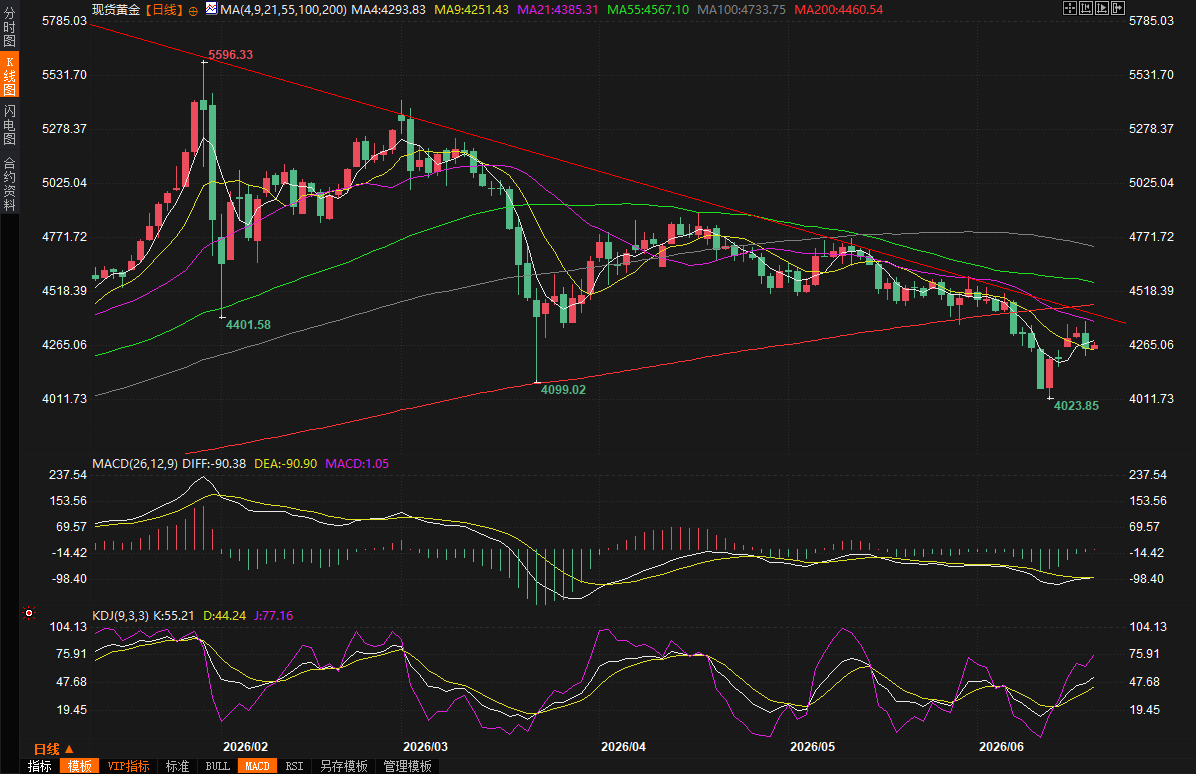
(Spot gold daily chart, source: FX678)
At 07:37 Beijing time, spot gold was trading at $4277.08 per ounce.
I. Interest rates remain unchanged, but the "hawk" has been released.
The Federal Reserve's decision to hold rates steady was largely expected by the market. The Fed announced on Wednesday that it would maintain its policy rate at 3.50% to 3.75%, marking the fourth consecutive day it has held rates unchanged. This decision itself was not surprising—strong U.S. job growth, a relatively low unemployment rate of 4.3%, and inflation well above the 2% target meant that most analysts had already anticipated the Fed keeping rates unchanged. What truly ignited the market was the summary of economic projections released alongside the rate decision, also known as the "dot plot."
The dot plot reveals a surprising "hawkish coup." The latest quarterly forecasts show that nine of the 19 Federal Reserve policymakers believe a rate hike is necessary this year, while only one member favors a rate cut. This contrasts sharply with the previous dot plot, where the median forecast was for a rate cut. Even more striking is that six of the nine officials supporting a rate hike expect at least two increases. The market reacted swiftly; the CME FedWatch tool showed that the market's expectation of a December rate hike jumped from 61% before the decision to 83%. The short-term interest rate futures market even suggests that the probability of a Fed rate hike as early as September is now higher than the probability of keeping rates unchanged.
Independent metals trader Tai Wong pinpointed the turning point in market sentiment: "Both the statement and the dot plot were hawkish, and Walsh did not refute it." This statement reveals the core logic behind the gold price crash—the market had expected the new chairman to release some dovish signals, but instead received a resounding hawkish slap in the face.
II. Walsh's "Debut": A Style Revolution or a Policy Shift?
A statement that was only half a page long. Warsh quickly made his mark at the first meeting, pushing for consensus and issuing a significantly abridged policy statement. This concise statement reverted to the style of former Chairman Greenspan, drastically reducing the word count and removing all forward guidance on near-term policy actions. Thomas Simons, chief U.S. economist at Jefferies, commented: “The change in the policy statement is profound. After the global financial crisis, the statements became lengthy; now it’s returning to a communication style closer to the Greenspan era.”
At the press conference, Warsh stated bluntly, "I can't tell you what we're going to do next. The good news is, we'll have another meeting in six weeks." He also cautioned the market against overinterpreting the dot plot, calling the forecasts "written in pencil—the kind with a big eraser." However, this seemingly downplaying statement actually made the market focus more on the hawkish signals conveyed by the dot plot.
“Manager, not trustee.” Tai Wong summarized Warsh’s style shift in one sentence: “This is a new Federal Reserve—Wash is quick-witted, decisive, and energetic—he will be a manager, not a trustee. The message is: change is coming.”
At the press conference, Warsh announced a comprehensive review of the Federal Reserve's operations in several key policy areas, including its balance sheet, policy communication, data sources, productivity, employment, and inflation framework. These areas have been the focus of his criticism for years, reflecting his desire to reshape the Fed into a leaner, and even less transparent, institution.
Market observers particularly noted that Warsh twice stated that "he believes interest rates are only tightening in the housing sector"—making him appear more hawkish than his predecessor, Powell. With inflation still significantly above target, this statement is tantamount to announcing to the market that the door to interest rate hikes is open.
III. The US-Iran Agreement: The Sudden Disappearance of Geopolitical Premium
The "peace dividend" briefly boosted gold prices. Just days before the Federal Reserve's decision, the gold market had experienced a strong rebound. News of a ceasefire agreement between the US and Iran pushed international oil prices down sharply, inflation expectations declined, and gold prices rose by more than 6% for four consecutive trading days. The market logic is clear: lower oil prices eased inflationary pressures, expectations of a Fed rate hike cooled, and the attractiveness of gold, a non-interest-bearing asset, increased. On Thursday (June 18) in early Asian trading, as of 7:30 AM, spot gold had rebounded slightly, rising as much as 0.6% to $4283.78 per ounce.
The signing of the agreement took a dramatic turn. However, the highly anticipated memorandum itself was fraught with drama. Trump announced the formal signing of the document after a dinner at the Palace of Versailles in France, while the Iranian Foreign Ministry had previously confirmed that the signing was completed remotely and electronically. The memorandum was only about one and a half pages long, less than 800 words, with many sensitive details left for subsequent 60 days of technical negotiations. This "framework first, details later" negotiation model, while temporarily alleviating the risk of the most acute geopolitical conflict, also sowed the seeds of future uncertainty.
It's worth noting that Trump subsequently stated the agreement with Iran was not final and that war could resume if he was dissatisfied with it. This uncertainty limited further downside for gold prices—after all, the "tail risks" of geopolitics have not completely dissipated.
IV. Market Chain Reaction: A Complete Collapse from Stocks, Bonds, Currencies to Gold
The dollar surged on Wednesday, putting pressure on gold. Following the interest rate decision, the dollar continued its upward trend, with the dollar index rising 0.8% to 100.38. For dollar-denominated gold, a stronger dollar means it will be more expensive for overseas buyers, directly suppressing demand. Corpay's chief market strategist, Karl Schamotta, stated bluntly: "The committee's stance shifted sharply to hawkish...the market was shocked, yields rose along with interest rate expectations, and the dollar strengthened against all major currencies."
A double whammy of stock and bond sell-offs spread panic. The US stock market also suffered a severe blow. The S&P 500 closed down 1.21%, the Nasdaq fell 1.34%, and the Dow Jones Industrial Average dropped 0.98%. All 11 major sectors of the S&P 500 closed lower. The Chicago Board Options Exchange Volatility Index (VIX) rose 2 points to 18.44, marking its biggest one-day gain in four days.
In the bond market, the yield on the two-year US Treasury note, which is most sensitive to interest rate expectations, surged 17 basis points to 4.216%, its highest level since February 2025. The yield on the 10-year US Treasury note rose 7 basis points to 4.495%. This new steepening of the yield curve reflects the market's repricing of the tightening cycle.
Regional banks and the real estate sector are bearing the brunt. Michael James of Rosenblatt Securities points out that rising interest rates will have a greater impact on regional banks. The KBW Regional Banks Index closed down 1.8%, while the S&P 500 Banks Index fell only 0.2%. The State Street SPDR S&P 500 Homebuilders ETF fell 2.3%, as rising interest rates typically put pressure on the housing market.
Gold Outlook: Short-term pressure, but still has long-term investment value.
In summary, the recent sharp drop in gold prices is a result of the Federal Reserve's policy shift, changes in its communication style, and a confluence of macroeconomic data. In the short term, as interest rate hike expectations are fully priced into the market, gold may continue to face downward pressure, with particular attention needed on subsequent economic data and the progress of the Warsh Working Group's review. If inflation falls more slowly than expected, or if geopolitical conflicts in the Middle East further ease, gold still has room for a rebound.
From a medium- to long-term perspective, gold's safe-haven and inflation-hedging properties have not disappeared. Global central bank gold-buying trends, geopolitical uncertainties, and potential monetary policy shifts all provide support for gold. Investors should remain cautious at present, paying close attention to key variables such as the US dollar index, real yields, and the progress of subsequent US-Iran negotiations, seeking opportunities to gradually build positions during pullbacks.
Overall, the Warsh-era Federal Reserve is leading monetary policy with a more pragmatic and hawkish stance, posing a direct challenge to the gold market. However, as history has repeatedly shown, gold's value in times of uncertainty often resurfaces at the most unexpected moments. Investors need to examine this correction from a holistic perspective, manage risks effectively, and prepare for the potential next upward cycle.
(Spot gold daily chart, source: FX678)
At 07:37 Beijing time, spot gold was trading at $4277.08 per ounce.
- Risk Warning and Disclaimer
- The market involves risk, and trading may not be suitable for all investors. This article is for reference only and does not constitute personal investment advice, nor does it take into account certain users’ specific investment objectives, financial situation, or other needs. Any investment decisions made based on this information are at your own risk.