Gold Trading Alert: Hawkish Fed pushes dollar to over one-year high, gold prices aim for $4,000?
2026-06-19 08:01:48
Just as the market was digesting the easing of geopolitical risks brought about by the interim peace agreement between the US and Iran, the unexpectedly hawkish signals released by the new Federal Reserve Chairman Kevin Warsh in his debut speech extinguished the enthusiasm of gold bulls like a bucket of ice water. Spot gold closed down 1.14% on Thursday, settling at $4208.92 per ounce, and continued its weakness in early Asian trading on Friday, hitting a near one-week low of $4187.84 per ounce as of 07:55. This gold price volatility triggered by a sudden change in policy expectations reflects the complex game currently unfolding in the gold market—the "dual pressure" of hawkish monetary policy and geopolitical easing is testing the patience and determination of gold bulls.
The biggest "black swan" event in the gold market this week didn't come from geopolitical conflicts, but from the Federal Reserve's interest rate meeting. On Wednesday, the Fed kept interest rates unchanged at 3.50% to 3.75% as expected. However, what truly shook the market was the release of the quarterly interest rate projections—the so-called "dot plot." Data showed that among the 18 officials who provided interest rate projections, 9 expected at least one rate hike in 2026, with 5 predicting two hikes and 1 predicting three. This result contrasts sharply with the March dot plot—at that time, no official predicted a rate hike this year.
While newly appointed Federal Reserve Chairman Warsh did not submit his personal dot plot forecast, his streamlined policy statement, which omitted all forward guidance on future actions, was interpreted by the market as a hawkish stance of "refusing to feed the market." At the press conference, Warsh emphasized the central bank's commitment to controlling inflation and expressed concern about a "second-round price effect" of inflation. The median forecast for the federal funds rate in 2026 by Fed officials rose sharply to 3.8% from 3.4% in March, with inflation forecasts also revised upwards—the median forecast for the personal consumption expenditures price index rose from 2.7% to 3.6%.
The impact of this series of hawkish signals quickly spread throughout the market. The CME FedWatch tool showed that the market's expectation of a December rate hike by the Federal Reserve surged from 60% before the statement to 85%. Peter Grant, Vice President and Senior Precious Metals Strategist at Zaner Metals, stated bluntly: "The most crucial factor was the hawkish bias shown by the Fed yesterday. This pushed the dollar to a new high for the year, thus putting pressure on gold." For gold, a high-interest-rate environment means an increased opportunity cost of holding non-interest-bearing assets, which constitutes the most direct and severe downward pressure.
The Federal Reserve's hawkish shift quickly triggered a chain reaction in the foreign exchange market. The dollar index rose 0.45% to 100.80 on Thursday, having touched 100.92 earlier in the session, its highest level since May 2025. The index had already surged 0.85% in the previous trading session, marking its biggest one-day gain in more than three months.
Sarah Ying, Head of FX Strategy at CIBC Capital Markets, said: “Since late April, we have seen extremely strong U.S. economic data that has consistently exceeded market expectations; subsequently, the Fed’s statements have also been more hawkish than the market expected, thus further strengthening the dollar. There is still room for the dollar to strengthen further.”
The strength of the US dollar has dealt a double blow to gold. On the one hand, dollar-denominated gold has become more expensive for overseas buyers holding other currencies, directly suppressing physical demand. On the other hand, a stronger dollar is often accompanied by tighter global liquidity and a decline in risk appetite, further weakening gold's appeal as a safe-haven asset.
Lee Hardman, senior foreign exchange analyst at MUFG Financial Group, noted: "A hawkish policy update from the Fed could trigger a bullish breakout for the dollar. The dollar has been supported by a sharp correction in short-term U.S. interest rates, which has completely offset the dampening effect of the announcement of the U.S.-Iran agreement over the weekend."
The reaction in the US Treasury market also confirmed the rising expectations of an interest rate hike. The yield on the two-year Treasury note, most sensitive to Federal Reserve policy, climbed to a 16-month high of 4.207% on Wednesday. Although yields retreated somewhat on Thursday, the market still priced in a 69% probability of a rate hike at the September meeting.
Ian Lyngen, head of U.S. interest rate strategy at BMO Capital Markets, said Thursday’s decline in energy prices “easing market concerns about future inflation and leading to a significant pullback in long-term Treasury yields,” but he also stressed that “the policy outlook should remain symmetrical.”
Just days before the Federal Reserve's decision, the interim peace agreement between the US and Iran briefly sent the gold market into a frenzy. On June 15, spot gold prices surged by about 2.5%, reaching a high of over $4,315 per ounce. The initial market interpretation was that the easing of geopolitical risks would reduce global inflationary pressures, thereby diminishing the urgency for the Fed to raise interest rates, which would actually be beneficial for gold. This seemingly paradoxical logic was shared by many institutions at the time—Western Securities even believed that the US-Iran conflict's undermining of the "petrodollar" system could trigger a "fourth wave" of gold's rally.
However, once the Federal Reserve's hawkish statement took effect, the positive impact of the US-Iran agreement was quickly diminished. The 14-point memorandum of understanding signed by the two sides stipulated a 60-day negotiation period, during which Iran allowed ships to pass through the Strait of Hormuz free of charge and demanded that the strait's navigation capacity be restored to full capacity within 30 days. After the agreement was signed, approximately 12.5 million barrels of crude oil passed through the Strait of Hormuz overnight, and Brent crude oil briefly fell to its lowest level since February 27.
However, the agreement has sparked huge controversy within the United States. Louisiana Republican Senator Bill Cassidy called it "the worst foreign policy blunder in decades," pointing out that "13 Americans have lost their lives, Americans have paid billions more for high oil prices, and sanctions are about to be lifted." Conservative commentator Ben Shapiro went even further, calling the memorandum "a disaster." This political division means that the future implementation of the agreement remains highly uncertain.
More noteworthy is the subsequent warning from US Vice President Vance to Israel against further attacks on Hezbollah, the Iranian-backed group in Lebanon. John Kilduff, a partner at Again Capital, stated, "The Vice President's remarks regarding Israel could escalate tensions again. I believe even the slightest disturbance will trigger a market reaction." This fragile geopolitical balance has created a potential source of volatility in the gold market.
The Federal Reserve's confidence in issuing hawkish signals stems from the resilience shown by US economic data. Data released on Thursday showed that initial jobless claims in the US fell by 4,000 to 226,000 in the week ending June 13. While slightly higher than economists' expectations of 225,000, this figure remains at the upper end of the 190,000 to 230,000 range expected this year.
"We don't expect initial jobless claims to continue rising from current levels," said Nancy Vanden Houten, chief U.S. economist at Oxford Economics. "Despite rebounding from recent lows, the level of initial jobless claims remains consistent with a range of labor market indicators that show the job market is improving but not overheating."
Federal Reserve Chairman Warsh also clearly stated at a press conference that members of the monetary policy-making committee "believe the labor market remains stable," and that "some members of the committee believe it is performing even better than that." Three consecutive strong non-farm payroll reports and the unemployment rate remaining at 4.3% for three consecutive months—these data provide ample justification for the Fed to maintain its tightening stance.
However, the labor market is not without its concerns. Continuing jobless claims rose by 24,000 to 1.81 million, and the median duration of unemployment rose to 11.6 weeks, the longest since November 2021. John Ryding, senior economic advisor at Brean Capital, pointed out that jobless claims increased by 16,000 between the May and June survey weeks, "suggesting that job growth may have slowed in June." A Philadelphia Fed survey also showed that although manufacturing activity rebounded in June, "most businesses still reported no change in overall employment." These subtle signals suggest that the heat in the US labor market may be cooling marginally, but is not yet enough to shake the Federal Reserve's policy stance.
Gold prices rebounded strongly after hitting a low of $4,023 last week, the lowest since November 2025, and rose to around $4,382 this week, initially forming a "double bottom" pattern. However, the impact of hawkish signals from the Federal Reserve brought this rebound to an abrupt halt.
Currently, spot gold has initially broken below the $4,200 mark. Technical analysts point out that $4,200/oz is considered a key level for bulls and bears this week—if gold prices can hold this level, the bulls will still have the upper hand in the short term, with resistance around $4,380/oz, and a break above that level targeting $4,542/oz. Conversely, if the price breaks below $4,200, support will shift down to the strong support zone of $4,100 and even $4,020 for the year.
Ruida Futures points out that the upper resistance levels for London gold are at $4400 and $4500 per ounce, while the lower support levels are at $4200 and $4040 per ounce. This means that the current gold price is on the edge of a support zone, and the battle between bulls and bears at the $4200 level will determine the short-term direction.
Looking ahead, the direction of the gold market will be determined by three core variables.
First, the Federal Reserve's policy path. The market has already priced in an 85% rate hike in December, but whether it will actually happen depends on the evolution of inflation and employment data in the coming months. If inflationary pressures continue to exceed expectations, rate hike expectations will be further solidified, and gold will face greater pressure; conversely, if economic data shows signs of weakness, a decline in rate hike expectations may provide some breathing room for gold prices.
Secondly, the follow-up developments of the US-Iran agreement. The 60-day negotiation period is fraught with uncertainty. Strong political resistance to the agreement within the US, the risk of military friction between Israel and Hezbollah, and the actual progress of resuming navigation in the Strait of Hormuz will all continue to influence market assessments of geopolitical risks and inflation prospects. Any setbacks in the implementation of the agreement could trigger a resurgence of risk aversion.
Third, the policy moves of other central banks around the world. The Bank of England kept its interest rate unchanged at 3.75% in June, while the European Central Bank raised its benchmark deposit rate from 2% to 2.25%. The divergence and convergence of monetary policies among major central banks will indirectly affect gold prices through exchange rates and capital flows.
The divergence of opinions among institutions reflects the current high level of uncertainty in the market. Barclays explicitly stated that "it's time to increase gold exposure," while Citi raised its three-month gold price target to $4,500 per ounce; however, Citi also lowered its short-term target to $4,000 in early June. Plexis believes gold is "strategically bullish, but tactically neutral." Metals Focus even predicts that the average gold price will surge 43% to $4,920 by 2026. This divergence itself is a true reflection of the heated battle between bulls and bears in the gold market.
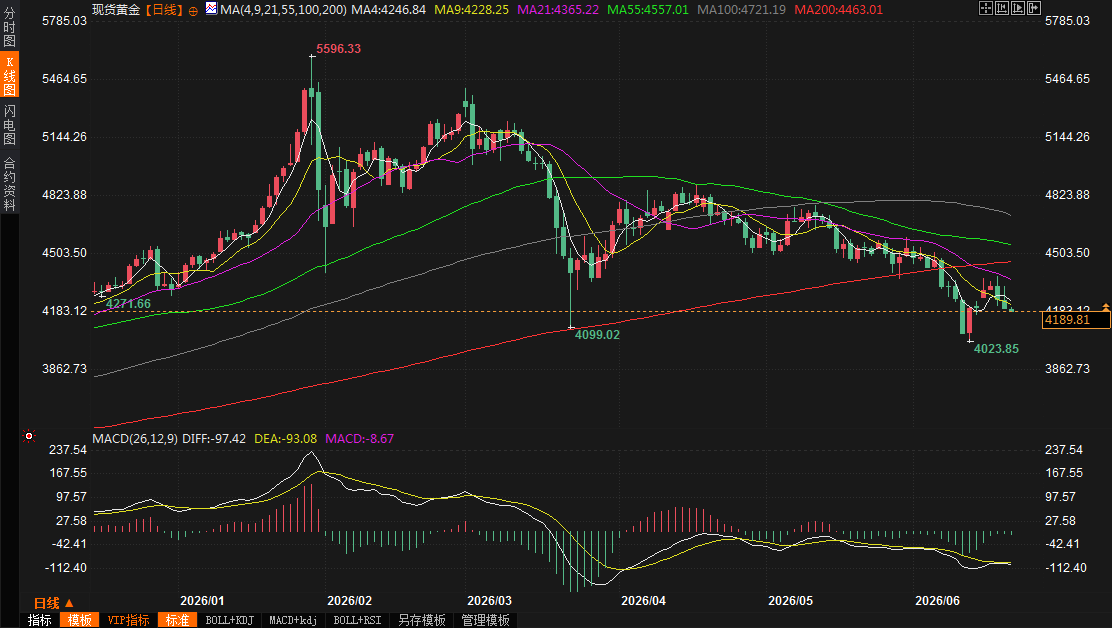
(Spot gold daily chart, source: FX678)
At 07:59 Beijing time, spot gold was trading at $4188.22 per ounce.
I. The Fed's Hawkish Stance Revealed: A Sudden Shift in Interest Rate Hike Expectations, the Core Driver of Pressure on Gold Prices
The biggest "black swan" event in the gold market this week didn't come from geopolitical conflicts, but from the Federal Reserve's interest rate meeting. On Wednesday, the Fed kept interest rates unchanged at 3.50% to 3.75% as expected. However, what truly shook the market was the release of the quarterly interest rate projections—the so-called "dot plot." Data showed that among the 18 officials who provided interest rate projections, 9 expected at least one rate hike in 2026, with 5 predicting two hikes and 1 predicting three. This result contrasts sharply with the March dot plot—at that time, no official predicted a rate hike this year.
While newly appointed Federal Reserve Chairman Warsh did not submit his personal dot plot forecast, his streamlined policy statement, which omitted all forward guidance on future actions, was interpreted by the market as a hawkish stance of "refusing to feed the market." At the press conference, Warsh emphasized the central bank's commitment to controlling inflation and expressed concern about a "second-round price effect" of inflation. The median forecast for the federal funds rate in 2026 by Fed officials rose sharply to 3.8% from 3.4% in March, with inflation forecasts also revised upwards—the median forecast for the personal consumption expenditures price index rose from 2.7% to 3.6%.
The impact of this series of hawkish signals quickly spread throughout the market. The CME FedWatch tool showed that the market's expectation of a December rate hike by the Federal Reserve surged from 60% before the statement to 85%. Peter Grant, Vice President and Senior Precious Metals Strategist at Zaner Metals, stated bluntly: "The most crucial factor was the hawkish bias shown by the Fed yesterday. This pushed the dollar to a new high for the year, thus putting pressure on gold." For gold, a high-interest-rate environment means an increased opportunity cost of holding non-interest-bearing assets, which constitutes the most direct and severe downward pressure.
II. The US dollar's strong rise: A new one-year high limits the upside potential for gold prices.
The Federal Reserve's hawkish shift quickly triggered a chain reaction in the foreign exchange market. The dollar index rose 0.45% to 100.80 on Thursday, having touched 100.92 earlier in the session, its highest level since May 2025. The index had already surged 0.85% in the previous trading session, marking its biggest one-day gain in more than three months.
Sarah Ying, Head of FX Strategy at CIBC Capital Markets, said: “Since late April, we have seen extremely strong U.S. economic data that has consistently exceeded market expectations; subsequently, the Fed’s statements have also been more hawkish than the market expected, thus further strengthening the dollar. There is still room for the dollar to strengthen further.”
The strength of the US dollar has dealt a double blow to gold. On the one hand, dollar-denominated gold has become more expensive for overseas buyers holding other currencies, directly suppressing physical demand. On the other hand, a stronger dollar is often accompanied by tighter global liquidity and a decline in risk appetite, further weakening gold's appeal as a safe-haven asset.
Lee Hardman, senior foreign exchange analyst at MUFG Financial Group, noted: "A hawkish policy update from the Fed could trigger a bullish breakout for the dollar. The dollar has been supported by a sharp correction in short-term U.S. interest rates, which has completely offset the dampening effect of the announcement of the U.S.-Iran agreement over the weekend."
The reaction in the US Treasury market also confirmed the rising expectations of an interest rate hike. The yield on the two-year Treasury note, most sensitive to Federal Reserve policy, climbed to a 16-month high of 4.207% on Wednesday. Although yields retreated somewhat on Thursday, the market still priced in a 69% probability of a rate hike at the September meeting.
Ian Lyngen, head of U.S. interest rate strategy at BMO Capital Markets, said Thursday’s decline in energy prices “easing market concerns about future inflation and leading to a significant pullback in long-term Treasury yields,” but he also stressed that “the policy outlook should remain symmetrical.”
III. The US-Iran Agreement: A Double-Edged Sword, Short-Term Support Unable to Withstand the Tide of Policy Change
Just days before the Federal Reserve's decision, the interim peace agreement between the US and Iran briefly sent the gold market into a frenzy. On June 15, spot gold prices surged by about 2.5%, reaching a high of over $4,315 per ounce. The initial market interpretation was that the easing of geopolitical risks would reduce global inflationary pressures, thereby diminishing the urgency for the Fed to raise interest rates, which would actually be beneficial for gold. This seemingly paradoxical logic was shared by many institutions at the time—Western Securities even believed that the US-Iran conflict's undermining of the "petrodollar" system could trigger a "fourth wave" of gold's rally.
However, once the Federal Reserve's hawkish statement took effect, the positive impact of the US-Iran agreement was quickly diminished. The 14-point memorandum of understanding signed by the two sides stipulated a 60-day negotiation period, during which Iran allowed ships to pass through the Strait of Hormuz free of charge and demanded that the strait's navigation capacity be restored to full capacity within 30 days. After the agreement was signed, approximately 12.5 million barrels of crude oil passed through the Strait of Hormuz overnight, and Brent crude oil briefly fell to its lowest level since February 27.
However, the agreement has sparked huge controversy within the United States. Louisiana Republican Senator Bill Cassidy called it "the worst foreign policy blunder in decades," pointing out that "13 Americans have lost their lives, Americans have paid billions more for high oil prices, and sanctions are about to be lifted." Conservative commentator Ben Shapiro went even further, calling the memorandum "a disaster." This political division means that the future implementation of the agreement remains highly uncertain.
More noteworthy is the subsequent warning from US Vice President Vance to Israel against further attacks on Hezbollah, the Iranian-backed group in Lebanon. John Kilduff, a partner at Again Capital, stated, "The Vice President's remarks regarding Israel could escalate tensions again. I believe even the slightest disturbance will trigger a market reaction." This fragile geopolitical balance has created a potential source of volatility in the gold market.
IV. Economic Data Reveals Hidden Clues: Labor Market Resilience Strengthens the Logic of Interest Rate Hikes
The Federal Reserve's confidence in issuing hawkish signals stems from the resilience shown by US economic data. Data released on Thursday showed that initial jobless claims in the US fell by 4,000 to 226,000 in the week ending June 13. While slightly higher than economists' expectations of 225,000, this figure remains at the upper end of the 190,000 to 230,000 range expected this year.
"We don't expect initial jobless claims to continue rising from current levels," said Nancy Vanden Houten, chief U.S. economist at Oxford Economics. "Despite rebounding from recent lows, the level of initial jobless claims remains consistent with a range of labor market indicators that show the job market is improving but not overheating."
Federal Reserve Chairman Warsh also clearly stated at a press conference that members of the monetary policy-making committee "believe the labor market remains stable," and that "some members of the committee believe it is performing even better than that." Three consecutive strong non-farm payroll reports and the unemployment rate remaining at 4.3% for three consecutive months—these data provide ample justification for the Fed to maintain its tightening stance.
However, the labor market is not without its concerns. Continuing jobless claims rose by 24,000 to 1.81 million, and the median duration of unemployment rose to 11.6 weeks, the longest since November 2021. John Ryding, senior economic advisor at Brean Capital, pointed out that jobless claims increased by 16,000 between the May and June survey weeks, "suggesting that job growth may have slowed in June." A Philadelphia Fed survey also showed that although manufacturing activity rebounded in June, "most businesses still reported no change in overall employment." These subtle signals suggest that the heat in the US labor market may be cooling marginally, but is not yet enough to shake the Federal Reserve's policy stance.
V. Market Outlook: Three Major Variables Dominate Gold's Fate
Gold prices rebounded strongly after hitting a low of $4,023 last week, the lowest since November 2025, and rose to around $4,382 this week, initially forming a "double bottom" pattern. However, the impact of hawkish signals from the Federal Reserve brought this rebound to an abrupt halt.
Currently, spot gold has initially broken below the $4,200 mark. Technical analysts point out that $4,200/oz is considered a key level for bulls and bears this week—if gold prices can hold this level, the bulls will still have the upper hand in the short term, with resistance around $4,380/oz, and a break above that level targeting $4,542/oz. Conversely, if the price breaks below $4,200, support will shift down to the strong support zone of $4,100 and even $4,020 for the year.
Ruida Futures points out that the upper resistance levels for London gold are at $4400 and $4500 per ounce, while the lower support levels are at $4200 and $4040 per ounce. This means that the current gold price is on the edge of a support zone, and the battle between bulls and bears at the $4200 level will determine the short-term direction.
Looking ahead, the direction of the gold market will be determined by three core variables.
First, the Federal Reserve's policy path. The market has already priced in an 85% rate hike in December, but whether it will actually happen depends on the evolution of inflation and employment data in the coming months. If inflationary pressures continue to exceed expectations, rate hike expectations will be further solidified, and gold will face greater pressure; conversely, if economic data shows signs of weakness, a decline in rate hike expectations may provide some breathing room for gold prices.
Secondly, the follow-up developments of the US-Iran agreement. The 60-day negotiation period is fraught with uncertainty. Strong political resistance to the agreement within the US, the risk of military friction between Israel and Hezbollah, and the actual progress of resuming navigation in the Strait of Hormuz will all continue to influence market assessments of geopolitical risks and inflation prospects. Any setbacks in the implementation of the agreement could trigger a resurgence of risk aversion.
Third, the policy moves of other central banks around the world. The Bank of England kept its interest rate unchanged at 3.75% in June, while the European Central Bank raised its benchmark deposit rate from 2% to 2.25%. The divergence and convergence of monetary policies among major central banks will indirectly affect gold prices through exchange rates and capital flows.
The divergence of opinions among institutions reflects the current high level of uncertainty in the market. Barclays explicitly stated that "it's time to increase gold exposure," while Citi raised its three-month gold price target to $4,500 per ounce; however, Citi also lowered its short-term target to $4,000 in early June. Plexis believes gold is "strategically bullish, but tactically neutral." Metals Focus even predicts that the average gold price will surge 43% to $4,920 by 2026. This divergence itself is a true reflection of the heated battle between bulls and bears in the gold market.
(Spot gold daily chart, source: FX678)
At 07:59 Beijing time, spot gold was trading at $4188.22 per ounce.
- Risk Warning and Disclaimer
- The market involves risk, and trading may not be suitable for all investors. This article is for reference only and does not constitute personal investment advice, nor does it take into account certain users’ specific investment objectives, financial situation, or other needs. Any investment decisions made based on this information are at your own risk.