Whether the fleet will return after the peak of Hormuz navigation season becomes a key gamble for oil prices.
2026-06-19 17:54:43
On Friday (June 19), during the Asian and European sessions, international oil prices rose and then fell back. The cancellation of the Swiss talks did not change the market's optimistic sentiment. Currently, WTI oil prices are down slightly by 0.1% to $75.74.
The news of a provisional agreement between the United States and Iran had injected a glimmer of easing into the tense geopolitical situation, but it encountered setbacks in the short term. The follow-up talks scheduled to be held in Burgenstock, Switzerland, were suddenly canceled, which not only increased the uncertainty of the agreement's implementation, but also highlighted that this peace process, which aims to end months of conflict, still faces multiple real-world challenges.
However, oil prices indicate that the market has not panicked excessively. At present, the market remains optimistic in the face of cruise ship traffic data. But after this data peak, will the market be able to remain calm?
The core reason for the cancellation of the talks was the failure to reach a consensus on logistical matters related to the negotiations. The Swiss Foreign Ministry officially notified that the talks could not proceed as scheduled, and the White House simultaneously announced that Vice President JD Vance had canceled his trip to Switzerland. A spokesperson explained that "the technical meeting plan is still being finalized, and the US delegation is ready to depart, but the logistical coordination of high-level negotiations is always complex and unpredictable."
This change occurred the day after President Trump signed a memorandum of understanding with Iranian President Masoud Pezehikyan, the core objective of which was to push for a permanent peace agreement and de-escalate tensions in the Middle East.
Faced with criticism that the U.S. had made too many concessions, Trump and Vice President Vance both spoke out in defense.
Vance stated unequivocally that "the United States has not provided any financial support to Iran," while Trump responded forcefully on the "Truth Social" platform: "Those idiots who accuse me of not being tough enough on Iran, look at the fact that the stock market is hitting record highs and oil prices are continuing to plummet—they are either jealous, malicious, or utterly stupid."
While the interim agreement is seen as a significant breakthrough, analysts generally warn that it is only the initial step in building a broader solution.
In a special report, UBS Group clearly pointed out that "the agreement is not the end of the conflict, but the beginning of the process of resolving the Iranian nuclear issue and ending the war."
Quantum Strategy strategist David Roach bluntly called it a "highly controversial and terrible deal" : On the one hand, he acknowledged the agreement's mitigating effect on shipping in the Strait of Hormuz—the Iranian attacks and US naval blockade under the Trump administration's orders had severely impacted this "global energy lifeline," and the resumption of shipping would directly benefit oil-import-dependent economies, with lower oil prices expected to curb inflation and reduce pressure on central banks to raise interest rates;
On the other hand, he emphasized that the agreement would strengthen Iran's strategic position in the Gulf region and limit external interference in its internal affairs. "Iran's rise will lead to continued instability in the Middle East geopolitical landscape, and Israel is unlikely to recognize the agreement, and Iran will never give up its nuclear ambitions."
Adel Abdel Ghafar, a senior fellow at the Australian Strategic Policy Institute, further pointed out that "core points of contention," such as Israel's military operations in Lebanon, have not been resolved. "If these issues remain unresolved, the risk of a renewed conflict cannot be ruled out, even though both sides are currently working to avoid this situation."
The stalled talks did not completely offset the positive impact of the agreement on shipping.
According to real-time monitoring by Vortex Shipping Data Company, following the signing of the preliminary agreement between the US and Iran, 40 oil tankers carrying a total of 80 million barrels of crude oil have entered the preparation stage for passage through the Strait of Hormuz. Among them, 21 tankers will sail to Asia, 5 to China, and another 5 to regional transshipment hubs such as Malaysia and Singapore. None of the tankers are carrying Iranian crude oil.
According to institutional estimates, the total amount of crude oil awaiting approval and destined for the Asian market is approximately 62 million barrels. This supply is expected to drive refineries to increase their processing capacity and replenish commercial inventories that have been continuously depleted over the past three months.
The twists and turns of this peace talks, along with the dynamics of shipping, ultimately had a direct impact on the global oil price market.
Despite the continued uncertainty surrounding the safe passage of oil tankers through the Strait of Hormuz, the expectation of a massive influx of crude oil into the global market is putting further pressure on oil prices, which are already nearing pre-war levels.
However, the pragmatic attitude shown by both sides in the peace talks reduced the risk of a renewed hostilities, prompting top institutions such as Morgan Stanley, Goldman Sachs, and Citigroup to collectively lower their oil price forecasts this week: Citigroup is the most pessimistic, predicting that the average price of Brent crude oil will fall to $75 per barrel in the next quarter.
Morgan Stanley, however, is relatively cautiously optimistic, believing that Brent crude oil prices will still reach $90 per barrel in the third quarter. As of press time, Brent crude was trading at $79.96 per barrel and West Texas Intermediate crude at $75.97 per barrel, both slightly higher than the previous trading day's closing price. The continued progress of the US-Iran peace talks will remain a key variable influencing future oil price trends.
Previous articles have analyzed the impact of the US-Iran conflict on global economic growth. As time drags on, the US will not only face domestic midterm election pressure, but will also be labeled as arrogant and reckless, dragging down the global economy. Coupled with the previous global trade war, the US has been on the opposite side of the world. Maintaining this status quo is not a wise move.
The oil price itself reflects that even if the Straits were opened, global restocking demand would keep oil prices high for a long time. However, due to the slowdown in global economic growth, the decline in demand has coincided with an unexpected recovery in supply (the US-Iran peace talks have progressed ahead of schedule).
This discrepancy between expected and actual price movements led to the recent overshooting in oil prices.
Similarly, if it turns out that the subsequent economic growth rate is revised upward, or if a crisis occurs again in the Strait of Hormuz, then oil prices may have the opportunity to correct upward rapidly. For example, the market may realize that after the strait is opened, a large number of oil tankers stranded in the Persian Gulf will sail out of the Persian Gulf, bringing a temporary increase in supply. However, after these tankers are freed, there are uncertainties such as whether there will be subsequent tankers sailing in, how insurance costs will be adjusted, and whether the mainstream fleet is willing to pay. These factors may lead to a rebound in oil prices later.
Technically, WTI oil prices fell sharply but the rebound was weak, indicating that the market does not believe that the postponement of the US-Iran talks in Switzerland will lead to a rebound in overall oil supply, and that recent shipping data is favorable. However, after the oil price has fallen too much, coupled with subsequent insurance cost adjustments and uncertainty about whether the fleet will be willing to return to the Strait of Hormuz, oil prices are likely to rebound.
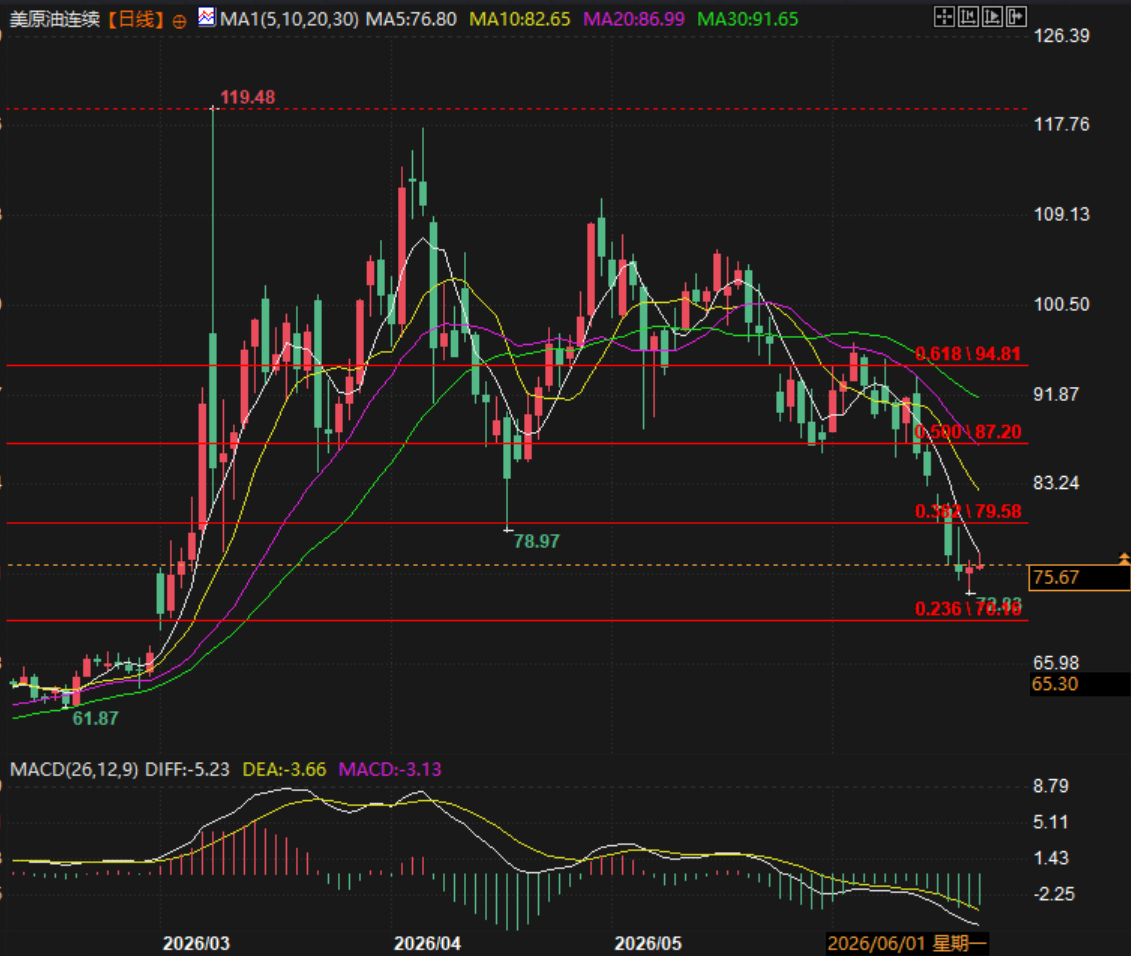
(WTI crude oil futures daily chart, source: FX678)
At 17:52 Beijing time, WTI crude oil futures were trading at $75.60 per barrel.
The news of a provisional agreement between the United States and Iran had injected a glimmer of easing into the tense geopolitical situation, but it encountered setbacks in the short term. The follow-up talks scheduled to be held in Burgenstock, Switzerland, were suddenly canceled, which not only increased the uncertainty of the agreement's implementation, but also highlighted that this peace process, which aims to end months of conflict, still faces multiple real-world challenges.
However, oil prices indicate that the market has not panicked excessively. At present, the market remains optimistic in the face of cruise ship traffic data. But after this data peak, will the market be able to remain calm?
The core reason for the cancellation of the talks was the failure to reach a consensus on logistical matters related to the negotiations. The Swiss Foreign Ministry officially notified that the talks could not proceed as scheduled, and the White House simultaneously announced that Vice President JD Vance had canceled his trip to Switzerland. A spokesperson explained that "the technical meeting plan is still being finalized, and the US delegation is ready to depart, but the logistical coordination of high-level negotiations is always complex and unpredictable."
This change occurred the day after President Trump signed a memorandum of understanding with Iranian President Masoud Pezehikyan, the core objective of which was to push for a permanent peace agreement and de-escalate tensions in the Middle East.
Faced with criticism that the U.S. had made too many concessions, Trump and Vice President Vance both spoke out in defense.
Vance stated unequivocally that "the United States has not provided any financial support to Iran," while Trump responded forcefully on the "Truth Social" platform: "Those idiots who accuse me of not being tough enough on Iran, look at the fact that the stock market is hitting record highs and oil prices are continuing to plummet—they are either jealous, malicious, or utterly stupid."
Analysts warn: The agreement is just the beginning; disputes and risks remain.
While the interim agreement is seen as a significant breakthrough, analysts generally warn that it is only the initial step in building a broader solution.
In a special report, UBS Group clearly pointed out that "the agreement is not the end of the conflict, but the beginning of the process of resolving the Iranian nuclear issue and ending the war."
Quantum Strategy strategist David Roach bluntly called it a "highly controversial and terrible deal" : On the one hand, he acknowledged the agreement's mitigating effect on shipping in the Strait of Hormuz—the Iranian attacks and US naval blockade under the Trump administration's orders had severely impacted this "global energy lifeline," and the resumption of shipping would directly benefit oil-import-dependent economies, with lower oil prices expected to curb inflation and reduce pressure on central banks to raise interest rates;
On the other hand, he emphasized that the agreement would strengthen Iran's strategic position in the Gulf region and limit external interference in its internal affairs. "Iran's rise will lead to continued instability in the Middle East geopolitical landscape, and Israel is unlikely to recognize the agreement, and Iran will never give up its nuclear ambitions."
Adel Abdel Ghafar, a senior fellow at the Australian Strategic Policy Institute, further pointed out that "core points of contention," such as Israel's military operations in Lebanon, have not been resolved. "If these issues remain unresolved, the risk of a renewed conflict cannot be ruled out, even though both sides are currently working to avoid this situation."
The stalled talks did not completely offset the positive impact of the agreement on shipping.
According to real-time monitoring by Vortex Shipping Data Company, following the signing of the preliminary agreement between the US and Iran, 40 oil tankers carrying a total of 80 million barrels of crude oil have entered the preparation stage for passage through the Strait of Hormuz. Among them, 21 tankers will sail to Asia, 5 to China, and another 5 to regional transshipment hubs such as Malaysia and Singapore. None of the tankers are carrying Iranian crude oil.
According to institutional estimates, the total amount of crude oil awaiting approval and destined for the Asian market is approximately 62 million barrels. This supply is expected to drive refineries to increase their processing capacity and replenish commercial inventories that have been continuously depleted over the past three months.
Oil price correlation: Progress of negotiations becomes a key variable for future trends
The twists and turns of this peace talks, along with the dynamics of shipping, ultimately had a direct impact on the global oil price market.
Despite the continued uncertainty surrounding the safe passage of oil tankers through the Strait of Hormuz, the expectation of a massive influx of crude oil into the global market is putting further pressure on oil prices, which are already nearing pre-war levels.
However, the pragmatic attitude shown by both sides in the peace talks reduced the risk of a renewed hostilities, prompting top institutions such as Morgan Stanley, Goldman Sachs, and Citigroup to collectively lower their oil price forecasts this week: Citigroup is the most pessimistic, predicting that the average price of Brent crude oil will fall to $75 per barrel in the next quarter.
Morgan Stanley, however, is relatively cautiously optimistic, believing that Brent crude oil prices will still reach $90 per barrel in the third quarter. As of press time, Brent crude was trading at $79.96 per barrel and West Texas Intermediate crude at $75.97 per barrel, both slightly higher than the previous trading day's closing price. The continued progress of the US-Iran peace talks will remain a key variable influencing future oil price trends.
The setback in the agreement does not change the overall optimistic tone on supply, but its sustainability in the future remains questionable.
Previous articles have analyzed the impact of the US-Iran conflict on global economic growth. As time drags on, the US will not only face domestic midterm election pressure, but will also be labeled as arrogant and reckless, dragging down the global economy. Coupled with the previous global trade war, the US has been on the opposite side of the world. Maintaining this status quo is not a wise move.
The oil price itself reflects that even if the Straits were opened, global restocking demand would keep oil prices high for a long time. However, due to the slowdown in global economic growth, the decline in demand has coincided with an unexpected recovery in supply (the US-Iran peace talks have progressed ahead of schedule).
This discrepancy between expected and actual price movements led to the recent overshooting in oil prices.
Similarly, if it turns out that the subsequent economic growth rate is revised upward, or if a crisis occurs again in the Strait of Hormuz, then oil prices may have the opportunity to correct upward rapidly. For example, the market may realize that after the strait is opened, a large number of oil tankers stranded in the Persian Gulf will sail out of the Persian Gulf, bringing a temporary increase in supply. However, after these tankers are freed, there are uncertainties such as whether there will be subsequent tankers sailing in, how insurance costs will be adjusted, and whether the mainstream fleet is willing to pay. These factors may lead to a rebound in oil prices later.
Technically, WTI oil prices fell sharply but the rebound was weak, indicating that the market does not believe that the postponement of the US-Iran talks in Switzerland will lead to a rebound in overall oil supply, and that recent shipping data is favorable. However, after the oil price has fallen too much, coupled with subsequent insurance cost adjustments and uncertainty about whether the fleet will be willing to return to the Strait of Hormuz, oil prices are likely to rebound.
(WTI crude oil futures daily chart, source: FX678)
At 17:52 Beijing time, WTI crude oil futures were trading at $75.60 per barrel.
- Risk Warning and Disclaimer
- The market involves risk, and trading may not be suitable for all investors. This article is for reference only and does not constitute personal investment advice, nor does it take into account certain users’ specific investment objectives, financial situation, or other needs. Any investment decisions made based on this information are at your own risk.