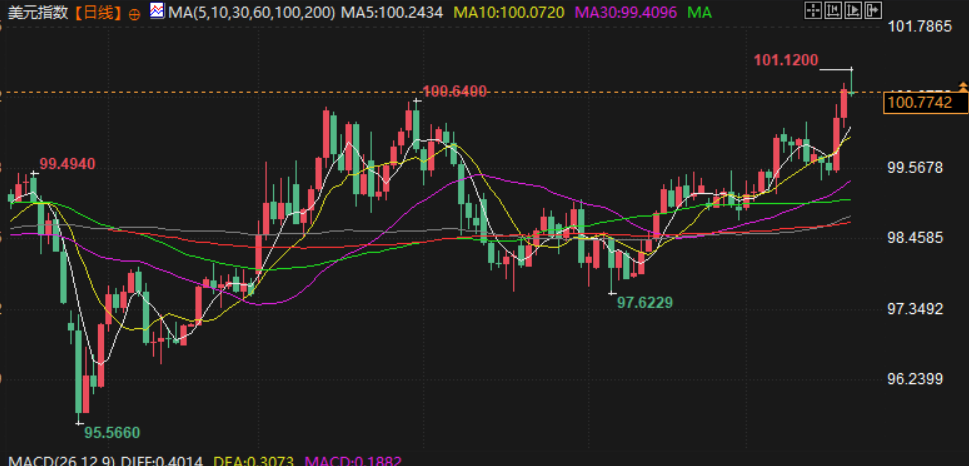
The uncertainty surrounding the Fed's interest rate hike has resurfaced, sending the dollar index soaring to a 13-month high, putting Japan's "invisible defenses" to a major test.
2026-06-20 08:17:18
The dollar index rose nearly 1% this week, hitting a 13-month high, primarily supported by hawkish signals from Wednesday's Federal Reserve meeting.
According to the latest quarterly forecasts, nine out of 19 policymakers expect interest rates to rise before the end of the year. This "dot plot" distribution breaks the market's previous consensus that the Federal Reserve would hold rates steady this year, triggering a repricing of the monetary policy path in the market.
ING strategist Francesco Pesole points out that once the first strong macroeconomic data emerges, the market may be "eager to fully digest expectations of the two rate hikes before December." This means the dollar may continue to enjoy "post-Fed meeting enthusiasm" in the short term, as the market needs time to fully factor new policy expectations into asset prices.
We are currently at a critical juncture in reshaping policy expectations—previously, the mainstream market expectation was the end of the interest rate hike cycle or even a rate cut, but the current shift suggests that the adjustment of dollar positioning is far from complete, and further upward momentum still exists. It is worth noting that the Fed's hawkish stance contrasts sharply with the relatively moderate or lagging policy pace of other major central banks globally (such as the ECB and the Bank of Japan), providing the dollar with additional comparative advantage.
Furthermore, geopolitical factors supported the safe-haven demand for the US dollar. On one hand, risk sentiment deteriorated—the prospects for a peace agreement between the US and Iran remained uncertain, and Switzerland confirmed that US and Iranian negotiators would not hold talks on Friday. This perpetuated uncertainty in the Middle East and increased the safe-haven appeal of the US dollar.
On the other hand, more optimistic news came from Lebanon, where a US official stated that Israel and Hezbollah had agreed to a ceasefire, after the escalation of the conflict in Lebanon threatened the implementation of the interim US-Iran agreement. This mixed geopolitical situation further solidified the US dollar's position as the preferred safe-haven asset.
Historically, the evolution of conflicts in the Middle East has often had a direct and dramatic impact on safe-haven currency pairs such as USD/JPY and USD/CHF. This is because, although the yen and Swiss franc also possess safe-haven attributes, their safe-haven function has been significantly weakened by the divergence in monetary policies against the backdrop of the current extreme widening of the USD/JPY and USD/CHF interest rate differentials, and investors tend to hold the US dollar directly.
Signals of interest rate hikes from the Bank of Japan
The US dollar hit a near two-year high against the Japanese yen this week, rising to 161.8 at one point, just shy of the 161.94 level reached in July 2024. A break above this level would mark the highest level since 1986, a peak in approximately 40 years. The core driver of this move is the widening gap in monetary policy between the Federal Reserve and the Bank of Japan—the Fed is maintaining high interest rates and even signaling rate hikes, while the Bank of Japan, although having raised rates to 1%, still maintains an absolute interest rate level that is among the lowest globally.
Traders are currently on high alert, closely watching whether Japanese authorities will initiate direct market intervention if the yen falls below 162 against the dollar. A historical reference point is late April to early May 2024, when the Japanese Ministry of Finance intervened in batches, distributing approximately 9.8 trillion yen after the yen fell below 160. Current market liquidity is reduced due to the US holiday, which objectively provides the Bank of Japan with a window of opportunity, but also amplifies the possibility of speculative capital pushing the exchange rate above key resistance levels.
ING strategists have clearly pointed out that the yen is "deeply trapped in the intervention zone," and if no official action is seen, speculators may push the exchange rate to the 162-163 range, further testing Japan's policy bottom line.
Bank of Japan Deputy Governor Ryozo Himino's remarks on Friday delivered a clear hawkish signal, making it one of the most closely watched policy developments in the foreign exchange market this week. He explicitly stated that the underlying inflation rate may exceed the central bank's 2% target and warned of the "costs of delaying interest rate hikes," suggesting the Bank of Japan's firm resolve to continue raising interest rates.
The logic is clear: businesses are passing on the increased costs from the Iran war to consumers, and wholesale inflation is accelerating rapidly, which could trigger broader price increases. Ryozo Himino specifically points out that the current price increases have a "demand-driven side"—strong corporate profits, steady wage growth, and robust global demand for AI-related products are all supporting economic growth, meaning that the foundation for sustained inflation is forming.
When asked about the yen's depreciation, he stated that the central bank is closely monitoring the exchange rate as a key factor influencing the economy and inflation. Minutes from the Bank of Japan's April meeting revealed that some committee members believed there was room to accelerate the pace of interest rate hikes, with one even calling for "rate hikes every few months," highlighting the central bank's growing concern about inflation risks. The Bank of Japan will hold its next policy meeting in July and release its latest quarterly forecasts; the market will be closely watching for any specific signals of further interest rate hikes at that time.
Market pricing indicates that most analysts expect the Bank of Japan to raise interest rates to 1.25% in the fourth quarter, but following the central bank's hawkish comments this week, some analysts believe there is a possibility of an earlier move.
Analysis of the exchange rate between British Pound and Swiss Franc
The pound touched a more than two-month low of $1.3162 against the dollar on Friday before rebounding to around $1.324, reflecting a complex interplay of factors. The Bank of England kept interest rates unchanged this week. On the economic data front, stronger-than-expected May retail sales provided temporary support for the pound, but another set of data showed a larger-than-expected budget deficit, putting downward pressure on the currency. This mixed data combination leaves the pound without a solid foundation for a sustained rebound.
There are also uncertainties on the political front: Manchester Mayor Burnham won a parliamentary seat in the northwest of England with an overwhelming victory for the Labour Party. Analysts believe this may pave the way for him to challenge Prime Minister Starmer within the party, and the political uncertainty has marginally increased the risk premium of the pound.
Regarding the Swiss franc, the euro rose 0.39% against the franc to 0.9254 francs, while the dollar touched a high of 0.8091 against the franc, its highest level since November 2025. The core trigger was the Swiss National Bank keeping its benchmark interest rate unchanged on Thursday and reiterating its commitment to "more actively intervene in the market to curb the appreciation of the Swiss franc." This statement essentially provided policy support for the relative weakness of the Swiss franc, making it weaker among major currencies.
European Central Bank's Inflation Assessment and Policy Stance
European Central Bank Chief Economist Lane's remarks on Friday provided the market with an important framework for understanding the nature of the current inflation in the eurozone. He characterized the current inflationary environment as a "moderate" shock, and contrasted it sharply with the sharp inflation during the 2021/22 pandemic and the period of ultra-low inflation following the eurozone debt crisis.
Lane's core assessment is that such shocks are "not too large and will not last too long," that monetary policy can be "responded to in a prudent manner," and that we are currently "far from a scenario of runaway inflation." However, he also acknowledges that inflation has already had a considerable impact, expecting the inflation rate to remain above 3% for the remainder of this year and to remain above the 2% target into next year, thus necessitating policy action.
Financial markets have fully priced in the expectation of another European Central Bank rate hike before October. If another rate hike occurs, deposit rates will reach the upper limit of the neutral interest rate range (1.75%-2.50%), meaning there is limited room for further tightening. Lane also pointed out that high energy costs will drag down economic growth, but the economy remains resilient—ample household savings, investment concentrated in artificial intelligence and defense needs, and ample liquidity in the financial system collectively form a buffer against inflationary shocks in the Eurozone.
According to the latest quarterly forecasts, nine out of 19 policymakers expect interest rates to rise before the end of the year. This "dot plot" distribution breaks the market's previous consensus that the Federal Reserve would hold rates steady this year, triggering a repricing of the monetary policy path in the market.
ING strategist Francesco Pesole points out that once the first strong macroeconomic data emerges, the market may be "eager to fully digest expectations of the two rate hikes before December." This means the dollar may continue to enjoy "post-Fed meeting enthusiasm" in the short term, as the market needs time to fully factor new policy expectations into asset prices.
We are currently at a critical juncture in reshaping policy expectations—previously, the mainstream market expectation was the end of the interest rate hike cycle or even a rate cut, but the current shift suggests that the adjustment of dollar positioning is far from complete, and further upward momentum still exists. It is worth noting that the Fed's hawkish stance contrasts sharply with the relatively moderate or lagging policy pace of other major central banks globally (such as the ECB and the Bank of Japan), providing the dollar with additional comparative advantage.
Furthermore, geopolitical factors supported the safe-haven demand for the US dollar. On one hand, risk sentiment deteriorated—the prospects for a peace agreement between the US and Iran remained uncertain, and Switzerland confirmed that US and Iranian negotiators would not hold talks on Friday. This perpetuated uncertainty in the Middle East and increased the safe-haven appeal of the US dollar.
On the other hand, more optimistic news came from Lebanon, where a US official stated that Israel and Hezbollah had agreed to a ceasefire, after the escalation of the conflict in Lebanon threatened the implementation of the interim US-Iran agreement. This mixed geopolitical situation further solidified the US dollar's position as the preferred safe-haven asset.
Historically, the evolution of conflicts in the Middle East has often had a direct and dramatic impact on safe-haven currency pairs such as USD/JPY and USD/CHF. This is because, although the yen and Swiss franc also possess safe-haven attributes, their safe-haven function has been significantly weakened by the divergence in monetary policies against the backdrop of the current extreme widening of the USD/JPY and USD/CHF interest rate differentials, and investors tend to hold the US dollar directly.
Signals of interest rate hikes from the Bank of Japan
The US dollar hit a near two-year high against the Japanese yen this week, rising to 161.8 at one point, just shy of the 161.94 level reached in July 2024. A break above this level would mark the highest level since 1986, a peak in approximately 40 years. The core driver of this move is the widening gap in monetary policy between the Federal Reserve and the Bank of Japan—the Fed is maintaining high interest rates and even signaling rate hikes, while the Bank of Japan, although having raised rates to 1%, still maintains an absolute interest rate level that is among the lowest globally.
Traders are currently on high alert, closely watching whether Japanese authorities will initiate direct market intervention if the yen falls below 162 against the dollar. A historical reference point is late April to early May 2024, when the Japanese Ministry of Finance intervened in batches, distributing approximately 9.8 trillion yen after the yen fell below 160. Current market liquidity is reduced due to the US holiday, which objectively provides the Bank of Japan with a window of opportunity, but also amplifies the possibility of speculative capital pushing the exchange rate above key resistance levels.
ING strategists have clearly pointed out that the yen is "deeply trapped in the intervention zone," and if no official action is seen, speculators may push the exchange rate to the 162-163 range, further testing Japan's policy bottom line.
Bank of Japan Deputy Governor Ryozo Himino's remarks on Friday delivered a clear hawkish signal, making it one of the most closely watched policy developments in the foreign exchange market this week. He explicitly stated that the underlying inflation rate may exceed the central bank's 2% target and warned of the "costs of delaying interest rate hikes," suggesting the Bank of Japan's firm resolve to continue raising interest rates.
The logic is clear: businesses are passing on the increased costs from the Iran war to consumers, and wholesale inflation is accelerating rapidly, which could trigger broader price increases. Ryozo Himino specifically points out that the current price increases have a "demand-driven side"—strong corporate profits, steady wage growth, and robust global demand for AI-related products are all supporting economic growth, meaning that the foundation for sustained inflation is forming.
When asked about the yen's depreciation, he stated that the central bank is closely monitoring the exchange rate as a key factor influencing the economy and inflation. Minutes from the Bank of Japan's April meeting revealed that some committee members believed there was room to accelerate the pace of interest rate hikes, with one even calling for "rate hikes every few months," highlighting the central bank's growing concern about inflation risks. The Bank of Japan will hold its next policy meeting in July and release its latest quarterly forecasts; the market will be closely watching for any specific signals of further interest rate hikes at that time.
Market pricing indicates that most analysts expect the Bank of Japan to raise interest rates to 1.25% in the fourth quarter, but following the central bank's hawkish comments this week, some analysts believe there is a possibility of an earlier move.
Analysis of the exchange rate between British Pound and Swiss Franc
The pound touched a more than two-month low of $1.3162 against the dollar on Friday before rebounding to around $1.324, reflecting a complex interplay of factors. The Bank of England kept interest rates unchanged this week. On the economic data front, stronger-than-expected May retail sales provided temporary support for the pound, but another set of data showed a larger-than-expected budget deficit, putting downward pressure on the currency. This mixed data combination leaves the pound without a solid foundation for a sustained rebound.
There are also uncertainties on the political front: Manchester Mayor Burnham won a parliamentary seat in the northwest of England with an overwhelming victory for the Labour Party. Analysts believe this may pave the way for him to challenge Prime Minister Starmer within the party, and the political uncertainty has marginally increased the risk premium of the pound.
Regarding the Swiss franc, the euro rose 0.39% against the franc to 0.9254 francs, while the dollar touched a high of 0.8091 against the franc, its highest level since November 2025. The core trigger was the Swiss National Bank keeping its benchmark interest rate unchanged on Thursday and reiterating its commitment to "more actively intervene in the market to curb the appreciation of the Swiss franc." This statement essentially provided policy support for the relative weakness of the Swiss franc, making it weaker among major currencies.
European Central Bank's Inflation Assessment and Policy Stance
European Central Bank Chief Economist Lane's remarks on Friday provided the market with an important framework for understanding the nature of the current inflation in the eurozone. He characterized the current inflationary environment as a "moderate" shock, and contrasted it sharply with the sharp inflation during the 2021/22 pandemic and the period of ultra-low inflation following the eurozone debt crisis.
Lane's core assessment is that such shocks are "not too large and will not last too long," that monetary policy can be "responded to in a prudent manner," and that we are currently "far from a scenario of runaway inflation." However, he also acknowledges that inflation has already had a considerable impact, expecting the inflation rate to remain above 3% for the remainder of this year and to remain above the 2% target into next year, thus necessitating policy action.
Financial markets have fully priced in the expectation of another European Central Bank rate hike before October. If another rate hike occurs, deposit rates will reach the upper limit of the neutral interest rate range (1.75%-2.50%), meaning there is limited room for further tightening. Lane also pointed out that high energy costs will drag down economic growth, but the economy remains resilient—ample household savings, investment concentrated in artificial intelligence and defense needs, and ample liquidity in the financial system collectively form a buffer against inflationary shocks in the Eurozone.
- Risk Warning and Disclaimer
- The market involves risk, and trading may not be suitable for all investors. This article is for reference only and does not constitute personal investment advice, nor does it take into account certain users’ specific investment objectives, financial situation, or other needs. Any investment decisions made based on this information are at your own risk.