US-Iran negotiations may be postponed until next Monday; the Lebanon-Israel ceasefire is conditional; and an "uncertainty premium" remains even after the oil price plunge.
2026-06-20 08:46:14
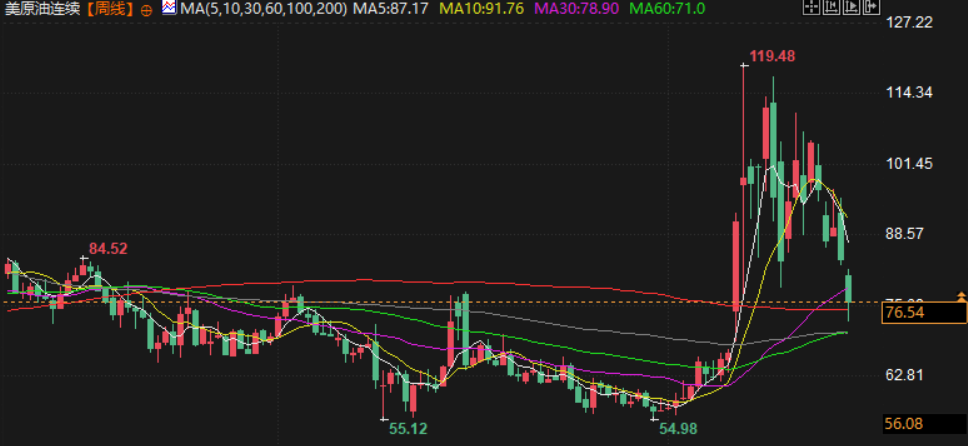
Oil prices rose more than 1% on Friday, with Brent crude up 1.2% to $80.33 a barrel and WTI crude up 1.35% to $76.54, but still down about 8% for the week. The core driver of this significant decline was the rapid release of geopolitical risks – the ceasefire agreement between Israel and Hezbollah in Lebanon, and the signing of a temporary memorandum of understanding between the United States and Iran to end the war. These two diplomatic breakthroughs occurred almost simultaneously, completely reversing previous extreme market concerns about supply disruptions in the Middle East.

It's worth noting that Friday's trading was light due to the US federal holiday, meaning the price rebound that day may lack sufficient liquidity support, casting doubt on its sustainability. At a deeper level, this weekly plunge signifies that the geopolitical risk premium accumulated over the past two months is being systematically squeezed out, with the market shifting its pricing focus back to supply and demand fundamentals. However, Iran's imposition of additional conditions on passage through the Strait of Hormuz casts a shadow over the full normalization of supply, meaning that oil prices still retain some uncertainty premiums within the downward trend.
The postponement of US-Iran talks and the difficulties in implementing the interim agreement
The main factor driving oil prices lower this week was the signing of an electronic memorandum of understanding between the US and Iran. However, the meeting between US and Iranian officials, originally scheduled for Friday in Burgenstock, Switzerland, has been postponed, and talks are currently being arranged for the next few days.
The Iranian Foreign Ministry explained that the meeting was no longer urgent, as the two sides had already remotely signed a memorandum of understanding on ending the war. However, the White House attributed the postponement to the fact that "logistical arrangements are never simple and unpredictable."
However, according to Axios, U.S. envoy Witkov and Trump's son-in-law Kushner are already in Switzerland, and Iranian Foreign Minister Araghchi plans to travel there on Saturday. Sources say the negotiations may not begin until next Monday at the earliest.
The repeated changes to this timeline reflect the deep differences that remain between the two sides at the implementation level. According to the terms of the memorandum of understanding, thorny issues (including Iran's nuclear program) were postponed for 60 days, giving both sides time to reach a lasting agreement or extend the interim agreement. However, the Iranian Foreign Ministry made it clear that the United States would be held responsible for any breach of its commitments under the agreement, including the commitment to end the fighting in Lebanon—linking the Lebanese ceasefire to the US-Iran agreement and increasing the complexity of implementation. Iranian Foreign Minister Araghchi emphasized to several foreign ministers that the Lebanese ceasefire was crucial for Iran and "decisive" in the US-Iran negotiations, and that Iran wanted to see the ceasefire implemented before going to Switzerland. This position essentially sets a precondition for subsequent negotiations, making the 60-day window potentially risk being substantially shortened.
A ceasefire agreement between Israel and Hezbollah has been reached and taken effect.
Israel and the Iranian-backed Lebanese Hezbollah officially ceasefire at 4 p.m. local time on Friday (9 p.m. Beijing time). The fighting had escalated significantly earlier, even threatening the possibility of the interim US-Iran agreement becoming a lasting peace.
Under the terms of the agreement, Israel will maintain its troops in southern Lebanon, while explicitly stating that "it is not a time of war for us if Hezbollah does not attack us." This statement essentially establishes a conditional and reversible ceasefire arrangement, rather than a full-fledged peace treaty. In the first hour after the ceasefire, Israel launched more than ten airstrikes, but no new airstrikes were recorded after 5 p.m., indicating that the agreement was largely implemented in its initial phase.
Multiple Hezbollah sources and a senior Israeli official confirmed the ceasefire, which was brokered by US and Qatari negotiators with Iranian assistance. This ceasefire arrangement directly clears the way for Gulf oil-producing countries to resume exports, but the fragile balance means that any violation by either side could quickly escalate tensions again.
The U.S. State Department announced that a new round of Lebanon-Israel dialogue will be held in Washington from June 23 to 25. During a phone call with Lebanese President Aoun, Secretary of State Rubio reiterated the "necessity of disarming Hezbollah" and reaffirmed U.S. support for a fully sovereign Lebanon.
The Lebanese presidential palace stated that a comprehensive ceasefire is a fundamental pillar of these negotiations. However, Hezbollah, as an Iranian-backed armed group, is deeply embedded in Lebanon's political and social structure, and its demands for disarmament face significant practical obstacles.
Resumption of shipping in the Strait of Hormuz and conditions for Iranian control
With the ceasefire agreement in effect, shipping activity in the Strait of Hormuz has rebounded significantly. MarineTraffic data shows that at least four oil tankers carrying crude oil, refined oil products, and liquefied petroleum gas entered the strait on Friday, bound for Iraqi Gulf ports. On June 18, a total of 25 merchant ships transited the strait, setting a new single-day record since April 18 and more than five times the average daily throughput for the first ten days of June. Ships have also resumed broadcasting their positions, ending the unconventional practice of concealing their movements by turning off transponders for several weeks.
However, the recovery of shipping is not without obstacles – Iran has sent clear signals of tightened controls: state television reported that ships must coordinate with the Revolutionary Guard Navy for transit, and the Persian Gulf Straits Authority (PGSA) stated in an undated announcement that "no vessel may pass through the Strait of Hormuz without a valid permit issued by the PGSA."
Furthermore, Iranian forces ordered a Hong Kong-flagged oil tanker and a Saint Kitts and Nevis-flagged bulk carrier to turn back on Thursday. British maritime security firm Ambrey confirmed these orders, indicating that Iran is attempting to transform the interim agreement into a permanent exercise of control over the Straits, rather than simply restoring freedom of passage. Shipbroker Braemar warned in a report that risks include the threat of mines and the possibility of ships becoming stranded in the Middle East Gulf should the situation escalate and Iran re-block the Straits. These conditions add significant uncertainty to the prospects for shipping recovery.
Massive amounts of crude oil awaiting release will drastically increase supply-side pressure.
Analysts predict that the US-Iran agreement will release more than 85 million barrels of crude oil stranded in the Gulf region into the global market. This figure alone constitutes a significant potential supply shock. At the same time, the agreement also includes the lifting of US sanctions on Iranian oil, meaning Iran will regain its normal export capacity as a major OPEC oil producer.
Gulf oil producers have begun to take action: Kuwait Petroleum Corporation (KPC) is selling crude oil for July delivery through a tender after lifting force majeure and announcing plans to increase production; Abu Dhabi National Oil Company (ADNOC) issued its fourth tender this month.
The US also officially lifted its blockade of Iranian ports on Thursday. This series of actions indicates that the supply-side valves are being opened simultaneously from multiple directions. Given that global crude oil demand has not seen significant growth despite previous geopolitical tensions, such a large potential increase in supply will exert sustained downward pressure on prices. Even if Iran imposes restrictions on passage through the Strait of Hormuz, in the long run, as long as the agreement is largely maintained, the increasing trend in crude oil supply is unlikely to reverse, constituting the core bearish factor for oil prices in the medium term.
It's worth noting that Friday's trading was light due to the US federal holiday, meaning the price rebound that day may lack sufficient liquidity support, casting doubt on its sustainability. At a deeper level, this weekly plunge signifies that the geopolitical risk premium accumulated over the past two months is being systematically squeezed out, with the market shifting its pricing focus back to supply and demand fundamentals. However, Iran's imposition of additional conditions on passage through the Strait of Hormuz casts a shadow over the full normalization of supply, meaning that oil prices still retain some uncertainty premiums within the downward trend.
The postponement of US-Iran talks and the difficulties in implementing the interim agreement
The main factor driving oil prices lower this week was the signing of an electronic memorandum of understanding between the US and Iran. However, the meeting between US and Iranian officials, originally scheduled for Friday in Burgenstock, Switzerland, has been postponed, and talks are currently being arranged for the next few days.
The Iranian Foreign Ministry explained that the meeting was no longer urgent, as the two sides had already remotely signed a memorandum of understanding on ending the war. However, the White House attributed the postponement to the fact that "logistical arrangements are never simple and unpredictable."
However, according to Axios, U.S. envoy Witkov and Trump's son-in-law Kushner are already in Switzerland, and Iranian Foreign Minister Araghchi plans to travel there on Saturday. Sources say the negotiations may not begin until next Monday at the earliest.
The repeated changes to this timeline reflect the deep differences that remain between the two sides at the implementation level. According to the terms of the memorandum of understanding, thorny issues (including Iran's nuclear program) were postponed for 60 days, giving both sides time to reach a lasting agreement or extend the interim agreement. However, the Iranian Foreign Ministry made it clear that the United States would be held responsible for any breach of its commitments under the agreement, including the commitment to end the fighting in Lebanon—linking the Lebanese ceasefire to the US-Iran agreement and increasing the complexity of implementation. Iranian Foreign Minister Araghchi emphasized to several foreign ministers that the Lebanese ceasefire was crucial for Iran and "decisive" in the US-Iran negotiations, and that Iran wanted to see the ceasefire implemented before going to Switzerland. This position essentially sets a precondition for subsequent negotiations, making the 60-day window potentially risk being substantially shortened.
A ceasefire agreement between Israel and Hezbollah has been reached and taken effect.
Israel and the Iranian-backed Lebanese Hezbollah officially ceasefire at 4 p.m. local time on Friday (9 p.m. Beijing time). The fighting had escalated significantly earlier, even threatening the possibility of the interim US-Iran agreement becoming a lasting peace.
Under the terms of the agreement, Israel will maintain its troops in southern Lebanon, while explicitly stating that "it is not a time of war for us if Hezbollah does not attack us." This statement essentially establishes a conditional and reversible ceasefire arrangement, rather than a full-fledged peace treaty. In the first hour after the ceasefire, Israel launched more than ten airstrikes, but no new airstrikes were recorded after 5 p.m., indicating that the agreement was largely implemented in its initial phase.
Multiple Hezbollah sources and a senior Israeli official confirmed the ceasefire, which was brokered by US and Qatari negotiators with Iranian assistance. This ceasefire arrangement directly clears the way for Gulf oil-producing countries to resume exports, but the fragile balance means that any violation by either side could quickly escalate tensions again.
The U.S. State Department announced that a new round of Lebanon-Israel dialogue will be held in Washington from June 23 to 25. During a phone call with Lebanese President Aoun, Secretary of State Rubio reiterated the "necessity of disarming Hezbollah" and reaffirmed U.S. support for a fully sovereign Lebanon.
The Lebanese presidential palace stated that a comprehensive ceasefire is a fundamental pillar of these negotiations. However, Hezbollah, as an Iranian-backed armed group, is deeply embedded in Lebanon's political and social structure, and its demands for disarmament face significant practical obstacles.
Resumption of shipping in the Strait of Hormuz and conditions for Iranian control
With the ceasefire agreement in effect, shipping activity in the Strait of Hormuz has rebounded significantly. MarineTraffic data shows that at least four oil tankers carrying crude oil, refined oil products, and liquefied petroleum gas entered the strait on Friday, bound for Iraqi Gulf ports. On June 18, a total of 25 merchant ships transited the strait, setting a new single-day record since April 18 and more than five times the average daily throughput for the first ten days of June. Ships have also resumed broadcasting their positions, ending the unconventional practice of concealing their movements by turning off transponders for several weeks.
However, the recovery of shipping is not without obstacles – Iran has sent clear signals of tightened controls: state television reported that ships must coordinate with the Revolutionary Guard Navy for transit, and the Persian Gulf Straits Authority (PGSA) stated in an undated announcement that "no vessel may pass through the Strait of Hormuz without a valid permit issued by the PGSA."
Furthermore, Iranian forces ordered a Hong Kong-flagged oil tanker and a Saint Kitts and Nevis-flagged bulk carrier to turn back on Thursday. British maritime security firm Ambrey confirmed these orders, indicating that Iran is attempting to transform the interim agreement into a permanent exercise of control over the Straits, rather than simply restoring freedom of passage. Shipbroker Braemar warned in a report that risks include the threat of mines and the possibility of ships becoming stranded in the Middle East Gulf should the situation escalate and Iran re-block the Straits. These conditions add significant uncertainty to the prospects for shipping recovery.
Massive amounts of crude oil awaiting release will drastically increase supply-side pressure.
Analysts predict that the US-Iran agreement will release more than 85 million barrels of crude oil stranded in the Gulf region into the global market. This figure alone constitutes a significant potential supply shock. At the same time, the agreement also includes the lifting of US sanctions on Iranian oil, meaning Iran will regain its normal export capacity as a major OPEC oil producer.
Gulf oil producers have begun to take action: Kuwait Petroleum Corporation (KPC) is selling crude oil for July delivery through a tender after lifting force majeure and announcing plans to increase production; Abu Dhabi National Oil Company (ADNOC) issued its fourth tender this month.
The US also officially lifted its blockade of Iranian ports on Thursday. This series of actions indicates that the supply-side valves are being opened simultaneously from multiple directions. Given that global crude oil demand has not seen significant growth despite previous geopolitical tensions, such a large potential increase in supply will exert sustained downward pressure on prices. Even if Iran imposes restrictions on passage through the Strait of Hormuz, in the long run, as long as the agreement is largely maintained, the increasing trend in crude oil supply is unlikely to reverse, constituting the core bearish factor for oil prices in the medium term.
- Risk Warning and Disclaimer
- The market involves risk, and trading may not be suitable for all investors. This article is for reference only and does not constitute personal investment advice, nor does it take into account certain users’ specific investment objectives, financial situation, or other needs. Any investment decisions made based on this information are at your own risk.