June 22nd Financial Breakfast: A stronger dollar limited gold price gains; US-Iran-Switzerland talks resumed but then stalled again; US oil surged over 2%.
2026-06-22 07:23:37
On Monday (June 22, Beijing time) in early Asian trading, spot gold was trading around $4,157 per ounce. Although geopolitical uncertainties supported gold prices, a stronger dollar and hawkish signals from the Federal Reserve limited gains. US-Iran-Switzerland negotiations resumed on Sunday, but were suspended after about an hour and a half as US President Trump threatened Iran to refuse to return to talks. Oil prices were boosted by this, with US crude rising over 2%, briefly surpassing $98 per barrel at the open, and currently trading around $77.67 per barrel.

Gold prices fell more than 1% on Friday to $4,155.44 an ounce, after hitting a more than one-week low of $4,121.79 during the session. This marked the third consecutive week of declines, primarily driven by a stronger dollar and hawkish signals from the Federal Reserve, which put pressure on non-interest-bearing assets. Gold prices have remained below the 200-day moving average since June 5th.
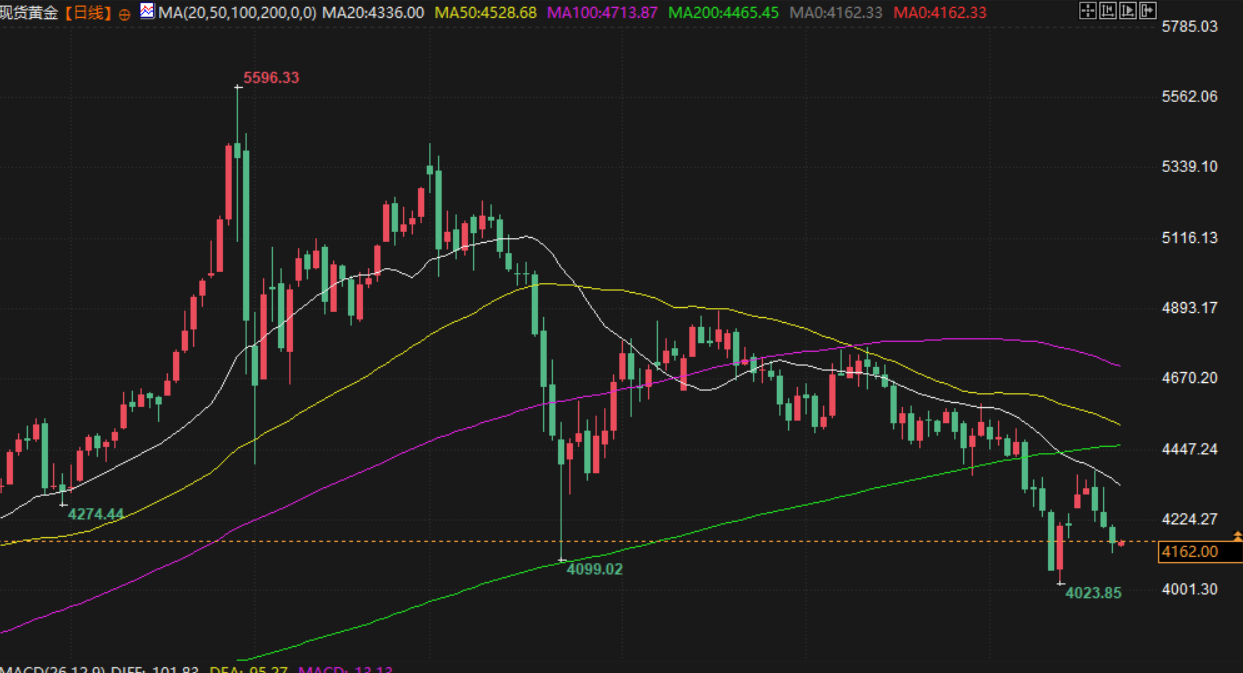
Nikos Tzabouras, senior market analyst at Tradedu.com, a subsidiary of Jefferies, pointed out that gold faces a significant risk of falling further below the $4,000 mark. Market expectations that the Federal Reserve will "maintain higher interest rates for a longer period" are unfavorable for gold prices, while supporting the US dollar.
According to the latest forecasts from the Federal Reserve, 9 out of 19 policymakers believe that interest rates need to be raised this year, while the CME Group's FedWatch tool shows that traders expect a 70% probability of a rate hike before September. The market's future direction will depend on the progress of US-Iran negotiations, this week's US inflation data, and the market's pricing in the Fed's policy path.
Goldman Sachs lowered its December gold price forecast from $5,400 to $4,900, stating that it is structurally bullish but remains tactically cautious.
Oil prices rose on Friday, with Brent crude up 1.2% to $80.33 a barrel and WTI crude up 1.35% to $76.54, but the weekly decline was still as high as about 8%, the largest weekly drop in recent times.
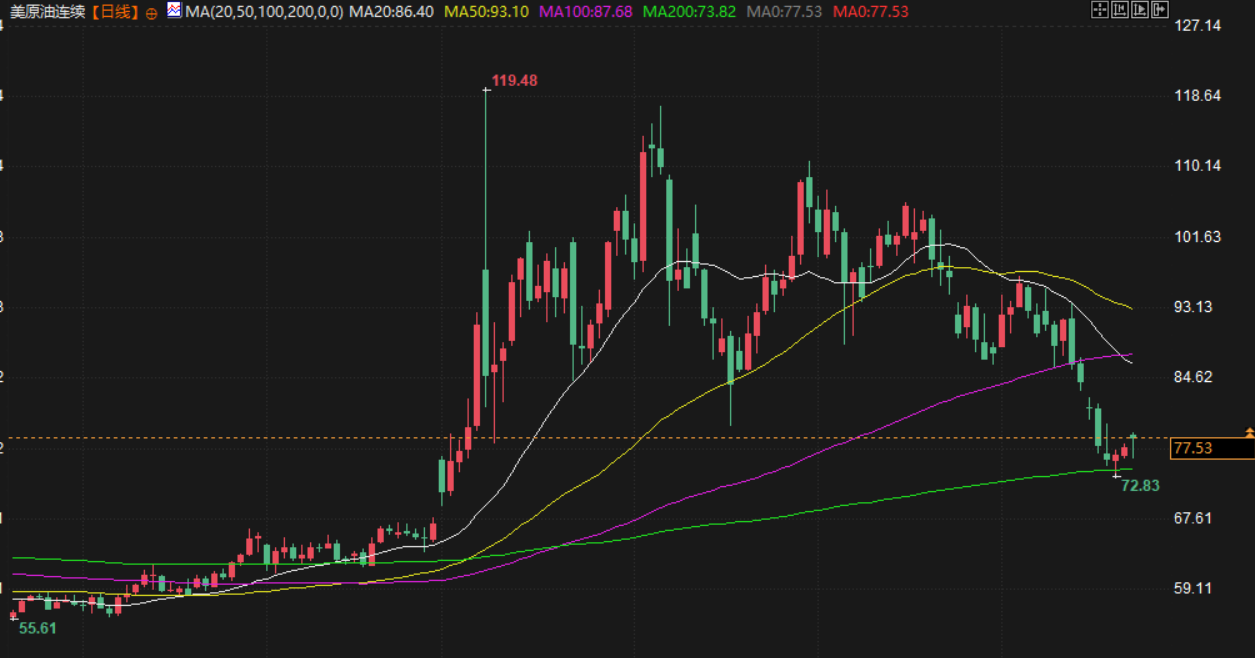
Following the ceasefire between the US and Iran taking effect on Friday, Gulf oil-producing countries prepared to increase exports. At least four oil tankers entered the Strait of Hormuz on Friday, heading to Iraqi ports. However, Iran signaled stricter controls, requiring ships to obtain permission from the Revolutionary Guard before passage. Concerns about this pushed up oil prices that day.
Although US and Iranian delegations officially began peace agreement negotiations in Switzerland on Sunday, US President Trump threatened military action during the talks, stating that the US would launch military strikes if Hezbollah continued its attacks on Israel. Trump's tough stance, coinciding with the negotiation window, reignited investor concerns about the Middle East situation. Amid increased geopolitical uncertainty, market risk appetite was suppressed, supporting oil prices.
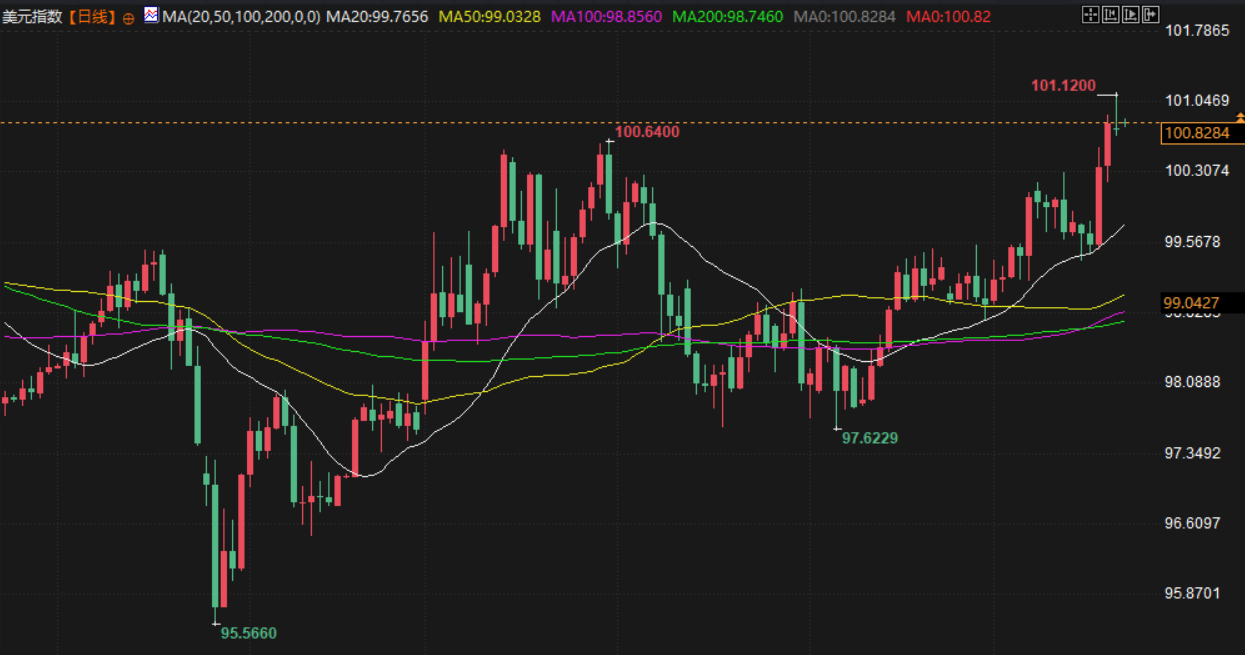
The dollar index climbed about 1% to a 13-month high on Friday, supported by hawkish signals from the Federal Reserve meeting, in which nine of the 19 policymakers predicted a rate hike before the end of the year. This pushed the dollar to near a two-year low of 161.80 against the yen, just a step away from 161.94, which was reached in July 2024. A break above this level would bring it to its lowest level in nearly 40 years since 1986. Traders are wary that Japanese authorities may intervene directly in the foreign exchange market, as they did in late April and early May.
Meanwhile, the dollar touched a seven-month high of 0.8091 against the Swiss franc, with the franc weakening due to the Swiss National Bank keeping interest rates unchanged and reiterating its commitment to more aggressive intervention to curb the franc's appreciation. The pound, however, bucked the trend, rising after hitting a more than two-month low of 1.3164 before rebounding to 1.322, driven by stronger-than-expected May retail sales data and a landslide victory for Greater Manchester Mayor Burnham, representing the Labour Party, in a by-election that paved the way for his challenge to Prime Minister Starmer.
The euro touched a three-month low of 1.1418 against the dollar before rising slightly to 1.1464, while news of an uncertain future for a peace agreement between Iran and the United States and a ceasefire agreement between Israel and Hezbollah in Lebanon also provided support for safe-haven currencies.
According to CME's "FedWatch": the probability of the Federal Reserve keeping interest rates unchanged in December is 8%, the probability of raising rates by at least 25 basis points is 92%, and the probability of raising rates by at least 50 basis points is 60.6%.
Sources say US-Iran negotiations remain suspended.
According to Iranian sources on the 22nd, a source stated that negotiations between Iran and the United States in Switzerland began around 3 PM local time on the 21st. After lasting approximately one and a half hours, the talks were adjourned for 30 minutes to allow for internal consultations between the delegations. However, due to threatening remarks made by Trump, the Iranian delegation refused to return to continue negotiations. Despite this, Qatar and Pakistan continued their mediation efforts, with Iran and the United States communicating through intermediaries. Mediation efforts are ongoing, but no final result has been achieved. During the negotiations, the Iranian delegation lodged a clear protest against the US's breach of commitments, particularly Article 1 of the Memorandum of Understanding. The Iranian delegation also demanded that the US expedite the fulfillment of its commitments, including unfreezing frozen Iranian assets and issuing sanctions waivers for Iranian oil exports. Regarding the nuclear issue, the Iranian delegation emphasized that the prerequisite for initiating nuclear negotiations is that the US fulfill its commitments according to Articles 1, 4, 10, and 11 of the Memorandum. (CCTV News)
British Business Secretary Denies Starmer's Plans to Resign on Monday
British Business Secretary Peter Keill said on Sunday that he had no reason to believe Prime Minister Keir Starmer planned to announce his resignation on Monday. Keill said he had a “frank” conversation with Starmer on Friday. This came after The Observer reported that Starmer was expected to resign and announce a timetable for his departure on Monday. A government source had previously stated that Starmer remained focused on continuing to fulfill his governing duties. Despite calls from over 100 Labour MPs for Starmer's resignation or a timetable for his departure, and Burnham's victory in the by-election giving him a leadership challenge, Keill's latest statement further reinforces the signal that Starmer will remain in office.
Ukraine's accession to the EU enters negotiation stage, internal divisions emerge.
The EU summer summit was held in Brussels from July 18th to 19th local time. During the summit, Ukrainian President Zelenskyy again urged the EU to accelerate the process of Ukraine's accession to the EU. However, as the issue of Ukraine's accession enters a substantial stage of progress, differences among EU member states on issues such as the pace of expansion, financial burden, and institutional reforms are gradually emerging. (CCTV News)
Iranian Revolutionary Guard: The war is not over yet; a 50-year deterrent must be ensured; the US and Israel are at an impasse.
The Iranian Revolutionary Guard stated that the war and defense are not over, and the war must end in a way that ensures Iran maintains its deterrent power for the next fifty years. The rights of the Iranian people and the resistance must be consolidated. The Revolutionary Guard pointed out that the US and Israel realized the situation was out of control by the fifteenth day of the war, citing reasons such as internal chaos in the US, US military fatigue and inadequate preparation, the lack of a military solution for the Strait of Hormuz, congressional obstruction, lack of cooperation from allies, and pressure from the international community, represented by Spain. The Revolutionary Guard claimed that Iranian armed forces severely damaged the most advanced US technology and equipment, that Iran's international status and prestige have significantly improved in this war, and stressed that the Strait of Hormuz and Iran's regional sovereignty are inviolable, identifying the US as a defeated and helpless criminal.
The United States announced that a new round of Lebanon-Israel talks will be held in Washington from June 23-25.
The U.S. State Department said Friday that following a phone call between Secretary of State Marco Rubio and Lebanese President Michel Aoun, both sides confirmed that a new round of Lebanon-Israel dialogue will be held in Washington from June 23 to 25. State Department spokesman Tommy Pigott said in a statement that Rubio reiterated the necessity of disarming Hezbollah. Rubio also confirmed that the United States supports the Lebanese government's efforts to establish a fully sovereign state that can live peacefully with all its neighbors.
SIPRI Report: South Korea Becomes One of the World's Fastest Growing Arms Suppliers, Second Only to the United States in Supplying Europe.
A report by the Stockholm International Peace Research Institute (SIPRI) shows that South Korea has become one of the world's fastest-growing arms suppliers. The combined revenue of South Korea's four major defense companies—Hanwha Group, Hyundai Rotem, LIG Nex1, and Korea Aerospace Industries—is projected to reach approximately $37 billion this year, nearly tripling from 2021. Furthermore, South Korea has become the second-largest source of arms supplies to NATO member states in Europe, second only to the United States.
Israeli media: Israel is considering a "small-scale withdrawal" of troops from southern Lebanon.
Israel's Channel 12 television website reported on the evening of the 21st that Israel is considering a "small-scale withdrawal" of troops from southern Lebanon. The report stated that a series of consultations were held by high-ranking Israeli political and security officials in the past 24 hours, and that Israel and the United States also communicated "at various levels." The report quoted a senior official familiar with the matter as saying that Israel has not yet received any requests from the United States for the withdrawal of Israeli troops from southern Lebanon, but Israel is studying a "small-scale withdrawal" from some areas outside the "yellow line" currently under Israeli control. (Xinhua)
Members of the Iranian negotiating team stated that a draft bill for waivers of Iranian oil sanctions has been finalized.
On the 21st local time, according to Iranian sources, a member of the Iranian negotiating team revealed that the draft of the waiver for Iranian oil sanctions has been finalized, adding that the waiver will be issued soon. Administrative procedures for unfreezing Iranian funds are underway with the participation of a Qatari delegation. (CCTV News)
The first round of direct talks between Iran and the United States did not address the nuclear issue.
Iranian state television reported on June 21 that the four-party talks, with Pakistan and Qatar as mediators, were temporarily suspended after 80 minutes of negotiations for a break and internal consultations. The report also stated that, contrary to some foreign media reports, the first round of talks did not discuss issues related to Iran's nuclear program, but instead focused on implementing Article 13 of the Memorandum of Understanding and prioritizing issues related to Lebanon.
Iranian President reiterates that he will never give up the right to enrich uranium.
In a video broadcast by Iranian media on June 21, Iranian President Pezechzian stated that Iran will never relinquish its right to enrich uranium, and the United States will ultimately be forced to accept it. The Iranian president said the US cannot ignore Iran's rights. Pezechzian stated that US President Trump's attitude has undergone a 180-degree turn, previously saying Iran must surrender unconditionally and has no right to do this or that, then later saying Iran has the right—a complete reversal of stance. This shows that Trump has acknowledged that the US cannot ignore Iran's rights. (CCTV International News)
Trump again threatens Iran over Lebanon
US President Donald Trump posted on social media on the 21st that Iran must immediately cease its proxy operations in Lebanon, or the US will launch another fierce attack on Iran, "just like last week, and even fiercer." (Xinhua)
Vance said that US-Iran negotiations "will not resolve all differences."
U.S. Vice President Vance said in Bielgen, Switzerland, on the 21st that the U.S.-Iran negotiations had made "great progress in the past few hours," and he expected "we will make more progress in relevant areas," but the negotiations "will not resolve all differences." At the start of the U.S.-Iran negotiations, Vance said, "Today really represents the beginning of technical negotiations—it won't resolve all differences, but it's the first time we've sat down together as a team." Vance stated that political leadership from all sides were gathered there "hoping to build a framework for the second phase of negotiations" and to achieve breakthroughs in key areas. "There's still a lot of work to be done." Vance said that if Iran is willing to abandon its pursuit of nuclear weapons, the U.S. is willing to "fundamentally" change the bilateral relationship between the U.S. and Iran. He said that in the past few days, "we've made great progress in securing a ceasefire in Lebanon." Vance defended the repeated violations of the Israel-Lebanon ceasefire agreement, saying, "These things are always a bit messy." Vance said the question now is, "Can we turn a new page, can we permanently change the landscape of relations in the Middle East, or are we going to go back to the old ways of doing things—which, while not what we want, is certainly possible." (Xinhua)
Polls show Netanyahu's approval ratings have plummeted.
A poll released on the 21st showed that Israeli Prime Minister Benjamin Netanyahu's approval rating has plummeted, falling from 40.5% in early March to 29.4%. The poll, conducted jointly by the Hebrew University of Jerusalem and the think tank Agam Lab, surveyed 3,644 respondents between June 17th and 20th. The results indicate that the Israeli government is facing a crisis of confidence. (Xinhua)
The 2026 APEC CEO Forum in China will be held in Beijing.
On June 21, the 2026 APEC CEO Summit China Forum was successfully held in Beijing. Ren Hongbin, Chairman of the China Council for the Promotion of International Trade (CCPIT) and Chairman of the 2026 APEC CEO Summit, stated that the Asia-Pacific region accounts for over 60% of the world's total economic output and nearly half of its trade volume. The Asia-Pacific business community should work together to uphold the multilateral trading system with the WTO at its core, continuously promote regional trade and investment liberalization and facilitation, and deepen the process of Asia-Pacific economic integration. This year marks China's third time hosting APEC and is also the first year of China's 15th Five-Year Plan. The CCPIT and the China Chamber of International Commerce are willing to join hands with the Asia-Pacific business community to explore cooperation potential, promote the deep integration of industrial chains, supply chains, and value chains, and contribute to building an Asia-Pacific community. (China CCPIT)
Pan Gongsheng, Governor of the People's Bank of China, met with Indonesian Finance Minister Purbaya Yudi Sadeva.
On June 18, 2026, Pan Gongsheng, Governor of the People's Bank of China, met with Purbayar Yudi Sadeva, Minister of Finance of Indonesia. The two sides exchanged views on the current economic and financial situation, China-Indonesia financial cooperation, and the issuance of RMB-denominated bonds (Panda Bonds) by the Indonesian Ministry of Finance in my country. (PBOC)
Key Focus Today
Gold Market
Gold prices fell more than 1% on Friday to $4,155.44 an ounce, after hitting a more than one-week low of $4,121.79 during the session. This marked the third consecutive week of declines, primarily driven by a stronger dollar and hawkish signals from the Federal Reserve, which put pressure on non-interest-bearing assets. Gold prices have remained below the 200-day moving average since June 5th.
Nikos Tzabouras, senior market analyst at Tradedu.com, a subsidiary of Jefferies, pointed out that gold faces a significant risk of falling further below the $4,000 mark. Market expectations that the Federal Reserve will "maintain higher interest rates for a longer period" are unfavorable for gold prices, while supporting the US dollar.
According to the latest forecasts from the Federal Reserve, 9 out of 19 policymakers believe that interest rates need to be raised this year, while the CME Group's FedWatch tool shows that traders expect a 70% probability of a rate hike before September. The market's future direction will depend on the progress of US-Iran negotiations, this week's US inflation data, and the market's pricing in the Fed's policy path.
Goldman Sachs lowered its December gold price forecast from $5,400 to $4,900, stating that it is structurally bullish but remains tactically cautious.
oil market
Oil prices rose on Friday, with Brent crude up 1.2% to $80.33 a barrel and WTI crude up 1.35% to $76.54, but the weekly decline was still as high as about 8%, the largest weekly drop in recent times.
Following the ceasefire between the US and Iran taking effect on Friday, Gulf oil-producing countries prepared to increase exports. At least four oil tankers entered the Strait of Hormuz on Friday, heading to Iraqi ports. However, Iran signaled stricter controls, requiring ships to obtain permission from the Revolutionary Guard before passage. Concerns about this pushed up oil prices that day.
Although US and Iranian delegations officially began peace agreement negotiations in Switzerland on Sunday, US President Trump threatened military action during the talks, stating that the US would launch military strikes if Hezbollah continued its attacks on Israel. Trump's tough stance, coinciding with the negotiation window, reignited investor concerns about the Middle East situation. Amid increased geopolitical uncertainty, market risk appetite was suppressed, supporting oil prices.
Foreign exchange market
The dollar index climbed about 1% to a 13-month high on Friday, supported by hawkish signals from the Federal Reserve meeting, in which nine of the 19 policymakers predicted a rate hike before the end of the year. This pushed the dollar to near a two-year low of 161.80 against the yen, just a step away from 161.94, which was reached in July 2024. A break above this level would bring it to its lowest level in nearly 40 years since 1986. Traders are wary that Japanese authorities may intervene directly in the foreign exchange market, as they did in late April and early May.
Meanwhile, the dollar touched a seven-month high of 0.8091 against the Swiss franc, with the franc weakening due to the Swiss National Bank keeping interest rates unchanged and reiterating its commitment to more aggressive intervention to curb the franc's appreciation. The pound, however, bucked the trend, rising after hitting a more than two-month low of 1.3164 before rebounding to 1.322, driven by stronger-than-expected May retail sales data and a landslide victory for Greater Manchester Mayor Burnham, representing the Labour Party, in a by-election that paved the way for his challenge to Prime Minister Starmer.
The euro touched a three-month low of 1.1418 against the dollar before rising slightly to 1.1464, while news of an uncertain future for a peace agreement between Iran and the United States and a ceasefire agreement between Israel and Hezbollah in Lebanon also provided support for safe-haven currencies.
International News
According to CME's "FedWatch": the probability of the Federal Reserve keeping interest rates unchanged in December is 8%, the probability of raising rates by at least 25 basis points is 92%, and the probability of raising rates by at least 50 basis points is 60.6%.
Sources say US-Iran negotiations remain suspended.
According to Iranian sources on the 22nd, a source stated that negotiations between Iran and the United States in Switzerland began around 3 PM local time on the 21st. After lasting approximately one and a half hours, the talks were adjourned for 30 minutes to allow for internal consultations between the delegations. However, due to threatening remarks made by Trump, the Iranian delegation refused to return to continue negotiations. Despite this, Qatar and Pakistan continued their mediation efforts, with Iran and the United States communicating through intermediaries. Mediation efforts are ongoing, but no final result has been achieved. During the negotiations, the Iranian delegation lodged a clear protest against the US's breach of commitments, particularly Article 1 of the Memorandum of Understanding. The Iranian delegation also demanded that the US expedite the fulfillment of its commitments, including unfreezing frozen Iranian assets and issuing sanctions waivers for Iranian oil exports. Regarding the nuclear issue, the Iranian delegation emphasized that the prerequisite for initiating nuclear negotiations is that the US fulfill its commitments according to Articles 1, 4, 10, and 11 of the Memorandum. (CCTV News)
British Business Secretary Denies Starmer's Plans to Resign on Monday
British Business Secretary Peter Keill said on Sunday that he had no reason to believe Prime Minister Keir Starmer planned to announce his resignation on Monday. Keill said he had a “frank” conversation with Starmer on Friday. This came after The Observer reported that Starmer was expected to resign and announce a timetable for his departure on Monday. A government source had previously stated that Starmer remained focused on continuing to fulfill his governing duties. Despite calls from over 100 Labour MPs for Starmer's resignation or a timetable for his departure, and Burnham's victory in the by-election giving him a leadership challenge, Keill's latest statement further reinforces the signal that Starmer will remain in office.
Ukraine's accession to the EU enters negotiation stage, internal divisions emerge.
The EU summer summit was held in Brussels from July 18th to 19th local time. During the summit, Ukrainian President Zelenskyy again urged the EU to accelerate the process of Ukraine's accession to the EU. However, as the issue of Ukraine's accession enters a substantial stage of progress, differences among EU member states on issues such as the pace of expansion, financial burden, and institutional reforms are gradually emerging. (CCTV News)
Iranian Revolutionary Guard: The war is not over yet; a 50-year deterrent must be ensured; the US and Israel are at an impasse.
The Iranian Revolutionary Guard stated that the war and defense are not over, and the war must end in a way that ensures Iran maintains its deterrent power for the next fifty years. The rights of the Iranian people and the resistance must be consolidated. The Revolutionary Guard pointed out that the US and Israel realized the situation was out of control by the fifteenth day of the war, citing reasons such as internal chaos in the US, US military fatigue and inadequate preparation, the lack of a military solution for the Strait of Hormuz, congressional obstruction, lack of cooperation from allies, and pressure from the international community, represented by Spain. The Revolutionary Guard claimed that Iranian armed forces severely damaged the most advanced US technology and equipment, that Iran's international status and prestige have significantly improved in this war, and stressed that the Strait of Hormuz and Iran's regional sovereignty are inviolable, identifying the US as a defeated and helpless criminal.
The United States announced that a new round of Lebanon-Israel talks will be held in Washington from June 23-25.
The U.S. State Department said Friday that following a phone call between Secretary of State Marco Rubio and Lebanese President Michel Aoun, both sides confirmed that a new round of Lebanon-Israel dialogue will be held in Washington from June 23 to 25. State Department spokesman Tommy Pigott said in a statement that Rubio reiterated the necessity of disarming Hezbollah. Rubio also confirmed that the United States supports the Lebanese government's efforts to establish a fully sovereign state that can live peacefully with all its neighbors.
SIPRI Report: South Korea Becomes One of the World's Fastest Growing Arms Suppliers, Second Only to the United States in Supplying Europe.
A report by the Stockholm International Peace Research Institute (SIPRI) shows that South Korea has become one of the world's fastest-growing arms suppliers. The combined revenue of South Korea's four major defense companies—Hanwha Group, Hyundai Rotem, LIG Nex1, and Korea Aerospace Industries—is projected to reach approximately $37 billion this year, nearly tripling from 2021. Furthermore, South Korea has become the second-largest source of arms supplies to NATO member states in Europe, second only to the United States.
Israeli media: Israel is considering a "small-scale withdrawal" of troops from southern Lebanon.
Israel's Channel 12 television website reported on the evening of the 21st that Israel is considering a "small-scale withdrawal" of troops from southern Lebanon. The report stated that a series of consultations were held by high-ranking Israeli political and security officials in the past 24 hours, and that Israel and the United States also communicated "at various levels." The report quoted a senior official familiar with the matter as saying that Israel has not yet received any requests from the United States for the withdrawal of Israeli troops from southern Lebanon, but Israel is studying a "small-scale withdrawal" from some areas outside the "yellow line" currently under Israeli control. (Xinhua)
Members of the Iranian negotiating team stated that a draft bill for waivers of Iranian oil sanctions has been finalized.
On the 21st local time, according to Iranian sources, a member of the Iranian negotiating team revealed that the draft of the waiver for Iranian oil sanctions has been finalized, adding that the waiver will be issued soon. Administrative procedures for unfreezing Iranian funds are underway with the participation of a Qatari delegation. (CCTV News)
The first round of direct talks between Iran and the United States did not address the nuclear issue.
Iranian state television reported on June 21 that the four-party talks, with Pakistan and Qatar as mediators, were temporarily suspended after 80 minutes of negotiations for a break and internal consultations. The report also stated that, contrary to some foreign media reports, the first round of talks did not discuss issues related to Iran's nuclear program, but instead focused on implementing Article 13 of the Memorandum of Understanding and prioritizing issues related to Lebanon.
Iranian President reiterates that he will never give up the right to enrich uranium.
In a video broadcast by Iranian media on June 21, Iranian President Pezechzian stated that Iran will never relinquish its right to enrich uranium, and the United States will ultimately be forced to accept it. The Iranian president said the US cannot ignore Iran's rights. Pezechzian stated that US President Trump's attitude has undergone a 180-degree turn, previously saying Iran must surrender unconditionally and has no right to do this or that, then later saying Iran has the right—a complete reversal of stance. This shows that Trump has acknowledged that the US cannot ignore Iran's rights. (CCTV International News)
Trump again threatens Iran over Lebanon
US President Donald Trump posted on social media on the 21st that Iran must immediately cease its proxy operations in Lebanon, or the US will launch another fierce attack on Iran, "just like last week, and even fiercer." (Xinhua)
Vance said that US-Iran negotiations "will not resolve all differences."
U.S. Vice President Vance said in Bielgen, Switzerland, on the 21st that the U.S.-Iran negotiations had made "great progress in the past few hours," and he expected "we will make more progress in relevant areas," but the negotiations "will not resolve all differences." At the start of the U.S.-Iran negotiations, Vance said, "Today really represents the beginning of technical negotiations—it won't resolve all differences, but it's the first time we've sat down together as a team." Vance stated that political leadership from all sides were gathered there "hoping to build a framework for the second phase of negotiations" and to achieve breakthroughs in key areas. "There's still a lot of work to be done." Vance said that if Iran is willing to abandon its pursuit of nuclear weapons, the U.S. is willing to "fundamentally" change the bilateral relationship between the U.S. and Iran. He said that in the past few days, "we've made great progress in securing a ceasefire in Lebanon." Vance defended the repeated violations of the Israel-Lebanon ceasefire agreement, saying, "These things are always a bit messy." Vance said the question now is, "Can we turn a new page, can we permanently change the landscape of relations in the Middle East, or are we going to go back to the old ways of doing things—which, while not what we want, is certainly possible." (Xinhua)
Polls show Netanyahu's approval ratings have plummeted.
A poll released on the 21st showed that Israeli Prime Minister Benjamin Netanyahu's approval rating has plummeted, falling from 40.5% in early March to 29.4%. The poll, conducted jointly by the Hebrew University of Jerusalem and the think tank Agam Lab, surveyed 3,644 respondents between June 17th and 20th. The results indicate that the Israeli government is facing a crisis of confidence. (Xinhua)
Domestic News
The 2026 APEC CEO Forum in China will be held in Beijing.
On June 21, the 2026 APEC CEO Summit China Forum was successfully held in Beijing. Ren Hongbin, Chairman of the China Council for the Promotion of International Trade (CCPIT) and Chairman of the 2026 APEC CEO Summit, stated that the Asia-Pacific region accounts for over 60% of the world's total economic output and nearly half of its trade volume. The Asia-Pacific business community should work together to uphold the multilateral trading system with the WTO at its core, continuously promote regional trade and investment liberalization and facilitation, and deepen the process of Asia-Pacific economic integration. This year marks China's third time hosting APEC and is also the first year of China's 15th Five-Year Plan. The CCPIT and the China Chamber of International Commerce are willing to join hands with the Asia-Pacific business community to explore cooperation potential, promote the deep integration of industrial chains, supply chains, and value chains, and contribute to building an Asia-Pacific community. (China CCPIT)
Pan Gongsheng, Governor of the People's Bank of China, met with Indonesian Finance Minister Purbaya Yudi Sadeva.
On June 18, 2026, Pan Gongsheng, Governor of the People's Bank of China, met with Purbayar Yudi Sadeva, Minister of Finance of Indonesia. The two sides exchanged views on the current economic and financial situation, China-Indonesia financial cooperation, and the issuance of RMB-denominated bonds (Panda Bonds) by the Indonesian Ministry of Finance in my country. (PBOC)
- Risk Warning and Disclaimer
- The market involves risk, and trading may not be suitable for all investors. This article is for reference only and does not constitute personal investment advice, nor does it take into account certain users’ specific investment objectives, financial situation, or other needs. Any investment decisions made based on this information are at your own risk.