Asset management guru: US fiscal debt is the core support, and the foundation for a long-term bull market in gold remains intact.
2026-06-22 11:07:21
There are widespread concerns that the new Federal Reserve chairman's anti-inflation policies will put downward pressure on gold, but Axel Merk, founder of Merck Investments, offers a completely different assessment.
He believes that Warsh's hawkish measures will only cause short-term fluctuations in gold prices, but will stabilize market volatility in the long run. The underlying logic supporting the gold bull market is the structural problems such as high US debt and persistent fiscal deficits. Investors should not judge the value of gold simply by the rise and fall of interest rates.
Last Wednesday (June 17), Kevin Warsh held his first press conference as Chairman of the Federal Reserve, focusing on stabilizing prices and curbing inflation as the core of his policies. His hawkish rhetoric led the market to significantly raise its expectations for interest rate hikes, and gold prices subsequently experienced a short-term correction.
Axel Merkle stated that, from an interest rate perspective alone, a hawkish policy would indeed create a short-term negative impact, but the institutional reforms implemented by Warsh have long-term benefits. He eliminated excessive forward guidance, weakened the dot plot's guidance on expectations, and reduced frequent central bank intervention in the market, avoiding the significant market volatility caused by past policy signal confusion.
He said, "The Fed's past policy adjustments have always been lagging, which can easily amplify market shocks. Reducing communication based on policy predictions can help avoid major decision-making errors and lower overall asset volatility." In his view, a stable market environment is more conducive to gold achieving sustained price increases.
The prevailing view in the industry is that rising US Treasury yields will increase the cost of holding non-interest-bearing gold, thereby suppressing gold prices. However, Merck questions this simplistic logic. He points out that gold's asset function has multiple attributes and is not solely influenced by interest rates. In periods of fiscal imbalance and weakened monetary credit, gold is a core tool for hedging against shrinking purchasing power.
Merck stated, "My core objective in allocating gold is to safeguard the real purchasing power of assets in the long term."
Even if Warsh gradually suppresses inflation, the entire adjustment cycle will last for several years. Referring to the historical experience of former Federal Reserve Chairman Paul Volcker, when he strongly controlled inflation, he failed to quickly bring inflation back to the 2% target. The easing of inflationary pressure is a long process, and the risks to the monetary system will not dissipate quickly during this period.
As policy expectations become less volatile, investors will gradually shift their focus away from closely monitoring Federal Reserve policies and refocus on the unsustainable fiscal situation in the United States. The ever-expanding fiscal deficit and continuously rising federal government debt are structural factors that are bullish for gold in the long term, and this logic will not disappear due to short-term interest rate hikes.
Recent pressure on gold prices has been compounded by geopolitical disturbances. Fluctuations in the situation related to Iran have impacted oil prices, inflation expectations, and real interest rates, briefly creating a correlation between gold and oil prices. Axel Merkle predicts that this short-term correlation will gradually dissipate, and once gold is no longer constrained by oil price movements, the independent upward trend will once again dominate the market.
In summary , the Federal Reserve's hawkish policy focused on inflation can only cause a short-term pullback in gold prices and cannot reverse the long-term upward trend of gold. Multiple core positive factors remain unchanged: policy communication reforms reduce market volatility, the risk of US fiscal debt persists, and geopolitical risks remain long-term. Investors should not simply link gold investment to interest rate trends. Allocating gold from the perspective of long-term asset preservation and hedging against credit risk still has ample logical support.
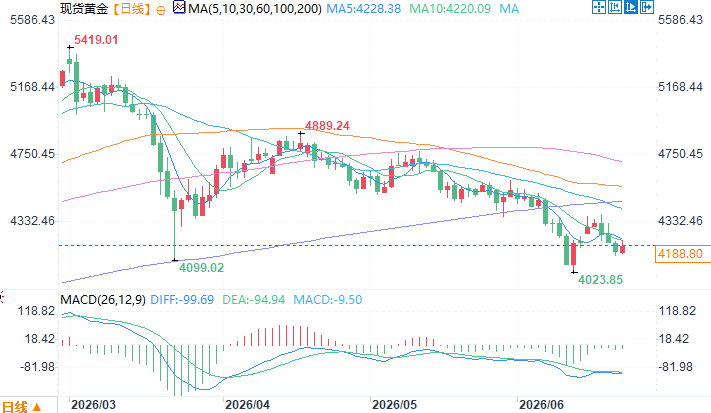
Spot gold daily chart source: EasyForex
At 11:07 AM Beijing time on June 22, spot gold was trading at $4188.16 per ounce.
He believes that Warsh's hawkish measures will only cause short-term fluctuations in gold prices, but will stabilize market volatility in the long run. The underlying logic supporting the gold bull market is the structural problems such as high US debt and persistent fiscal deficits. Investors should not judge the value of gold simply by the rise and fall of interest rates.
Warsh's hawkish stance is putting short-term downward pressure on gold prices, while reform measures are reducing market volatility.
Last Wednesday (June 17), Kevin Warsh held his first press conference as Chairman of the Federal Reserve, focusing on stabilizing prices and curbing inflation as the core of his policies. His hawkish rhetoric led the market to significantly raise its expectations for interest rate hikes, and gold prices subsequently experienced a short-term correction.
Axel Merkle stated that, from an interest rate perspective alone, a hawkish policy would indeed create a short-term negative impact, but the institutional reforms implemented by Warsh have long-term benefits. He eliminated excessive forward guidance, weakened the dot plot's guidance on expectations, and reduced frequent central bank intervention in the market, avoiding the significant market volatility caused by past policy signal confusion.
He said, "The Fed's past policy adjustments have always been lagging, which can easily amplify market shocks. Reducing communication based on policy predictions can help avoid major decision-making errors and lower overall asset volatility." In his view, a stable market environment is more conducive to gold achieving sustained price increases.
The opportunity cost logic of interest rates has limitations; the core value of gold lies in preserving purchasing power.
The prevailing view in the industry is that rising US Treasury yields will increase the cost of holding non-interest-bearing gold, thereby suppressing gold prices. However, Merck questions this simplistic logic. He points out that gold's asset function has multiple attributes and is not solely influenced by interest rates. In periods of fiscal imbalance and weakened monetary credit, gold is a core tool for hedging against shrinking purchasing power.
Merck stated, "My core objective in allocating gold is to safeguard the real purchasing power of assets in the long term."
Even if Warsh gradually suppresses inflation, the entire adjustment cycle will last for several years. Referring to the historical experience of former Federal Reserve Chairman Paul Volcker, when he strongly controlled inflation, he failed to quickly bring inflation back to the 2% target. The easing of inflationary pressure is a long process, and the risks to the monetary system will not dissipate quickly during this period.
Market focus will eventually return to fiscal risks, with massive debt providing long-term support for gold prices.
As policy expectations become less volatile, investors will gradually shift their focus away from closely monitoring Federal Reserve policies and refocus on the unsustainable fiscal situation in the United States. The ever-expanding fiscal deficit and continuously rising federal government debt are structural factors that are bullish for gold in the long term, and this logic will not disappear due to short-term interest rate hikes.
Recent pressure on gold prices has been compounded by geopolitical disturbances. Fluctuations in the situation related to Iran have impacted oil prices, inflation expectations, and real interest rates, briefly creating a correlation between gold and oil prices. Axel Merkle predicts that this short-term correlation will gradually dissipate, and once gold is no longer constrained by oil price movements, the independent upward trend will once again dominate the market.
In summary , the Federal Reserve's hawkish policy focused on inflation can only cause a short-term pullback in gold prices and cannot reverse the long-term upward trend of gold. Multiple core positive factors remain unchanged: policy communication reforms reduce market volatility, the risk of US fiscal debt persists, and geopolitical risks remain long-term. Investors should not simply link gold investment to interest rate trends. Allocating gold from the perspective of long-term asset preservation and hedging against credit risk still has ample logical support.
Spot gold daily chart source: EasyForex
At 11:07 AM Beijing time on June 22, spot gold was trading at $4188.16 per ounce.
- Risk Warning and Disclaimer
- The market involves risk, and trading may not be suitable for all investors. This article is for reference only and does not constitute personal investment advice, nor does it take into account certain users’ specific investment objectives, financial situation, or other needs. Any investment decisions made based on this information are at your own risk.