The Federal Reserve's hawkish stance, coupled with tensions in the Middle East, led to a continued upward trend in the US dollar index.
2026-06-22 10:42:19
The US dollar index rose in Asian trading on Monday, regaining buying support after a pullback in the previous session, and is currently trading around 100.80. Renewed concerns about the prospects of a US-Iran peace agreement have driven funds back into dollar assets, keeping the dollar index strong.

Over the weekend, new uncertainties emerged in the Middle East. US President Trump stated that if Lebanese armed groups continue attacks against Israel, the US might take direct military action against Iran. This statement has raised market concerns that the previously established framework for peace negotiations is facing new challenges, and has prompted investors to reassess the risks of escalating regional tensions.
Meanwhile, Iran's announcement of the renewed closure of the Strait of Hormuz has raised concerns about the security of global energy transportation. As one of the world's most important oil shipping routes, changes in the situation in the Strait of Hormuz directly impact the international energy market. Market concerns are that energy supply risks could reignite global inflationary pressures, thereby prolonging the period when major central banks maintain high interest rate policies.
Although Iranian officials have stated that they have suspended negotiations with the United States, communication channels between the two sides have not been completely severed, and some contacts are still ongoing. However, the market generally believes that the uncertainty surrounding the future progress of negotiations has increased significantly. Besides geopolitical risks, the outlook for the Federal Reserve's monetary policy continues to be a significant force supporting the US dollar. Last week, the Fed kept its benchmark interest rate unchanged, but its policy statement and officials' expectations were generally hawkish. The latest dot plot shows that nine out of 19 policymakers now expect at least one rate hike this year.
The market is beginning to reprice the possibility of further tightening by the Federal Reserve, with some investors even anticipating a rate hike as early as September. As oil prices remain high due to geopolitical tensions, market concerns that rising energy prices could again drive up US inflation further strengthen the case for the Fed to maintain its high-interest-rate policy.
Analysts point out that the US dollar is currently supported by both safe-haven demand and interest rate advantages. On the one hand, uncertainty in the Middle East is driving funds to safe-haven assets; on the other hand, the Federal Reserve's hawkish stance has increased the attractiveness of dollar-denominated asset yields, allowing the dollar to maintain a relative advantage among major currencies. Market performance shows that the dollar index has recently regained its footing above the 100 mark, indicating that market expectations for the resilience of the US economy and the continued high-interest-rate environment remain strong. Meanwhile, slowing economic growth in Europe and the UK, along with a more cautious policy outlook from related central banks, further strengthens the dollar's relative advantage.
The market will focus on the progress of negotiations between the US and Iran, changes in the Middle East situation, and the performance of US economic data this week. If energy prices continue to rise and drive up inflation expectations, the US dollar index is likely to continue to be supported; conversely, if geopolitical risks ease, the short-term rise in the US dollar may slow down.
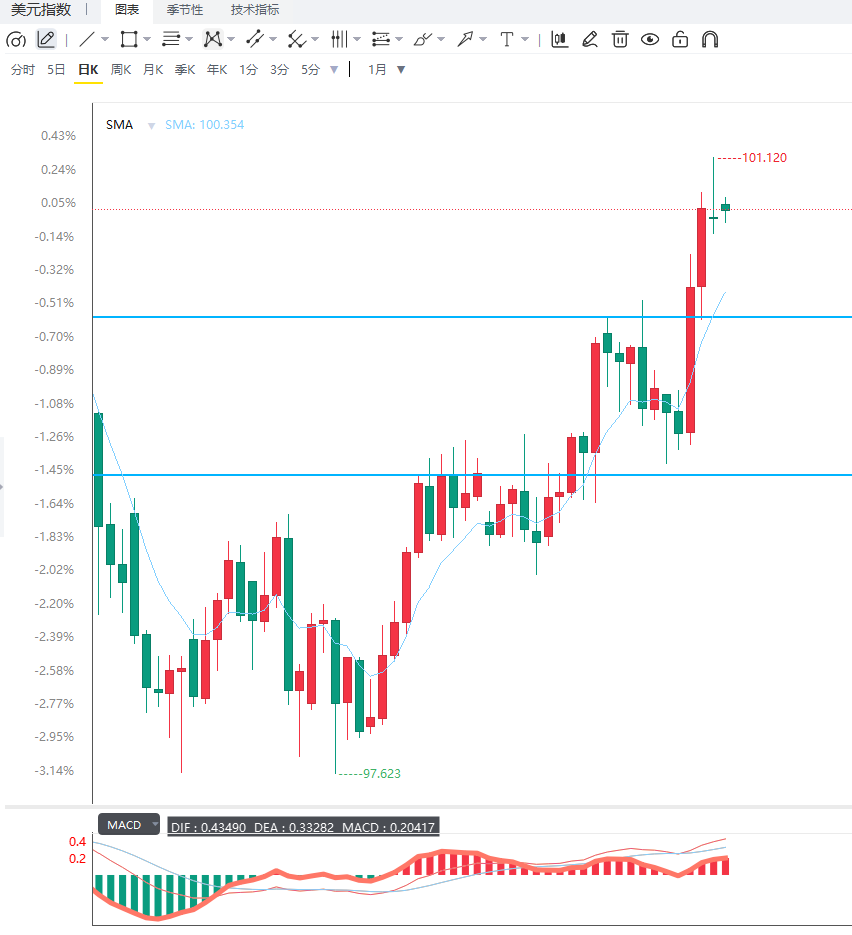
From a daily chart perspective, the US dollar index rebounded after finding significant support near the 100 level, indicating that the bullish trend remains dominant. Currently, the price has regained its position above the major moving average system, and the upward channel structure remains intact. Key resistance levels to watch are 101.20 and 102.00; a successful break above these levels could lead to a further challenge of the year's high. On the downside, support levels to watch are 100.00 and 99.50. As long as the price remains above these levels, the medium-term bullish trend is not expected to change significantly.
Observing the 4-hour chart, the US dollar index has rebounded quickly after a recent pullback, with short-term moving averages forming an upward divergence structure again, indicating increased buying power in the market. The area around 100.50 has now become a key short-term support zone. If it can subsequently hold above 100.80, it is expected to continue its advance towards the 101.20 area. Overall, risk aversion and expectations of hawkish monetary policy are jointly supporting the dollar's performance, and the short-term trend is expected to remain volatile with a slight upward bias.
Editor's Summary : The recent strengthening of the US dollar index is mainly driven by two factors: firstly, the resurgence of safe-haven demand due to tensions in the Middle East; and secondly, the Federal Reserve's hawkish stance reinforcing market expectations of a continued high-interest-rate environment. The renewed closure of the Strait of Hormuz and the uncertainty surrounding the prospects of US-Iran negotiations have further increased market focus on energy supply and inflation risks. Against this backdrop, the dollar's advantages as a major global safe-haven and high-yield currency have been strengthened. In the short term, as long as the Federal Reserve maintains its hawkish tone and geopolitical risks do not significantly ease, the US dollar index is expected to remain relatively strong. It is crucial to pay close attention to the impact of changes in inflation expectations and US policy signals on the market.
Over the weekend, new uncertainties emerged in the Middle East. US President Trump stated that if Lebanese armed groups continue attacks against Israel, the US might take direct military action against Iran. This statement has raised market concerns that the previously established framework for peace negotiations is facing new challenges, and has prompted investors to reassess the risks of escalating regional tensions.
Meanwhile, Iran's announcement of the renewed closure of the Strait of Hormuz has raised concerns about the security of global energy transportation. As one of the world's most important oil shipping routes, changes in the situation in the Strait of Hormuz directly impact the international energy market. Market concerns are that energy supply risks could reignite global inflationary pressures, thereby prolonging the period when major central banks maintain high interest rate policies.
Although Iranian officials have stated that they have suspended negotiations with the United States, communication channels between the two sides have not been completely severed, and some contacts are still ongoing. However, the market generally believes that the uncertainty surrounding the future progress of negotiations has increased significantly. Besides geopolitical risks, the outlook for the Federal Reserve's monetary policy continues to be a significant force supporting the US dollar. Last week, the Fed kept its benchmark interest rate unchanged, but its policy statement and officials' expectations were generally hawkish. The latest dot plot shows that nine out of 19 policymakers now expect at least one rate hike this year.
The market is beginning to reprice the possibility of further tightening by the Federal Reserve, with some investors even anticipating a rate hike as early as September. As oil prices remain high due to geopolitical tensions, market concerns that rising energy prices could again drive up US inflation further strengthen the case for the Fed to maintain its high-interest-rate policy.
Analysts point out that the US dollar is currently supported by both safe-haven demand and interest rate advantages. On the one hand, uncertainty in the Middle East is driving funds to safe-haven assets; on the other hand, the Federal Reserve's hawkish stance has increased the attractiveness of dollar-denominated asset yields, allowing the dollar to maintain a relative advantage among major currencies. Market performance shows that the dollar index has recently regained its footing above the 100 mark, indicating that market expectations for the resilience of the US economy and the continued high-interest-rate environment remain strong. Meanwhile, slowing economic growth in Europe and the UK, along with a more cautious policy outlook from related central banks, further strengthens the dollar's relative advantage.
The market will focus on the progress of negotiations between the US and Iran, changes in the Middle East situation, and the performance of US economic data this week. If energy prices continue to rise and drive up inflation expectations, the US dollar index is likely to continue to be supported; conversely, if geopolitical risks ease, the short-term rise in the US dollar may slow down.
From a daily chart perspective, the US dollar index rebounded after finding significant support near the 100 level, indicating that the bullish trend remains dominant. Currently, the price has regained its position above the major moving average system, and the upward channel structure remains intact. Key resistance levels to watch are 101.20 and 102.00; a successful break above these levels could lead to a further challenge of the year's high. On the downside, support levels to watch are 100.00 and 99.50. As long as the price remains above these levels, the medium-term bullish trend is not expected to change significantly.
Observing the 4-hour chart, the US dollar index has rebounded quickly after a recent pullback, with short-term moving averages forming an upward divergence structure again, indicating increased buying power in the market. The area around 100.50 has now become a key short-term support zone. If it can subsequently hold above 100.80, it is expected to continue its advance towards the 101.20 area. Overall, risk aversion and expectations of hawkish monetary policy are jointly supporting the dollar's performance, and the short-term trend is expected to remain volatile with a slight upward bias.
Editor's Summary : The recent strengthening of the US dollar index is mainly driven by two factors: firstly, the resurgence of safe-haven demand due to tensions in the Middle East; and secondly, the Federal Reserve's hawkish stance reinforcing market expectations of a continued high-interest-rate environment. The renewed closure of the Strait of Hormuz and the uncertainty surrounding the prospects of US-Iran negotiations have further increased market focus on energy supply and inflation risks. Against this backdrop, the dollar's advantages as a major global safe-haven and high-yield currency have been strengthened. In the short term, as long as the Federal Reserve maintains its hawkish tone and geopolitical risks do not significantly ease, the US dollar index is expected to remain relatively strong. It is crucial to pay close attention to the impact of changes in inflation expectations and US policy signals on the market.
- Risk Warning and Disclaimer
- The market involves risk, and trading may not be suitable for all investors. This article is for reference only and does not constitute personal investment advice, nor does it take into account certain users’ specific investment objectives, financial situation, or other needs. Any investment decisions made based on this information are at your own risk.