The US-Iran negotiations spiraled out of control, causing oil prices to surge. Is the Middle East powder keg about to explode again?
2026-06-22 08:45:27
On Monday (June 22), US crude oil futures opened higher and are currently trading around $77.40, up about 2%. The immediate trigger for the oil price increase was the setback in US-Iran negotiations on Sunday (June 21). On Sunday, the Iranian delegation, which was holding negotiations with the US in Bielgen, Switzerland, suddenly suspended talks to protest US President Trump's threatening remarks against Iran that day.
On Sunday, Trump warned Iran on social media to immediately cease its "proxy" operations in Lebanon, or the United States would launch another strike against Iran, "and it would be more powerful."
According to reports, the Iranian delegation protested Trump's remarks to the US side and left the meeting, suspending the 80-minute negotiations to conduct internal consultations. The report states that Iran is developing an appropriate response plan.
Recently, the United States and Iran launched a new round of peace talks in Switzerland, attempting to consolidate the bilateral ceasefire, resolve regional disputes, and address core differences such as Iran's nuclear program. However, from the outset, these talks have been mired in contradictions, presenting a fragmented situation of frontline dialogue and consultation versus maximum pressure from the White House.
US Vice President Vance led a delegation to advance peace talks and seek a thaw in bilateral relations, while US President Trump issued repeated threats of military strikes, which completely intensified the confrontation, causing the negotiations to be constantly interrupted and even suspended at one point. The future of the US-Iran game is full of uncertainty, and the situation in the Middle East has once again fallen into a state of tension.
The recent US-Iran talks, held at the Swiss resort of Burgenstock and also known as the Lucerne Summit, were a key step in the 60-day reconciliation campaign between the two countries. The core objective was to implement the previously signed ceasefire memorandum of understanding and finalize details of a long-term peace agreement. Previously, Trump had signed a related memorandum at the Palace of Versailles in France, clarifying the responsibilities and cooperation directions of both sides. The US pledged to gradually lift sanctions against Iran, unfreeze billions of dollars in Iranian assets, and lift the maritime blockade of Iranian ports. Iran, in turn, pledged to guarantee free passage of ships through the Strait of Hormuz, restrain Hezbollah's military operations in Lebanon, and cooperate with the US in resolving the nuclear program dispute. The US was also required to pressure Israel to halt its military strikes against Hezbollah.
This negotiation was not a bilateral consultation between the US and Iran. Pakistan and Qatar participated as neutral mediators throughout the process, with the first round of talks lasting approximately 80 minutes. At the beginning of the talks, Vance signaled a willingness to ease tensions, expressing his hope that the US and Iran would abandon their past confrontational approach, open a new chapter in bilateral relations, permanently reshape the geopolitical landscape of the Middle East, and completely break free from the vicious cycle of repeated conflicts.
The advancement of these negotiations is driven by a strong practical necessity. Since the outbreak of the Middle East conflict on February 28, international oil prices have soared, severely damaging the US economy. Coupled with public discontent over rising fuel prices, this has directly led to a continuous decline in Trump's approval rating. As a core global energy transport corridor, the stability of navigation through the Strait of Hormuz is crucial for stabilizing oil prices and alleviating economic pressure, and is also one of the core points of contention in these negotiations.
Just over the crucial weekend for the start of US-Iran-Switzerland negotiations, a sudden shift in the regional situation exacerbated the already difficult talks. Following Israel's military attack on Lebanon, Iran retaliated by announcing the closure of the Strait of Hormuz, instantly escalating the crisis regarding navigation through the strait.
The U.S. Central Command has been inconsistent in its stance. On Saturday (June 20), it claimed that merchant ships could pass through the Strait of Hormuz normally, but there was no further announcement of the latest progress on navigation on Sunday, which exacerbated the panic in the global energy market.
In response to Iran's blockade of the Strait of Hormuz, Trump issued an extremely tough military threat, completely shattering the atmosphere of détente in negotiations. In a Fox News interview, he publicly issued an ultimatum to Iran, stating that if Iran continued to block the Strait of Hormuz and interfere with shipping, the United States would launch a fierce airstrike against Iran, completely destroying the existing order in Iran, and even threatening to directly take over the Strait of Hormuz, with the United States acting as the "guardian" of the shipping lanes.
Trump subsequently escalated his threats on social media, demanding that Iran immediately restrain Hezbollah in Lebanon from all confrontational actions, or the US would launch a more severe strike against Iran than before. In addition, Trump proposed an extreme condition: if the US-Iran agreement ultimately fails, the US would charge tolls to ships passing through the Strait of Hormuz, thereby seizing profits and recouping the so-called "costs of maintaining stability in the Middle East."
Trump's strong rhetoric directly triggered a strong protest from the Iranian delegation, bringing the Swiss negotiations to a standstill. Iran's chief negotiator and parliamentary speaker, Ghalibaf, directly countered the US threats, stating that the US pressure tactics were ineffective and a desperate measure. He also explicitly warned that Iran would resolutely retaliate against any US military aggression and advised the US to exercise caution in its words and actions.
The standoff directly led to the suspension of the negotiation process. Iran's official news agency, Yilna, confirmed that the Iranian negotiating team lodged a strong protest and left the negotiating room on the spot, suspending the consultation process, due to Trump's continued threatening remarks against Iran.
However, diplomatic sources indicate that the Iranian delegation did not leave Switzerland. After meeting with the Qatari mediation team, they temporarily withdrew from the negotiation venue to conduct internal consultations, and the negotiation channels between the two sides were not completely closed.
The situation presented a stark contrast: at the Swiss negotiating table, Vance's team released positive signals, claiming significant progress in the negotiations; meanwhile, Trump in Washington escalated his confrontational rhetoric, completely negating the progress made. Iran's official news agency subsequently assessed that the four-party talks had officially entered a "difficult phase," with bilateral differences becoming fully public.
According to multiple sources, the focus of the negotiations is on three core areas, with significant differences in the demands of the parties and extremely high difficulty in reconciliation.
One is the control of navigation in the Strait of Hormuz. The US has forcibly tied the right of passage through the strait to the implementation of the agreement, attempting to control the dominance of the waterway and seek economic benefits. Iran, on the other hand, has used the strait closure as a countermeasure and firmly rejected the US's hegemonic terms.
Secondly, regarding the situation in Lebanon, Iran insists that the US pressure Israel to cease fire and stop attacks. However, Israel is not a signatory to the agreement and has publicly condemned it. Furthermore, the Israeli military has only temporarily reduced its defenses and has not completely ceased military operations, indicating that the US has limited control over the situation.
Thirdly, there is the dispute over Iran's nuclear program. The US insists on including the Iranian nuclear issue in the negotiation agenda in an attempt to restrain Iran's nuclear development, while Iran has explicitly excluded the issue. The core demands of the two sides are completely opposed.
In addition, Israel's attitude has become the biggest external variable.
US intelligence agencies had already warned that Israeli Prime Minister Netanyahu was unlikely to end the military operation in Lebanon, and that the ongoing regional conflict could completely undermine US-Iran reconciliation efforts. Although the Israeli military has ordered its troops to maintain only defensive operations within Lebanon, and the bilateral conflict temporarily eased on Sunday, the situation could escalate at any time, posing a significant threat to US-Iran negotiations.
As of Monday, the US-Iran negotiations had not completely broken down, and all parties were actively maintaining communication channels. The two sides are scheduled to begin a second round of talks, while continuing detailed technical consultations. Some preliminary progress has been made in the negotiations, with the draft agreement on sanctions waivers for Iranian oil sales nearing completion, providing some support for bilateral de-escalation.
Overall, however, the US-Iran negotiations still face numerous obstacles. The contradictory strategy of the US simultaneously negotiating and exerting pressure has severely eroded Iran's trust in the negotiations. The two sides have vastly different positions and conflicting demands. Coupled with multiple intertwined conflicts such as the situation in Israel, energy interests, and the nuclear issue, it is difficult to reach a comprehensive consensus in the short term.
Whether the US and Iran can abandon confrontation, implement the memorandum of understanding, and reach a long-term peace agreement during the next 60-day critical period remains highly uncertain.
From a technical perspective, according to the daily chart, after reaching a high of 119.48, US crude oil entered a long-term downward channel, completely reversing the overall bullish trend. The price recently tested the support level of 72.83 and rebounded slightly, indicating a short-term oversold correction, but it is currently facing resistance from all medium-term moving averages.
The moving average system clearly shows a bearish pattern: the short-term MA20 and medium-term MA50 continue to decline, and the price is under pressure below the two moving averages. Only the MA100 (87.68) and MA200 (73.83) form a range support. The 73 level is a key medium-term dividing line between bullish and bearish trends. The current low point has just retraced to the 200-day moving average, showing a technical bottoming signal.
In terms of indicators, the MACD indicator shows DIFF at -5.16 and DEA at -3.95, with both lines below the zero axis and the green bars continuing to diverge, indicating that the bearish momentum has not yet exhausted itself; the RSI value is 35.92, which is in the weak zone below 40 and has not yet entered the oversold extreme value, so the rebound strength is limited.
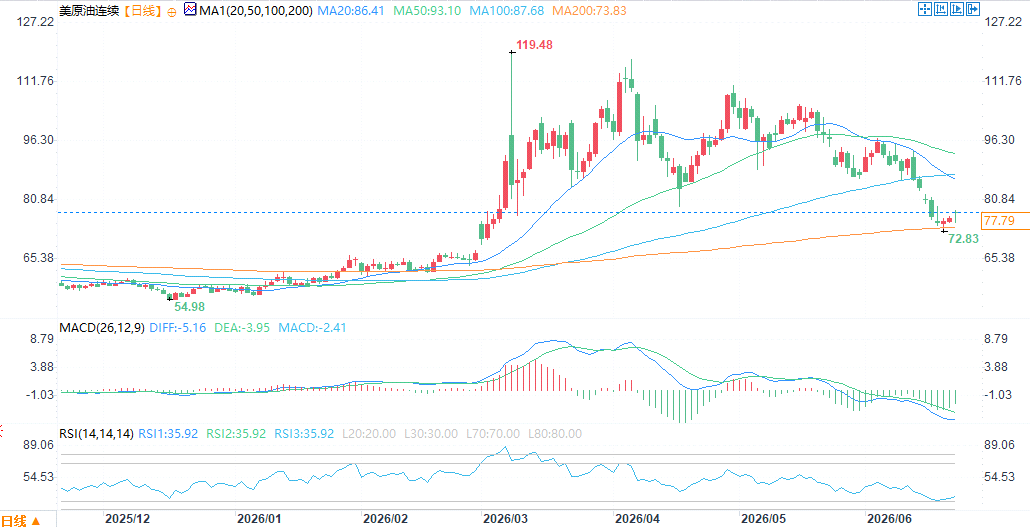
(US crude oil daily chart, source: FX678)
At 8:44 AM Beijing time on June 22, US crude oil futures were trading at $77.36 per barrel.
On Sunday, Trump warned Iran on social media to immediately cease its "proxy" operations in Lebanon, or the United States would launch another strike against Iran, "and it would be more powerful."
According to reports, the Iranian delegation protested Trump's remarks to the US side and left the meeting, suspending the 80-minute negotiations to conduct internal consultations. The report states that Iran is developing an appropriate response plan.
Recently, the United States and Iran launched a new round of peace talks in Switzerland, attempting to consolidate the bilateral ceasefire, resolve regional disputes, and address core differences such as Iran's nuclear program. However, from the outset, these talks have been mired in contradictions, presenting a fragmented situation of frontline dialogue and consultation versus maximum pressure from the White House.
US Vice President Vance led a delegation to advance peace talks and seek a thaw in bilateral relations, while US President Trump issued repeated threats of military strikes, which completely intensified the confrontation, causing the negotiations to be constantly interrupted and even suspended at one point. The future of the US-Iran game is full of uncertainty, and the situation in the Middle East has once again fallen into a state of tension.
Background to the Negotiations: A 60-Day Campaign to Resolve Multiple Disputes
The recent US-Iran talks, held at the Swiss resort of Burgenstock and also known as the Lucerne Summit, were a key step in the 60-day reconciliation campaign between the two countries. The core objective was to implement the previously signed ceasefire memorandum of understanding and finalize details of a long-term peace agreement. Previously, Trump had signed a related memorandum at the Palace of Versailles in France, clarifying the responsibilities and cooperation directions of both sides. The US pledged to gradually lift sanctions against Iran, unfreeze billions of dollars in Iranian assets, and lift the maritime blockade of Iranian ports. Iran, in turn, pledged to guarantee free passage of ships through the Strait of Hormuz, restrain Hezbollah's military operations in Lebanon, and cooperate with the US in resolving the nuclear program dispute. The US was also required to pressure Israel to halt its military strikes against Hezbollah.
This negotiation was not a bilateral consultation between the US and Iran. Pakistan and Qatar participated as neutral mediators throughout the process, with the first round of talks lasting approximately 80 minutes. At the beginning of the talks, Vance signaled a willingness to ease tensions, expressing his hope that the US and Iran would abandon their past confrontational approach, open a new chapter in bilateral relations, permanently reshape the geopolitical landscape of the Middle East, and completely break free from the vicious cycle of repeated conflicts.
The advancement of these negotiations is driven by a strong practical necessity. Since the outbreak of the Middle East conflict on February 28, international oil prices have soared, severely damaging the US economy. Coupled with public discontent over rising fuel prices, this has directly led to a continuous decline in Trump's approval rating. As a core global energy transport corridor, the stability of navigation through the Strait of Hormuz is crucial for stabilizing oil prices and alleviating economic pressure, and is also one of the core points of contention in these negotiations.
Situation escalates suddenly: Iran blocks the strait in standoff, Trump takes a hard line.
Just over the crucial weekend for the start of US-Iran-Switzerland negotiations, a sudden shift in the regional situation exacerbated the already difficult talks. Following Israel's military attack on Lebanon, Iran retaliated by announcing the closure of the Strait of Hormuz, instantly escalating the crisis regarding navigation through the strait.
The U.S. Central Command has been inconsistent in its stance. On Saturday (June 20), it claimed that merchant ships could pass through the Strait of Hormuz normally, but there was no further announcement of the latest progress on navigation on Sunday, which exacerbated the panic in the global energy market.
In response to Iran's blockade of the Strait of Hormuz, Trump issued an extremely tough military threat, completely shattering the atmosphere of détente in negotiations. In a Fox News interview, he publicly issued an ultimatum to Iran, stating that if Iran continued to block the Strait of Hormuz and interfere with shipping, the United States would launch a fierce airstrike against Iran, completely destroying the existing order in Iran, and even threatening to directly take over the Strait of Hormuz, with the United States acting as the "guardian" of the shipping lanes.
Trump subsequently escalated his threats on social media, demanding that Iran immediately restrain Hezbollah in Lebanon from all confrontational actions, or the US would launch a more severe strike against Iran than before. In addition, Trump proposed an extreme condition: if the US-Iran agreement ultimately fails, the US would charge tolls to ships passing through the Strait of Hormuz, thereby seizing profits and recouping the so-called "costs of maintaining stability in the Middle East."
Negotiations stalled: Iran's strong response brought talks to a standstill.
Trump's strong rhetoric directly triggered a strong protest from the Iranian delegation, bringing the Swiss negotiations to a standstill. Iran's chief negotiator and parliamentary speaker, Ghalibaf, directly countered the US threats, stating that the US pressure tactics were ineffective and a desperate measure. He also explicitly warned that Iran would resolutely retaliate against any US military aggression and advised the US to exercise caution in its words and actions.
The standoff directly led to the suspension of the negotiation process. Iran's official news agency, Yilna, confirmed that the Iranian negotiating team lodged a strong protest and left the negotiating room on the spot, suspending the consultation process, due to Trump's continued threatening remarks against Iran.
However, diplomatic sources indicate that the Iranian delegation did not leave Switzerland. After meeting with the Qatari mediation team, they temporarily withdrew from the negotiation venue to conduct internal consultations, and the negotiation channels between the two sides were not completely closed.
The situation presented a stark contrast: at the Swiss negotiating table, Vance's team released positive signals, claiming significant progress in the negotiations; meanwhile, Trump in Washington escalated his confrontational rhetoric, completely negating the progress made. Iran's official news agency subsequently assessed that the four-party talks had officially entered a "difficult phase," with bilateral differences becoming fully public.
Core Disagreements and Potential Variables in the Negotiations
According to multiple sources, the focus of the negotiations is on three core areas, with significant differences in the demands of the parties and extremely high difficulty in reconciliation.
One is the control of navigation in the Strait of Hormuz. The US has forcibly tied the right of passage through the strait to the implementation of the agreement, attempting to control the dominance of the waterway and seek economic benefits. Iran, on the other hand, has used the strait closure as a countermeasure and firmly rejected the US's hegemonic terms.
Secondly, regarding the situation in Lebanon, Iran insists that the US pressure Israel to cease fire and stop attacks. However, Israel is not a signatory to the agreement and has publicly condemned it. Furthermore, the Israeli military has only temporarily reduced its defenses and has not completely ceased military operations, indicating that the US has limited control over the situation.
Thirdly, there is the dispute over Iran's nuclear program. The US insists on including the Iranian nuclear issue in the negotiation agenda in an attempt to restrain Iran's nuclear development, while Iran has explicitly excluded the issue. The core demands of the two sides are completely opposed.
In addition, Israel's attitude has become the biggest external variable.
US intelligence agencies had already warned that Israeli Prime Minister Netanyahu was unlikely to end the military operation in Lebanon, and that the ongoing regional conflict could completely undermine US-Iran reconciliation efforts. Although the Israeli military has ordered its troops to maintain only defensive operations within Lebanon, and the bilateral conflict temporarily eased on Sunday, the situation could escalate at any time, posing a significant threat to US-Iran negotiations.
Future developments: Negotiations continue, but the prospects for reconciliation remain uncertain.
As of Monday, the US-Iran negotiations had not completely broken down, and all parties were actively maintaining communication channels. The two sides are scheduled to begin a second round of talks, while continuing detailed technical consultations. Some preliminary progress has been made in the negotiations, with the draft agreement on sanctions waivers for Iranian oil sales nearing completion, providing some support for bilateral de-escalation.
Overall, however, the US-Iran negotiations still face numerous obstacles. The contradictory strategy of the US simultaneously negotiating and exerting pressure has severely eroded Iran's trust in the negotiations. The two sides have vastly different positions and conflicting demands. Coupled with multiple intertwined conflicts such as the situation in Israel, energy interests, and the nuclear issue, it is difficult to reach a comprehensive consensus in the short term.
Whether the US and Iran can abandon confrontation, implement the memorandum of understanding, and reach a long-term peace agreement during the next 60-day critical period remains highly uncertain.
From a technical perspective, according to the daily chart, after reaching a high of 119.48, US crude oil entered a long-term downward channel, completely reversing the overall bullish trend. The price recently tested the support level of 72.83 and rebounded slightly, indicating a short-term oversold correction, but it is currently facing resistance from all medium-term moving averages.
The moving average system clearly shows a bearish pattern: the short-term MA20 and medium-term MA50 continue to decline, and the price is under pressure below the two moving averages. Only the MA100 (87.68) and MA200 (73.83) form a range support. The 73 level is a key medium-term dividing line between bullish and bearish trends. The current low point has just retraced to the 200-day moving average, showing a technical bottoming signal.
In terms of indicators, the MACD indicator shows DIFF at -5.16 and DEA at -3.95, with both lines below the zero axis and the green bars continuing to diverge, indicating that the bearish momentum has not yet exhausted itself; the RSI value is 35.92, which is in the weak zone below 40 and has not yet entered the oversold extreme value, so the rebound strength is limited.
(US crude oil daily chart, source: FX678)
At 8:44 AM Beijing time on June 22, US crude oil futures were trading at $77.36 per barrel.
- Risk Warning and Disclaimer
- The market involves risk, and trading may not be suitable for all investors. This article is for reference only and does not constitute personal investment advice, nor does it take into account certain users’ specific investment objectives, financial situation, or other needs. Any investment decisions made based on this information are at your own risk.