The divergence in policies between European and American central banks is reshaping the euro's trajectory.
2026-06-22 22:03:10
On June 22, European Central Bank President Christine Lagarde attended a hearing of the European Parliament Committee and made a significant statement on the current inflation situation in the Eurozone and the pace of monetary policy. She clarified that there is currently no risk of inflation derailing in the Eurozone, and the ECB does not need to further tighten its policies. She set the tone for the central bank to maintain a gradual, data-dependent monetary policy stance. This mildly dovish statement directly affected the short-term trend of the euro and further amplified the divergence in monetary policy between the Federal Reserve and the European Central Bank.

Based on Lagarde's official statements, current inflation in the Eurozone has a clear external component, but is generally well-controlled. Lagarde pointed out that the Eurozone has not yet experienced a second round of secondary inflation caused by inflation decoupling or cost transmission, and therefore does not yet have the conditions for a strong monetary tightening policy.
Compared to the inflation triggered by the previous energy crisis, the inflationary impact of this round of geopolitical conflicts is weaker. The European Central Bank, relying on appropriate monetary policy tools, remains confident in pushing inflation back to its policy target range.
The Eurozone's macroeconomic situation is showing increasing signs of stagflation, with its economic fundamentals under significant pressure. The ongoing geopolitical conflict with Iran continues to weaken the region's overall economic momentum, with all economic indicators declining, particularly in the service sector. Uncertainty surrounding the regional macroeconomic outlook remains high, with persistent upward pressure on inflation and downward pressure on economic growth, leaving central banks caught in a dilemma between combating inflation and stabilizing growth. Due to its heavy reliance on external energy sources, the Eurozone is highly vulnerable to Middle East geopolitical tensions and oil price fluctuations, highlighting significant weaknesses in its economic resilience.
Lagarde's speech this time leaned towards a dovish market sentiment, directly guiding the foreign exchange market. The FXS sentiment score for this speech was only 4.6 out of 10, below its historical average of 6. The core logic behind this is that the central bank rejected aggressive interest rate hikes and maintained a wait-and-see approach.
On the one hand, the statement was slightly negative for the euro, limiting its short-term rebound potential; on the other hand, the market has not fully priced in a dovish outlook, as geopolitical risks could still push up prices again, the risk of an inflation rebound remains, and the European Central Bank cannot completely shift to easing, thus limiting the euro's downside potential as well.
Looking at major central banks globally, the Federal Reserve and the European Central Bank have diverged significantly in their policy paths, and this policy divergence has become the core factor driving the medium- to long-term trend of the euro against the US dollar. Tiuwe Mevisen, senior macro strategist at Rabobank, stated that the pricing weight of the US-EU monetary policy divergence on the EUR/USD exchange rate is continuously increasing.
The Federal Reserve's policy has completely shifted to a hawkish stance, abandoning all expectations of interest rate cuts this year. Last week's Fed meeting removed any mention of rate cuts, maintaining the federal funds rate at 3.50%-3.75%. The Fed determined that the US economy is resilient and inflation remains sticky. The latest dot plot shows that US inflation is declining slowly, with core PCE inflation expected to remain above the 2% policy target throughout 2026. Analysts predict the Fed will only implement two rounds of rate cuts next April and June, maintaining a high-interest-rate environment in the medium to long term.
Conversely, pressured by imported inflation, the European Central Bank (ECB) returned to a tighter monetary policy, raising interest rates by 25 basis points in early June. This rate hike stemmed from the energy inflation shock caused by the geopolitical conflict with Iran. The ECB simultaneously raised its inflation forecast, estimating an average inflation rate of 3.0% for the Eurozone by 2026, while lowering its regional economic growth forecast, further exacerbating the stagflation crisis.
From the perspective of the policy's original intention, the ECB's current round of interest rate hikes is mainly aimed at anchoring inflation expectations, rather than being a proactive tightening after the economic recovery.
From the perspective of exchange rate logic, the short-term interest rate differential between the US and Europe is theoretically beneficial to the euro. The ECB's interest rate hike and the Fed's maintenance of interest rates provide temporary support for the euro, but this benefit has very strong limitations.
The Eurozone's three major weaknesses—weak endogenous economic growth, high dependence on external energy sources, and high sensitivity to geopolitical risks—will continue to offset the exchange rate benefits brought by interest rate differentials, making it difficult for the euro to break out of a one-sided strong trend.
At the asset class level, the current global macroeconomic pricing logic is fragmented, and a unified trading theme has not yet been formed. At present, the market asset pricing is significantly differentiated: the stock market trades on the logic of global economic resilience, the bond market continues to price medium- to long-term inflation stickiness, and commodities have fully absorbed the Middle East geopolitical safe-haven premium.
The interplay between inflation and growth expectations continues to dominate global asset price fluctuations. Coupled with the ongoing policy misalignment between the European and American central banks, volatility in foreign exchange and commodities is likely to remain high.
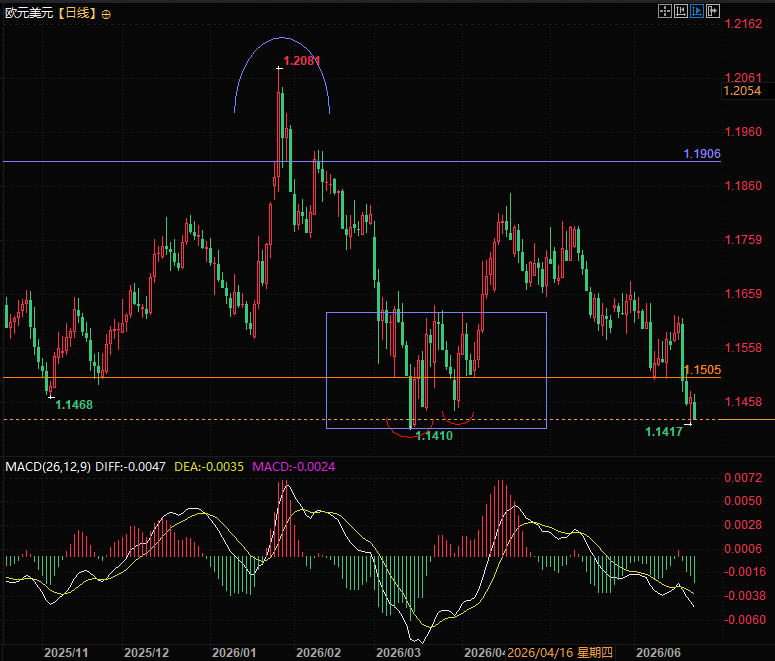
(Euro/USD daily chart, source: FX678)
At 22:01 Beijing time, the euro was trading at 1.1426/27 against the US dollar.
Eurozone inflation situation: Significantly influenced by imported factors; this round of shocks is weaker than previous ones.
Based on Lagarde's official statements, current inflation in the Eurozone has a clear external component, but is generally well-controlled. Lagarde pointed out that the Eurozone has not yet experienced a second round of secondary inflation caused by inflation decoupling or cost transmission, and therefore does not yet have the conditions for a strong monetary tightening policy.
Compared to the inflation triggered by the previous energy crisis, the inflationary impact of this round of geopolitical conflicts is weaker. The European Central Bank, relying on appropriate monetary policy tools, remains confident in pushing inflation back to its policy target range.
Eurozone fundamentals: Stagflation risks are becoming increasingly apparent, and the economy is under significant pressure.
The Eurozone's macroeconomic situation is showing increasing signs of stagflation, with its economic fundamentals under significant pressure. The ongoing geopolitical conflict with Iran continues to weaken the region's overall economic momentum, with all economic indicators declining, particularly in the service sector. Uncertainty surrounding the regional macroeconomic outlook remains high, with persistent upward pressure on inflation and downward pressure on economic growth, leaving central banks caught in a dilemma between combating inflation and stabilizing growth. Due to its heavy reliance on external energy sources, the Eurozone is highly vulnerable to Middle East geopolitical tensions and oil price fluctuations, highlighting significant weaknesses in its economic resilience.
Speech Interpretation: Moderately Dovish, Euro's Ups and Downs Limited
Lagarde's speech this time leaned towards a dovish market sentiment, directly guiding the foreign exchange market. The FXS sentiment score for this speech was only 4.6 out of 10, below its historical average of 6. The core logic behind this is that the central bank rejected aggressive interest rate hikes and maintained a wait-and-see approach.
On the one hand, the statement was slightly negative for the euro, limiting its short-term rebound potential; on the other hand, the market has not fully priced in a dovish outlook, as geopolitical risks could still push up prices again, the risk of an inflation rebound remains, and the European Central Bank cannot completely shift to easing, thus limiting the euro's downside potential as well.
Core Market Logic: Divergent Policies Between European and American Central Banks Dominate Euro's Movement
Looking at major central banks globally, the Federal Reserve and the European Central Bank have diverged significantly in their policy paths, and this policy divergence has become the core factor driving the medium- to long-term trend of the euro against the US dollar. Tiuwe Mevisen, senior macro strategist at Rabobank, stated that the pricing weight of the US-EU monetary policy divergence on the EUR/USD exchange rate is continuously increasing.
Federal Reserve Policy Path: Hawkish Stance, Significantly Delayed Rate Cuts
The Federal Reserve's policy has completely shifted to a hawkish stance, abandoning all expectations of interest rate cuts this year. Last week's Fed meeting removed any mention of rate cuts, maintaining the federal funds rate at 3.50%-3.75%. The Fed determined that the US economy is resilient and inflation remains sticky. The latest dot plot shows that US inflation is declining slowly, with core PCE inflation expected to remain above the 2% policy target throughout 2026. Analysts predict the Fed will only implement two rounds of rate cuts next April and June, maintaining a high-interest-rate environment in the medium to long term.
ECB Policy Path: Passive Interest Rate Hikes, Caught in the Dilemma of Stagflation
Conversely, pressured by imported inflation, the European Central Bank (ECB) returned to a tighter monetary policy, raising interest rates by 25 basis points in early June. This rate hike stemmed from the energy inflation shock caused by the geopolitical conflict with Iran. The ECB simultaneously raised its inflation forecast, estimating an average inflation rate of 3.0% for the Eurozone by 2026, while lowering its regional economic growth forecast, further exacerbating the stagflation crisis.
From the perspective of the policy's original intention, the ECB's current round of interest rate hikes is mainly aimed at anchoring inflation expectations, rather than being a proactive tightening after the economic recovery.
Euro exchange rate forecast: Limited benefit from interest rate differentials, unlikely to see a one-sided trend.
From the perspective of exchange rate logic, the short-term interest rate differential between the US and Europe is theoretically beneficial to the euro. The ECB's interest rate hike and the Fed's maintenance of interest rates provide temporary support for the euro, but this benefit has very strong limitations.
The Eurozone's three major weaknesses—weak endogenous economic growth, high dependence on external energy sources, and high sensitivity to geopolitical risks—will continue to offset the exchange rate benefits brought by interest rate differentials, making it difficult for the euro to break out of a one-sided strong trend.
Asset Class Outlook: Macroeconomic Pricing Fragmentation, High Market Volatility
At the asset class level, the current global macroeconomic pricing logic is fragmented, and a unified trading theme has not yet been formed. At present, the market asset pricing is significantly differentiated: the stock market trades on the logic of global economic resilience, the bond market continues to price medium- to long-term inflation stickiness, and commodities have fully absorbed the Middle East geopolitical safe-haven premium.
The interplay between inflation and growth expectations continues to dominate global asset price fluctuations. Coupled with the ongoing policy misalignment between the European and American central banks, volatility in foreign exchange and commodities is likely to remain high.
(Euro/USD daily chart, source: FX678)
At 22:01 Beijing time, the euro was trading at 1.1426/27 against the US dollar.
- Risk Warning and Disclaimer
- The market involves risk, and trading may not be suitable for all investors. This article is for reference only and does not constitute personal investment advice, nor does it take into account certain users’ specific investment objectives, financial situation, or other needs. Any investment decisions made based on this information are at your own risk.