The US-Iran 60-day roadmap has been launched and sanctions waivers have been implemented, but the Israeli "safe zone" remains the biggest variable.
2026-06-23 08:43:45
On Tuesday (June 23) in early Asian trading, US crude oil futures rebounded slightly, currently trading around $74.10 per barrel. This followed a sharp drop of over 3% in the previous trading day due to easing tensions in the Middle East.
The US and Iran concluded their first round of talks in Switzerland on Monday, formally launching a 60-day process to finalize a peace agreement. The US announced a 60-day sanctions waiver for Iran, allowing it to export crude oil and related products.
Meanwhile, the situation in Lebanon has calmed down since Saturday night, after fighting had prompted Iran to close the Strait of Hormuz, jeopardizing a peace agreement reached just a week ago.
As an initial step in the agreement to provide economic benefits to Iran, the U.S. Treasury Department announced a 60-day sanctions waiver (until August 21) that would allow Iran to sell crude oil and related products and receive revenue.
The mediators, Pakistan and Qatar, said that during their talks at a mountain resort in Bilgensstock, Switzerland, they attempted to build on the provisional agreement signed last week and agreed on a roadmap for reaching a permanent agreement within 60 days.
Both sides also agreed to establish a mechanism to end the conflict between U.S. ally Israel and Iran-backed Hezbollah in Lebanon, and to open communication channels to help ensure the safe passage of merchant ships through the Strait of Hormuz.
Technical talks are expected to continue for the remainder of the week.
Iranian Foreign Ministry spokesman Esmaeil Baghaei stated on Monday that Tehran did not negotiate its nuclear program or accept any new commitments during its talks with the United States on Sunday.
He added that Iran will continue to cooperate with the International Atomic Energy Agency (IAEA) in accordance with existing procedures, but this is subject to approval by the Iranian parliament and the decision of the Supreme National Security Council.
Iranian Foreign Minister Araqchi stated on social media that Tehran has secured sanctions waivers for oil and petrochemical exports, the release of some frozen overseas assets, and the launch of Iran's reconstruction and development plan.
U.S. Vice President Vance has maintained a relatively optimistic tone since the signing of the memorandum of understanding.
He stated that Tehran has agreed to allow inspectors to enter the country and to establish mechanisms to handle their frozen assets overseas and manage the ceasefire.
“We have laid a very good foundation for reaching a successful final agreement,” Vance told reporters after the meeting.
He downplayed the tensions that arose over the weekend—tensions stemming from the escalating conflict in Lebanon, Iran's recent announcement of a renewed blockade of the Strait of Hormuz, and Trump's angry response. "There have been some threats, and some complaints, but ultimately, the talks are continuing, and we've made a lot of progress."
Vance also revealed that White House Special Envoy and Trump's son-in-law, Jared Kushner, proposed an arrangement: after the Iranian funds are unfrozen, they would be jointly managed by the United States and Qatar, and these funds could be used to purchase U.S. corn, soybeans, and wheat.
Trump also emphasized on Monday that Iran should use the unfrozen funds specifically to buy food from the United States. “All of these funds will flow back in the form of buying the food they desperately need. Iran has 91 million people and can’t feed them. Therefore, the funds we unfreeze will go to our farmers.”
However, Trump also issued a warning about compliance: "If Iran does not comply with the agreement, or behaves improperly, I will take the action I have to take."
Israel is not a party to the peace agreement. Following a security meeting, the Israeli Prime Minister, Defense Minister, and military chiefs issued a joint statement saying the military will continue to take action to "eliminate" threats against Israeli soldiers and citizens, destroy militant infrastructure, and maintain a safe zone in southern Lebanon.
The statement emphasized that "the safety of Israeli citizens and the Israel Defense Forces will always be their guiding principle, and there will be no compromise on this."
Israeli President Herzog stated that Israel is not opposed to ending the conflict with Iran through diplomatic means, but any agreement must ensure that Tehran does not use the funds obtained for military purposes or to support regional proxies.
Despite a new ceasefire agreement agreed to by Israel last Friday, followed by another day of intense fighting, Lebanese officials say the situation has de-escalated since Saturday evening. Lebanese President Aoun discussed efforts to maintain the ceasefire and prevent Israeli military escalation in telephone conversations with Vance, the Qatari prime minister, and Kushner.
The events of last weekend briefly jeopardized the peace agreement—Iran announced the closure of the Strait of Hormuz in response to Israel's military action in Lebanon, and Trump immediately threatened to reignite the conflict if Iran blocked the strait. However, tanker traffic on the waterway subsequently resumed, and oil prices resumed their downward trend.
In summary, the launch of the 60-day peace roadmap between the US and Iran and the implementation of sanctions waivers mark a substantial step forward for both sides on the road to ending nearly four months of conflict. The temporary calm in Lebanon has also provided breathing room for the implementation of the agreement.
However, the challenges ahead remain clear: Israel has made it clear that it will continue to maintain its security zone in southern Lebanon and retain the right to conduct military operations—meaning that the fighting in Lebanon could reignite at any time, while Iran has previously made a ceasefire in Lebanon a red line for compliance. The avoidance of the nuclear issue also leaves the fundamental differences in the agreement unresolved. Trump's warning of "action for non-compliance" and Vance's optimistic tone once again create a division within the US.
The 60-day window has opened. The sustainability of the ceasefire in Lebanon, the follow-up arrangements for the nuclear issue, and the political constraints faced by all parties domestically will be fully tested in the next two months. Oil prices and global market fluctuations will closely follow every step of this process.
Technically, US crude oil prices weakened after reaching a high of 119.48 on the daily chart, and are currently trading around 74.10, with the previous low of 72.83 providing short-term support. Moving averages are in a bearish pattern, with the short-term MA20, MA50, and MA100 all above the price, keeping it under pressure from these moving averages. Only the long-term MA200 is still trending upwards. While the long-term bullish trend has not completely reversed, a short-term pullback is clear.
The indicators are showing bearish signals simultaneously. The MACD DIFF line continues to be below the DEA line, and the green bearish bars continue to expand, indicating that the downward momentum has not weakened significantly. The RSI value is 31.62, which is below the 50 midline and close to the oversold zone. The short-term downside potential has narrowed, but there is no clear bottoming signal yet.
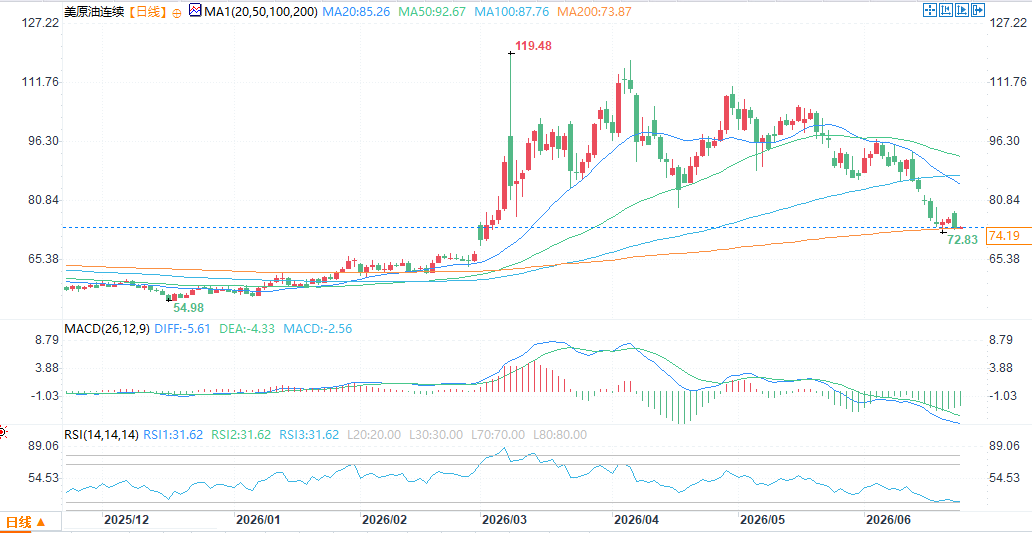
(US crude oil futures daily chart, source: FX678)
At 8:43 AM Beijing time on June 23, US crude oil futures were trading at $74.12 per barrel.
The US and Iran concluded their first round of talks in Switzerland on Monday, formally launching a 60-day process to finalize a peace agreement. The US announced a 60-day sanctions waiver for Iran, allowing it to export crude oil and related products.
Meanwhile, the situation in Lebanon has calmed down since Saturday night, after fighting had prompted Iran to close the Strait of Hormuz, jeopardizing a peace agreement reached just a week ago.
60-Day Roadmap Launched: Sanctions Exemptions Granted, Technology Negotiations Continue to Advance
As an initial step in the agreement to provide economic benefits to Iran, the U.S. Treasury Department announced a 60-day sanctions waiver (until August 21) that would allow Iran to sell crude oil and related products and receive revenue.
The mediators, Pakistan and Qatar, said that during their talks at a mountain resort in Bilgensstock, Switzerland, they attempted to build on the provisional agreement signed last week and agreed on a roadmap for reaching a permanent agreement within 60 days.
Both sides also agreed to establish a mechanism to end the conflict between U.S. ally Israel and Iran-backed Hezbollah in Lebanon, and to open communication channels to help ensure the safe passage of merchant ships through the Strait of Hormuz.
Technical talks are expected to continue for the remainder of the week.
Iran: Key economic benefits secured without discussing nuclear issues.
Iranian Foreign Ministry spokesman Esmaeil Baghaei stated on Monday that Tehran did not negotiate its nuclear program or accept any new commitments during its talks with the United States on Sunday.
He added that Iran will continue to cooperate with the International Atomic Energy Agency (IAEA) in accordance with existing procedures, but this is subject to approval by the Iranian parliament and the decision of the Supreme National Security Council.
Iranian Foreign Minister Araqchi stated on social media that Tehran has secured sanctions waivers for oil and petrochemical exports, the release of some frozen overseas assets, and the launch of Iran's reconstruction and development plan.
US: Vance expresses optimism, Trump issues compliance warning
U.S. Vice President Vance has maintained a relatively optimistic tone since the signing of the memorandum of understanding.
He stated that Tehran has agreed to allow inspectors to enter the country and to establish mechanisms to handle their frozen assets overseas and manage the ceasefire.
“We have laid a very good foundation for reaching a successful final agreement,” Vance told reporters after the meeting.
He downplayed the tensions that arose over the weekend—tensions stemming from the escalating conflict in Lebanon, Iran's recent announcement of a renewed blockade of the Strait of Hormuz, and Trump's angry response. "There have been some threats, and some complaints, but ultimately, the talks are continuing, and we've made a lot of progress."
Vance also revealed that White House Special Envoy and Trump's son-in-law, Jared Kushner, proposed an arrangement: after the Iranian funds are unfrozen, they would be jointly managed by the United States and Qatar, and these funds could be used to purchase U.S. corn, soybeans, and wheat.
Trump also emphasized on Monday that Iran should use the unfrozen funds specifically to buy food from the United States. “All of these funds will flow back in the form of buying the food they desperately need. Iran has 91 million people and can’t feed them. Therefore, the funds we unfreeze will go to our farmers.”
However, Trump also issued a warning about compliance: "If Iran does not comply with the agreement, or behaves improperly, I will take the action I have to take."
Israel: Maintaining the safe zone, supporting diplomacy but reserving military options
Israel is not a party to the peace agreement. Following a security meeting, the Israeli Prime Minister, Defense Minister, and military chiefs issued a joint statement saying the military will continue to take action to "eliminate" threats against Israeli soldiers and citizens, destroy militant infrastructure, and maintain a safe zone in southern Lebanon.
The statement emphasized that "the safety of Israeli citizens and the Israel Defense Forces will always be their guiding principle, and there will be no compromise on this."
Israeli President Herzog stated that Israel is not opposed to ending the conflict with Iran through diplomatic means, but any agreement must ensure that Tehran does not use the funds obtained for military purposes or to support regional proxies.
Despite a new ceasefire agreement agreed to by Israel last Friday, followed by another day of intense fighting, Lebanese officials say the situation has de-escalated since Saturday evening. Lebanese President Aoun discussed efforts to maintain the ceasefire and prevent Israeli military escalation in telephone conversations with Vance, the Qatari prime minister, and Kushner.
Market reaction: Oil prices resume their downward trend
The events of last weekend briefly jeopardized the peace agreement—Iran announced the closure of the Strait of Hormuz in response to Israel's military action in Lebanon, and Trump immediately threatened to reignite the conflict if Iran blocked the strait. However, tanker traffic on the waterway subsequently resumed, and oil prices resumed their downward trend.
In summary, the launch of the 60-day peace roadmap between the US and Iran and the implementation of sanctions waivers mark a substantial step forward for both sides on the road to ending nearly four months of conflict. The temporary calm in Lebanon has also provided breathing room for the implementation of the agreement.
However, the challenges ahead remain clear: Israel has made it clear that it will continue to maintain its security zone in southern Lebanon and retain the right to conduct military operations—meaning that the fighting in Lebanon could reignite at any time, while Iran has previously made a ceasefire in Lebanon a red line for compliance. The avoidance of the nuclear issue also leaves the fundamental differences in the agreement unresolved. Trump's warning of "action for non-compliance" and Vance's optimistic tone once again create a division within the US.
The 60-day window has opened. The sustainability of the ceasefire in Lebanon, the follow-up arrangements for the nuclear issue, and the political constraints faced by all parties domestically will be fully tested in the next two months. Oil prices and global market fluctuations will closely follow every step of this process.
Technically, US crude oil prices weakened after reaching a high of 119.48 on the daily chart, and are currently trading around 74.10, with the previous low of 72.83 providing short-term support. Moving averages are in a bearish pattern, with the short-term MA20, MA50, and MA100 all above the price, keeping it under pressure from these moving averages. Only the long-term MA200 is still trending upwards. While the long-term bullish trend has not completely reversed, a short-term pullback is clear.
The indicators are showing bearish signals simultaneously. The MACD DIFF line continues to be below the DEA line, and the green bearish bars continue to expand, indicating that the downward momentum has not weakened significantly. The RSI value is 31.62, which is below the 50 midline and close to the oversold zone. The short-term downside potential has narrowed, but there is no clear bottoming signal yet.
(US crude oil futures daily chart, source: FX678)
At 8:43 AM Beijing time on June 23, US crude oil futures were trading at $74.12 per barrel.
- Risk Warning and Disclaimer
- The market involves risk, and trading may not be suitable for all investors. This article is for reference only and does not constitute personal investment advice, nor does it take into account certain users’ specific investment objectives, financial situation, or other needs. Any investment decisions made based on this information are at your own risk.