Hawkish expectations from the Federal Reserve dampened demand for precious metals, causing silver to fall below $65 and hit a new low for the period.
2026-06-23 10:32:16
On Tuesday during Asian trading hours, spot silver (XAG/USD) continued its downward trend, falling to around $63.90 per ounce , a significant drop from the previous trading day's high. The precious metals sector as a whole faced considerable pressure as the market reassessed the global inflation outlook and the Federal Reserve's future policy path.
The core factor influencing market sentiment remains expectations regarding US monetary policy. Last week, the Federal Reserve announced it would maintain the federal funds rate at 3.50%-3.75% , but its latest economic projections and the remarks made by new Chairman Kevin Warsh during his first policy meeting were clearly hawkish. The market believes the Fed's concerns about inflation risks have increased, and it is in no hurry to signal easing. As a result, US Treasury yields have remained high, and the dollar index is near a one-year high. Since silver, like gold, is a non-yielding asset, its attractiveness typically diminishes in a rising interest rate environment.
Interest rate futures markets indicate that investors have largely priced in a 25-basis-point rate hike by the Federal Reserve at its September meeting, with some even betting on action as early as next month's meeting. This shift in expectations continues to weigh on the precious metals market. Meanwhile, signs of easing tensions in the Middle East have further weakened demand for safe-haven assets. US Vice President Vance stated that negotiations between the US and Iran in Switzerland have made "significant progress," and while some differences remain, the overall process is proceeding more smoothly than the market expected.
Previously, Vance had confirmed that Iran had agreed to reinstate IAEA inspectors to its territory. Iranian Foreign Minister Abbas Araqchi subsequently stated that the dialogue had yielded significant results. The market believes these positive signals will help push for a broader agreement in the future. In fact, since the escalation of the Middle East conflict at the end of February this year, the precious metals market has been profoundly affected by energy price fluctuations and changes in global inflation expectations. Due to the disruption to shipping security in the Strait of Hormuz, international oil prices surged, and the market worried that major central banks might maintain high interest rate policies for an extended period to curb inflation, thus putting sustained pressure on gold and silver.
Recent developments have brought about new challenges. The United States granted Iran a 60-day license to export crude oil , allowing it to resume some oil sales activities on the international market. This move significantly improved global energy supply expectations and prompted the market to anticipate a gradual easing of tight crude oil supply in the coming months. With increased expectations of supply recovery, international oil prices have continued to decline, and market concerns about future inflationary pressures have also eased. For silver, declining inflation expectations mean a reduced importance of its inflation-hedging properties, further weakening investment demand.
However, the market remains cautious about the successful implementation of the US-Iran agreement. Significant disagreements remain on key issues such as navigation arrangements in the Strait of Hormuz, the Iranian nuclear issue, and frozen assets. Therefore, geopolitical risks have not completely disappeared from the market's view, and the downside potential for silver may be somewhat limited.
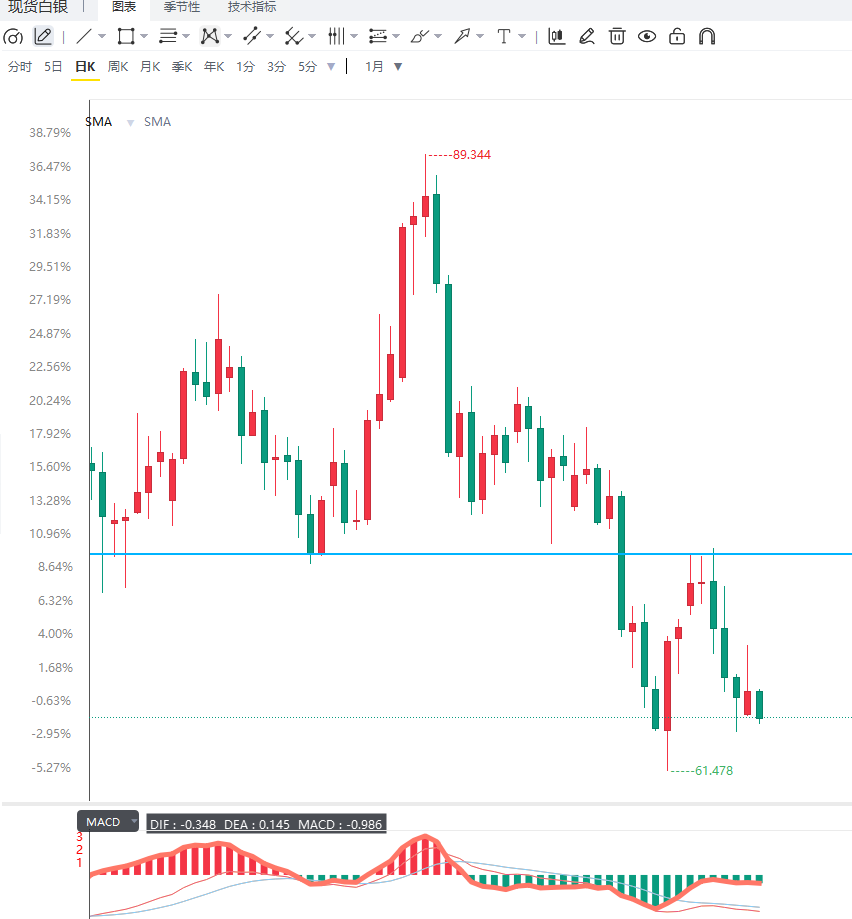
From a technical perspective, silver is maintaining a high-level pullback pattern on the daily chart. After breaking below the $65 mark, the short-term bearish advantage has further expanded. The MACD indicator is running below the zero line, and the green momentum bars continue to expand, indicating that selling pressure still dominates the market. Key resistance levels to watch are $66.00 , $67.50 , and $69.00 . If it cannot regain a foothold above $66, the upside potential is expected to be limited. Support levels are located around $63.50 , $62.50 , and $60.00 .
From a 4-hour chart perspective, silver is trading within a clear downward channel. The MACD lines remain below the zero line, indicating insufficient short-term rebound momentum. After breaking below multiple short-term moving averages, market sentiment is cautious. A further drop to the $62.50 area could occur if the $63.00 support level is breached; conversely, a retest of the $66.00 resistance level could alleviate current downward pressure. In the short term, silver is expected to remain in a weak, range-bound trading pattern until a new stabilization signal emerges.
Editor's Summary : The silver market is currently influenced by both hawkish expectations from the Federal Reserve and easing tensions in the Middle East. With rising expectations of interest rate hikes and a strengthening of energy supply recovery, precious metals are under overall pressure. However, geopolitical risks have not been completely eliminated, and market demand for safe-haven assets may rebound if the situation re deteriorates. In the short term, silver's trend remains weak and consolidating. Investors should pay close attention to the impact of speeches by Federal Reserve officials, US inflation data, and the progress of US-Iran negotiations on market sentiment.
The core factor influencing market sentiment remains expectations regarding US monetary policy. Last week, the Federal Reserve announced it would maintain the federal funds rate at 3.50%-3.75% , but its latest economic projections and the remarks made by new Chairman Kevin Warsh during his first policy meeting were clearly hawkish. The market believes the Fed's concerns about inflation risks have increased, and it is in no hurry to signal easing. As a result, US Treasury yields have remained high, and the dollar index is near a one-year high. Since silver, like gold, is a non-yielding asset, its attractiveness typically diminishes in a rising interest rate environment.
Interest rate futures markets indicate that investors have largely priced in a 25-basis-point rate hike by the Federal Reserve at its September meeting, with some even betting on action as early as next month's meeting. This shift in expectations continues to weigh on the precious metals market. Meanwhile, signs of easing tensions in the Middle East have further weakened demand for safe-haven assets. US Vice President Vance stated that negotiations between the US and Iran in Switzerland have made "significant progress," and while some differences remain, the overall process is proceeding more smoothly than the market expected.
Previously, Vance had confirmed that Iran had agreed to reinstate IAEA inspectors to its territory. Iranian Foreign Minister Abbas Araqchi subsequently stated that the dialogue had yielded significant results. The market believes these positive signals will help push for a broader agreement in the future. In fact, since the escalation of the Middle East conflict at the end of February this year, the precious metals market has been profoundly affected by energy price fluctuations and changes in global inflation expectations. Due to the disruption to shipping security in the Strait of Hormuz, international oil prices surged, and the market worried that major central banks might maintain high interest rate policies for an extended period to curb inflation, thus putting sustained pressure on gold and silver.
Recent developments have brought about new challenges. The United States granted Iran a 60-day license to export crude oil , allowing it to resume some oil sales activities on the international market. This move significantly improved global energy supply expectations and prompted the market to anticipate a gradual easing of tight crude oil supply in the coming months. With increased expectations of supply recovery, international oil prices have continued to decline, and market concerns about future inflationary pressures have also eased. For silver, declining inflation expectations mean a reduced importance of its inflation-hedging properties, further weakening investment demand.
However, the market remains cautious about the successful implementation of the US-Iran agreement. Significant disagreements remain on key issues such as navigation arrangements in the Strait of Hormuz, the Iranian nuclear issue, and frozen assets. Therefore, geopolitical risks have not completely disappeared from the market's view, and the downside potential for silver may be somewhat limited.
From a technical perspective, silver is maintaining a high-level pullback pattern on the daily chart. After breaking below the $65 mark, the short-term bearish advantage has further expanded. The MACD indicator is running below the zero line, and the green momentum bars continue to expand, indicating that selling pressure still dominates the market. Key resistance levels to watch are $66.00 , $67.50 , and $69.00 . If it cannot regain a foothold above $66, the upside potential is expected to be limited. Support levels are located around $63.50 , $62.50 , and $60.00 .
From a 4-hour chart perspective, silver is trading within a clear downward channel. The MACD lines remain below the zero line, indicating insufficient short-term rebound momentum. After breaking below multiple short-term moving averages, market sentiment is cautious. A further drop to the $62.50 area could occur if the $63.00 support level is breached; conversely, a retest of the $66.00 resistance level could alleviate current downward pressure. In the short term, silver is expected to remain in a weak, range-bound trading pattern until a new stabilization signal emerges.
Editor's Summary : The silver market is currently influenced by both hawkish expectations from the Federal Reserve and easing tensions in the Middle East. With rising expectations of interest rate hikes and a strengthening of energy supply recovery, precious metals are under overall pressure. However, geopolitical risks have not been completely eliminated, and market demand for safe-haven assets may rebound if the situation re deteriorates. In the short term, silver's trend remains weak and consolidating. Investors should pay close attention to the impact of speeches by Federal Reserve officials, US inflation data, and the progress of US-Iran negotiations on market sentiment.
- Risk Warning and Disclaimer
- The market involves risk, and trading may not be suitable for all investors. This article is for reference only and does not constitute personal investment advice, nor does it take into account certain users’ specific investment objectives, financial situation, or other needs. Any investment decisions made based on this information are at your own risk.