US-Iran risks persist, causing turmoil in equity markets and a rare simultaneous decline in gold and oil prices.
2026-06-23 15:54:33
On Tuesday (June 23), during the Asian and European sessions, spot gold opened with a slight sideways movement before turning into a one-sided decline. At the same time, the decline in oil prices did not bring optimism to gold prices, resulting in a situation where gold and crude oil fell together.
Gold prices fell in tandem with Google's stock, which plunged nearly 7% intraday, and with sharp declines in South Korean and Japanese stock markets, as risk appetite tightened rapidly.
In terms of geopolitics, after the conclusion of the US-Iran-Switzerland negotiations, several interim consensuses were reached: the two sides will conduct lower-level technical consultations in the remainder of this week to refine the details of the agreement and pave the way for a subsequent high-level signing.
They jointly established a conflict relief task force, including the Lebanese government, to oversee the complete termination of military operations in Lebanon in an attempt to quell the armed conflict within the country.

Several bilateral framework clauses were finalized in this round of negotiations: the US will temporarily grant Iran the right to export its oil across the entire territory, unfreeze billions of dollars of frozen overseas assets of Iran, and the two sides will draft a text on temporary sanctions exemptions for oil and oil derivatives.
Iran needs to reduce its stockpile of highly enriched uranium, which was stored at a nuclear facility that was targeted by the U.S. military a year ago.
The agreement stipulates that commercial vessels can navigate the Strait of Hormuz free of charge for sixty days, and all parties will work together to establish a dual implementation mechanism for strait navigation and a ceasefire in southern Lebanon.
In addition, Oman's Foreign Minister met with Iranian Parliament Speaker Ghalibaf in Muscat. The two sides conducted constructive consultations on the Strait of Hormuz-related clauses in the US-Iran Memorandum of Understanding, jointly stating their commitment to international law and emphasizing the guarantee of safe and free passage through the strait.
The ceasefire agreement brokered by Lebanon on Saturday is currently in effect, and Israel has announced the lifting of travel restrictions for residents along the Lebanese-Israeli border, resulting in a slight short-term improvement in the regional situation.
The atmosphere was tense from the start of this round of negotiations in Switzerland. US President Trump exerted pressure from afar throughout the process, making numerous threatening remarks that disrupted the pace of the negotiations and became the biggest external obstacle to the US-China trade process.
At the start of negotiations on Sunday, Trump publicly called on social media to order Iran to immediately control its affiliated armed proxies in Lebanon and cease operations. He threatened that if Iran refused to cooperate, the US would launch a military strike far more powerful than last week to severely punish Iran.
In a subsequent interview with Fox News, he again warned the Iranian president to be careful with his words and actions, and even made extreme remarks about taking over the Iranian regime.
Following the conclusion of the first round of negotiations in Switzerland, Trump updated his statement again, bluntly warning Iran that the US would immediately take all necessary punitive actions should it violate the bilateral peace agreement.
In addition, Trump stated that the frozen funds in Iran would be used to purchase American agricultural products.
The US stated that if a final agreement between the US and Iran cannot be reached within 60 days, it will impose a passage fee on ships transiting the Strait of Hormuz, as payment for providing security and navigation protection to Middle Eastern countries.
Faced with escalating military and economic threats from the United States, the Iranian government has responded in a tiered manner, with a firm stance and a unified position.
Iranian Central Bank Governor Hemmati made it clear that Iran has no obligation to use the unfrozen funds to purchase US agricultural products.
Iran's chief negotiator, Mohammad Ghalibaf, was the first to respond on social media, stating that the US could only make statements and that the Iranian armed forces were ready to fight back and would retaliate against US provocations in their own unique way.
Iranian President Peshikyan publicly drew a red line: Iran will never give up its legitimate sovereignty over uranium enrichment, and the United States must accept Iran's right to independent nuclear research and development.
Iran officially announced the closure of the Strait of Hormuz again last weekend, countering the US's claim of control over navigation and directly refuting the US's assertion that the strait is open to normal navigation.
Iranian Foreign Minister Araqchi maintained a rational stance, affirming the value of the mediation efforts by Pakistan and Qatar, while stating frankly that whether the war in Lebanon can be quelled is the core criterion for evaluating the effectiveness of this round of negotiations with the United States, and that the bottom line for the negotiations must be maintained.
Overall, Iran is maintaining the negotiation channels while countering US pressure through military statements, asserting its sovereignty, and taking actions in the Taiwan Strait.
Firstly, although a dedicated Israel-Lebanon ceasefire group has been established, neither Israel nor Hezbollah has signed the bilateral agreement between the US and Iran, and therefore they are not part of the current agreement to fulfill with the US.
Israeli Prime Minister Netanyahu has taken a hard line, insisting that Israeli troops remain in southern Lebanon until the security threats to the north are completely eliminated.
Hezbollah has drawn a line on reciprocity, stating that it will not cease its armed counterattacks until the Israeli army fully withdraws. The Reconciliation Group currently lacks the capacity to enforce binding force on both sides, making the Lebanese conflict highly susceptible to reignition and directly undermining the basic consensus reached with the United States.
Secondly, the core demands of the US and Iran lie in their deep-rooted differences on the nuclear issue and the management of the Taiwan Strait.
The core demands of the United States are to secure Iran's regular participation in the Iran nuclear negotiations, restrict Iran's military nuclear research and development capabilities, and permanently guarantee the United States' control over the right of navigation in the Strait of Hormuz.
Iran adheres to three bottom lines: sovereignty over uranium enrichment, the right to use unfrozen funds independently, and autonomy over the control of the Strait of Hormuz, rejecting unilateral constraints from the United States. Coupled with past negotiation history—both US-Iran nuclear talks in the past year were abruptly interrupted by US military strikes—Iran has extreme doubts about the credibility of US compliance, resulting in a weak foundation of trust for negotiations.
Ultimately, the internal partisan divide in the United States made the agreement's sustainability extremely precarious.
The interim agreement reached between Trump and Vice President Vance has been fiercely criticized by hardliners within the Republican Party. The conservative Republican faction compares this agreement to the Obama-era Iran nuclear deal, criticizing it for failing to curb Iran's nuclear capability expansion and contradicting the Republican Party's consistent hardline stance on Iran.
Internal divisions within the US political arena mean that the US could potentially tear up the agreement, reinstate sanctions, or even launch military action at any time.
Finally, it should be noted that this is a memorandum of understanding rather than a formal agreement, which allows for considerable flexibility in interpretation. Moreover, it only stipulates that the Strait will be free of charge for sixty days and does not restrict Iran from levying navigation fees on its own subsequently. Both the US and Iran retain the initiative in controlling the Strait.
At the same time, the agreement does not explicitly define the constraints on US military actions, giving Trump the authority to unilaterally launch military strikes. Either party could take targeted action and directly declare a break with the US.
Recent geopolitical risks pose a threat, so the drop in oil prices may be a misjudgment by the market. The short-term turning point for gold and oil will most likely still be influenced by the latest developments between the US and Iran.
The recent US-Iran talks have led to an increase in crude oil supply, a drop in oil prices, and a decline in inflation expectations. However, since the real interest rate equals the nominal interest rate minus inflation expectations, the drop in oil prices has caused inflation expectations to decline.
However, observations revealed that the yields on US Treasury bonds with maturities of 2-10 years did not fall significantly, meaning that nominal interest rates did not decline in tandem. This resulted in the decline in oil prices pushing up real interest rates, which increased the cost of holding gold.
Meanwhile, the continued strengthening of the US dollar index also suppressed gold. Ultimately, global risk appetite was severely impacted, and the Japanese and South Korean stock markets plummeted. Institutions sold off their gold and oil holdings with relatively small losses, causing gold and oil prices to fall together.
From a technical perspective, spot gold continues to be in a downward channel, while oil prices have a need for repeated rebounds due to the lingering risks between the US and Iran. Unless there is a clear reversal signal, gold prices may continue to explore lower levels.
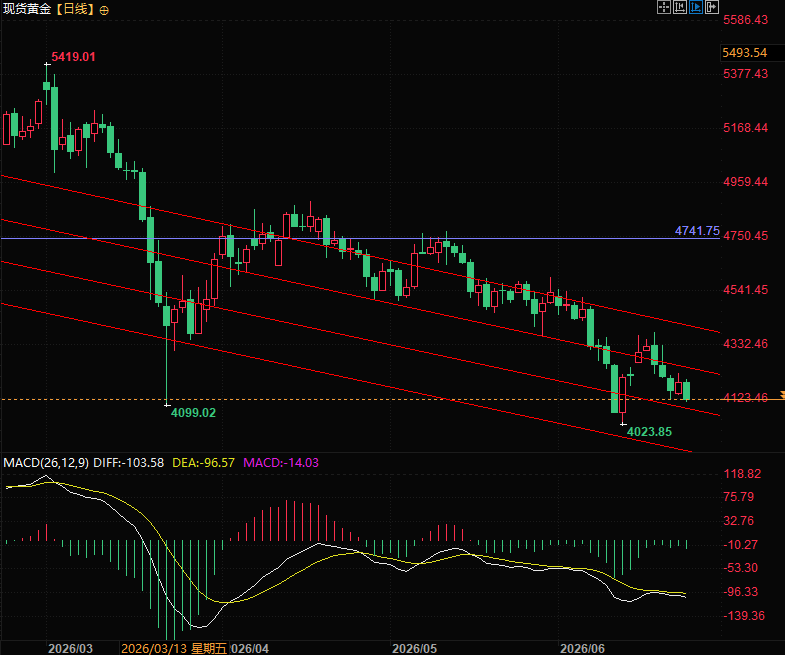
(At 15:52 Beijing time, spot gold is currently trading at $4099 per ounce)
Gold prices fell in tandem with Google's stock, which plunged nearly 7% intraday, and with sharp declines in South Korean and Japanese stock markets, as risk appetite tightened rapidly.
In terms of geopolitics, after the conclusion of the US-Iran-Switzerland negotiations, several interim consensuses were reached: the two sides will conduct lower-level technical consultations in the remainder of this week to refine the details of the agreement and pave the way for a subsequent high-level signing.
They jointly established a conflict relief task force, including the Lebanese government, to oversee the complete termination of military operations in Lebanon in an attempt to quell the armed conflict within the country.
Several bilateral framework clauses were finalized in this round of negotiations: the US will temporarily grant Iran the right to export its oil across the entire territory, unfreeze billions of dollars of frozen overseas assets of Iran, and the two sides will draft a text on temporary sanctions exemptions for oil and oil derivatives.
Iran needs to reduce its stockpile of highly enriched uranium, which was stored at a nuclear facility that was targeted by the U.S. military a year ago.
The agreement stipulates that commercial vessels can navigate the Strait of Hormuz free of charge for sixty days, and all parties will work together to establish a dual implementation mechanism for strait navigation and a ceasefire in southern Lebanon.
In addition, Oman's Foreign Minister met with Iranian Parliament Speaker Ghalibaf in Muscat. The two sides conducted constructive consultations on the Strait of Hormuz-related clauses in the US-Iran Memorandum of Understanding, jointly stating their commitment to international law and emphasizing the guarantee of safe and free passage through the strait.
The ceasefire agreement brokered by Lebanon on Saturday is currently in effect, and Israel has announced the lifting of travel restrictions for residents along the Lebanese-Israeli border, resulting in a slight short-term improvement in the regional situation.
Trump continues to exert verbal pressure and interfere in negotiations, leading to ongoing language clashes between the US and Iran.
The atmosphere was tense from the start of this round of negotiations in Switzerland. US President Trump exerted pressure from afar throughout the process, making numerous threatening remarks that disrupted the pace of the negotiations and became the biggest external obstacle to the US-China trade process.
At the start of negotiations on Sunday, Trump publicly called on social media to order Iran to immediately control its affiliated armed proxies in Lebanon and cease operations. He threatened that if Iran refused to cooperate, the US would launch a military strike far more powerful than last week to severely punish Iran.
In a subsequent interview with Fox News, he again warned the Iranian president to be careful with his words and actions, and even made extreme remarks about taking over the Iranian regime.
Following the conclusion of the first round of negotiations in Switzerland, Trump updated his statement again, bluntly warning Iran that the US would immediately take all necessary punitive actions should it violate the bilateral peace agreement.
In addition, Trump stated that the frozen funds in Iran would be used to purchase American agricultural products.
The US stated that if a final agreement between the US and Iran cannot be reached within 60 days, it will impose a passage fee on ships transiting the Strait of Hormuz, as payment for providing security and navigation protection to Middle Eastern countries.
Faced with escalating military and economic threats from the United States, the Iranian government has responded in a tiered manner, with a firm stance and a unified position.
Iranian Central Bank Governor Hemmati made it clear that Iran has no obligation to use the unfrozen funds to purchase US agricultural products.
Iran's chief negotiator, Mohammad Ghalibaf, was the first to respond on social media, stating that the US could only make statements and that the Iranian armed forces were ready to fight back and would retaliate against US provocations in their own unique way.
Iranian President Peshikyan publicly drew a red line: Iran will never give up its legitimate sovereignty over uranium enrichment, and the United States must accept Iran's right to independent nuclear research and development.
Iran officially announced the closure of the Strait of Hormuz again last weekend, countering the US's claim of control over navigation and directly refuting the US's assertion that the strait is open to normal navigation.
Iranian Foreign Minister Araqchi maintained a rational stance, affirming the value of the mediation efforts by Pakistan and Qatar, while stating frankly that whether the war in Lebanon can be quelled is the core criterion for evaluating the effectiveness of this round of negotiations with the United States, and that the bottom line for the negotiations must be maintained.
Overall, Iran is maintaining the negotiation channels while countering US pressure through military statements, asserting its sovereignty, and taking actions in the Taiwan Strait.
The current US-Iran peace talks face multiple structural risks.
Firstly, although a dedicated Israel-Lebanon ceasefire group has been established, neither Israel nor Hezbollah has signed the bilateral agreement between the US and Iran, and therefore they are not part of the current agreement to fulfill with the US.
Israeli Prime Minister Netanyahu has taken a hard line, insisting that Israeli troops remain in southern Lebanon until the security threats to the north are completely eliminated.
Hezbollah has drawn a line on reciprocity, stating that it will not cease its armed counterattacks until the Israeli army fully withdraws. The Reconciliation Group currently lacks the capacity to enforce binding force on both sides, making the Lebanese conflict highly susceptible to reignition and directly undermining the basic consensus reached with the United States.
Secondly, the core demands of the US and Iran lie in their deep-rooted differences on the nuclear issue and the management of the Taiwan Strait.
The core demands of the United States are to secure Iran's regular participation in the Iran nuclear negotiations, restrict Iran's military nuclear research and development capabilities, and permanently guarantee the United States' control over the right of navigation in the Strait of Hormuz.
Iran adheres to three bottom lines: sovereignty over uranium enrichment, the right to use unfrozen funds independently, and autonomy over the control of the Strait of Hormuz, rejecting unilateral constraints from the United States. Coupled with past negotiation history—both US-Iran nuclear talks in the past year were abruptly interrupted by US military strikes—Iran has extreme doubts about the credibility of US compliance, resulting in a weak foundation of trust for negotiations.
Ultimately, the internal partisan divide in the United States made the agreement's sustainability extremely precarious.
The interim agreement reached between Trump and Vice President Vance has been fiercely criticized by hardliners within the Republican Party. The conservative Republican faction compares this agreement to the Obama-era Iran nuclear deal, criticizing it for failing to curb Iran's nuclear capability expansion and contradicting the Republican Party's consistent hardline stance on Iran.
Internal divisions within the US political arena mean that the US could potentially tear up the agreement, reinstate sanctions, or even launch military action at any time.
Finally, it should be noted that this is a memorandum of understanding rather than a formal agreement, which allows for considerable flexibility in interpretation. Moreover, it only stipulates that the Strait will be free of charge for sixty days and does not restrict Iran from levying navigation fees on its own subsequently. Both the US and Iran retain the initiative in controlling the Strait.
At the same time, the agreement does not explicitly define the constraints on US military actions, giving Trump the authority to unilaterally launch military strikes. Either party could take targeted action and directly declare a break with the US.
Gold and silver prices fell sharply in a rare simultaneous manner, with real interest rates suppressing gold prices.
Recent geopolitical risks pose a threat, so the drop in oil prices may be a misjudgment by the market. The short-term turning point for gold and oil will most likely still be influenced by the latest developments between the US and Iran.
The recent US-Iran talks have led to an increase in crude oil supply, a drop in oil prices, and a decline in inflation expectations. However, since the real interest rate equals the nominal interest rate minus inflation expectations, the drop in oil prices has caused inflation expectations to decline.
However, observations revealed that the yields on US Treasury bonds with maturities of 2-10 years did not fall significantly, meaning that nominal interest rates did not decline in tandem. This resulted in the decline in oil prices pushing up real interest rates, which increased the cost of holding gold.
Meanwhile, the continued strengthening of the US dollar index also suppressed gold. Ultimately, global risk appetite was severely impacted, and the Japanese and South Korean stock markets plummeted. Institutions sold off their gold and oil holdings with relatively small losses, causing gold and oil prices to fall together.
From a technical perspective, spot gold continues to be in a downward channel, while oil prices have a need for repeated rebounds due to the lingering risks between the US and Iran. Unless there is a clear reversal signal, gold prices may continue to explore lower levels.
(At 15:52 Beijing time, spot gold is currently trading at $4099 per ounce)
- Risk Warning and Disclaimer
- The market involves risk, and trading may not be suitable for all investors. This article is for reference only and does not constitute personal investment advice, nor does it take into account certain users’ specific investment objectives, financial situation, or other needs. Any investment decisions made based on this information are at your own risk.