June 25th Financial Breakfast: Increased bets on interest rate hikes send gold prices to a more than seven-month low; oil tankers stranded in the Strait of Hormuz depart, causing oil prices to plunge by over 4%.
2026-06-25 07:31:18
On Thursday (June 25, Beijing time) in early Asian trading, spot gold was trading around $3,997 per ounce. Gold prices fell to a more than seven-month low of $3,959.04 per ounce on Wednesday, mainly due to a stronger dollar to a 13-month high, hawkish signals from the Federal Reserve, and rising market concerns about inflation driven by the Iran war. Traders increased their bets on a US interest rate hike this year, while declining inflation expectations further weakened gold's appeal. Oil prices plunged more than 4% on Wednesday, with US crude falling below $70 for the first time since March 2, as more previously stranded tankers left the Strait of Hormuz, easing supply concerns. US crude is currently trading around $69.89 per barrel.

U.S. stocks diverged on Wednesday, with the Nasdaq and S&P 500 closing down 0.43% and 0.1%, respectively, dragged down by technology stocks and persistent concerns about high valuations and a hawkish Federal Reserve. The Nasdaq 100 has lost more than $1 trillion in market capitalization this week. However, the Dow Jones Industrial Average rose 0.35% to 51,848.90 points, boosted by falling oil prices and airline and travel stocks. The S&P 500 and Nasdaq closed at 7,358.22 and 25,476.64 points, respectively.
Oil prices fell to their lowest level since the Iran war, and the S&P passenger airline index surged 5.2%, with Expedia and Booking both rising. Technology stocks were under pressure; Micron's better-than-expected quarterly results and forecasts boosted after-hours gains, but Cerebras Systems plummeted 19.6% due to poor full-year profit margin expectations and OpenAI's launch of its self-developed inference chip. Hertz's stock price plunged 40.7% after forecasting core earnings close to the lower end of its range and announcing a share issuance.
After Trump canceled his plans to sign the housing bill, builder Hovnanian, PulteGroup, and Toll Brothers saw their shares rise by 11.3%, 7.2%, and 6.7%, respectively.
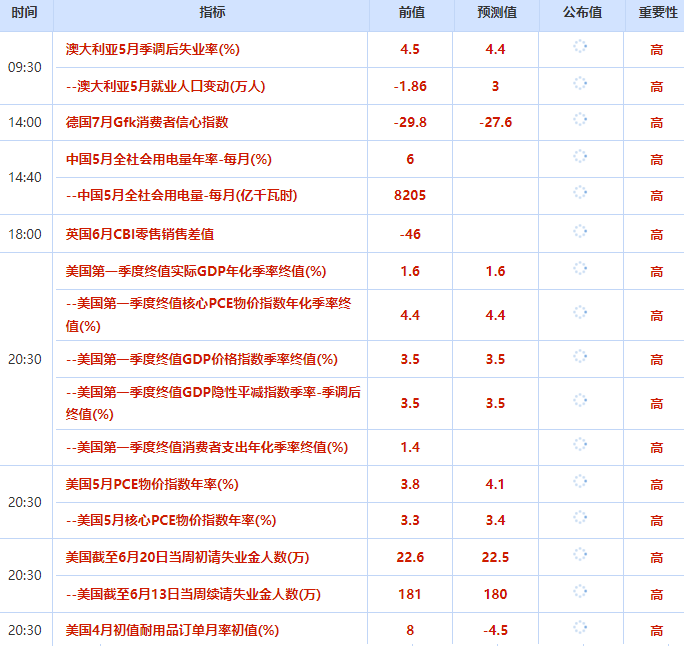
Traders are increasing their bets on a second Federal Reserve rate hike before the end of December, with the market focused on the PCE price index to be released on Thursday.
Gold prices fell to a more than seven-month low on Wednesday, with spot gold closing down 2.7% at $3,998.95 per ounce. The price touched its lowest level since November 2025 and broke below the key $4,000 mark, mainly due to a stronger dollar to a 13-month high, hawkish signals from the latest Federal Reserve policy meeting, and rising market concerns about the Iran war pushing up inflation. Traders increased their bets on US interest rate hikes this year, while declining inflation expectations further weakened gold's appeal.
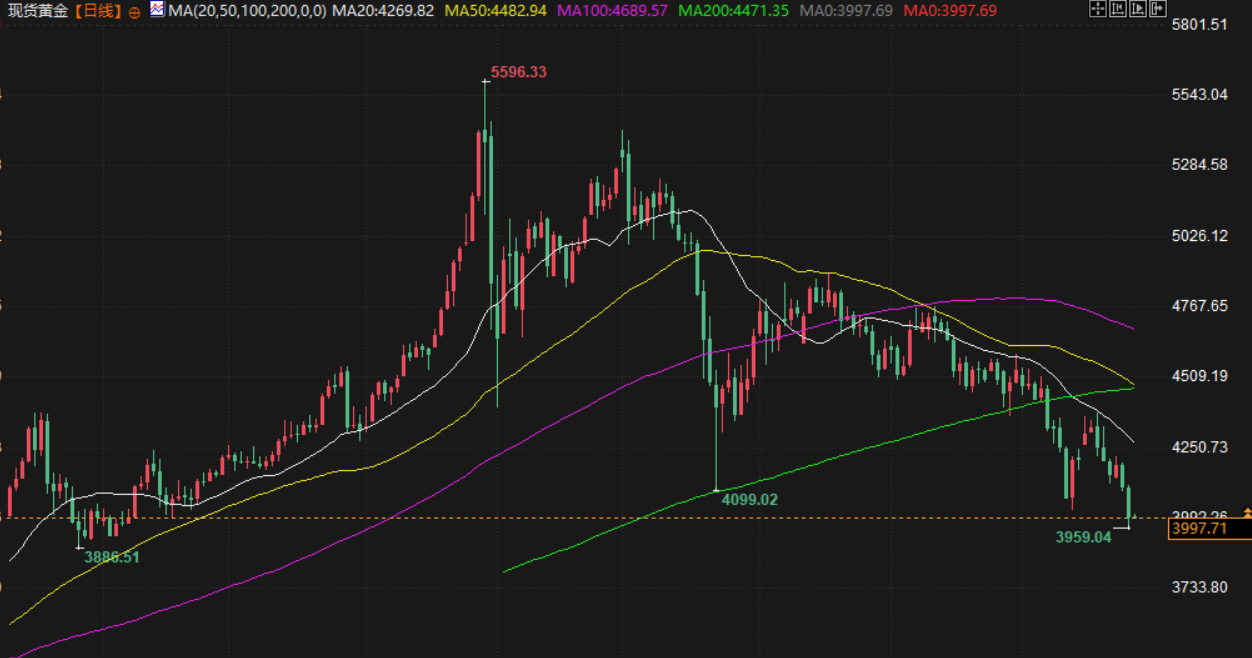
Independent metals trader Tai Wong pointed out that precious metals are under pressure overall, but believes there is support below $3,900 and central banks continue to buy, making it difficult for gold prices to collapse, but they may enter a longer period of consolidation.
Since hitting a record high of $5,594.82 in late January, gold prices have fallen by more than $1,600. ING analysts have also lowered their gold price forecasts, reducing their average price predictions for the third and fourth quarters of 2026 to $4,300 and $4,600, respectively, from $4,850 and $5,000. Investors are focusing on the US PCE inflation data to be released on Thursday. Lukman Otunuga, senior research analyst at FXTM, said that if the Federal Reserve releases further hawkish signals or data supports an interest rate hike, gold prices still face downside risks.
In other precious metals, spot silver fell 6.69% to $57.40, hitting a new low since November 2025 at $55.58 per ounce during the session. Standard Chartered Bank said that outflows from exchange-traded products have increased short-term volatility in silver, but insufficient supply may indicate a future rebound. Platinum and palladium fell 5.5% and 6.8% respectively, to $1,560.72 and $1,153.68.
Oil prices fell on Wednesday, with Brent crude closing down 4.81% at $73.13 a barrel and WTI crude closing down 4.35% at $69.87. Brent crude touched its lowest level since February 27 (the day before the US-Israel attack on Iran) at $73.04 a barrel, while WTI crude fell below $70 for the first time since March 2, mainly due to more previously stranded tankers leaving the Strait of Hormuz, easing supply concerns.
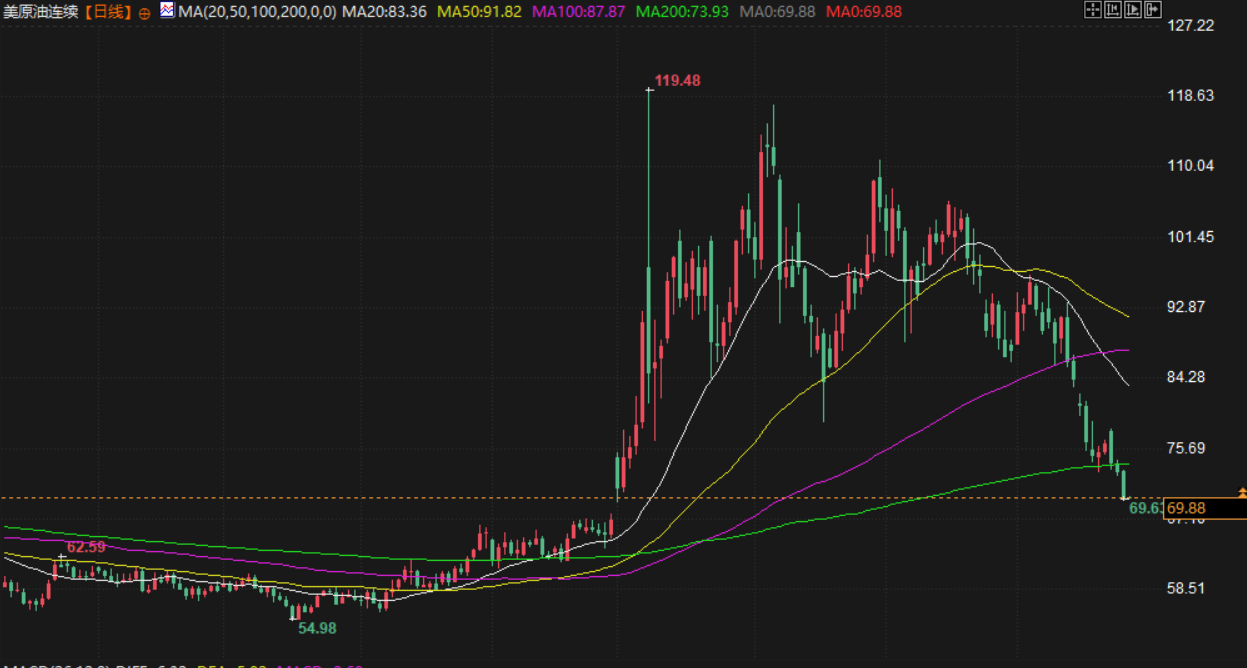
U.S. Energy Secretary Wright stated that approximately 20 million barrels of crude oil were transported out of the Strait of Hormuz under military escort in the past 24 hours, with shipments nearly returning to pre-war levels. He added that the U.S. will ensure unimpeded oil transport even without an agreement with Iran. Shipping data shows that three tankers carrying a total of 5 million barrels of crude oil have left the strait, two of which are heading to Asia. With the temporary U.S.-Iran agreement, pent-up supply is gradually being released, and global physical crude oil is being sold at a discount. The rapid recovery in Middle Eastern supply is changing trade flows, and the higher Brent crude price in the following month compared to the near-month price is also a sign of short-term supply increases.
Despite EIA data showing that U.S. crude oil inventories (including commercial and strategic reserves) fell by 15.1 million barrels to 743.3 million barrels in the week ending June 19, the lowest level since 1984, ING analysts pointed out that positive signals from the Persian Gulf are driving optimistic expectations for a recovery in crude oil flows.
On the same day, JPMorgan Chase lowered its Brent crude oil price forecast for the second half of 2026, expecting average prices of $86 and $80 in the third and fourth quarters, respectively, citing a smaller-than-expected decline in OECD commercial inventories and weak oil demand.
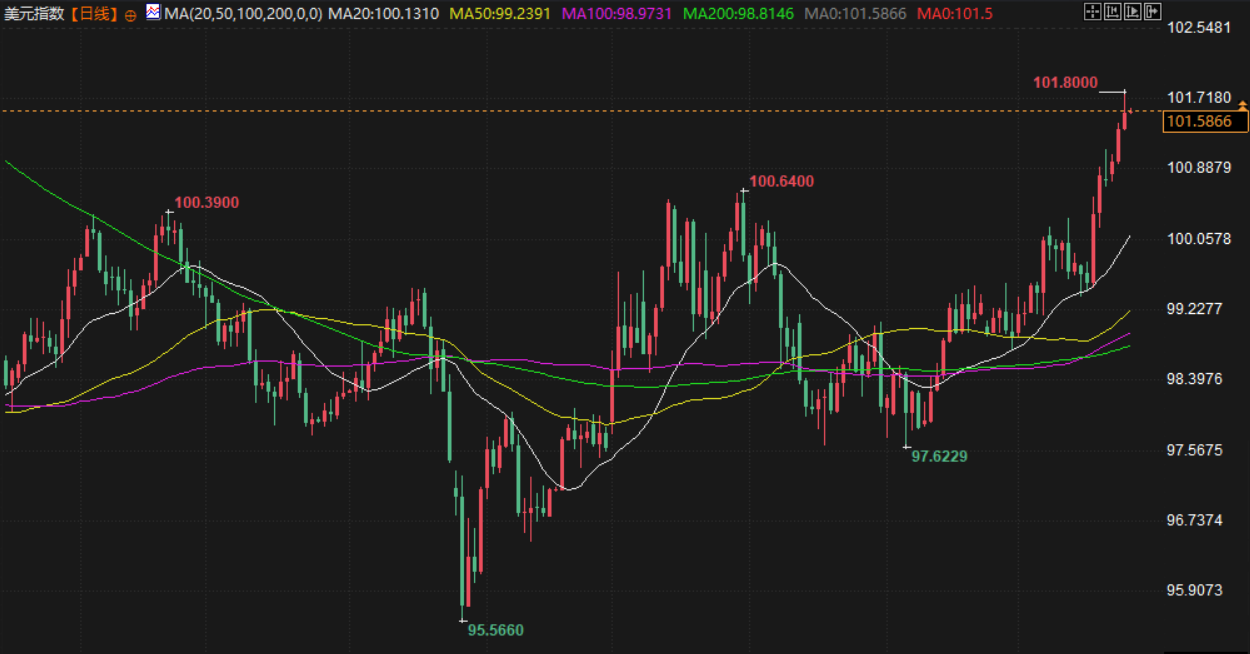
The dollar rose for the third straight session on Wednesday, with the dollar index hitting a 13-month high of 101.80, mainly as markets prepared for a Federal Reserve rate hike this year. The recent sell-off in tech stocks and uncertainty surrounding the initial peace agreement between the US and Iran also boosted safe-haven demand.
The euro fell 0.21% against the dollar to 1.1357, while the pound fell 0.29% to 1.3165, hitting a low of 1.3137, its lowest level since November. The pound fell for two consecutive days after Prime Minister Starmer resigned on Monday. The dollar rose 0.13% against the yen to 161.78, approaching the lowest level since 1986 at 161.96, despite verbal warnings from Japanese officials having little effect. Former Bank of Japan board member Sayuri Shirai said that the yen could fall to 165 if the Federal Reserve raises interest rates, and the summary of opinions from the Bank of Japan's June meeting showed that some members called for further interest rate hikes.
The market currently estimates a 34.2% probability of a Fed rate hike of at least 25 basis points in July and a 67% probability in September. Investors are focused on the May PCE inflation data to be released on Thursday. Barclays models show a mild buy signal for the dollar at the end of the month, but quarter-end models point to a strong sell signal, indicating that the dollar will not have a clear one-sided trend against major currencies at the end of June.
Trump: I will not accept any shipping-related costs included in the US-Iran agreement.
On June 24 local time, US President Trump stated that any form of cost related to shipping or maritime activities included in the final US-Iran agreement would be "unacceptable" to him. (CCTV News)
Rubio: US-Iran technical talks will resume at the end of the month.
U.S. Secretary of State Marco Rubio stated in Kuwait City on the 24th that technical talks between the United States and Iran will resume at the end of this month, most likely in Switzerland. Before concluding his visit to Kuwait and departing for Bahrain, Rubio told reporters that the United States' handling of the Iran issue would not jeopardize the security of its Gulf allies. "We will maintain full alignment with our partners in the Gulf region," he said. (Xinhua)
Iran accuses US officials of making contradictory statements regarding the memorandum of understanding.
On March 24, local time, Iranian Foreign Ministry spokesman Baghae stated on his personal social media that the US government has never shown sincerity in its treatment of the Iranian people. Baghae said that the contradictory statements by US officials regarding the memorandum of understanding will not reduce the growing distrust among the Iranian people, but will only remind them of the US's repeated breaches of contract. The US government must recognize that the principle of "reciprocity" requires both sides to fulfill their respective obligations and avoid interpreting the text of the memorandum of understanding in a way that completely contradicts its explicit content. He stated that although Iran has sufficient reason to be suspicious, it still joined the diplomatic process in good faith and signed the memorandum of understanding to end the imposed war. The Iranians understand that the enemy's hostility will not end with the signing of an agreement, and considering the experience of the past 50 years—especially the developments of the past year and a half—Iran will proceed with caution in every step. (CCTV News)
US Energy Secretary: 72 ships passed through the Strait of Hormuz in the past 24 hours
U.S. Energy Secretary Frank Wright stated that 72 ships passed through the Strait of Hormuz in the past 24 hours, transporting approximately 20 million barrels of crude oil. Wright made these remarks in New York that day, adding that Iran will no longer be able to close the Strait of Hormuz, calling it a "key bargaining chip" for Iran, and that the U.S. is weakening this chip. (CCTV News)
Netanyahu stated that Israeli troops will not withdraw from the "safe zone" in southern Lebanon as long as he remains in power.
On the 24th local time, Israeli Prime Minister Benjamin Netanyahu addressed a meeting of Israeli local governments, discussing the IDF's military operations and security policies in multiple directions. He emphasized that as long as he remains prime minister, the IDF will not withdraw from the "safe zone" in southern Lebanon and will never allow Iran to possess nuclear weapons. Netanyahu stated that although Hezbollah still exists in Lebanon, the IDF has established a "safe zone" in southern Lebanon and is comprehensively destroying its underground infrastructure to cut off its possibility of crossing the border into the Galilee region. He stressed that as long as he is in office, the IDF will maintain this "safe zone" indefinitely. (CCTV News)
The Bank of Canada denies that economic weakness equates to recession.
Bank of Canada officials denied claims that the country's economy was in recession, while acknowledging weak economic growth and slack in the labor market. The central bank stated that while the economy is currently weakening and the labor market is experiencing a surplus, it does not exhibit typical recessionary characteristics—a deep, widespread, and sustained decline in overall economic activity. Policymakers kept the policy rate unchanged at 2.25%, citing a dilemma: cutting rates to boost the economy risks rising oil prices and pushing up overall inflation; tightening rates to support prices, however, could further suppress growth.
Trump: The US will participate in the IAEA's inspections of Iran's nuclear program.
In an interview with Fox News on the 24th, US President Trump said that US personnel would participate in the International Atomic Energy Agency's (IAEA) inspections of Iran's nuclear facilities. Regarding Iran's claim that it currently has no plans to allow the IAEA access to the attacked facilities, Trump responded, "They'll reach an agreement, put it in writing, and then they'll go back on their word, claiming that's not true." Trump stated, "They've agreed, they've agreed to let inspectors in." He added that there's no rush to send inspectors to Iran immediately. (Xinhua)
The International Maritime Organization (IMO) has released operational details of its evacuation plan from the Strait of Hormuz.
On March 24, local time, the International Maritime Organization (IMO) released operational details of its evacuation plan from the Strait of Hormuz, stating that over 11,000 crew members stranded on ships in the Gulf region will be evacuated in phases according to a unified coordination mechanism. According to the IMO document, all ships awaiting evacuation should remain in their current positions and are not permitted to proceed to the Strait of Hormuz or designated waiting areas independently, but should await further notification. The IMO emphasized that this measure aims to avoid channel congestion and reduce the risks posed by mines and complex navigational environments. The document shows that the UK Maritime Trade Operations Office (UKMTO) and the French-led Indian Ocean Maritime Information Centre (MICACentre) will be responsible for contacting relevant ships and instructing them to proceed to designated waiting areas. Ships can then choose to leave the Strait of Hormuz via the northern route through Iranian waters or the southern route through Oman and US-coordinated waters, based on their own risk assessments. (CCTV News)
The first-ever AI-themed zone showcases innovative applications at the Blockchain Expo.
The 4th China International Supply Chain Promotion Expo is being held in Beijing. This year's expo has upgraded the digital technology chain to the intelligent digital technology chain and, for the first time, established an artificial intelligence zone, showcasing the entire industrial ecosystem from data collection and intelligent computing to industry application scenarios. A large number of innovative artificial intelligence applications are on display. (CCTV)
Li Qiang attended the 2026 Summer Davos Forum Business Representatives Symposium.
On the afternoon of June 24, Premier Li Qiang attended a symposium with business representatives at the 2026 Summer Davos Forum in Dalian. After listening to the speeches of the business representatives, Li Qiang pointed out that in recent years, the international community has increasingly recognized that there are no winners in trade wars and tariff wars, and more and more countries are actively promoting economic and trade exchanges, returning to the right path of mutual benefit and win-win results. This fully reflects that openness and cooperation are an irreversible trend of the times and an inherent need for all countries to expand their development space. No matter how the external environment changes, China will always follow the historical trend of openness and cooperation, and will continue to deeply participate in international trade, investment, and other cooperation, promoting the connection and integration of the Chinese market with the world market. China's high-quality exports make an important contribution to the world economy and are conducive to improving the economic efficiency and welfare of importing countries. We never deliberately pursue a trade surplus, and have always shared our domestic market with the world. We are willing to import more high-quality products from all countries and work with all parties to promote the optimized and balanced development of trade by expanding the trade pie. China's industrial competitiveness is not achieved through subsidies, but comes from the comprehensive advantages formed by its complete industrial system, super-large-scale market, and sound innovation ecosystem, and from the long-term unremitting efforts and investments of its enterprises. China's industrial subsidies strictly adhere to WTO rules, are fair and inclusive, and treat domestic and foreign-invested enterprises equally. It is hoped that the entrepreneurs present will convey more rational voices to the international community and inject more positive energy into global economic and trade cooperation. Li Qiang stated that in recent years, China's economy has been developing in a new and superior direction, bringing more new opportunities to enterprises from all countries. The revitalization and upgrading of the Chinese market will create richer incremental space, especially with the diversified expansion of demand levels within its vast scale, presenting a valuable opportunity that enterprises from all countries cannot afford to miss. The revitalization and upgrading of "Made in China" will form a more efficient industrial ecosystem, providing customized solutions for the implementation of new products by enterprises from all countries, helping them quickly improve their development capabilities. The revitalization and upgrading of China's infrastructure will provide more favorable comprehensive conditions, helping enterprises from all countries take the lead in innovative development through the digital and intelligent upgrading of traditional infrastructure and the networked layout of new infrastructure, while also providing numerous investment opportunities. Li Qiang stated that the Chinese government will do its utmost to serve enterprises from all countries and create a more open, fair, and friendly environment. We will continue to expand the scope and extent of opening up the service sector, take more pragmatic actions, fully implement national treatment for foreign-invested enterprises, better understand and respond to the demands of enterprises from all countries, help solve practical difficulties, and enable everyone to operate with peace of mind, work comfortably, and achieve excellent results in China. (Xinhua)
Key Focus Today
stock market
U.S. stocks diverged on Wednesday, with the Nasdaq and S&P 500 closing down 0.43% and 0.1%, respectively, dragged down by technology stocks and persistent concerns about high valuations and a hawkish Federal Reserve. The Nasdaq 100 has lost more than $1 trillion in market capitalization this week. However, the Dow Jones Industrial Average rose 0.35% to 51,848.90 points, boosted by falling oil prices and airline and travel stocks. The S&P 500 and Nasdaq closed at 7,358.22 and 25,476.64 points, respectively.
Oil prices fell to their lowest level since the Iran war, and the S&P passenger airline index surged 5.2%, with Expedia and Booking both rising. Technology stocks were under pressure; Micron's better-than-expected quarterly results and forecasts boosted after-hours gains, but Cerebras Systems plummeted 19.6% due to poor full-year profit margin expectations and OpenAI's launch of its self-developed inference chip. Hertz's stock price plunged 40.7% after forecasting core earnings close to the lower end of its range and announcing a share issuance.
After Trump canceled his plans to sign the housing bill, builder Hovnanian, PulteGroup, and Toll Brothers saw their shares rise by 11.3%, 7.2%, and 6.7%, respectively.
Traders are increasing their bets on a second Federal Reserve rate hike before the end of December, with the market focused on the PCE price index to be released on Thursday.
Gold Market
Gold prices fell to a more than seven-month low on Wednesday, with spot gold closing down 2.7% at $3,998.95 per ounce. The price touched its lowest level since November 2025 and broke below the key $4,000 mark, mainly due to a stronger dollar to a 13-month high, hawkish signals from the latest Federal Reserve policy meeting, and rising market concerns about the Iran war pushing up inflation. Traders increased their bets on US interest rate hikes this year, while declining inflation expectations further weakened gold's appeal.
Independent metals trader Tai Wong pointed out that precious metals are under pressure overall, but believes there is support below $3,900 and central banks continue to buy, making it difficult for gold prices to collapse, but they may enter a longer period of consolidation.
Since hitting a record high of $5,594.82 in late January, gold prices have fallen by more than $1,600. ING analysts have also lowered their gold price forecasts, reducing their average price predictions for the third and fourth quarters of 2026 to $4,300 and $4,600, respectively, from $4,850 and $5,000. Investors are focusing on the US PCE inflation data to be released on Thursday. Lukman Otunuga, senior research analyst at FXTM, said that if the Federal Reserve releases further hawkish signals or data supports an interest rate hike, gold prices still face downside risks.
In other precious metals, spot silver fell 6.69% to $57.40, hitting a new low since November 2025 at $55.58 per ounce during the session. Standard Chartered Bank said that outflows from exchange-traded products have increased short-term volatility in silver, but insufficient supply may indicate a future rebound. Platinum and palladium fell 5.5% and 6.8% respectively, to $1,560.72 and $1,153.68.
oil market
Oil prices fell on Wednesday, with Brent crude closing down 4.81% at $73.13 a barrel and WTI crude closing down 4.35% at $69.87. Brent crude touched its lowest level since February 27 (the day before the US-Israel attack on Iran) at $73.04 a barrel, while WTI crude fell below $70 for the first time since March 2, mainly due to more previously stranded tankers leaving the Strait of Hormuz, easing supply concerns.
U.S. Energy Secretary Wright stated that approximately 20 million barrels of crude oil were transported out of the Strait of Hormuz under military escort in the past 24 hours, with shipments nearly returning to pre-war levels. He added that the U.S. will ensure unimpeded oil transport even without an agreement with Iran. Shipping data shows that three tankers carrying a total of 5 million barrels of crude oil have left the strait, two of which are heading to Asia. With the temporary U.S.-Iran agreement, pent-up supply is gradually being released, and global physical crude oil is being sold at a discount. The rapid recovery in Middle Eastern supply is changing trade flows, and the higher Brent crude price in the following month compared to the near-month price is also a sign of short-term supply increases.
Despite EIA data showing that U.S. crude oil inventories (including commercial and strategic reserves) fell by 15.1 million barrels to 743.3 million barrels in the week ending June 19, the lowest level since 1984, ING analysts pointed out that positive signals from the Persian Gulf are driving optimistic expectations for a recovery in crude oil flows.
On the same day, JPMorgan Chase lowered its Brent crude oil price forecast for the second half of 2026, expecting average prices of $86 and $80 in the third and fourth quarters, respectively, citing a smaller-than-expected decline in OECD commercial inventories and weak oil demand.
Foreign exchange market
The dollar rose for the third straight session on Wednesday, with the dollar index hitting a 13-month high of 101.80, mainly as markets prepared for a Federal Reserve rate hike this year. The recent sell-off in tech stocks and uncertainty surrounding the initial peace agreement between the US and Iran also boosted safe-haven demand.
The euro fell 0.21% against the dollar to 1.1357, while the pound fell 0.29% to 1.3165, hitting a low of 1.3137, its lowest level since November. The pound fell for two consecutive days after Prime Minister Starmer resigned on Monday. The dollar rose 0.13% against the yen to 161.78, approaching the lowest level since 1986 at 161.96, despite verbal warnings from Japanese officials having little effect. Former Bank of Japan board member Sayuri Shirai said that the yen could fall to 165 if the Federal Reserve raises interest rates, and the summary of opinions from the Bank of Japan's June meeting showed that some members called for further interest rate hikes.
The market currently estimates a 34.2% probability of a Fed rate hike of at least 25 basis points in July and a 67% probability in September. Investors are focused on the May PCE inflation data to be released on Thursday. Barclays models show a mild buy signal for the dollar at the end of the month, but quarter-end models point to a strong sell signal, indicating that the dollar will not have a clear one-sided trend against major currencies at the end of June.
International News
Trump: I will not accept any shipping-related costs included in the US-Iran agreement.
On June 24 local time, US President Trump stated that any form of cost related to shipping or maritime activities included in the final US-Iran agreement would be "unacceptable" to him. (CCTV News)
Rubio: US-Iran technical talks will resume at the end of the month.
U.S. Secretary of State Marco Rubio stated in Kuwait City on the 24th that technical talks between the United States and Iran will resume at the end of this month, most likely in Switzerland. Before concluding his visit to Kuwait and departing for Bahrain, Rubio told reporters that the United States' handling of the Iran issue would not jeopardize the security of its Gulf allies. "We will maintain full alignment with our partners in the Gulf region," he said. (Xinhua)
Iran accuses US officials of making contradictory statements regarding the memorandum of understanding.
On March 24, local time, Iranian Foreign Ministry spokesman Baghae stated on his personal social media that the US government has never shown sincerity in its treatment of the Iranian people. Baghae said that the contradictory statements by US officials regarding the memorandum of understanding will not reduce the growing distrust among the Iranian people, but will only remind them of the US's repeated breaches of contract. The US government must recognize that the principle of "reciprocity" requires both sides to fulfill their respective obligations and avoid interpreting the text of the memorandum of understanding in a way that completely contradicts its explicit content. He stated that although Iran has sufficient reason to be suspicious, it still joined the diplomatic process in good faith and signed the memorandum of understanding to end the imposed war. The Iranians understand that the enemy's hostility will not end with the signing of an agreement, and considering the experience of the past 50 years—especially the developments of the past year and a half—Iran will proceed with caution in every step. (CCTV News)
US Energy Secretary: 72 ships passed through the Strait of Hormuz in the past 24 hours
U.S. Energy Secretary Frank Wright stated that 72 ships passed through the Strait of Hormuz in the past 24 hours, transporting approximately 20 million barrels of crude oil. Wright made these remarks in New York that day, adding that Iran will no longer be able to close the Strait of Hormuz, calling it a "key bargaining chip" for Iran, and that the U.S. is weakening this chip. (CCTV News)
Netanyahu stated that Israeli troops will not withdraw from the "safe zone" in southern Lebanon as long as he remains in power.
On the 24th local time, Israeli Prime Minister Benjamin Netanyahu addressed a meeting of Israeli local governments, discussing the IDF's military operations and security policies in multiple directions. He emphasized that as long as he remains prime minister, the IDF will not withdraw from the "safe zone" in southern Lebanon and will never allow Iran to possess nuclear weapons. Netanyahu stated that although Hezbollah still exists in Lebanon, the IDF has established a "safe zone" in southern Lebanon and is comprehensively destroying its underground infrastructure to cut off its possibility of crossing the border into the Galilee region. He stressed that as long as he is in office, the IDF will maintain this "safe zone" indefinitely. (CCTV News)
The Bank of Canada denies that economic weakness equates to recession.
Bank of Canada officials denied claims that the country's economy was in recession, while acknowledging weak economic growth and slack in the labor market. The central bank stated that while the economy is currently weakening and the labor market is experiencing a surplus, it does not exhibit typical recessionary characteristics—a deep, widespread, and sustained decline in overall economic activity. Policymakers kept the policy rate unchanged at 2.25%, citing a dilemma: cutting rates to boost the economy risks rising oil prices and pushing up overall inflation; tightening rates to support prices, however, could further suppress growth.
Trump: The US will participate in the IAEA's inspections of Iran's nuclear program.
In an interview with Fox News on the 24th, US President Trump said that US personnel would participate in the International Atomic Energy Agency's (IAEA) inspections of Iran's nuclear facilities. Regarding Iran's claim that it currently has no plans to allow the IAEA access to the attacked facilities, Trump responded, "They'll reach an agreement, put it in writing, and then they'll go back on their word, claiming that's not true." Trump stated, "They've agreed, they've agreed to let inspectors in." He added that there's no rush to send inspectors to Iran immediately. (Xinhua)
The International Maritime Organization (IMO) has released operational details of its evacuation plan from the Strait of Hormuz.
On March 24, local time, the International Maritime Organization (IMO) released operational details of its evacuation plan from the Strait of Hormuz, stating that over 11,000 crew members stranded on ships in the Gulf region will be evacuated in phases according to a unified coordination mechanism. According to the IMO document, all ships awaiting evacuation should remain in their current positions and are not permitted to proceed to the Strait of Hormuz or designated waiting areas independently, but should await further notification. The IMO emphasized that this measure aims to avoid channel congestion and reduce the risks posed by mines and complex navigational environments. The document shows that the UK Maritime Trade Operations Office (UKMTO) and the French-led Indian Ocean Maritime Information Centre (MICACentre) will be responsible for contacting relevant ships and instructing them to proceed to designated waiting areas. Ships can then choose to leave the Strait of Hormuz via the northern route through Iranian waters or the southern route through Oman and US-coordinated waters, based on their own risk assessments. (CCTV News)
Domestic News
The first-ever AI-themed zone showcases innovative applications at the Blockchain Expo.
The 4th China International Supply Chain Promotion Expo is being held in Beijing. This year's expo has upgraded the digital technology chain to the intelligent digital technology chain and, for the first time, established an artificial intelligence zone, showcasing the entire industrial ecosystem from data collection and intelligent computing to industry application scenarios. A large number of innovative artificial intelligence applications are on display. (CCTV)
Li Qiang attended the 2026 Summer Davos Forum Business Representatives Symposium.
On the afternoon of June 24, Premier Li Qiang attended a symposium with business representatives at the 2026 Summer Davos Forum in Dalian. After listening to the speeches of the business representatives, Li Qiang pointed out that in recent years, the international community has increasingly recognized that there are no winners in trade wars and tariff wars, and more and more countries are actively promoting economic and trade exchanges, returning to the right path of mutual benefit and win-win results. This fully reflects that openness and cooperation are an irreversible trend of the times and an inherent need for all countries to expand their development space. No matter how the external environment changes, China will always follow the historical trend of openness and cooperation, and will continue to deeply participate in international trade, investment, and other cooperation, promoting the connection and integration of the Chinese market with the world market. China's high-quality exports make an important contribution to the world economy and are conducive to improving the economic efficiency and welfare of importing countries. We never deliberately pursue a trade surplus, and have always shared our domestic market with the world. We are willing to import more high-quality products from all countries and work with all parties to promote the optimized and balanced development of trade by expanding the trade pie. China's industrial competitiveness is not achieved through subsidies, but comes from the comprehensive advantages formed by its complete industrial system, super-large-scale market, and sound innovation ecosystem, and from the long-term unremitting efforts and investments of its enterprises. China's industrial subsidies strictly adhere to WTO rules, are fair and inclusive, and treat domestic and foreign-invested enterprises equally. It is hoped that the entrepreneurs present will convey more rational voices to the international community and inject more positive energy into global economic and trade cooperation. Li Qiang stated that in recent years, China's economy has been developing in a new and superior direction, bringing more new opportunities to enterprises from all countries. The revitalization and upgrading of the Chinese market will create richer incremental space, especially with the diversified expansion of demand levels within its vast scale, presenting a valuable opportunity that enterprises from all countries cannot afford to miss. The revitalization and upgrading of "Made in China" will form a more efficient industrial ecosystem, providing customized solutions for the implementation of new products by enterprises from all countries, helping them quickly improve their development capabilities. The revitalization and upgrading of China's infrastructure will provide more favorable comprehensive conditions, helping enterprises from all countries take the lead in innovative development through the digital and intelligent upgrading of traditional infrastructure and the networked layout of new infrastructure, while also providing numerous investment opportunities. Li Qiang stated that the Chinese government will do its utmost to serve enterprises from all countries and create a more open, fair, and friendly environment. We will continue to expand the scope and extent of opening up the service sector, take more pragmatic actions, fully implement national treatment for foreign-invested enterprises, better understand and respond to the demands of enterprises from all countries, help solve practical difficulties, and enable everyone to operate with peace of mind, work comfortably, and achieve excellent results in China. (Xinhua)
- Risk Warning and Disclaimer
- The market involves risk, and trading may not be suitable for all investors. This article is for reference only and does not constitute personal investment advice, nor does it take into account certain users’ specific investment objectives, financial situation, or other needs. Any investment decisions made based on this information are at your own risk.