A strong US dollar continues to exert downward pressure, pushing the New Zealand dollar to a new low for the period; expectations of interest rate hikes may become the only line of defense.
2026-06-25 10:30:05
On Thursday (June 25) in early Asian trading, the New Zealand dollar continued its decline against the US dollar, currently trading around 0.5640, a new low since the end of last year.
Complex geopolitical tensions in the Middle East, coupled with strong US economic data, have boosted the US dollar, putting sustained downward pressure on the New Zealand dollar. However, widespread market expectations of a July rate hike by the Reserve Bank of New Zealand have provided some support for the New Zealand dollar.

The situation in the Middle East is showing complex and contradictory signals.
US President Trump claimed that Iran had “fully and completely” agreed to open its facilities for nuclear inspections, but Iranian Foreign Minister Abbas Araqchi quickly responded that substantive nuclear negotiations had not yet begun, clearly downplaying market optimism about a rapid breakthrough between the US and Iran.
Meanwhile, Iran’s chief nuclear negotiator issued a stern warning, stating that the Strait of Hormuz “will never return to its pre-war state” and will always remain under Iran’s tight control, further exacerbating market concerns about energy supplies and regional stability.
However, positive signals also emerged from Washington—the US sponsored a new round of negotiations between Israel and Lebanon, aimed at facilitating a ceasefire agreement with Hezbollah, which is backed by Iran. This complex geopolitical situation has continued to support the US dollar as the world's primary safe-haven asset.
The latest S&P Global US Flash Purchase PMI data for June 2026 shows that US economic activity is expanding faster than the market generally expected, providing strong fundamental support for the US dollar.
The composite PMI output index rose to 52.2, significantly higher than 51.5 in May, reaching a five-month high; the manufacturing output index jumped sharply to 55.7, far exceeding the market expectation of 54.8, marking the strongest performance in nearly 49 months; the services PMI recorded 51.3, also higher than the previous value and expectations.
This overall better-than-expected performance highlights the unique resilience of the US economy among developed countries. Despite the lingering effects of Middle East geopolitical conflicts and global supply chain disruptions, new orders in the US manufacturing sector surged, with production expanding at its fastest pace since July 2021, and extended supplier lead times reflecting strong demand. The service sector also benefited from stable consumption and a boost from specific events, resulting in overall expansion in new orders. The business confidence index rose to its highest level since February, indicating relative optimism about the future outlook.
Despite the New Zealand dollar's continued weakness in the face of a strong US dollar, the outlook for New Zealand's domestic monetary policy has provided some support for the exchange rate. The market widely expects the Reserve Bank of New Zealand to raise the official cash rate by 25 basis points to 2.5% at its July meeting.
This hawkish outlook is strongly supported by domestic inflationary pressures – the consumer price index remained stubbornly high at 3.1% year-on-year in the first quarter, consistently above the median of the Reserve Bank of New Zealand's (RBNZ) 1% to 3% inflation target range, forcing policymakers to take further action. The RBNZ is one of the few developed-economy central banks to maintain a tightening stance in 2026, and its policy divergence with other major central banks (especially those likely to cut rates) could be beneficial to the New Zealand dollar in the medium term.
According to the daily chart, the New Zealand dollar continued its accelerated downward trend against the US dollar, with the bearish trend dominating the market. The moving average system formed strong downward resistance, with the price breaking through the MA20, MA50, MA100, and MA200 moving averages. The short-term MA20 (0.5800) has become a core resistance level, and the medium- and long-term moving averages have also turned downwards, indicating ample room for any rebound.
The MACD indicator DIFF (-0.0055) continues to run below DEA (-0.0036), the green momentum bars continue to expand, the bearish momentum continues to be released, and there has been no low-level golden cross stop signal yet.
The RSI value fell to 28.26, entering the oversold range of 20-30, indicating a short-term need for a slight technical rebound, but the overall downward structure has not changed substantially.
In terms of price movement, after encountering resistance at the previous high of 0.5993 (a double top), the price continued to weaken, successively breaking through the key support level of 0.5815 and testing a low of 0.5630. The previous low of 0.5679 has been effectively broken, and there is currently no dense support zone below, opening up further downside potential. The first resistance level above is the previous consolidation platform at 0.5815.
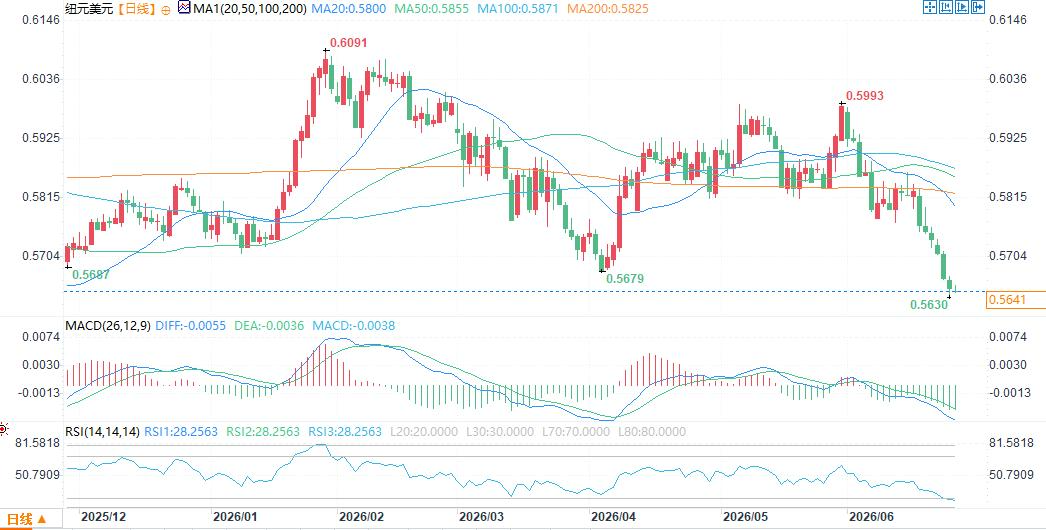
(NZD/USD daily chart, source: FX678)
At 10:29 Beijing time on June 25, the New Zealand dollar was trading at 0.5639/40 against the US dollar.
Complex geopolitical tensions in the Middle East, coupled with strong US economic data, have boosted the US dollar, putting sustained downward pressure on the New Zealand dollar. However, widespread market expectations of a July rate hike by the Reserve Bank of New Zealand have provided some support for the New Zealand dollar.
Geopolitical risks escalate: Confusing signals from US-Iran nuclear talks, ongoing Hormuz dispute.
The situation in the Middle East is showing complex and contradictory signals.
US President Trump claimed that Iran had “fully and completely” agreed to open its facilities for nuclear inspections, but Iranian Foreign Minister Abbas Araqchi quickly responded that substantive nuclear negotiations had not yet begun, clearly downplaying market optimism about a rapid breakthrough between the US and Iran.
Meanwhile, Iran’s chief nuclear negotiator issued a stern warning, stating that the Strait of Hormuz “will never return to its pre-war state” and will always remain under Iran’s tight control, further exacerbating market concerns about energy supplies and regional stability.
However, positive signals also emerged from Washington—the US sponsored a new round of negotiations between Israel and Lebanon, aimed at facilitating a ceasefire agreement with Hezbollah, which is backed by Iran. This complex geopolitical situation has continued to support the US dollar as the world's primary safe-haven asset.
Strong economic data: US PMIs exceeded expectations across the board, highlighting the advantage of "exceptionalism".
The latest S&P Global US Flash Purchase PMI data for June 2026 shows that US economic activity is expanding faster than the market generally expected, providing strong fundamental support for the US dollar.
The composite PMI output index rose to 52.2, significantly higher than 51.5 in May, reaching a five-month high; the manufacturing output index jumped sharply to 55.7, far exceeding the market expectation of 54.8, marking the strongest performance in nearly 49 months; the services PMI recorded 51.3, also higher than the previous value and expectations.
This overall better-than-expected performance highlights the unique resilience of the US economy among developed countries. Despite the lingering effects of Middle East geopolitical conflicts and global supply chain disruptions, new orders in the US manufacturing sector surged, with production expanding at its fastest pace since July 2021, and extended supplier lead times reflecting strong demand. The service sector also benefited from stable consumption and a boost from specific events, resulting in overall expansion in new orders. The business confidence index rose to its highest level since February, indicating relative optimism about the future outlook.
RBNZ Rate Hike Expectations: Support for the New Zealand Dollar
Despite the New Zealand dollar's continued weakness in the face of a strong US dollar, the outlook for New Zealand's domestic monetary policy has provided some support for the exchange rate. The market widely expects the Reserve Bank of New Zealand to raise the official cash rate by 25 basis points to 2.5% at its July meeting.
This hawkish outlook is strongly supported by domestic inflationary pressures – the consumer price index remained stubbornly high at 3.1% year-on-year in the first quarter, consistently above the median of the Reserve Bank of New Zealand's (RBNZ) 1% to 3% inflation target range, forcing policymakers to take further action. The RBNZ is one of the few developed-economy central banks to maintain a tightening stance in 2026, and its policy divergence with other major central banks (especially those likely to cut rates) could be beneficial to the New Zealand dollar in the medium term.
Technical Analysis
According to the daily chart, the New Zealand dollar continued its accelerated downward trend against the US dollar, with the bearish trend dominating the market. The moving average system formed strong downward resistance, with the price breaking through the MA20, MA50, MA100, and MA200 moving averages. The short-term MA20 (0.5800) has become a core resistance level, and the medium- and long-term moving averages have also turned downwards, indicating ample room for any rebound.
The MACD indicator DIFF (-0.0055) continues to run below DEA (-0.0036), the green momentum bars continue to expand, the bearish momentum continues to be released, and there has been no low-level golden cross stop signal yet.
The RSI value fell to 28.26, entering the oversold range of 20-30, indicating a short-term need for a slight technical rebound, but the overall downward structure has not changed substantially.
In terms of price movement, after encountering resistance at the previous high of 0.5993 (a double top), the price continued to weaken, successively breaking through the key support level of 0.5815 and testing a low of 0.5630. The previous low of 0.5679 has been effectively broken, and there is currently no dense support zone below, opening up further downside potential. The first resistance level above is the previous consolidation platform at 0.5815.
(NZD/USD daily chart, source: FX678)
At 10:29 Beijing time on June 25, the New Zealand dollar was trading at 0.5639/40 against the US dollar.
- Risk Warning and Disclaimer
- The market involves risk, and trading may not be suitable for all investors. This article is for reference only and does not constitute personal investment advice, nor does it take into account certain users’ specific investment objectives, financial situation, or other needs. Any investment decisions made based on this information are at your own risk.