Crude oil trading alert: Market risk appetite is recovering, and oil prices are falling rapidly. When will the decline stop?
2026-06-25 09:31:07
International crude oil prices continued their decline during Asian trading hours on Thursday, with WTI crude oil trading around $69.50 per barrel . Looking at the overall market environment, oil prices still face significant pressure, with expectations of increased supply due to easing tensions between the US and Iran becoming a key factor influencing the market.

Recent peace talks between the United States and Iran have made significant progress, substantially improving market expectations for the stability of global crude oil supply. Previously, tensions in the Middle East had raised concerns among investors about the security of shipping through the Strait of Hormuz, causing significant fluctuations in international oil prices. However, as diplomatic negotiations continue, market risk premiums have rapidly declined, and the crude oil market has returned to a fundamental supply and demand logic.
Data shows that the Strait of Hormuz, as one of the world's most important energy transportation routes, handles approximately 20% of global seaborne crude oil shipments. U.S. Energy Secretary Chris Wright stated at the Global Energy Forum in New York that about 20 million barrels of crude oil successfully passed through the Strait of Hormuz in the past 24 hours, indicating that shipping activity in the region has largely returned to normal levels. Meanwhile, shipping data shows that three supertankers previously stranded due to regional tensions successfully departed the Persian Gulf on Wednesday, transporting a total of 5 million barrels of crude oil. This development further strengthens market confidence in the recovery of Middle Eastern crude oil supplies.
In addition to the resumption of normal transportation, the US government's temporary waiver for already loaded Iranian crude oil is also seen by the market as an important signal of increased supply. The market generally expects that as restrictions are eased in stages, more Iranian crude oil will re-enter the international market, thereby further improving the global supply environment.
As a result, significant selling pressure emerged in the international crude oil futures market. Market participants adjusted their previously established positions related to tight supply, leading to a continued decline in oil prices. Market surveys indicate that energy futures traders generally believe that the recovery in Middle Eastern crude oil supply is exceeding market expectations, with a large number of sell orders concentrated in the August delivery contract, suggesting that investors are already priced in the impact of future supply growth.
From a market sentiment perspective, the rapid fading of geopolitical risk premiums has been a significant driver of the recent decline in oil prices. Previously, the core logic supporting rising oil prices stemmed primarily from concerns about transportation disruptions and supply contraction. However, as peace agreements progress and transportation returns to normal, these risk premiums are being gradually eliminated by the market.
However, investors are still closely monitoring the progress of subsequent negotiations and the performance of global demand. If global economic growth remains stable, especially driven by the summer travel season, crude oil consumption demand is expected to continue to provide some support for oil prices. In addition, changes in US crude oil inventories, OPEC+ production policies, and manufacturing activity data from major global economies will continue to influence future market trends.
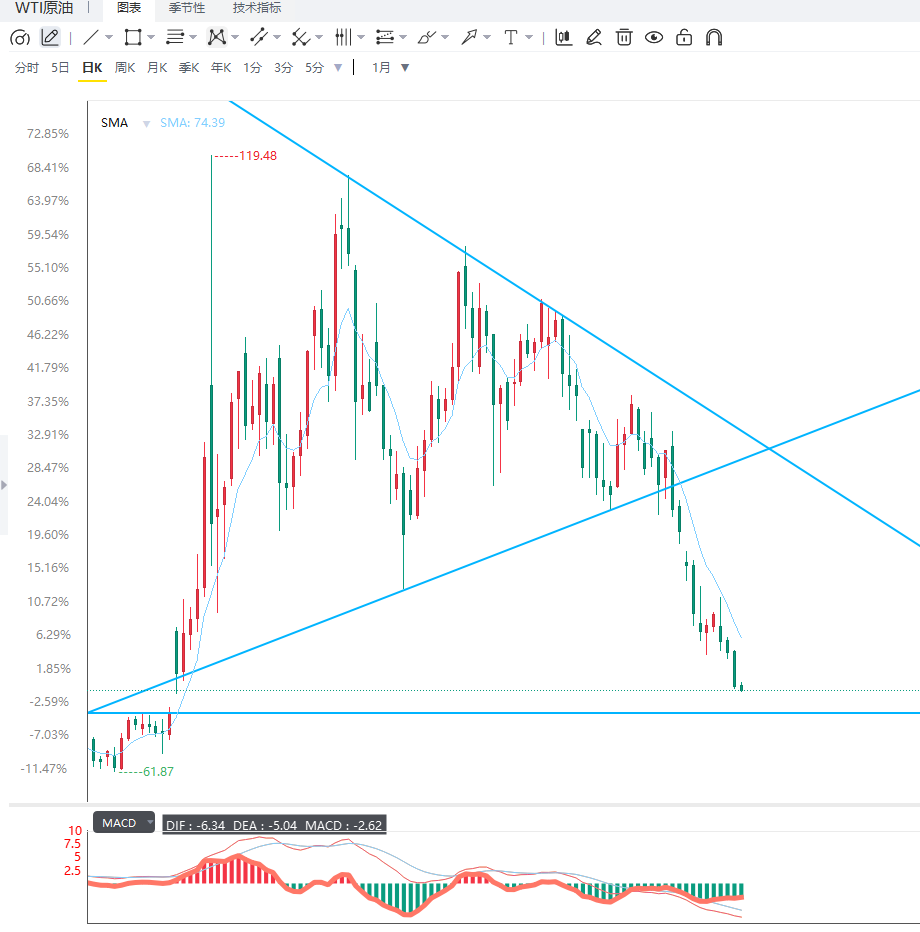
From a daily chart perspective, WTI crude oil has been trading within a downward channel since its previous high, currently hovering around $69.50, and remains in a bearish trend. The moving average system shows a bearish alignment, reflecting a continued weak medium-term trend. Key support levels are currently at $68.50 and $67.00 ; a break below these levels could lead to further testing of support around $65. On the upside, key resistance levels are at $71.50 and $73.00 . Only a sustained move above $73 would suggest a potential reversal of the recent downtrend. From a momentum perspective, while some selling pressure has dissipated, the rebound has been relatively limited, indicating that investors remain cautious about potential supply increases.
From a 4-hour chart perspective, WTI crude oil has not shown any oversold correction after its continuous decline, and indicators have entered oversold territory. If the oversold rebound can effectively break through and hold above $70.50, the rebound target could further point towards the $71.50 area. However, if the rebound is resisted and falls back below $69, it means that the bearish trend may regain dominance, and oil prices may then risk retesting the $68.50 support level. Overall, the short-term market is in a directional decision-making phase, and with continued improvement in supply expectations, the upside potential may be somewhat limited.
Editor's Summary : Improved US-Iran relations and the resumption of normal shipping in the Strait of Hormuz are significantly altering supply and demand expectations in the international crude oil market. With large quantities of crude oil re-entering the global circulation system, the premium previously created by geopolitical risks has rapidly diminished, becoming a major reason for recent downward pressure on oil prices. In the short term, expectations of increased supply will continue to limit the upside potential of WTI crude oil, while the recovery in global demand will be a key variable influencing the next phase of price movements. Investors should pay close attention to the progress of subsequent US-Iran negotiations, OPEC+ policy developments, and changes in US inventory data, as these factors may determine whether oil prices can stabilize in the current range and embark on a new trend.
Recent peace talks between the United States and Iran have made significant progress, substantially improving market expectations for the stability of global crude oil supply. Previously, tensions in the Middle East had raised concerns among investors about the security of shipping through the Strait of Hormuz, causing significant fluctuations in international oil prices. However, as diplomatic negotiations continue, market risk premiums have rapidly declined, and the crude oil market has returned to a fundamental supply and demand logic.
Data shows that the Strait of Hormuz, as one of the world's most important energy transportation routes, handles approximately 20% of global seaborne crude oil shipments. U.S. Energy Secretary Chris Wright stated at the Global Energy Forum in New York that about 20 million barrels of crude oil successfully passed through the Strait of Hormuz in the past 24 hours, indicating that shipping activity in the region has largely returned to normal levels. Meanwhile, shipping data shows that three supertankers previously stranded due to regional tensions successfully departed the Persian Gulf on Wednesday, transporting a total of 5 million barrels of crude oil. This development further strengthens market confidence in the recovery of Middle Eastern crude oil supplies.
In addition to the resumption of normal transportation, the US government's temporary waiver for already loaded Iranian crude oil is also seen by the market as an important signal of increased supply. The market generally expects that as restrictions are eased in stages, more Iranian crude oil will re-enter the international market, thereby further improving the global supply environment.
As a result, significant selling pressure emerged in the international crude oil futures market. Market participants adjusted their previously established positions related to tight supply, leading to a continued decline in oil prices. Market surveys indicate that energy futures traders generally believe that the recovery in Middle Eastern crude oil supply is exceeding market expectations, with a large number of sell orders concentrated in the August delivery contract, suggesting that investors are already priced in the impact of future supply growth.
From a market sentiment perspective, the rapid fading of geopolitical risk premiums has been a significant driver of the recent decline in oil prices. Previously, the core logic supporting rising oil prices stemmed primarily from concerns about transportation disruptions and supply contraction. However, as peace agreements progress and transportation returns to normal, these risk premiums are being gradually eliminated by the market.
However, investors are still closely monitoring the progress of subsequent negotiations and the performance of global demand. If global economic growth remains stable, especially driven by the summer travel season, crude oil consumption demand is expected to continue to provide some support for oil prices. In addition, changes in US crude oil inventories, OPEC+ production policies, and manufacturing activity data from major global economies will continue to influence future market trends.
From a daily chart perspective, WTI crude oil has been trading within a downward channel since its previous high, currently hovering around $69.50, and remains in a bearish trend. The moving average system shows a bearish alignment, reflecting a continued weak medium-term trend. Key support levels are currently at $68.50 and $67.00 ; a break below these levels could lead to further testing of support around $65. On the upside, key resistance levels are at $71.50 and $73.00 . Only a sustained move above $73 would suggest a potential reversal of the recent downtrend. From a momentum perspective, while some selling pressure has dissipated, the rebound has been relatively limited, indicating that investors remain cautious about potential supply increases.
From a 4-hour chart perspective, WTI crude oil has not shown any oversold correction after its continuous decline, and indicators have entered oversold territory. If the oversold rebound can effectively break through and hold above $70.50, the rebound target could further point towards the $71.50 area. However, if the rebound is resisted and falls back below $69, it means that the bearish trend may regain dominance, and oil prices may then risk retesting the $68.50 support level. Overall, the short-term market is in a directional decision-making phase, and with continued improvement in supply expectations, the upside potential may be somewhat limited.
Editor's Summary : Improved US-Iran relations and the resumption of normal shipping in the Strait of Hormuz are significantly altering supply and demand expectations in the international crude oil market. With large quantities of crude oil re-entering the global circulation system, the premium previously created by geopolitical risks has rapidly diminished, becoming a major reason for recent downward pressure on oil prices. In the short term, expectations of increased supply will continue to limit the upside potential of WTI crude oil, while the recovery in global demand will be a key variable influencing the next phase of price movements. Investors should pay close attention to the progress of subsequent US-Iran negotiations, OPEC+ policy developments, and changes in US inventory data, as these factors may determine whether oil prices can stabilize in the current range and embark on a new trend.
- Risk Warning and Disclaimer
- The market involves risk, and trading may not be suitable for all investors. This article is for reference only and does not constitute personal investment advice, nor does it take into account certain users’ specific investment objectives, financial situation, or other needs. Any investment decisions made based on this information are at your own risk.