The US dollar remained strong, and silver fell to a new low near $56.90.
2026-06-25 14:37:41
On Thursday during Asian trading hours, spot silver (XAG/USD) continued its recent weakness, falling back to around $56.90 per ounce , marking its third consecutive day of decline. Rising market expectations for future interest rate hikes by the Federal Reserve, coupled with a persistently high US dollar index, combined to exert significant downward pressure on silver prices.
The biggest recent change in financial markets stems from the repricing of expectations regarding Federal Reserve policy. Although international oil prices had previously fallen sharply due to easing tensions in the Middle East, market concerns about US inflation risks have not completely dissipated. In a recent speech, Federal Reserve Chairman Kevin Warsh reiterated the Fed's firm commitment to controlling inflation and emphasized that the US economy as a whole remains robust, which the market interpreted as a hawkish signal.
As the Federal Reserve continues to signal a tightening stance, investors are increasing their bets on future interest rate hikes. According to the CME FedWatch tool, the market now expects at least one rate hike by the Fed before the end of this year to be 83.1% , indicating a significant extension of market expectations for the duration of the high-interest-rate environment. For silver, a high-interest-rate environment often poses a disadvantage. Since silver itself does not generate interest income, when market interest rates rise, investors tend to allocate to bonds and money market instruments that provide fixed income, thus weakening the attractiveness of precious metals.
It is worth noting that the global energy market has recently seen significant changes. With progress in peace talks between the US and Iran, international crude oil prices have fallen back to near pre-conflict levels. The resumption of normal shipping in the Strait of Hormuz and the gradual recovery of Iranian energy exports have effectively alleviated previous market concerns about energy supply disruptions.
Under normal circumstances, a decline in oil prices helps reduce future inflationary pressures and may lessen the need for the Federal Reserve to continue tightening policy. However, the market is currently more focused on the inflation data itself and the Fed's policy stance, so the positive impact of falling energy prices on silver is relatively limited. The market's focus now shifts to the upcoming release of the US May Personal Consumption Expenditures Price Index (PCE) data. As one of the Fed's most closely watched inflation indicators, the PCE data will directly influence investors' judgments on future interest rate policy.
The market expects the US May PCE annual rate to rise to 4.1% from 3.8% previously; the core PCE annual rate is expected to rise to 3.4% from 3.3 %. If the data continues to rise, the likelihood of the Federal Reserve maintaining a hawkish stance will significantly increase, thus putting new downward pressure on silver. Meanwhile, the persistently high level of the US dollar index is also a significant reason for the continued pressure on silver. Currently, the US dollar index is still close to its previous high of over a year at 101.80 . Since silver is priced in US dollars, a stronger dollar means higher costs for holders of other currencies to purchase silver, thereby suppressing global demand and weakening price performance.
From a market sentiment perspective, funds are continuously flowing into dollar assets and fixed-income markets, while the precious metals sector as a whole is performing weakly. Until the Federal Reserve clearly shifts its policy direction towards easing, the silver market may still face significant pressure in the short term.
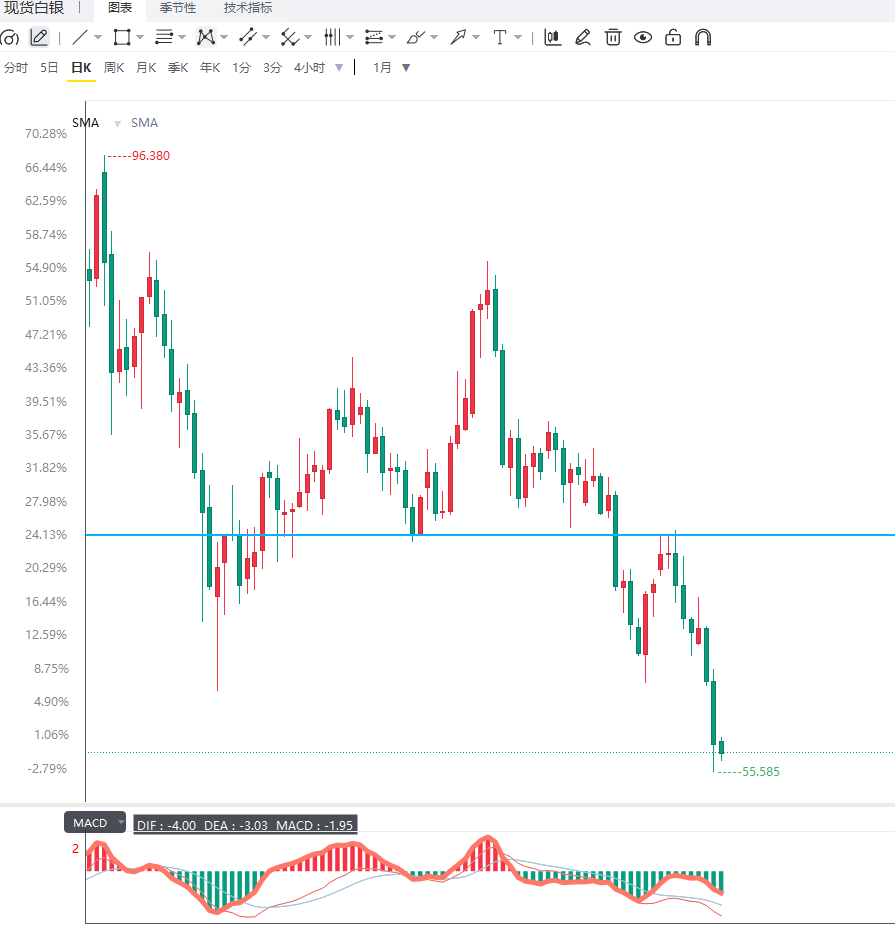
From a daily chart perspective, silver has fallen to around $56.90 after three consecutive trading days of decline, exhibiting a clear bearish pattern. The previous consolidation range at higher levels has been effectively broken, and the market's center of gravity continues to shift downwards. Currently, the price is trading below the major moving average system, indicating a bearish medium-term trend. Key support levels to watch are $56.00 and the $54.50 area; a further break below these levels could open up potential downside towards the $52.00 area. The first resistance level is around $58.50, with further resistance at $60.00 and the $61.80 area. Until a sustained move above $60 is achieved, the overall outlook remains bearish.
From a 4-hour chart perspective, silver is trading within a descending channel, with short-term bearish momentum still dominating. Prices continue to be suppressed by short-term moving averages, reflecting weak market sentiment for a rebound. However, with the continuous decline, some short-term technical indicators are approaching oversold territory, suggesting the pace of the decline may be slowing. If prices can hold the $56.00 support level and break above $58.50 again, a technical rebound is possible, potentially testing the $60 mark. Conversely, if prices fall below $56, the bears may further extend their advantage, pushing prices towards $54.50 or even lower. Overall, the short-term rebound potential is limited, and the trend remains downward.
Editor's Summary : The core reason for silver's recent continued weakness lies in the significantly increased market expectations for further interest rate hikes by the Federal Reserve. Although the decline in oil prices has alleviated some inflationary pressures, investors are more focused on the resilience of the US economy and future changes in interest rates. Against the backdrop of a persistently high US dollar index and rising interest rate expectations, silver's attractiveness as a non-interest-bearing asset has been significantly weakened. In the short term, US PCE inflation data will be a key factor influencing market direction. If inflation data continues to exceed expectations, silver may continue its downward trend; if inflation shows signs of cooling, it is expected to prompt the market to reassess its interest rate hike expectations, providing a period of recovery for silver.
The biggest recent change in financial markets stems from the repricing of expectations regarding Federal Reserve policy. Although international oil prices had previously fallen sharply due to easing tensions in the Middle East, market concerns about US inflation risks have not completely dissipated. In a recent speech, Federal Reserve Chairman Kevin Warsh reiterated the Fed's firm commitment to controlling inflation and emphasized that the US economy as a whole remains robust, which the market interpreted as a hawkish signal.
As the Federal Reserve continues to signal a tightening stance, investors are increasing their bets on future interest rate hikes. According to the CME FedWatch tool, the market now expects at least one rate hike by the Fed before the end of this year to be 83.1% , indicating a significant extension of market expectations for the duration of the high-interest-rate environment. For silver, a high-interest-rate environment often poses a disadvantage. Since silver itself does not generate interest income, when market interest rates rise, investors tend to allocate to bonds and money market instruments that provide fixed income, thus weakening the attractiveness of precious metals.
It is worth noting that the global energy market has recently seen significant changes. With progress in peace talks between the US and Iran, international crude oil prices have fallen back to near pre-conflict levels. The resumption of normal shipping in the Strait of Hormuz and the gradual recovery of Iranian energy exports have effectively alleviated previous market concerns about energy supply disruptions.
Under normal circumstances, a decline in oil prices helps reduce future inflationary pressures and may lessen the need for the Federal Reserve to continue tightening policy. However, the market is currently more focused on the inflation data itself and the Fed's policy stance, so the positive impact of falling energy prices on silver is relatively limited. The market's focus now shifts to the upcoming release of the US May Personal Consumption Expenditures Price Index (PCE) data. As one of the Fed's most closely watched inflation indicators, the PCE data will directly influence investors' judgments on future interest rate policy.
The market expects the US May PCE annual rate to rise to 4.1% from 3.8% previously; the core PCE annual rate is expected to rise to 3.4% from 3.3 %. If the data continues to rise, the likelihood of the Federal Reserve maintaining a hawkish stance will significantly increase, thus putting new downward pressure on silver. Meanwhile, the persistently high level of the US dollar index is also a significant reason for the continued pressure on silver. Currently, the US dollar index is still close to its previous high of over a year at 101.80 . Since silver is priced in US dollars, a stronger dollar means higher costs for holders of other currencies to purchase silver, thereby suppressing global demand and weakening price performance.
From a market sentiment perspective, funds are continuously flowing into dollar assets and fixed-income markets, while the precious metals sector as a whole is performing weakly. Until the Federal Reserve clearly shifts its policy direction towards easing, the silver market may still face significant pressure in the short term.
From a daily chart perspective, silver has fallen to around $56.90 after three consecutive trading days of decline, exhibiting a clear bearish pattern. The previous consolidation range at higher levels has been effectively broken, and the market's center of gravity continues to shift downwards. Currently, the price is trading below the major moving average system, indicating a bearish medium-term trend. Key support levels to watch are $56.00 and the $54.50 area; a further break below these levels could open up potential downside towards the $52.00 area. The first resistance level is around $58.50, with further resistance at $60.00 and the $61.80 area. Until a sustained move above $60 is achieved, the overall outlook remains bearish.
From a 4-hour chart perspective, silver is trading within a descending channel, with short-term bearish momentum still dominating. Prices continue to be suppressed by short-term moving averages, reflecting weak market sentiment for a rebound. However, with the continuous decline, some short-term technical indicators are approaching oversold territory, suggesting the pace of the decline may be slowing. If prices can hold the $56.00 support level and break above $58.50 again, a technical rebound is possible, potentially testing the $60 mark. Conversely, if prices fall below $56, the bears may further extend their advantage, pushing prices towards $54.50 or even lower. Overall, the short-term rebound potential is limited, and the trend remains downward.
Editor's Summary : The core reason for silver's recent continued weakness lies in the significantly increased market expectations for further interest rate hikes by the Federal Reserve. Although the decline in oil prices has alleviated some inflationary pressures, investors are more focused on the resilience of the US economy and future changes in interest rates. Against the backdrop of a persistently high US dollar index and rising interest rate expectations, silver's attractiveness as a non-interest-bearing asset has been significantly weakened. In the short term, US PCE inflation data will be a key factor influencing market direction. If inflation data continues to exceed expectations, silver may continue its downward trend; if inflation shows signs of cooling, it is expected to prompt the market to reassess its interest rate hike expectations, providing a period of recovery for silver.
- Risk Warning and Disclaimer
- The market involves risk, and trading may not be suitable for all investors. This article is for reference only and does not constitute personal investment advice, nor does it take into account certain users’ specific investment objectives, financial situation, or other needs. Any investment decisions made based on this information are at your own risk.