The Reserve Bank of New Zealand's July rate hike expectations have been dashed, and the New Zealand dollar is losing ground against a strong US dollar.
2026-06-26 11:18:24
The New Zealand dollar continued to weaken against the US dollar during the Asian session on Friday (June 26), currently trading around 0.5630.
Accelerated rises in US PCE inflation data, continued increases in expectations of a Fed rate hike, and renewed geopolitical tensions in the Middle East fueling safe-haven demand have all put downward pressure on the New Zealand dollar.
Meanwhile, ASB Bank in New Zealand abandoned its expectation of a rate hike in July, instead predicting that the central bank would hold rates steady, further weakening interest rate support for the New Zealand dollar.

The U.S. Personal Consumption Expenditures (PCE) price index report released on Thursday showed that inflationary pressures remain stubborn. Overall PCE rose 4.1% year-on-year, well above the previous reading of 3.3% and significantly exceeding the Federal Reserve's 2% target. Core PCE (the Fed's preferred inflation gauge) rose 3.4% year-on-year, higher than the previous reading of 3.3%, in line with market expectations, and reached its highest level since October 2023.
Meanwhile, the annualized growth rate of US GDP in the first quarter was revised upward to 2.1%, higher than the market expectation of 1.6% and the previous value of 1.6%. The strong growth data, coupled with sticky inflation, further solidified the market's judgment that the Federal Reserve will maintain its tightening stance.
According to the CME FedWatch tool, the market is currently pricing in three Fed rate hikes this year, with a probability of about 63.4% for a September rate hike. This hawkish expectation continues to push up the US dollar, putting significant pressure on non-US currencies such as the New Zealand dollar.
Escalating geopolitical tensions in the Strait of Hormuz have further exacerbated downward pressure on the New Zealand dollar.
On Thursday, a cargo ship flying the Singapore flag was attacked near Oman. The US and Iran blamed each other, and the United Nations International Maritime Organization subsequently suspended evacuation operations in the Strait of Hormuz.
This event reignited market concerns about disruptions to global energy supplies, causing crude oil prices to rebound and prompting safe-haven flows into the US dollar.
As a traditional safe-haven currency, the US dollar typically performs strongly when geopolitical risks escalate, while the New Zealand dollar, as a high-beta commodity currency, often comes under pressure when global risk appetite declines.
Although the initial peace agreement reached between the US and Iran had eased market anxiety, the attack exposed the fragility of the agreement in its implementation, and geopolitical risk premiums are being re-incorporated into asset prices.
The New Zealand dollar also faces pressure from expectations regarding domestic monetary policy.
ASB Bank in New Zealand has abandoned its previous expectation of a rate hike in July, and now expects the Reserve Bank of New Zealand to keep the official cash rate unchanged at its upcoming July meeting, and then gradually raise rates in increments of 25 basis points starting in September, with the peak rate expected to reach 3.25% in early 2027.
The Reserve Bank of New Zealand kept the official cash rate at 2.25% at its May meeting.
Analysts believe that the cooling energy market provides the Reserve Bank of New Zealand with ample policy space to assess the data before deciding on its next course of action.
The fading expectations of domestic interest rate hikes have further weakened the New Zealand dollar's attractiveness in terms of interest rates. Previously, widespread market expectations of a July rate hike by the Reserve Bank of New Zealand had been a significant support factor for the New Zealand dollar, but ASB Bank's policy shift indicates that this support is weakening.
According to the daily chart, the long-term downtrend of the New Zealand dollar against the US dollar is clear. After two previous attempts to break through 0.6091 and 0.5993, forming a double top structure, the price has been fluctuating and weakening. The moving average system is fully in a bearish alignment, with the short-term MA20, medium-term MA50, MA100, and long-term MA200 all pressing down simultaneously. Each small rebound has been blocked by the short-term moving averages, and the highs and lows have been continuously moving down in a step-like manner, forming a complete and clear downward channel.
In terms of indicators, the MACD remains in a bearish pattern below the zero line, the DIFF line continues to be below the DEA line, and the green energy bars continue to expand, indicating that the downward momentum has not yet shown obvious signs of exhaustion. The RSI value is 27.13, falling into the oversold zone below 30, indicating a short-term technical rebound demand, but no bottom divergence has been formed, which cannot reverse the overall downward trend.
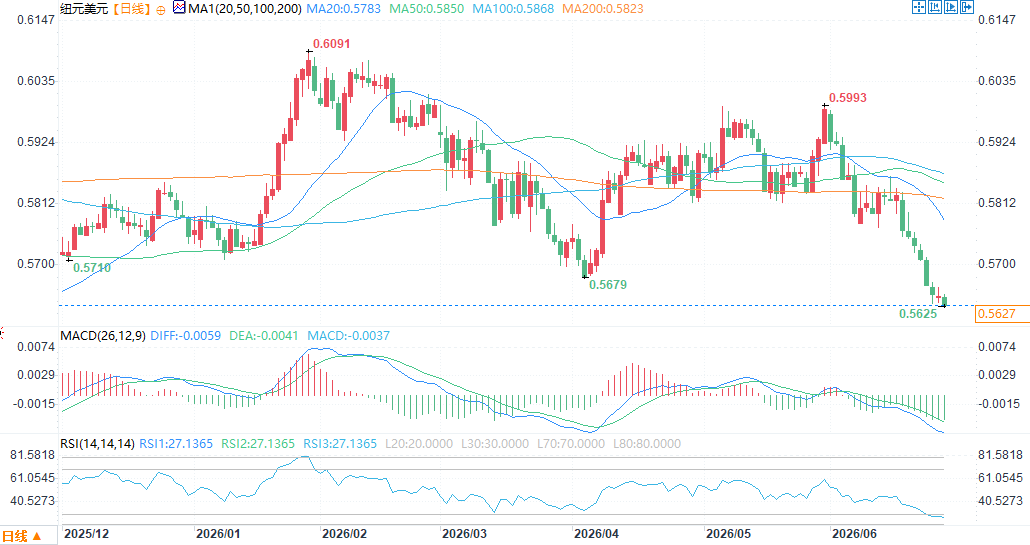
(NZD/USD daily chart, source: FX678)
At 11:17 Beijing time on June 26, the New Zealand dollar was trading at 0.5633/34 against the US dollar.
Accelerated rises in US PCE inflation data, continued increases in expectations of a Fed rate hike, and renewed geopolitical tensions in the Middle East fueling safe-haven demand have all put downward pressure on the New Zealand dollar.
Meanwhile, ASB Bank in New Zealand abandoned its expectation of a rate hike in July, instead predicting that the central bank would hold rates steady, further weakening interest rate support for the New Zealand dollar.
US PCE data confirms sticky inflation, fueling expectations of a Fed rate hike.
The U.S. Personal Consumption Expenditures (PCE) price index report released on Thursday showed that inflationary pressures remain stubborn. Overall PCE rose 4.1% year-on-year, well above the previous reading of 3.3% and significantly exceeding the Federal Reserve's 2% target. Core PCE (the Fed's preferred inflation gauge) rose 3.4% year-on-year, higher than the previous reading of 3.3%, in line with market expectations, and reached its highest level since October 2023.
Meanwhile, the annualized growth rate of US GDP in the first quarter was revised upward to 2.1%, higher than the market expectation of 1.6% and the previous value of 1.6%. The strong growth data, coupled with sticky inflation, further solidified the market's judgment that the Federal Reserve will maintain its tightening stance.
According to the CME FedWatch tool, the market is currently pricing in three Fed rate hikes this year, with a probability of about 63.4% for a September rate hike. This hawkish expectation continues to push up the US dollar, putting significant pressure on non-US currencies such as the New Zealand dollar.
Middle East geopolitical risks reignite: Cargo ship attack fuels demand for safe-haven assets.
Escalating geopolitical tensions in the Strait of Hormuz have further exacerbated downward pressure on the New Zealand dollar.
On Thursday, a cargo ship flying the Singapore flag was attacked near Oman. The US and Iran blamed each other, and the United Nations International Maritime Organization subsequently suspended evacuation operations in the Strait of Hormuz.
This event reignited market concerns about disruptions to global energy supplies, causing crude oil prices to rebound and prompting safe-haven flows into the US dollar.
As a traditional safe-haven currency, the US dollar typically performs strongly when geopolitical risks escalate, while the New Zealand dollar, as a high-beta commodity currency, often comes under pressure when global risk appetite declines.
Although the initial peace agreement reached between the US and Iran had eased market anxiety, the attack exposed the fragility of the agreement in its implementation, and geopolitical risk premiums are being re-incorporated into asset prices.
New Zealand domestic factors: ASB Bank abandons expectations of a July rate hike
The New Zealand dollar also faces pressure from expectations regarding domestic monetary policy.
ASB Bank in New Zealand has abandoned its previous expectation of a rate hike in July, and now expects the Reserve Bank of New Zealand to keep the official cash rate unchanged at its upcoming July meeting, and then gradually raise rates in increments of 25 basis points starting in September, with the peak rate expected to reach 3.25% in early 2027.
The Reserve Bank of New Zealand kept the official cash rate at 2.25% at its May meeting.
Analysts believe that the cooling energy market provides the Reserve Bank of New Zealand with ample policy space to assess the data before deciding on its next course of action.
The fading expectations of domestic interest rate hikes have further weakened the New Zealand dollar's attractiveness in terms of interest rates. Previously, widespread market expectations of a July rate hike by the Reserve Bank of New Zealand had been a significant support factor for the New Zealand dollar, but ASB Bank's policy shift indicates that this support is weakening.
Technical Analysis
According to the daily chart, the long-term downtrend of the New Zealand dollar against the US dollar is clear. After two previous attempts to break through 0.6091 and 0.5993, forming a double top structure, the price has been fluctuating and weakening. The moving average system is fully in a bearish alignment, with the short-term MA20, medium-term MA50, MA100, and long-term MA200 all pressing down simultaneously. Each small rebound has been blocked by the short-term moving averages, and the highs and lows have been continuously moving down in a step-like manner, forming a complete and clear downward channel.
In terms of indicators, the MACD remains in a bearish pattern below the zero line, the DIFF line continues to be below the DEA line, and the green energy bars continue to expand, indicating that the downward momentum has not yet shown obvious signs of exhaustion. The RSI value is 27.13, falling into the oversold zone below 30, indicating a short-term technical rebound demand, but no bottom divergence has been formed, which cannot reverse the overall downward trend.
(NZD/USD daily chart, source: FX678)
At 11:17 Beijing time on June 26, the New Zealand dollar was trading at 0.5633/34 against the US dollar.
- Risk Warning and Disclaimer
- The market involves risk, and trading may not be suitable for all investors. This article is for reference only and does not constitute personal investment advice, nor does it take into account certain users’ specific investment objectives, financial situation, or other needs. Any investment decisions made based on this information are at your own risk.