2028! Latest forecast from a senior Federal Reserve official: Inflation target will be reached in another four years?
2026-06-26 16:30:57
On Friday (June 26) during the European session, the US dollar index retreated slightly and is currently trading around 101.25.
John Williams, president of the Federal Reserve Bank of New York, said on Thursday that inflation returning to the Fed's 2% target may take longer than previously expected, with the process projected to continue until 2028, a year later than previously forecast.
This statement reinforces the signal that the Federal Reserve will maintain a restrictive monetary policy for an extended period.
In his speech on Thursday, Williams made it clear that "inflation is still too high" and stressed that "it is imperative that we bring inflation back to a sustained 2% level."
He now expects inflation to return to its target level in 2028, a year later than previously projected. This delay reflects a deteriorating assessment within the Federal Reserve of inflation stickiness.
Despite his hawkish stance on inflation assessments, Goolsby declined to offer specific guidance on the next policy move. He refused to speculate on whether the Fed should raise or keep rates unchanged, agreeing with Fed Chairman Warsh's approach of avoiding unnecessary market speculation about the future path of interest rates.
This stance continues the signal that Warsh has been conveying in recent public appearances: central banks will not easily reveal their policy direction before the data is clear.
Goolsby's remarks reinforced the consensus within the Federal Reserve that policymakers are firmly focused on restoring price stability while leaving future decisions entirely dependent on subsequent economic data.
Despite the deteriorating inflation outlook, Williams did not advocate for further policy tightening in the near term.
Conversely, he believes that "monetary policy is well-suited to reducing price pressures," suggesting that the current policy stance remains sufficiently restrictive. This assessment contrasts with concerns among some market participants about further interest rate hikes.
Williams expects inflation to gradually slow in the coming quarters as tariff-related price increases subside, housing inflation cools, and geopolitical pressures in the Middle East continue to ease. This outlook depends on the fading of external shocks rather than further policy action by the Federal Reserve.
Williams maintains a constructive view on the overall U.S. economic outlook, believing that despite high uncertainty, economic growth should remain positive. A strong labor market, along with gradually easing inflation, should allow the current policy stance to continue to play a role in the economy.
This assessment provides fundamental economic support for the Federal Reserve's strategy of "maintaining high interest rates for a longer period"—as long as the job market remains resilient, the central bank does not need to rush to cut interest rates due to concerns about growth.
According to the daily chart, the US dollar index continues its strong upward trend, rising steadily from a low of 97.62 to a new high of 101.80. Currently trading at 101.35, the price is firmly above all moving averages across different timeframes. The short-term 20-day moving average (MA20), medium-term MA50 and MA100, and long-term MA200 are all trending upwards, forming a multi-tiered support structure. Each pullback has been quickly recovered from the short-term moving averages, with the lows gradually rising, completing a stepped upward structure.
In terms of indicators, the MACD maintains a bullish pattern, with the DIFF (0.6045) continuing to run above the DEA (0.4783), and the red energy bars steadily increasing in volume, indicating that the bullish momentum has not shown any significant weakening. The RSI value is 70.05, close to the overbought threshold of 80, suggesting a short-term technical pullback for consolidation. There are currently no top divergence reversal signals on the market.
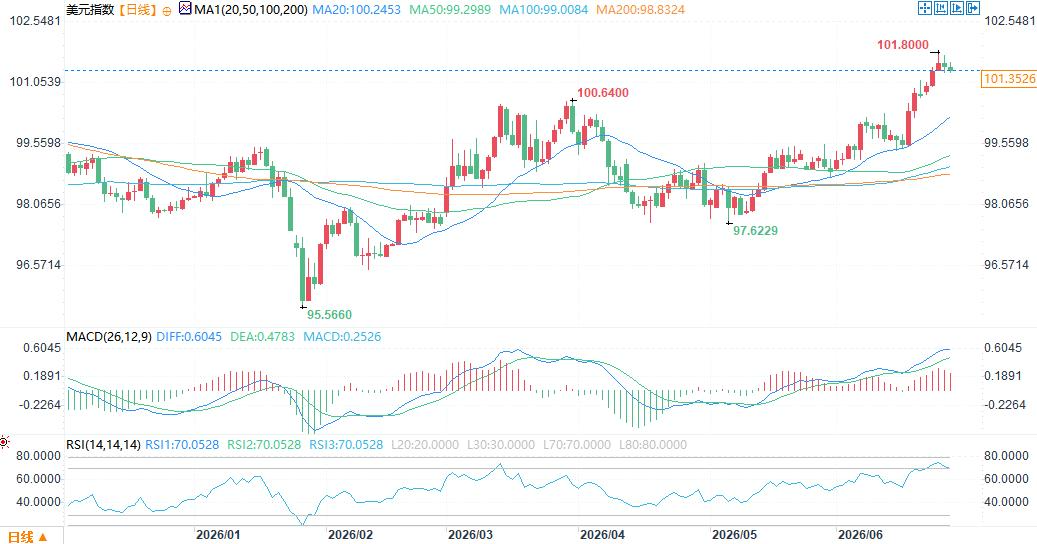
(US Dollar Index Daily Chart, Source: FX678)
At 16:20 Beijing time on June 26, the US dollar index was at 101.25.
John Williams, president of the Federal Reserve Bank of New York, said on Thursday that inflation returning to the Fed's 2% target may take longer than previously expected, with the process projected to continue until 2028, a year later than previously forecast.
This statement reinforces the signal that the Federal Reserve will maintain a restrictive monetary policy for an extended period.
Inflation return target postponed to 2028: High interest rates will take longer.
In his speech on Thursday, Williams made it clear that "inflation is still too high" and stressed that "it is imperative that we bring inflation back to a sustained 2% level."
He now expects inflation to return to its target level in 2028, a year later than previously projected. This delay reflects a deteriorating assessment within the Federal Reserve of inflation stickiness.
Despite his hawkish stance on inflation assessments, Goolsby declined to offer specific guidance on the next policy move. He refused to speculate on whether the Fed should raise or keep rates unchanged, agreeing with Fed Chairman Warsh's approach of avoiding unnecessary market speculation about the future path of interest rates.
This stance continues the signal that Warsh has been conveying in recent public appearances: central banks will not easily reveal their policy direction before the data is clear.
Goolsby's remarks reinforced the consensus within the Federal Reserve that policymakers are firmly focused on restoring price stability while leaving future decisions entirely dependent on subsequent economic data.
Monetary policy stance: Current interest rates are sufficiently restrictive, and there is no need to rush into further tightening.
Despite the deteriorating inflation outlook, Williams did not advocate for further policy tightening in the near term.
Conversely, he believes that "monetary policy is well-suited to reducing price pressures," suggesting that the current policy stance remains sufficiently restrictive. This assessment contrasts with concerns among some market participants about further interest rate hikes.
Williams expects inflation to gradually slow in the coming quarters as tariff-related price increases subside, housing inflation cools, and geopolitical pressures in the Middle East continue to ease. This outlook depends on the fading of external shocks rather than further policy action by the Federal Reserve.
Economic Outlook: Growth Remains Positive, Supported by Labor Market Resilience
Williams maintains a constructive view on the overall U.S. economic outlook, believing that despite high uncertainty, economic growth should remain positive. A strong labor market, along with gradually easing inflation, should allow the current policy stance to continue to play a role in the economy.
This assessment provides fundamental economic support for the Federal Reserve's strategy of "maintaining high interest rates for a longer period"—as long as the job market remains resilient, the central bank does not need to rush to cut interest rates due to concerns about growth.
Technical Analysis
According to the daily chart, the US dollar index continues its strong upward trend, rising steadily from a low of 97.62 to a new high of 101.80. Currently trading at 101.35, the price is firmly above all moving averages across different timeframes. The short-term 20-day moving average (MA20), medium-term MA50 and MA100, and long-term MA200 are all trending upwards, forming a multi-tiered support structure. Each pullback has been quickly recovered from the short-term moving averages, with the lows gradually rising, completing a stepped upward structure.
In terms of indicators, the MACD maintains a bullish pattern, with the DIFF (0.6045) continuing to run above the DEA (0.4783), and the red energy bars steadily increasing in volume, indicating that the bullish momentum has not shown any significant weakening. The RSI value is 70.05, close to the overbought threshold of 80, suggesting a short-term technical pullback for consolidation. There are currently no top divergence reversal signals on the market.
(US Dollar Index Daily Chart, Source: FX678)
At 16:20 Beijing time on June 26, the US dollar index was at 101.25.
- Risk Warning and Disclaimer
- The market involves risk, and trading may not be suitable for all investors. This article is for reference only and does not constitute personal investment advice, nor does it take into account certain users’ specific investment objectives, financial situation, or other needs. Any investment decisions made based on this information are at your own risk.