The euro/dollar exchange rate fell below 1.14 and then recovered, revealing three key themes.
2026-06-26 17:55:21
On Friday, June 26, the euro fluctuated around the 1.14 level against the US dollar. Although it rebounded slightly during the day, it is still down 1.96% over the past month. This is not a simple technical correction in the exchange rate, but rather the result of a simultaneous reassessment of three factors: energy prices, pricing in another interest rate hike by the European Central Bank, and the duration of the Federal Reserve's high interest rates.
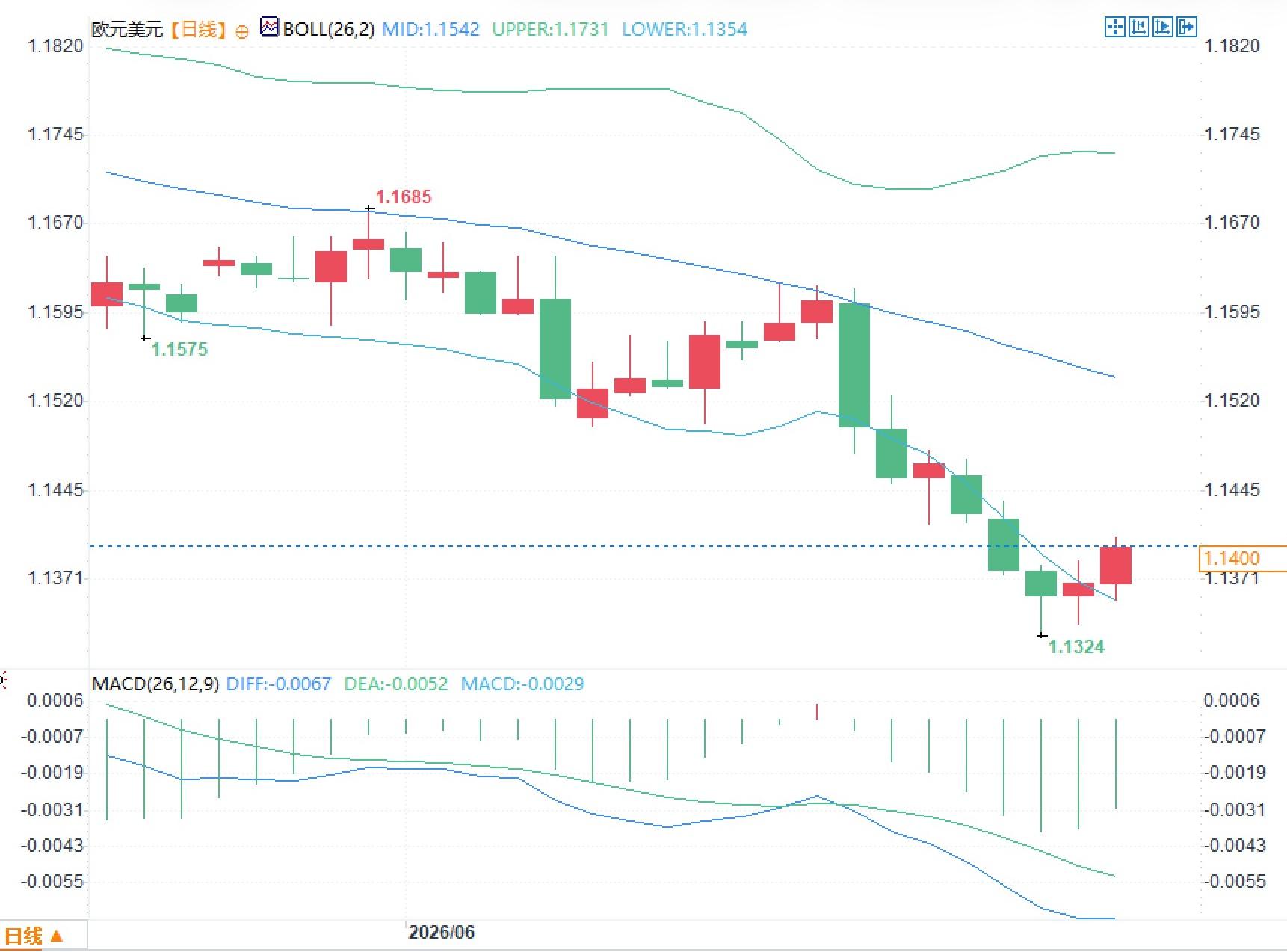
The euro attempted to recover after recently falling below 1.14 against the US dollar, but from the daily chart, the price is still trading below the middle Bollinger Band at 1.1542 and close to the lower band at 1.1354. The MACD is still in negative territory, indicating that the short-term rebound is more like a correction after the decline, rather than a complete shift in the trend structure.
The key to exchange rate pricing is not whether the European Central Bank (ECB) will raise interest rates again, but whether the market is willing to increase the probability of "continuous tightening." The ECB raised its deposit facility rate to 2.25% on June 11, and its main refinancing rate and marginal lending rate to 2.40% and 2.65% respectively, effective June 17. ECB President Christine Lagarde reiterated in a recent hearing that the rate hikes are to ensure that inflation returns to the 2% target in the medium term, but the policy statement also emphasized that it does not pre-commit to a specific interest rate path.
The unusual aspect of this round of euro movement is that the decline in oil prices, which should have improved the eurozone's terms of trade, did not directly boost the euro. This is because the drop in energy prices first and foremost lowers the inflation risk premium, reducing market expectations for further tightening by the European Central Bank. On June 26, Brent crude oil fell to $72.80 per barrel, a 2.8% decrease from the previous day.
The Eurozone's harmonized CPI rose 3.2% year-on-year in May, up from 3.0% in April, with services contributing 1.61 percentage points and energy contributing 0.98 percentage points. This indicates that Eurozone inflation remains significantly above target, but with energy prices declining marginally, the market may question whether the European Central Bank (ECB) needs to continue raising policy rates rapidly. The ECB's June baseline forecast also shows that HICP inflation is expected to be 3.0% in 2026, falling to 2.3% in 2027, and returning to 2.0% in 2028, providing a basis for pricing in "rate hikes but not aggressive ones."
Another constraint on the euro comes from the dollar. The Federal Reserve maintained its target range for the federal funds rate at 3.50% to 3.75% at its June meeting, while the latest PCE data from the US shows that the PCE price index rose 0.4% month-on-month and 4.1% year-on-year in May; core PCE, excluding food and energy, rose 3.4% year-on-year. Under this data combination, it is difficult for the dollar yield curve to quickly shift towards pricing in easing.
The current euro/dollar exchange rate is not simply a "trade benefiting from Eurozone oil prices," but rather a tug-of-war between "declining expectations of ECB rate hikes" and "improved energy bills." Lower oil prices improve European import costs but also reduce expectations of inflation-driven rate hikes; high US inflation, on the other hand, maintains support for real interest rates on the dollar side. Therefore, for the euro to break out of the 1.13-1.15 range, it needs to see a resurgence in Eurozone core inflation and wage stickiness, or a sustained cooling of US inflation data; otherwise, the exchange rate is likely to enter a period of consolidation.
In the coming weeks, the key variable for the euro against the dollar will not be the daily fluctuations in oil prices, but whether the decline in oil prices will truly translate into consumer expectations, core service prices, and wage negotiations. European consumer inflation expectations are released monthly, covering the next 12 months, 3 years, and 5 years; this data will directly influence policymakers' assessments of the risk of secondary transmission.
The current issue in the Eurozone is not whether inflation remains high, but rather how much of that high inflation stems from a one-off energy shock and how much is entering the services and wage system. If the decline in energy prices only lowers overall inflation while core service prices remain strong, the ECB will still have room to maintain its hawkish stance. However, if the decline in energy prices simultaneously leads to a cooling of expectations and a easing of core inflation, then the upside potential for euro interest rates will be limited, and the euro's upside potential against the dollar will also be constrained.
Question 1: Why didn't the drop in oil prices significantly boost the euro?
A: While lower oil prices have indeed improved import costs in the Eurozone, they have also weakened the European Central Bank's case for continuing to raise interest rates. For exchange rates, improved terms of trade provide support, while declining interest rate expectations exert downward pressure; these two factors offset each other in the short term.
Question 2: What is the core significance of the euro/dollar exchange rate around 1.14?
A: The area around 1.14 is both a recent technical rebound level and a region where the market is reassessing the interest rate differential between the ECB and the Fed. If the price cannot return above the Bollinger Band's middle line, it will be difficult to prove that the momentum has been fully restored.
Question 3: What is the most critical data for the next stage?
A: The key is not just the CPI figure, but whether energy, services, wages, and inflation expectations are all declining in tandem. If only energy prices cool down, the core pressures remain, and the ECB will retain policy flexibility; if the core pressures also ease, the upward momentum for the euro will be weakened.
I. The euro's rebound is limited; the core issue remains interest rate expectations.
The euro attempted to recover after recently falling below 1.14 against the US dollar, but from the daily chart, the price is still trading below the middle Bollinger Band at 1.1542 and close to the lower band at 1.1354. The MACD is still in negative territory, indicating that the short-term rebound is more like a correction after the decline, rather than a complete shift in the trend structure.
The key to exchange rate pricing is not whether the European Central Bank (ECB) will raise interest rates again, but whether the market is willing to increase the probability of "continuous tightening." The ECB raised its deposit facility rate to 2.25% on June 11, and its main refinancing rate and marginal lending rate to 2.40% and 2.65% respectively, effective June 17. ECB President Christine Lagarde reiterated in a recent hearing that the rate hikes are to ensure that inflation returns to the 2% target in the medium term, but the policy statement also emphasized that it does not pre-commit to a specific interest rate path.
II. Lower oil prices reduce pressure on the European Central Bank to raise interest rates again.
The unusual aspect of this round of euro movement is that the decline in oil prices, which should have improved the eurozone's terms of trade, did not directly boost the euro. This is because the drop in energy prices first and foremost lowers the inflation risk premium, reducing market expectations for further tightening by the European Central Bank. On June 26, Brent crude oil fell to $72.80 per barrel, a 2.8% decrease from the previous day.
The Eurozone's harmonized CPI rose 3.2% year-on-year in May, up from 3.0% in April, with services contributing 1.61 percentage points and energy contributing 0.98 percentage points. This indicates that Eurozone inflation remains significantly above target, but with energy prices declining marginally, the market may question whether the European Central Bank (ECB) needs to continue raising policy rates rapidly. The ECB's June baseline forecast also shows that HICP inflation is expected to be 3.0% in 2026, falling to 2.3% in 2027, and returning to 2.0% in 2028, providing a basis for pricing in "rate hikes but not aggressive ones."
Third, the US dollar has not shown significant easing, and interest rate differentials continue to suppress euro valuations.
Another constraint on the euro comes from the dollar. The Federal Reserve maintained its target range for the federal funds rate at 3.50% to 3.75% at its June meeting, while the latest PCE data from the US shows that the PCE price index rose 0.4% month-on-month and 4.1% year-on-year in May; core PCE, excluding food and energy, rose 3.4% year-on-year. Under this data combination, it is difficult for the dollar yield curve to quickly shift towards pricing in easing.
The current euro/dollar exchange rate is not simply a "trade benefiting from Eurozone oil prices," but rather a tug-of-war between "declining expectations of ECB rate hikes" and "improved energy bills." Lower oil prices improve European import costs but also reduce expectations of inflation-driven rate hikes; high US inflation, on the other hand, maintains support for real interest rates on the dollar side. Therefore, for the euro to break out of the 1.13-1.15 range, it needs to see a resurgence in Eurozone core inflation and wage stickiness, or a sustained cooling of US inflation data; otherwise, the exchange rate is likely to enter a period of consolidation.
Fourth, the market will focus more on the inflation structure rather than oil prices alone.
In the coming weeks, the key variable for the euro against the dollar will not be the daily fluctuations in oil prices, but whether the decline in oil prices will truly translate into consumer expectations, core service prices, and wage negotiations. European consumer inflation expectations are released monthly, covering the next 12 months, 3 years, and 5 years; this data will directly influence policymakers' assessments of the risk of secondary transmission.
The current issue in the Eurozone is not whether inflation remains high, but rather how much of that high inflation stems from a one-off energy shock and how much is entering the services and wage system. If the decline in energy prices only lowers overall inflation while core service prices remain strong, the ECB will still have room to maintain its hawkish stance. However, if the decline in energy prices simultaneously leads to a cooling of expectations and a easing of core inflation, then the upside potential for euro interest rates will be limited, and the euro's upside potential against the dollar will also be constrained.
Frequently Asked Questions
Question 1: Why didn't the drop in oil prices significantly boost the euro?
A: While lower oil prices have indeed improved import costs in the Eurozone, they have also weakened the European Central Bank's case for continuing to raise interest rates. For exchange rates, improved terms of trade provide support, while declining interest rate expectations exert downward pressure; these two factors offset each other in the short term.
Question 2: What is the core significance of the euro/dollar exchange rate around 1.14?
A: The area around 1.14 is both a recent technical rebound level and a region where the market is reassessing the interest rate differential between the ECB and the Fed. If the price cannot return above the Bollinger Band's middle line, it will be difficult to prove that the momentum has been fully restored.
Question 3: What is the most critical data for the next stage?
A: The key is not just the CPI figure, but whether energy, services, wages, and inflation expectations are all declining in tandem. If only energy prices cool down, the core pressures remain, and the ECB will retain policy flexibility; if the core pressures also ease, the upward momentum for the euro will be weakened.
- Risk Warning and Disclaimer
- The market involves risk, and trading may not be suitable for all investors. This article is for reference only and does not constitute personal investment advice, nor does it take into account certain users’ specific investment objectives, financial situation, or other needs. Any investment decisions made based on this information are at your own risk.