Shipping data overshadows geopolitical risks? Oil prices plunge nearly 10% in a single week, geopolitical risks reignite over the weekend, beware of significant volatility next week.
2026-06-27 11:54:26
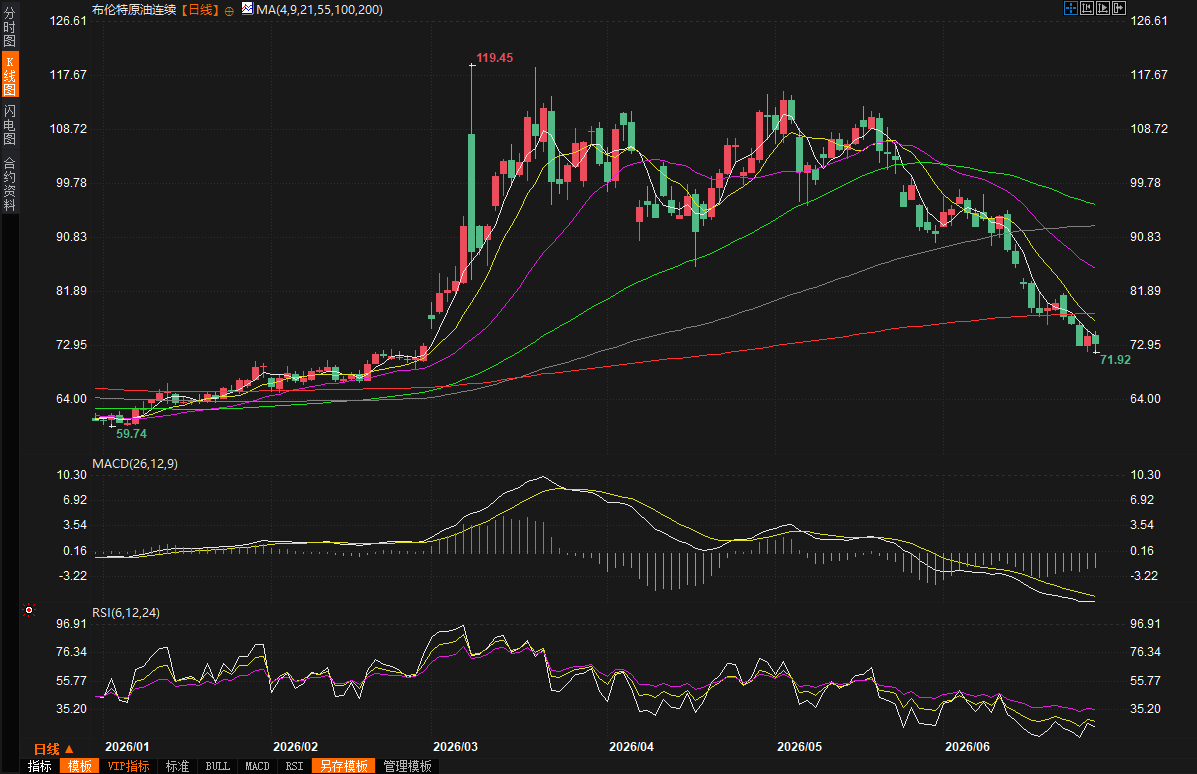
This week, the international crude oil market experienced a dramatic rollercoaster ride. Amidst signals of easing supply risks from high-level US-Iran talks, oil prices initially plummeted for several consecutive days, hitting their lowest levels since the outbreak of the war. However, a brief escalation of geopolitical tensions, triggered by an attack on a cargo ship near Oman and subsequent US airstrikes against Iran and the Iranian Revolutionary Guard's retaliation, led to a technical rebound in oil prices. Overall, however, the gradual resumption of shipping activity in the Strait of Hormuz and the release of stranded crude oil became the core forces driving market trends, ultimately resulting in a significant weekly decline in oil prices.

At the start of the week, the focus of the oil market quickly shifted to diplomatic developments. News broke that the US and Iran had concluded their first round of high-level talks in Switzerland, with US Vice President Vance stating that progress had been made and the Strait of Hormuz remained open, directly alleviating market concerns about disruptions to Middle Eastern oil supplies. Brent crude futures closed down more than 3% on Monday at $77.90 a barrel, with US crude futures also falling in tandem.
On Monday (June 22), oil prices briefly surged above $82 in early trading due to news of Trump's threat to restart the war against Iran and Iran's announcement that it might again close the Strait of Hormuz. However, rapid progress in negotiations reversed market sentiment. The US Treasury subsequently approved a general license for Iranian oil and petrochemical product exports, valid until August 21, further opening up channels for Iranian crude oil to enter the international market. UBS analyst Giovanni Staunovo pointed out that Iran has resumed some crude oil exports, and previously blocked supply is gradually being released, injecting additional crude oil into the global market. Ship tracking data showed that two oil tankers carrying nearly 2 million barrels of crude oil passed through the Strait of Hormuz on Monday, indicating a significant recovery in shipping activity.
On Tuesday (June 23), oil prices continued to decline by about 1%, with Brent crude falling to $77.08 and U.S. crude at $73.21. Investors closely watched the navigation situation in the Strait of Hormuz. Oman and Iran agreed to continue consultations on navigation management issues, three previously stranded supertankers passed through smoothly, and the evacuation plan of the United Nations maritime agency was being implemented step by step. These positive signals exacerbated market concerns about short-term oversupply, pushing oil prices to continue their decline.
On Wednesday (June 24), the pace of supply release accelerated further. The U.S. Energy Secretary stated that, under military escort, approximately 20 million barrels of crude oil were transported out of the Strait of Hormuz in the past 24 hours, bringing the strait's throughput close to pre-war levels. Oil-producing countries such as Saudi Aramco are also gradually resuming operations, with more previously stranded tankers leaving the strait.
As a result, Brent crude oil prices plummeted by more than 4% on the day, closing at $73.74, the lowest level since February 27 (the day before the US-Israel attack on Iran); US crude oil even fell below the $70 mark, closing at $70.34. JPMorgan Chase and other institutions subsequently lowered their oil price forecasts for the second half of 2026, reflecting concerns about a smaller-than-expected decline in OECD commercial inventories and relatively weak demand.
Despite a significant reduction in the US strategic petroleum reserve and historically low domestic inventories, the sale of Middle Eastern physical crude oil at a discount and the first-ever post-war phenomenon of next-month contracts trading at a premium to near-month contracts both indicate that increased short-term supply is altering the market balance. ING analysts believe that positive signals from the Persian Gulf are driving market optimism; although current shipping volumes remain below pre-war levels, the recovery trend is relatively clear.
A cargo ship attack triggered a brief rebound, but geopolitical risks reignited on Thursday (June 25) with a dramatic reversal in the situation. A cargo ship was struck by an unidentified projectile near Oman, reportedly linked to Iran, immediately raising market concerns about the security of the Strait of Hormuz and the speed of oil supply recovery. The UN's International Maritime Organization's suspension of its ship evacuation plan further amplified the uncertainty.
Oil prices rebounded by about 2% on the day, with Brent crude closing at $75.26 and U.S. crude at $71.92. Rystad Energy analysts warned that storage tanks in the Gulf region are already at 50-60% capacity, and if shipping traffic cannot continue to recover, oil-producing countries may be forced to cut production, delaying a full recovery until next year. Goldman Sachs also pointed out that even with extended sanctions waivers, Iranian oil production is unlikely to recover significantly, and China will remain its main buyer. Technically, the oversold condition after consecutive declines attracted some short covering and bargain hunting, pushing oil prices higher in the short term. U.S. gasoline and diesel futures rose in tandem, reflecting the sensitivity of the end-market to supply disruptions.
On Friday (June 25), oil prices fell sharply again by more than 3%, with Brent crude settling at $71.99 and U.S. crude at $69.23, a cumulative drop of nearly 10% for the week. Despite renewed geopolitical tensions following U.S. airstrikes on Iranian coastal targets and the Iranian Revolutionary Guard's subsequent announcement of strikes against multiple U.S. targets, shipping data showed that oil shipments through the Strait of Hormuz have risen to their highest level since the conflict began, with Saudi Aramco resuming loading operations at its Rastakhana terminal and more VLCC tankers entering service.
The preliminary ceasefire agreement signed between Israel and Lebanon, among other signs of de-escalation, has to some extent offset the impact of the escalating conflict. Overall, the market believes that oil will continue to be transported through the Straits, with short-term supply pressures prevailing. While Iran's warnings to Gulf states and its attempts to control the Straits have drawn attention, the actual resumption of shipping activity has become the primary basis for market pricing.
Investors need to keep a close eye on further developments in the Middle East.
The U.S. military launched airstrikes against Iran on Friday in response to an Iranian drone attack on a cargo ship in the Strait of Hormuz. U.S. Central Command stated that warplanes struck missile and drone storage sites as well as coastal radar stations. Iranian media reported that a munition struck an area near a port in the strategic waterway city of Sirik.
Iran's response was even stronger. The Iranian Islamic Revolutionary Guard Corps (IRGC) immediately issued a statement claiming that its navy had struck multiple U.S. targets in the Middle East. The statement accused the U.S. of "violating its commitments" by launching airstrikes against the Iranian coast under the pretext of "ships illegally navigating the Strait of Hormuz." The IRGC explicitly stated that, according to the Iran-U.S. memorandum of understanding, traffic control in the Strait of Hormuz is Iran's responsibility. It added that if any further violations occur, Iran's response will be even more severe.
Meanwhile, Israel and Lebanon signed a preliminary agreement aimed at ending the fighting between the two sides, but Hezbollah stated it would not cooperate. Iran, meanwhile, warned Gulf states not to side with Washington. Iran's Deputy Foreign Minister stated firmly on social media: "Under vague arrangements, parallel shipping routes, or decisions that fail to take into account Iran's role as a coastal state, the safety of navigation in the Strait of Hormuz cannot be guaranteed."
Overall, this week's market performance reflects a tug-of-war between the pace of supply release and geopolitical uncertainty. The release of US strategic reserves, the temporary easing of sanctions on Iran, the gradual resumption of production in Middle Eastern oil-producing countries, and the recovery of traffic in the Strait of Hormuz have collectively created a clearly bearish environment. Despite renewed tensions over the weekend, current shipping data indicates that blockages in approximately one-fifth of the global oil supply chain are gradually being cleared, putting continued downward pressure on oil prices.
Looking ahead to next week, investors will continue to focus on the progress of US-Iran negotiations, changes in actual traffic volume in the Strait of Hormuz, US inventory data, and potential production adjustments by OPEC+. UBS and other institutions have lowered their year-end oil price forecasts to the $80-85 range, reflecting a consensus on weak demand and increased supply. However, if either side takes extreme action on the Strait issue, oil prices could still rebound rapidly. Overall, the oil market will remain highly volatile in the short term, with the supply and demand fundamentals gradually shifting towards a more relaxed stance, but the risk of geopolitical black swan events cannot be ignored.
This week's crude oil market movements once again demonstrate that, in a complex geopolitical environment, actual oil flow data often carries more pricing power than statements and threats. In the coming period, the calm in the Strait of Hormuz will directly determine whether oil prices can stabilize and rebound.
At the beginning of the week, US-Iran negotiations broke down, and supply concerns were quickly alleviated.
At the start of the week, the focus of the oil market quickly shifted to diplomatic developments. News broke that the US and Iran had concluded their first round of high-level talks in Switzerland, with US Vice President Vance stating that progress had been made and the Strait of Hormuz remained open, directly alleviating market concerns about disruptions to Middle Eastern oil supplies. Brent crude futures closed down more than 3% on Monday at $77.90 a barrel, with US crude futures also falling in tandem.
On Monday (June 22), oil prices briefly surged above $82 in early trading due to news of Trump's threat to restart the war against Iran and Iran's announcement that it might again close the Strait of Hormuz. However, rapid progress in negotiations reversed market sentiment. The US Treasury subsequently approved a general license for Iranian oil and petrochemical product exports, valid until August 21, further opening up channels for Iranian crude oil to enter the international market. UBS analyst Giovanni Staunovo pointed out that Iran has resumed some crude oil exports, and previously blocked supply is gradually being released, injecting additional crude oil into the global market. Ship tracking data showed that two oil tankers carrying nearly 2 million barrels of crude oil passed through the Strait of Hormuz on Monday, indicating a significant recovery in shipping activity.
On Tuesday (June 23), oil prices continued to decline by about 1%, with Brent crude falling to $77.08 and U.S. crude at $73.21. Investors closely watched the navigation situation in the Strait of Hormuz. Oman and Iran agreed to continue consultations on navigation management issues, three previously stranded supertankers passed through smoothly, and the evacuation plan of the United Nations maritime agency was being implemented step by step. These positive signals exacerbated market concerns about short-term oversupply, pushing oil prices to continue their decline.
Medium-term shipping volumes recovered rapidly, and oil prices hit pre-war lows.
On Wednesday (June 24), the pace of supply release accelerated further. The U.S. Energy Secretary stated that, under military escort, approximately 20 million barrels of crude oil were transported out of the Strait of Hormuz in the past 24 hours, bringing the strait's throughput close to pre-war levels. Oil-producing countries such as Saudi Aramco are also gradually resuming operations, with more previously stranded tankers leaving the strait.
As a result, Brent crude oil prices plummeted by more than 4% on the day, closing at $73.74, the lowest level since February 27 (the day before the US-Israel attack on Iran); US crude oil even fell below the $70 mark, closing at $70.34. JPMorgan Chase and other institutions subsequently lowered their oil price forecasts for the second half of 2026, reflecting concerns about a smaller-than-expected decline in OECD commercial inventories and relatively weak demand.
Despite a significant reduction in the US strategic petroleum reserve and historically low domestic inventories, the sale of Middle Eastern physical crude oil at a discount and the first-ever post-war phenomenon of next-month contracts trading at a premium to near-month contracts both indicate that increased short-term supply is altering the market balance. ING analysts believe that positive signals from the Persian Gulf are driving market optimism; although current shipping volumes remain below pre-war levels, the recovery trend is relatively clear.
A cargo ship attack triggered a brief rebound, but geopolitical risks reignited on Thursday (June 25) with a dramatic reversal in the situation. A cargo ship was struck by an unidentified projectile near Oman, reportedly linked to Iran, immediately raising market concerns about the security of the Strait of Hormuz and the speed of oil supply recovery. The UN's International Maritime Organization's suspension of its ship evacuation plan further amplified the uncertainty.
Oil prices rebounded by about 2% on the day, with Brent crude closing at $75.26 and U.S. crude at $71.92. Rystad Energy analysts warned that storage tanks in the Gulf region are already at 50-60% capacity, and if shipping traffic cannot continue to recover, oil-producing countries may be forced to cut production, delaying a full recovery until next year. Goldman Sachs also pointed out that even with extended sanctions waivers, Iranian oil production is unlikely to recover significantly, and China will remain its main buyer. Technically, the oversold condition after consecutive declines attracted some short covering and bargain hunting, pushing oil prices higher in the short term. U.S. gasoline and diesel futures rose in tandem, reflecting the sensitivity of the end-market to supply disruptions.
Oil prices ultimately plunged at the close due to a combination of escalating weekend tensions and supply releases.
On Friday (June 25), oil prices fell sharply again by more than 3%, with Brent crude settling at $71.99 and U.S. crude at $69.23, a cumulative drop of nearly 10% for the week. Despite renewed geopolitical tensions following U.S. airstrikes on Iranian coastal targets and the Iranian Revolutionary Guard's subsequent announcement of strikes against multiple U.S. targets, shipping data showed that oil shipments through the Strait of Hormuz have risen to their highest level since the conflict began, with Saudi Aramco resuming loading operations at its Rastakhana terminal and more VLCC tankers entering service.
The preliminary ceasefire agreement signed between Israel and Lebanon, among other signs of de-escalation, has to some extent offset the impact of the escalating conflict. Overall, the market believes that oil will continue to be transported through the Straits, with short-term supply pressures prevailing. While Iran's warnings to Gulf states and its attempts to control the Straits have drawn attention, the actual resumption of shipping activity has become the primary basis for market pricing.
US airstrikes on Iran escalate geopolitical risks once again
Investors need to keep a close eye on further developments in the Middle East.
The U.S. military launched airstrikes against Iran on Friday in response to an Iranian drone attack on a cargo ship in the Strait of Hormuz. U.S. Central Command stated that warplanes struck missile and drone storage sites as well as coastal radar stations. Iranian media reported that a munition struck an area near a port in the strategic waterway city of Sirik.
Iran's response was even stronger. The Iranian Islamic Revolutionary Guard Corps (IRGC) immediately issued a statement claiming that its navy had struck multiple U.S. targets in the Middle East. The statement accused the U.S. of "violating its commitments" by launching airstrikes against the Iranian coast under the pretext of "ships illegally navigating the Strait of Hormuz." The IRGC explicitly stated that, according to the Iran-U.S. memorandum of understanding, traffic control in the Strait of Hormuz is Iran's responsibility. It added that if any further violations occur, Iran's response will be even more severe.
Meanwhile, Israel and Lebanon signed a preliminary agreement aimed at ending the fighting between the two sides, but Hezbollah stated it would not cooperate. Iran, meanwhile, warned Gulf states not to side with Washington. Iran's Deputy Foreign Minister stated firmly on social media: "Under vague arrangements, parallel shipping routes, or decisions that fail to take into account Iran's role as a coastal state, the safety of navigation in the Strait of Hormuz cannot be guaranteed."
Market Outlook: Supply recovery to dominate, geopolitical risks remain a variable.
Overall, this week's market performance reflects a tug-of-war between the pace of supply release and geopolitical uncertainty. The release of US strategic reserves, the temporary easing of sanctions on Iran, the gradual resumption of production in Middle Eastern oil-producing countries, and the recovery of traffic in the Strait of Hormuz have collectively created a clearly bearish environment. Despite renewed tensions over the weekend, current shipping data indicates that blockages in approximately one-fifth of the global oil supply chain are gradually being cleared, putting continued downward pressure on oil prices.
Looking ahead to next week, investors will continue to focus on the progress of US-Iran negotiations, changes in actual traffic volume in the Strait of Hormuz, US inventory data, and potential production adjustments by OPEC+. UBS and other institutions have lowered their year-end oil price forecasts to the $80-85 range, reflecting a consensus on weak demand and increased supply. However, if either side takes extreme action on the Strait issue, oil prices could still rebound rapidly. Overall, the oil market will remain highly volatile in the short term, with the supply and demand fundamentals gradually shifting towards a more relaxed stance, but the risk of geopolitical black swan events cannot be ignored.
This week's crude oil market movements once again demonstrate that, in a complex geopolitical environment, actual oil flow data often carries more pricing power than statements and threats. In the coming period, the calm in the Strait of Hormuz will directly determine whether oil prices can stabilize and rebound.
- Risk Warning and Disclaimer
- The market involves risk, and trading may not be suitable for all investors. This article is for reference only and does not constitute personal investment advice, nor does it take into account certain users’ specific investment objectives, financial situation, or other needs. Any investment decisions made based on this information are at your own risk.