Gold Trading Alert: With expectations of a September rate hike rising, gold prices have fallen for four consecutive weeks. Is it time for bulls to buy the dip?
2026-06-29 09:46:54
Spot gold rebounded by a meager 1.35% on Friday (June 26), closing at $4081.02 per ounce. However, this negligible gain cannot mask the harsh reality—gold prices have fallen for four consecutive weeks. Since reaching its all-time high of $5596 on January 29, gold prices have plummeted by approximately 29%. Once hailed as the king of safe havens, it is now experiencing its longest weekly losing streak since 2023. Meanwhile, tensions are high over the Strait of Hormuz, with the US and Iran exchanging fire again over the weekend. When safe-haven assets cease to be safe havens, and when gold prices falter amidst the sounds of gunfire, what market logic lies behind this gold price collapse? This article will delve into the truth behind gold's four-week losing streak and its future trajectory from three perspectives: dollar hegemony, the Federal Reserve's shift, and geopolitical changes.
On Monday (June 29) in early Asian trading, spot gold traded in a narrow range, currently around $4,060 per ounce.
Gold is priced in US dollars, and the strength of the dollar directly determines the pricing benchmark for gold. Last week, the dollar index reached a 13-month high above 101.8, marking its second consecutive weekly gain. A strong dollar acts like a heavy hammer, continuously suppressing gold prices.
The core driver of this round of dollar strength comes from the market's aggressive pricing in a shift in Federal Reserve policy. The first policy statement from the new Fed chairman was widely interpreted as a "hawkish" signal. The market quickly brought forward its expectations for interest rate hikes to as early as September, and the dollar subsequently began a continuous rise. Some analysts point out that this is not only due to the new chairman's appointment and some new data, but also because the dollar market has been in a bull market since January, and the current slight correction is not surprising.
The strength of the US dollar is also reflected in a key change—the "decoupling" of gold from geopolitical risks. In the past, when tensions escalated in the Middle East, safe-haven funds would flow into gold, driving up prices. But now, with every news of conflict in the Strait of Hormuz, the market's first reaction is to sell gold for dollars. Some analysts bluntly state that the narrative surrounding gold prices has changed. Previously, when the US-Iran conflict escalated, gold rose while oil fell, showing a clear negative correlation. But now, it seems the price trends of these two assets may converge, both falling. The US dollar's status as the ultimate safe-haven asset is clearly evident in this round of gold selling.
If the strengthening dollar was the final straw that broke the camel's back for gold, then the Fed's 180-degree policy reversal was the first domino to fall.
Just a few months ago, the market was still hotly debating when the Federal Reserve would cut interest rates. However, the inflationary shockwaves triggered by the Iraq War have completely changed everything. Latest data shows that the US personal consumption expenditure price index surged 4.1% year-on-year in May, and the core PCE rose to 3.4%, both reaching recent highs. Inflation has not only failed to cool down, but is accelerating.
The Federal Reserve reacted swiftly and decisively. At its latest policy meeting, nine of the 19 policymakers projected at least one rate hike by the end of the year, whereas no officials made a similar prediction in March. The market quickly priced in the rate hike – the probability of a September hike climbed to 70% at one point, and even after a slight decline following the release of inflation data, it remained around 59%.
What does this mean for gold? Gold is a non-interest-bearing asset. When bond yields rise and real interest rates increase, the opportunity cost of holding gold rises sharply. Some institutions warn that soaring oil prices are pushing up inflation expectations, forcing the market to price in tighter monetary policy, thus increasing the opportunity cost of gold. Some analysts even bluntly state that the Fed's rapid hawkish shift has created strong bullish momentum for the dollar, ultimately leading to this significant decline in gold prices, and they believe this correction could extend further to $3,400 in the long term. Other institutions predict that gold may fall to $3,500 by the end of 2026. Institutional investors are voting with their actions—gold ETFs saw outflows of over 15 tons in a single week, and several banks have suspended related precious metal trading services.
The traditional narrative surrounding gold is that it is a "safe-haven asset"—buy gold during times of turmoil. However, the dramatic developments in the Strait of Hormuz over the past week have precisely revealed the fragility of this narrative.
In mid-June, the United States and Iran announced a phase-one agreement and reopened the Strait of Hormuz. This news caused crude oil prices to plummet, significantly reducing market concerns about a large-scale escalation of conflict in the Middle East. Gold's safe-haven premium evaporated, and prices accelerated their decline. At the beginning of this week, gold opened near $4145, but subsequently, influenced by continued hawkish signals from the Federal Reserve, prices fell below the $4000 mark, hitting a seven-month low of $3959.
However, the fragility of the ceasefire agreement was quickly exposed. On Thursday, a cargo ship was attacked in the Strait of Hormuz, forcing a suspension of international escort operations. Early Saturday morning, a Panamanian-flagged oil tanker was again attacked by an Iranian drone, prompting a new round of US strikes against Iran. Senior US officials issued stern warnings on social media, stating that they might no longer exercise restraint and would take ultimate measures if the situation escalated. Both the US and Iran accused each other of violating the interim peace agreement signed two weeks prior.
However, gold's reaction to such a tense geopolitical situation was surprisingly muted. Gold prices rebounded only 1.3% on Friday, still down 1.79% for the week. Why? Because the market has formed a new consensus: geopolitical conflicts drive up oil prices → oil prices drive up inflation → inflation forces the Federal Reserve to raise interest rates → interest rate hikes push up the dollar and bond yields → gold comes under pressure and falls. In this transmission chain, geopolitical conflicts not only failed to save gold, but instead became a catalyst that accelerated its decline.
After four consecutive weeks of decline, Friday's rebound gave bulls a brief respite. Spot gold rose 1.35% to $4,081.02, while August gold futures settled up 1.2% at $4,096.30.
The immediate trigger for this rebound was the dollar's pullback from recent highs following the release of inflation data. The inflation data wasn't as bad as the market had expected, and coupled with a roughly 4% drop in oil prices on Friday, market expectations for a Fed rate hike cooled slightly, with the probability of a September rate hike falling from 64% to 59%. While the latest consumer confidence index has rebounded, market concerns about inflation remain.
There were also some positive signs in the physical market. Gold traded at a premium in India for the first time in a month and a half, as a price pullback boosted buying. However, demand remained weak in the Asian powerhouse, the largest consumer of gold.
Does this signify a trend reversal? The mainstream view on Wall Street is negative. In multiple surveys, only a few analysts predict gold prices will rise in the coming week, with most being bearish or expecting continued consolidation. Some institutions predict the downward trend in gold prices will continue in the coming weeks. However, some independent analysts hold a different view, arguing that the market has overreacted to the Fed's hawkish stance in the past few months, leading to excessive selling of gold and suggesting that it has not entered a long-term bear market but remains in a long-term bull market.
The coming week will be a crucial time that will determine the short-term fate of gold.
On Wednesday, Federal Reserve Chairman Warsh, European Central Bank President Lagarde, Bank of England Governor Bailey, and Bank of Canada Governor Macklem will speak at the European Central Bank Forum, which investors should pay attention to.
The US June non-farm payrolls report will be released early on Thursday (Friday is the US Independence Day holiday). The market expects the number of new jobs to be substantially different from last month's figure. This report is of extraordinary significance. If the employment data exceeds expectations, it will further solidify market bets on a Federal Reserve rate hike; if the data is weak, it may prompt investors to postpone their expectations for the timing of any rate hike. Meanwhile, the US and Iran have agreed to cease mutual attacks and will meet in Doha on Tuesday to try to solidify the ceasefire agreement, which has already shown cracks after only 11 days in effect. Iran continues to strengthen its control over the Strait of Hormuz, requiring all transit vessels to coordinate with the Revolutionary Guard, which brings uncertainty to the shipping industry regarding transit time costs and insurance premiums. Investors need to closely monitor developments and changes in market expectations.
Major investment banks have significantly lowered their year-end 2026 gold price targets from their highs. However, amidst the bearish sentiment, some institutions maintain a bullish stance, believing the Federal Reserve will not make any moves on interest rates this year. Other domestic securities firms believe that if geopolitical tensions ease in the second half of the year, oil prices and inflation decline, and market expectations for marginal easing of the Fed's monetary policy rise, gold prices could potentially resume their upward trend.
Gold's four-week losing streak is a perfect storm of multiple negative factors—a stronger dollar, rising expectations of a Fed rate hike, evaporating geopolitical premiums, and continuous outflows from ETFs. The 29% drop since its January high has left countless investors who bought at the peak deeply trapped.
However, the pendulum of history never swings in only one direction. A seasoned market veteran offers a sobering historical perspective: during the long bull market of the 1970s, gold prices fell by approximately 45% from their mid-decade peak to a low in 1976, before surging to record levels in 1980. Similarly, gold prices plummeted by 30% at the beginning of the Great Recession in 2008. These historical anecdotes reveal a pattern: in long-term gold bull markets, sharp corrections are often part of the journey.
The structural factors driving gold prices to record highs—central bank gold purchases, geopolitical risks, high global debt levels, and the trend of de-dollarization—have not disappeared. Last year, global central banks made net purchases of over 860 tons of gold, and gold has surpassed US Treasury bonds to become the world's primary reserve asset.
In the short term, gold still faces significant pressure. Non-farm payroll data, US-Iran negotiations, and speeches by Federal Reserve officials—each variable could trigger a new round of market volatility. However, as some strategists have pointed out, when countries produce more oil and income flows back into the market, these funds may not all flow into US Treasury bonds, but could return to the gold market. The repeated battles around the $4,000 mark may simply be a sharp pause in this long bull market. For investors with a longer-term perspective, the current "gold dip" may precisely be a rare window for long-term positioning.
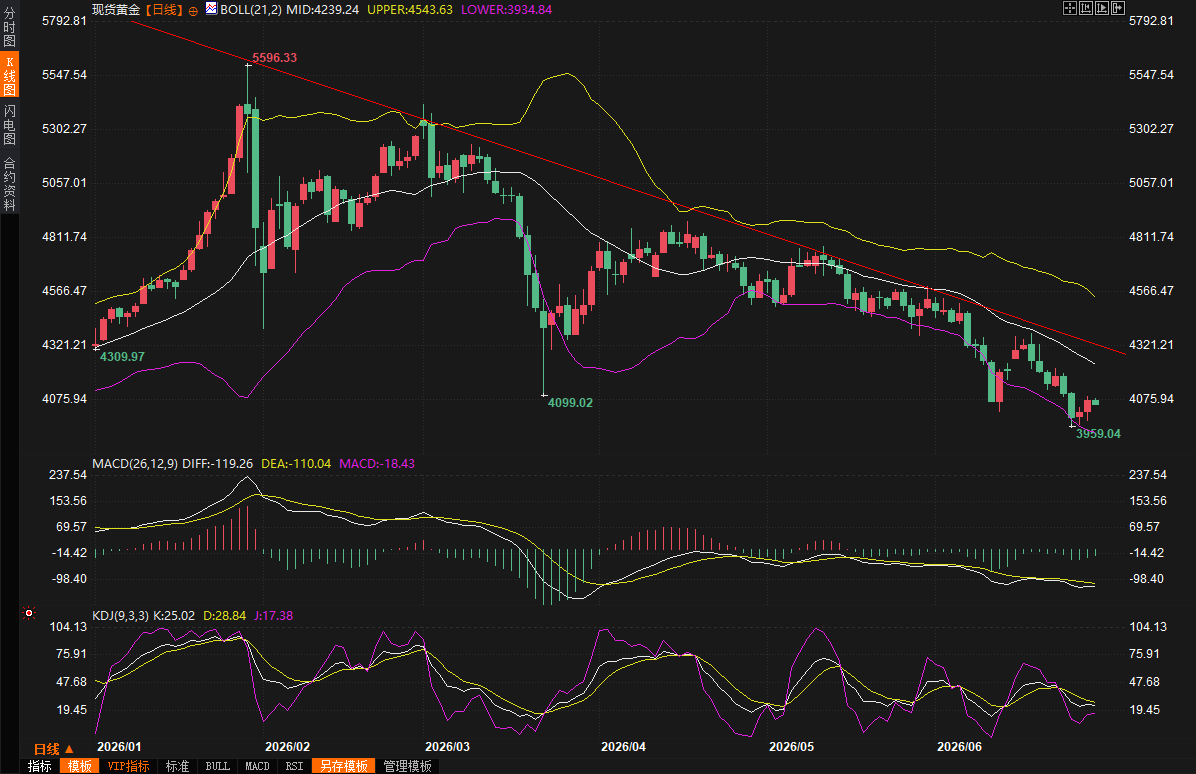
(Spot gold daily chart, source: FX678)
At 07:25 Beijing time, spot gold was trading at $4057.34 per ounce.
On Monday (June 29) in early Asian trading, spot gold traded in a narrow range, currently around $4,060 per ounce.
I. The Hammer of Dollar Hegemony: The Primary Driver of Gold Price Decline
Gold is priced in US dollars, and the strength of the dollar directly determines the pricing benchmark for gold. Last week, the dollar index reached a 13-month high above 101.8, marking its second consecutive weekly gain. A strong dollar acts like a heavy hammer, continuously suppressing gold prices.
The core driver of this round of dollar strength comes from the market's aggressive pricing in a shift in Federal Reserve policy. The first policy statement from the new Fed chairman was widely interpreted as a "hawkish" signal. The market quickly brought forward its expectations for interest rate hikes to as early as September, and the dollar subsequently began a continuous rise. Some analysts point out that this is not only due to the new chairman's appointment and some new data, but also because the dollar market has been in a bull market since January, and the current slight correction is not surprising.
The strength of the US dollar is also reflected in a key change—the "decoupling" of gold from geopolitical risks. In the past, when tensions escalated in the Middle East, safe-haven funds would flow into gold, driving up prices. But now, with every news of conflict in the Strait of Hormuz, the market's first reaction is to sell gold for dollars. Some analysts bluntly state that the narrative surrounding gold prices has changed. Previously, when the US-Iran conflict escalated, gold rose while oil fell, showing a clear negative correlation. But now, it seems the price trends of these two assets may converge, both falling. The US dollar's status as the ultimate safe-haven asset is clearly evident in this round of gold selling.
II. The Fed's "Eagle Claws": A Stunning Reversal from Rate Cuts to Rate Hikes
If the strengthening dollar was the final straw that broke the camel's back for gold, then the Fed's 180-degree policy reversal was the first domino to fall.
Just a few months ago, the market was still hotly debating when the Federal Reserve would cut interest rates. However, the inflationary shockwaves triggered by the Iraq War have completely changed everything. Latest data shows that the US personal consumption expenditure price index surged 4.1% year-on-year in May, and the core PCE rose to 3.4%, both reaching recent highs. Inflation has not only failed to cool down, but is accelerating.
The Federal Reserve reacted swiftly and decisively. At its latest policy meeting, nine of the 19 policymakers projected at least one rate hike by the end of the year, whereas no officials made a similar prediction in March. The market quickly priced in the rate hike – the probability of a September hike climbed to 70% at one point, and even after a slight decline following the release of inflation data, it remained around 59%.
What does this mean for gold? Gold is a non-interest-bearing asset. When bond yields rise and real interest rates increase, the opportunity cost of holding gold rises sharply. Some institutions warn that soaring oil prices are pushing up inflation expectations, forcing the market to price in tighter monetary policy, thus increasing the opportunity cost of gold. Some analysts even bluntly state that the Fed's rapid hawkish shift has created strong bullish momentum for the dollar, ultimately leading to this significant decline in gold prices, and they believe this correction could extend further to $3,400 in the long term. Other institutions predict that gold may fall to $3,500 by the end of 2026. Institutional investors are voting with their actions—gold ETFs saw outflows of over 15 tons in a single week, and several banks have suspended related precious metal trading services.
III. The Ghost of Hormuz: Why Geopolitics Can't Save Gold
The traditional narrative surrounding gold is that it is a "safe-haven asset"—buy gold during times of turmoil. However, the dramatic developments in the Strait of Hormuz over the past week have precisely revealed the fragility of this narrative.
In mid-June, the United States and Iran announced a phase-one agreement and reopened the Strait of Hormuz. This news caused crude oil prices to plummet, significantly reducing market concerns about a large-scale escalation of conflict in the Middle East. Gold's safe-haven premium evaporated, and prices accelerated their decline. At the beginning of this week, gold opened near $4145, but subsequently, influenced by continued hawkish signals from the Federal Reserve, prices fell below the $4000 mark, hitting a seven-month low of $3959.
However, the fragility of the ceasefire agreement was quickly exposed. On Thursday, a cargo ship was attacked in the Strait of Hormuz, forcing a suspension of international escort operations. Early Saturday morning, a Panamanian-flagged oil tanker was again attacked by an Iranian drone, prompting a new round of US strikes against Iran. Senior US officials issued stern warnings on social media, stating that they might no longer exercise restraint and would take ultimate measures if the situation escalated. Both the US and Iran accused each other of violating the interim peace agreement signed two weeks prior.
However, gold's reaction to such a tense geopolitical situation was surprisingly muted. Gold prices rebounded only 1.3% on Friday, still down 1.79% for the week. Why? Because the market has formed a new consensus: geopolitical conflicts drive up oil prices → oil prices drive up inflation → inflation forces the Federal Reserve to raise interest rates → interest rate hikes push up the dollar and bond yields → gold comes under pressure and falls. In this transmission chain, geopolitical conflicts not only failed to save gold, but instead became a catalyst that accelerated its decline.
IV. Last Friday's rebound: technical correction or trend reversal?
After four consecutive weeks of decline, Friday's rebound gave bulls a brief respite. Spot gold rose 1.35% to $4,081.02, while August gold futures settled up 1.2% at $4,096.30.
The immediate trigger for this rebound was the dollar's pullback from recent highs following the release of inflation data. The inflation data wasn't as bad as the market had expected, and coupled with a roughly 4% drop in oil prices on Friday, market expectations for a Fed rate hike cooled slightly, with the probability of a September rate hike falling from 64% to 59%. While the latest consumer confidence index has rebounded, market concerns about inflation remain.
There were also some positive signs in the physical market. Gold traded at a premium in India for the first time in a month and a half, as a price pullback boosted buying. However, demand remained weak in the Asian powerhouse, the largest consumer of gold.
Does this signify a trend reversal? The mainstream view on Wall Street is negative. In multiple surveys, only a few analysts predict gold prices will rise in the coming week, with most being bearish or expecting continued consolidation. Some institutions predict the downward trend in gold prices will continue in the coming weeks. However, some independent analysts hold a different view, arguing that the market has overreacted to the Fed's hawkish stance in the past few months, leading to excessive selling of gold and suggesting that it has not entered a long-term bear market but remains in a long-term bull market.
V. Super Week is Coming: Non-Farm Payroll Data Will Determine Fate
The coming week will be a crucial time that will determine the short-term fate of gold.
On Wednesday, Federal Reserve Chairman Warsh, European Central Bank President Lagarde, Bank of England Governor Bailey, and Bank of Canada Governor Macklem will speak at the European Central Bank Forum, which investors should pay attention to.
The US June non-farm payrolls report will be released early on Thursday (Friday is the US Independence Day holiday). The market expects the number of new jobs to be substantially different from last month's figure. This report is of extraordinary significance. If the employment data exceeds expectations, it will further solidify market bets on a Federal Reserve rate hike; if the data is weak, it may prompt investors to postpone their expectations for the timing of any rate hike. Meanwhile, the US and Iran have agreed to cease mutual attacks and will meet in Doha on Tuesday to try to solidify the ceasefire agreement, which has already shown cracks after only 11 days in effect. Iran continues to strengthen its control over the Strait of Hormuz, requiring all transit vessels to coordinate with the Revolutionary Guard, which brings uncertainty to the shipping industry regarding transit time costs and insurance premiums. Investors need to closely monitor developments and changes in market expectations.
Major investment banks have significantly lowered their year-end 2026 gold price targets from their highs. However, amidst the bearish sentiment, some institutions maintain a bullish stance, believing the Federal Reserve will not make any moves on interest rates this year. Other domestic securities firms believe that if geopolitical tensions ease in the second half of the year, oil prices and inflation decline, and market expectations for marginal easing of the Fed's monetary policy rise, gold prices could potentially resume their upward trend.
Conclusion
Gold's four-week losing streak is a perfect storm of multiple negative factors—a stronger dollar, rising expectations of a Fed rate hike, evaporating geopolitical premiums, and continuous outflows from ETFs. The 29% drop since its January high has left countless investors who bought at the peak deeply trapped.
However, the pendulum of history never swings in only one direction. A seasoned market veteran offers a sobering historical perspective: during the long bull market of the 1970s, gold prices fell by approximately 45% from their mid-decade peak to a low in 1976, before surging to record levels in 1980. Similarly, gold prices plummeted by 30% at the beginning of the Great Recession in 2008. These historical anecdotes reveal a pattern: in long-term gold bull markets, sharp corrections are often part of the journey.
The structural factors driving gold prices to record highs—central bank gold purchases, geopolitical risks, high global debt levels, and the trend of de-dollarization—have not disappeared. Last year, global central banks made net purchases of over 860 tons of gold, and gold has surpassed US Treasury bonds to become the world's primary reserve asset.
In the short term, gold still faces significant pressure. Non-farm payroll data, US-Iran negotiations, and speeches by Federal Reserve officials—each variable could trigger a new round of market volatility. However, as some strategists have pointed out, when countries produce more oil and income flows back into the market, these funds may not all flow into US Treasury bonds, but could return to the gold market. The repeated battles around the $4,000 mark may simply be a sharp pause in this long bull market. For investors with a longer-term perspective, the current "gold dip" may precisely be a rare window for long-term positioning.
(Spot gold daily chart, source: FX678)
At 07:25 Beijing time, spot gold was trading at $4057.34 per ounce.
- Risk Warning and Disclaimer
- The market involves risk, and trading may not be suitable for all investors. This article is for reference only and does not constitute personal investment advice, nor does it take into account certain users’ specific investment objectives, financial situation, or other needs. Any investment decisions made based on this information are at your own risk.