The Indian rupee's performance this week is driven by two key factors: Tuesday's Oman oil price fixing and Thursday's non-farm payrolls data fixing the US dollar.
2026-06-29 16:32:02
On Monday (June 29), during the European session, the US dollar fluctuated slightly against the Indian rupee around 94.35.
Investors are eagerly awaiting the outcome of Tuesday's talks between the United States and Iran in Oman, which are crucial for the peace and stability of the Strait of Hormuz—a vital waterway that carries nearly one-fifth of the world's energy supply.
Meanwhile, the US June non-farm payrolls report to be released this Thursday, along with potential policy clues from Federal Reserve Chairman Warsh, will also have a significant impact on the rupee's exchange rate.
The brief exchange of fire between the US and Iran near the Strait of Hormuz over the past weekend has reignited global market concerns about energy supply disruptions.
The Strait of Hormuz, a crucial choke point for global oil transportation, handles approximately 20% of the world's oil trade daily, and its security situation directly affects international oil prices.
Iranian Foreign Minister Araqchi subsequently issued a strong statement, clearly emphasizing that the responsibility for controlling the Strait of Hormuz lies entirely with Tehran, and warning that any attempt to bypass the waterway would trigger "tension and escalation," aiming to demonstrate Iran's absolute authority over this strategic waterway.
However, with international mediation, the two sides quickly reached a ceasefire agreement and plan to hold formal talks in Oman on Tuesday to de-escalate the situation and discuss long-term security arrangements.
Market participants remain highly vigilant: if signs of renewed conflict emerge between the two countries, oil prices could quickly return to previous highs.
This scenario would significantly increase global inflationary pressures, particularly weakening the currency attractiveness of emerging economies such as India and South Korea, which heavily rely on oil imports to meet their energy needs, and further supporting the safe-haven status of the US dollar.
In the short term, oil prices and geopolitical risk premiums will be the main drivers of volatility in the foreign exchange and commodity markets.
The US dollar index is currently trading in a narrow range around 101.30, indicating a degree of caution.
Investors are generally inclined to wait and see ahead of a flurry of US economic data releases this week, especially the June non-farm payrolls report due on Thursday, which will be the focus of the week.
The market is paying close attention to key indicators such as non-farm payroll data, unemployment rate, and wage growth, in order to find new clues about the outlook for the Federal Reserve's monetary policy.
Earlier this month, the hawkish remarks by newly appointed Federal Reserve Chairman Kevin Warsh at a monetary policy meeting suggested that, in the current complex environment, the central bank will further limit the use of forward guidance and rely more on actual economic data.
This makes the upcoming non-farm payroll report have a more significant and direct impact on market expectations.
According to the latest pricing from the CME FedWatch tool, the market now sees a near 90% probability of the Federal Reserve raising interest rates at least once this year, indicating a strong bet on a tightening path.
The short-term trend of the US dollar is expected to fluctuate wildly around the data results.
According to the daily chart, the USD/INR pair previously experienced a complete bullish rally, reaching a high of 96.96 before entering a period of consolidation at higher levels. The moving average structure is diverging; the short-term 20-day moving average (MA20) at 94.92 provides immediate resistance, while the medium- to long-term MA50, MA100, and MA200 continue to rise, indicating that the support of the larger-cycle uptrend has not been completely broken. Overall, the pair is in a pullback phase after the initial rise.
From a technical perspective, the MACD has fallen below the zero line into bearish territory, with the DIFF at -0.2141 trading below the DEA at -0.1339, and the green bars continuing to expand, indicating that short-term bearish forces are dominant and bullish momentum is clearly weakening. The RSI value is 42.18, below the 50 level, indicating weakening bullish momentum, but it has not yet reached the 30 oversold zone, suggesting further downside potential.
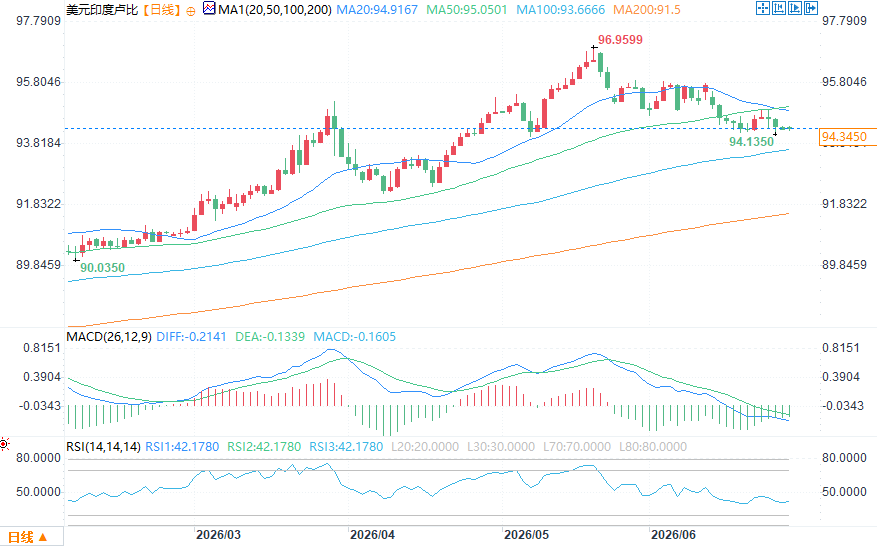
(USD/INR daily chart, source: FX678)
At 16:15 Beijing time on June 29, the US dollar was trading at 94.38/39 against the Indian rupee.
Investors are eagerly awaiting the outcome of Tuesday's talks between the United States and Iran in Oman, which are crucial for the peace and stability of the Strait of Hormuz—a vital waterway that carries nearly one-fifth of the world's energy supply.
Meanwhile, the US June non-farm payrolls report to be released this Thursday, along with potential policy clues from Federal Reserve Chairman Warsh, will also have a significant impact on the rupee's exchange rate.
Geopolitical Dynamics: US and Iran agree to ceasefire after weekend clashes; Oman talks become market focus.
The brief exchange of fire between the US and Iran near the Strait of Hormuz over the past weekend has reignited global market concerns about energy supply disruptions.
The Strait of Hormuz, a crucial choke point for global oil transportation, handles approximately 20% of the world's oil trade daily, and its security situation directly affects international oil prices.
Iranian Foreign Minister Araqchi subsequently issued a strong statement, clearly emphasizing that the responsibility for controlling the Strait of Hormuz lies entirely with Tehran, and warning that any attempt to bypass the waterway would trigger "tension and escalation," aiming to demonstrate Iran's absolute authority over this strategic waterway.
However, with international mediation, the two sides quickly reached a ceasefire agreement and plan to hold formal talks in Oman on Tuesday to de-escalate the situation and discuss long-term security arrangements.
Market participants remain highly vigilant: if signs of renewed conflict emerge between the two countries, oil prices could quickly return to previous highs.
This scenario would significantly increase global inflationary pressures, particularly weakening the currency attractiveness of emerging economies such as India and South Korea, which heavily rely on oil imports to meet their energy needs, and further supporting the safe-haven status of the US dollar.
In the short term, oil prices and geopolitical risk premiums will be the main drivers of volatility in the foreign exchange and commodity markets.
US Dollar Update: Non-Farm Payroll Week Begins, Dollar Index Consolidates at High Levels
The US dollar index is currently trading in a narrow range around 101.30, indicating a degree of caution.
Investors are generally inclined to wait and see ahead of a flurry of US economic data releases this week, especially the June non-farm payrolls report due on Thursday, which will be the focus of the week.
The market is paying close attention to key indicators such as non-farm payroll data, unemployment rate, and wage growth, in order to find new clues about the outlook for the Federal Reserve's monetary policy.
Earlier this month, the hawkish remarks by newly appointed Federal Reserve Chairman Kevin Warsh at a monetary policy meeting suggested that, in the current complex environment, the central bank will further limit the use of forward guidance and rely more on actual economic data.
This makes the upcoming non-farm payroll report have a more significant and direct impact on market expectations.
According to the latest pricing from the CME FedWatch tool, the market now sees a near 90% probability of the Federal Reserve raising interest rates at least once this year, indicating a strong bet on a tightening path.
The short-term trend of the US dollar is expected to fluctuate wildly around the data results.
Technical Analysis
According to the daily chart, the USD/INR pair previously experienced a complete bullish rally, reaching a high of 96.96 before entering a period of consolidation at higher levels. The moving average structure is diverging; the short-term 20-day moving average (MA20) at 94.92 provides immediate resistance, while the medium- to long-term MA50, MA100, and MA200 continue to rise, indicating that the support of the larger-cycle uptrend has not been completely broken. Overall, the pair is in a pullback phase after the initial rise.
From a technical perspective, the MACD has fallen below the zero line into bearish territory, with the DIFF at -0.2141 trading below the DEA at -0.1339, and the green bars continuing to expand, indicating that short-term bearish forces are dominant and bullish momentum is clearly weakening. The RSI value is 42.18, below the 50 level, indicating weakening bullish momentum, but it has not yet reached the 30 oversold zone, suggesting further downside potential.
(USD/INR daily chart, source: FX678)
At 16:15 Beijing time on June 29, the US dollar was trading at 94.38/39 against the Indian rupee.
- Risk Warning and Disclaimer
- The market involves risk, and trading may not be suitable for all investors. This article is for reference only and does not constitute personal investment advice, nor does it take into account certain users’ specific investment objectives, financial situation, or other needs. Any investment decisions made based on this information are at your own risk.