With signs of easing tensions between the US and Iran, can gold regain its safe-haven appeal?
2026-06-29 16:37:54
On Monday (June 29), spot gold saw a slight pullback during the Asian and European sessions, but the overall trend remained strong. It is currently down 0.5% and trading around 4060.
In the latter half of last week, the US and Iran once again clashed militarily. Iranian drones attacked a cargo ship that was not sailing in accordance with the routes requested by Iran. The US then bombed Iranian territory. Iran then bombed an oil tanker. In response, the US bombed Iranian territory again. Iran then directly bombed a US military base. Trump also made some harsh remarks, threatening to overthrow the Iranian regime if Iran refused to abide by the ceasefire agreement. The overall atmosphere was tense, and pessimism continued to spread globally.
However, on Monday , the United States signaled a de-escalation of the situation . A U.S. official said that technical negotiations with Iran are expected to continue in all areas of the memorandum of understanding, and both sides will exercise restraint for the time being, allowing ships to pass freely.
Another senior U.S. official said that the United States and Iran have agreed to cease attacks on each other and will continue negotiations on the Strait of Hormuz in Doha, the capital of Qatar, on the 30th.
However, the US military base did not react immediately after the attack. It is now the turn of the US military to respond tonight, and how the US military responds tonight is a key focus.
Meanwhile, global capital markets continued to correct downwards, but gold showed significant resilience, restoring some of its function as a hedge against equity market risks. This restoration of its function will drive a renewed inflow of allocation-oriented funds.

The core trigger for this round of conflict is the dispute over control of the Strait of Hormuz.
As a crucial waterway carrying one-fifth of the world's oil and gas transportation, the Strait of Hormuz, although belonging to the category of internationally used waterways, has always been insisted upon by Iran to maintain its dominant control over the strait.
Recently, the United States, leading a multinational maritime organization, has attempted to bypass Iranian control and expand independent shipping lanes near Oman in order to restart freedom of navigation in the Strait of Hormuz. This move has thoroughly angered Iran and triggered continuous exchanges of fire between the two sides in recent days.
Iran has stated firmly that any actions that deviate from Iran's existing control system or unilaterally adjust the rules for navigation in the Strait of Hormuz will exacerbate regional chaos, delay the resumption of navigation, and continue to escalate geopolitical tensions.
In retaliation for the unilateral actions of the United States, Iran has recently launched two strikes against ships passing through the new shipping lane on the Omani side, completely disrupting the stable regional shipping order.
The current round of tensions between the US and Iran began with the attack on their ships.
Earlier, Iranian drones launched the first attack on the cargo ship "M/V EverLovely" in waters near Oman, prompting the US to launch its first retaliatory airstrikes.
Although there was still room for a ceasefire at that time, Iran struck again in the early hours of June 28, using a one-way attack drone to hit the Panamanian-flagged giant oil tanker "M/T Kiku" near the Strait of Hormuz.
The tanker, carrying over 2 million barrels of Qatari crude oil, was severely damaged after the attack, directly exacerbating tensions between the two sides.
In response to Iran's continued attacks on ships, the U.S. military swiftly launched a second round of precision strikes, focusing on key military facilities within Iran, including military surveillance facilities, communication systems, air defense positions, drone storage bases, and mine-laying equipment, to precisely weaken Iran's maritime deterrence capabilities.
At the same time, Iran launched a large-scale counterattack, carrying out drone and missile strikes against Bahrain and Kuwait, where US military bases are located. The Iranian Revolutionary Guard officially claimed responsibility for all the attacks.
In this round of counterattacks against Iraq, Kuwait's air defense system successfully intercepted all incoming munitions, causing no loss of personnel or facilities;
While no one was killed, the damage to a residential building near Bahrain International Airport, which is home to the U.S. Navy's Fifth Fleet, signifies that the conflict has precisely targeted the core of the U.S. military's Gulf military posture.
The Bahrain Foreign Ministry strongly condemned Iran's actions, stating that they were not accidental or sudden, but rather a deliberate and routine escalation of aggression. Furthermore, regional military operations have affected Qatar, resulting in the death of one civilian and injuries to another, further escalating security risks for civilians in the Middle East.
As the situation continues to deteriorate, the US-Iran ceasefire agreement is on the verge of collapse.
Trump publicly accused Iran of unilaterally violating the ceasefire agreement and issued an extreme military warning, threatening that if the situation deteriorates further, the United States may completely end the existing Iranian regime.
However, both sides have reserved room for negotiation. With the mediation of Pakistan, Qatar and other parties, the US and Iran have tentatively scheduled to restart technical talks this Tuesday, and will discuss key issues such as navigation rules in the Strait of Hormuz, the lifting of US port blockades and unilateral sanctions against Iran, and the disposal of Iran's highly enriched uranium stockpile.
The memorandum of understanding signed by both sides earlier this month agreed to finalize all the details of the agreement within 60 days, but the ongoing war in Lebanon has become a key variable hindering the implementation of the agreement.
In addition to the direct confrontation between the US and Iran, multiple fronts in the Middle East are simultaneously locked in a stalemate.
The ceasefire framework agreement previously reached between Israel and Lebanon has been significantly weakened. The agreement did not include Iran and Hezbollah, and was publicly rejected by Hezbollah, whose position of refusing to disarm has remained firm.
Israel currently occupies approximately 600 square kilometers of land in southern Lebanon as a security buffer zone and refuses to withdraw its troops. Sporadic clashes continue along the Lebanese-Israeli border, and Hezbollah has stated that it will continue its struggle until the Israeli army completely withdraws.
In an effort to manage the complex situation, Iran has proposed the formation of a trilateral conflict management group involving the United States, Iran, and Lebanon, in an attempt to coordinate a ceasefire in the region .
The situation on the Syrian battlefield also remains tense.
Israel has recently continued its military strikes against targets in Syria, shelling the village of Abdin in Daraa province in southern Syria, forcing local villagers to evacuate.
Since the fall of the regime of former Syrian President Bashar al-Assad in December 2024, Israel has long occupied the UN-controlled buffer zone in southern Syria, transitioning from a temporary military presence to an indefinite occupation, continuously expanding its military influence in the region and further exacerbating the chaotic geopolitical situation in the Middle East.
The current focus is on two key aspects: first, how the United States will respond to Iran's public attack on US military bases; and second, whether gold has the opportunity to move independently of the equity market. Recently, after gold prices fell below key levels, leading to a concentrated exit of speculative positions, the function of gold as a hedge against the equity market is expected to return, which will benefit gold prices.
With oil prices continuing to fall, global geopolitical conflicts ongoing, and global capital markets undergoing corrections, liquidity is expected to shift towards gold, and gold prices are likely to continue to rise.
Technical Analysis: Spot gold has broken above the 5-day moving average and the middle line of the descending channel, showing signs of gradual strengthening. Support lies at the middle line of the channel and the 5-day moving average, while resistance is at the 0.618 Fibonacci retracement level of 4066. If the gold price can continue to hold above 4066, it is expected to continue its rebound.
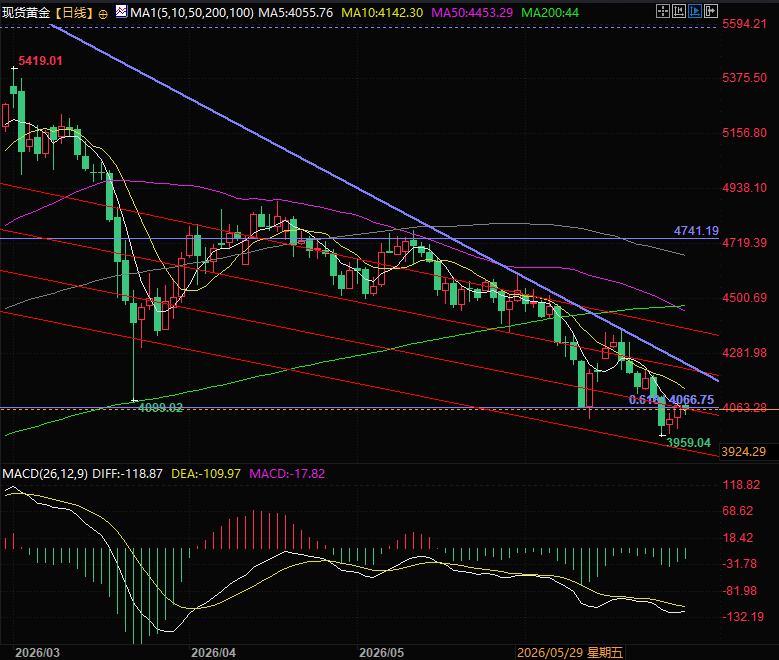
(Spot gold chart below, source: EasyForex)
At 16:33 Beijing time, spot gold was trading at $4,064 per ounce.
In the latter half of last week, the US and Iran once again clashed militarily. Iranian drones attacked a cargo ship that was not sailing in accordance with the routes requested by Iran. The US then bombed Iranian territory. Iran then bombed an oil tanker. In response, the US bombed Iranian territory again. Iran then directly bombed a US military base. Trump also made some harsh remarks, threatening to overthrow the Iranian regime if Iran refused to abide by the ceasefire agreement. The overall atmosphere was tense, and pessimism continued to spread globally.
However, on Monday , the United States signaled a de-escalation of the situation . A U.S. official said that technical negotiations with Iran are expected to continue in all areas of the memorandum of understanding, and both sides will exercise restraint for the time being, allowing ships to pass freely.
Another senior U.S. official said that the United States and Iran have agreed to cease attacks on each other and will continue negotiations on the Strait of Hormuz in Doha, the capital of Qatar, on the 30th.
However, the US military base did not react immediately after the attack. It is now the turn of the US military to respond tonight, and how the US military responds tonight is a key focus.
Meanwhile, global capital markets continued to correct downwards, but gold showed significant resilience, restoring some of its function as a hedge against equity market risks. This restoration of its function will drive a renewed inflow of allocation-oriented funds.
Root of the conflict: Intense power struggle over control of the Strait of Hormuz
The core trigger for this round of conflict is the dispute over control of the Strait of Hormuz.
As a crucial waterway carrying one-fifth of the world's oil and gas transportation, the Strait of Hormuz, although belonging to the category of internationally used waterways, has always been insisted upon by Iran to maintain its dominant control over the strait.
Recently, the United States, leading a multinational maritime organization, has attempted to bypass Iranian control and expand independent shipping lanes near Oman in order to restart freedom of navigation in the Strait of Hormuz. This move has thoroughly angered Iran and triggered continuous exchanges of fire between the two sides in recent days.
Iran has stated firmly that any actions that deviate from Iran's existing control system or unilaterally adjust the rules for navigation in the Strait of Hormuz will exacerbate regional chaos, delay the resumption of navigation, and continue to escalate geopolitical tensions.
In retaliation for the unilateral actions of the United States, Iran has recently launched two strikes against ships passing through the new shipping lane on the Omani side, completely disrupting the stable regional shipping order.
The conflict continues to escalate: successive attacks on ships trigger dual military strikes by the US and Iran.
The current round of tensions between the US and Iran began with the attack on their ships.
Earlier, Iranian drones launched the first attack on the cargo ship "M/V EverLovely" in waters near Oman, prompting the US to launch its first retaliatory airstrikes.
Although there was still room for a ceasefire at that time, Iran struck again in the early hours of June 28, using a one-way attack drone to hit the Panamanian-flagged giant oil tanker "M/T Kiku" near the Strait of Hormuz.
The tanker, carrying over 2 million barrels of Qatari crude oil, was severely damaged after the attack, directly exacerbating tensions between the two sides.
In response to Iran's continued attacks on ships, the U.S. military swiftly launched a second round of precision strikes, focusing on key military facilities within Iran, including military surveillance facilities, communication systems, air defense positions, drone storage bases, and mine-laying equipment, to precisely weaken Iran's maritime deterrence capabilities.
At the same time, Iran launched a large-scale counterattack, carrying out drone and missile strikes against Bahrain and Kuwait, where US military bases are located. The Iranian Revolutionary Guard officially claimed responsibility for all the attacks.
Several Gulf countries have been affected, and regional risks continue to escalate.
In this round of counterattacks against Iraq, Kuwait's air defense system successfully intercepted all incoming munitions, causing no loss of personnel or facilities;
While no one was killed, the damage to a residential building near Bahrain International Airport, which is home to the U.S. Navy's Fifth Fleet, signifies that the conflict has precisely targeted the core of the U.S. military's Gulf military posture.
The Bahrain Foreign Ministry strongly condemned Iran's actions, stating that they were not accidental or sudden, but rather a deliberate and routine escalation of aggression. Furthermore, regional military operations have affected Qatar, resulting in the death of one civilian and injuries to another, further escalating security risks for civilians in the Middle East.
The ceasefire is on the verge of collapse; the US and Iran are leaving a window for negotiations open.
As the situation continues to deteriorate, the US-Iran ceasefire agreement is on the verge of collapse.
Trump publicly accused Iran of unilaterally violating the ceasefire agreement and issued an extreme military warning, threatening that if the situation deteriorates further, the United States may completely end the existing Iranian regime.
However, both sides have reserved room for negotiation. With the mediation of Pakistan, Qatar and other parties, the US and Iran have tentatively scheduled to restart technical talks this Tuesday, and will discuss key issues such as navigation rules in the Strait of Hormuz, the lifting of US port blockades and unilateral sanctions against Iran, and the disposal of Iran's highly enriched uranium stockpile.
The memorandum of understanding signed by both sides earlier this month agreed to finalize all the details of the agreement within 60 days, but the ongoing war in Lebanon has become a key variable hindering the implementation of the agreement.
The Middle East is embroiled in a protracted conflict on multiple fronts, with the situation in Lebanon and Syria remaining volatile.
In addition to the direct confrontation between the US and Iran, multiple fronts in the Middle East are simultaneously locked in a stalemate.
The ceasefire framework agreement previously reached between Israel and Lebanon has been significantly weakened. The agreement did not include Iran and Hezbollah, and was publicly rejected by Hezbollah, whose position of refusing to disarm has remained firm.
Israel currently occupies approximately 600 square kilometers of land in southern Lebanon as a security buffer zone and refuses to withdraw its troops. Sporadic clashes continue along the Lebanese-Israeli border, and Hezbollah has stated that it will continue its struggle until the Israeli army completely withdraws.
In an effort to manage the complex situation, Iran has proposed the formation of a trilateral conflict management group involving the United States, Iran, and Lebanon, in an attempt to coordinate a ceasefire in the region .
The situation on the Syrian battlefield also remains tense.
Israel has recently continued its military strikes against targets in Syria, shelling the village of Abdin in Daraa province in southern Syria, forcing local villagers to evacuate.
Since the fall of the regime of former Syrian President Bashar al-Assad in December 2024, Israel has long occupied the UN-controlled buffer zone in southern Syria, transitioning from a temporary military presence to an indefinite occupation, continuously expanding its military influence in the region and further exacerbating the chaotic geopolitical situation in the Middle East.
Summary and Technical Analysis:
The current focus is on two key aspects: first, how the United States will respond to Iran's public attack on US military bases; and second, whether gold has the opportunity to move independently of the equity market. Recently, after gold prices fell below key levels, leading to a concentrated exit of speculative positions, the function of gold as a hedge against the equity market is expected to return, which will benefit gold prices.
With oil prices continuing to fall, global geopolitical conflicts ongoing, and global capital markets undergoing corrections, liquidity is expected to shift towards gold, and gold prices are likely to continue to rise.
Technical Analysis: Spot gold has broken above the 5-day moving average and the middle line of the descending channel, showing signs of gradual strengthening. Support lies at the middle line of the channel and the 5-day moving average, while resistance is at the 0.618 Fibonacci retracement level of 4066. If the gold price can continue to hold above 4066, it is expected to continue its rebound.
(Spot gold chart below, source: EasyForex)
At 16:33 Beijing time, spot gold was trading at $4,064 per ounce.
- Risk Warning and Disclaimer
- The market involves risk, and trading may not be suitable for all investors. This article is for reference only and does not constitute personal investment advice, nor does it take into account certain users’ specific investment objectives, financial situation, or other needs. Any investment decisions made based on this information are at your own risk.