Hormuz in a "partially open, partially closed" state: Traffic has sharply decreased after the attacks on the two ships, and oil prices are hovering around $70, awaiting a new catalyst.
2026-06-29 16:30:49
On Monday (June 29), during the European session, US crude oil futures rose by about 1% and are currently trading around $70 per barrel.
The fragile geopolitical situation provided a floor for crude oil prices.
Following the recent attacks on two merchant ships, commercial traffic in the Strait of Hormuz remains low, highlighting shipowners' continued concerns about the security situation in this vital global energy chokepoint.
Although the US and Iran reached an agreement earlier this month to temporarily open the Strait of Hormuz, and a small number of ships completed passage over the weekend, repeated clashes and geopolitical frictions are testing the fragile ceasefire consensus.
For global investors, shipowners, and insurance companies, the opening of the strait has become a litmus test for whether peace agreements can be sustained and whether supply chains can truly normalize.

According to vessel tracking data, only a few ships openly transited the Strait of Hormuz over the weekend. Among them, two Very Large Crude Carriers (VLCCs) entered the Persian Gulf empty, while a French container ship and two cargo tankers departed from the inland waters.
A noteworthy comparison is that, despite the decline in traffic observed over the weekend, it remained higher than levels seen for most of the period during the Iraq War.
This trend—with more and more ship owners willing to try to pass through the Strait of Hormuz—has picked up since Washington and Tehran announced a provisional agreement earlier this month to reopen the strait.
Last week, a Singapore-flagged container ship was attacked. Then, on Saturday, the Kiku oil tanker, carrying Qatari oil, was attacked in the Strait of Hormuz. These two incidents have once again put market nerves on edge.
Following the attack, the Joint Maritime Information Centre (JMIC), which liaises with navies and merchant shipping, raised the threat level in the region to "Substantial".
Meanwhile, the United Nations International Maritime Organization (IMO) warned on Friday that approximately 80 mines exist in the historic central channel of the strait, further exacerbating navigational risks.
Currently, shipowners' attitudes are divided – their confidence in crossing the strait varies.
Cautious observers note that some vessels that recently abandoned the route—including two cargo VLCCs and a Qatari-flagged LNG carrier—have not yet attempted to navigate it again since the attacks. Some shipowners have informed Bloomberg that they have suspended their withdrawal plans.
On the positive side: Some vessels still chose to continue their passage. Following the attacks, in addition to the two VLCCs that entered the port, a Norwegian-flagged product tanker, a tanker sanctioned by the US, and a liquefied petroleum gas carrier also entered the Persian Gulf. On the outbound side, in addition to the aforementioned three vessels, another product tanker and a crude oil tanker sanctioned by the US completed their crossing.
For energy traders, the flow of empty ships into ports is of particular interest.
The reason is that energy producers in the Persian Gulf region are seeking to resume exports after months of shutdowns, which requires empty ships to enter the Gulf to load cargo.
Therefore, whether unloaded VLCCs can successfully pass through the Hormuz into the Persian Gulf is directly related to the pace of global energy supply recovery.
Following the attacks on the two ships over the weekend, the US and Iran launched a tit-for-tat strike, putting the already fragile ceasefire agreement to the test.
Although both sides subsequently agreed to suspend the attacks and planned to resume negotiations this week, the situation remains highly volatile.
The Strait of Hormuz connects the Persian Gulf to global markets and is one of the world's most important energy chokepoints. Since the outbreak of war at the end of February, traffic through the Strait has plummeted to a trickle, with both the US and Iran imposing blockades.
The partial reopening that followed had driven a sharp drop in oil prices, and the current volatile security situation is causing the energy market to repric the geopolitical risk premium.
According to the daily chart, the medium-term downtrend in US crude oil futures is clear. Prices have been falling continuously from the year's high of 119.48, and recently stabilized slightly after testing a low of 68.56. The short-term 20-day and 50-day moving averages continue to decline, suppressing prices, while the medium-to-long-term 200-day moving average at 73.99 forms a key strong resistance level, making any bullish rebound extremely difficult.
From a technical perspective, the MACD is trading in a bearish zone below the zero line, with the DIFF line at -6.35 consistently below the DEA line at -5.47. The green histogram remains divergent, indicating that bearish momentum has not yet significantly weakened, and there are no signs of a bottom reversal. The RSI value is 29.63, approaching the oversold threshold of 30, suggesting a short-term need for technical correction after overselling. However, it has not broken through the 50 level, which is the dividing line between bullish and bearish sentiment, and any rebound is merely a minor correction within a downtrend.
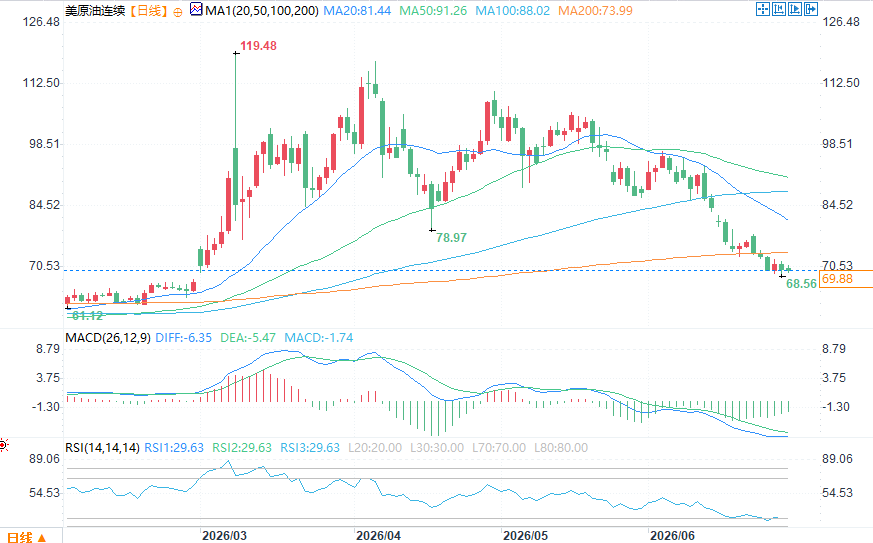
(US crude oil futures daily chart, source: FX678)
At 15:22 Beijing time on June 29, US crude oil futures were trading at $69.93 per barrel.
The fragile geopolitical situation provided a floor for crude oil prices.
Following the recent attacks on two merchant ships, commercial traffic in the Strait of Hormuz remains low, highlighting shipowners' continued concerns about the security situation in this vital global energy chokepoint.
Although the US and Iran reached an agreement earlier this month to temporarily open the Strait of Hormuz, and a small number of ships completed passage over the weekend, repeated clashes and geopolitical frictions are testing the fragile ceasefire consensus.
For global investors, shipowners, and insurance companies, the opening of the strait has become a litmus test for whether peace agreements can be sustained and whether supply chains can truly normalize.
Latest update: Flights are sparse over the weekend, but still above wartime levels.
According to vessel tracking data, only a few ships openly transited the Strait of Hormuz over the weekend. Among them, two Very Large Crude Carriers (VLCCs) entered the Persian Gulf empty, while a French container ship and two cargo tankers departed from the inland waters.
A noteworthy comparison is that, despite the decline in traffic observed over the weekend, it remained higher than levels seen for most of the period during the Iraq War.
This trend—with more and more ship owners willing to try to pass through the Strait of Hormuz—has picked up since Washington and Tehran announced a provisional agreement earlier this month to reopen the strait.
Security Crisis: Two Ships Attacked, Threat Level Raised
Last week, a Singapore-flagged container ship was attacked. Then, on Saturday, the Kiku oil tanker, carrying Qatari oil, was attacked in the Strait of Hormuz. These two incidents have once again put market nerves on edge.
Following the attack, the Joint Maritime Information Centre (JMIC), which liaises with navies and merchant shipping, raised the threat level in the region to "Substantial".
Meanwhile, the United Nations International Maritime Organization (IMO) warned on Friday that approximately 80 mines exist in the historic central channel of the strait, further exacerbating navigational risks.
Shipowners' reactions: Confidence is divided, with a strong wait-and-see attitude.
Currently, shipowners' attitudes are divided – their confidence in crossing the strait varies.
Cautious observers note that some vessels that recently abandoned the route—including two cargo VLCCs and a Qatari-flagged LNG carrier—have not yet attempted to navigate it again since the attacks. Some shipowners have informed Bloomberg that they have suspended their withdrawal plans.
On the positive side: Some vessels still chose to continue their passage. Following the attacks, in addition to the two VLCCs that entered the port, a Norwegian-flagged product tanker, a tanker sanctioned by the US, and a liquefied petroleum gas carrier also entered the Persian Gulf. On the outbound side, in addition to the aforementioned three vessels, another product tanker and a crude oil tanker sanctioned by the US completed their crossing.
Key Takeaway: Empty Vessels Entering Port – The “Lifeline” of Energy Production Recovery
For energy traders, the flow of empty ships into ports is of particular interest.
The reason is that energy producers in the Persian Gulf region are seeking to resume exports after months of shutdowns, which requires empty ships to enter the Gulf to load cargo.
Therefore, whether unloaded VLCCs can successfully pass through the Hormuz into the Persian Gulf is directly related to the pace of global energy supply recovery.
Geopolitical context: The ceasefire is fragile, and friction could reignite at any time.
Following the attacks on the two ships over the weekend, the US and Iran launched a tit-for-tat strike, putting the already fragile ceasefire agreement to the test.
Although both sides subsequently agreed to suspend the attacks and planned to resume negotiations this week, the situation remains highly volatile.
The Strait of Hormuz connects the Persian Gulf to global markets and is one of the world's most important energy chokepoints. Since the outbreak of war at the end of February, traffic through the Strait has plummeted to a trickle, with both the US and Iran imposing blockades.
The partial reopening that followed had driven a sharp drop in oil prices, and the current volatile security situation is causing the energy market to repric the geopolitical risk premium.
Technical Analysis
According to the daily chart, the medium-term downtrend in US crude oil futures is clear. Prices have been falling continuously from the year's high of 119.48, and recently stabilized slightly after testing a low of 68.56. The short-term 20-day and 50-day moving averages continue to decline, suppressing prices, while the medium-to-long-term 200-day moving average at 73.99 forms a key strong resistance level, making any bullish rebound extremely difficult.
From a technical perspective, the MACD is trading in a bearish zone below the zero line, with the DIFF line at -6.35 consistently below the DEA line at -5.47. The green histogram remains divergent, indicating that bearish momentum has not yet significantly weakened, and there are no signs of a bottom reversal. The RSI value is 29.63, approaching the oversold threshold of 30, suggesting a short-term need for technical correction after overselling. However, it has not broken through the 50 level, which is the dividing line between bullish and bearish sentiment, and any rebound is merely a minor correction within a downtrend.
(US crude oil futures daily chart, source: FX678)
At 15:22 Beijing time on June 29, US crude oil futures were trading at $69.93 per barrel.
- Risk Warning and Disclaimer
- The market involves risk, and trading may not be suitable for all investors. This article is for reference only and does not constitute personal investment advice, nor does it take into account certain users’ specific investment objectives, financial situation, or other needs. Any investment decisions made based on this information are at your own risk.