The US dollar posted its best monthly gain in a year; attention should be paid to a turning point between bullish and bearish trends.
2026-06-29 17:56:45
The US dollar index performed strongly this month and is on track to record its largest monthly gain in nearly a year. Multiple factors, including geopolitical tensions, a shift in Federal Reserve policy, and the return of global funds to safe havens, continue to support the dollar.
However, from a short-term perspective, the US dollar index showed signs of weakening on Monday. Multiple positive factors have diminished, policy expectations are gradually being revised, and there is a need for technical correction. The US dollar is likely to enter a period of consolidation with a slightly weaker bias in the short term, and the strong monthly closing rally may see a temporary cooling down.
In conjunction with Thursday's non-farm payrolls data, regardless of whether it meets expectations, the US dollar index may experience a profit-taking trend.
The ongoing geopolitical conflict in the Gulf region this month has continued to disrupt global markets, becoming a key short-term factor supporting the demand for the US dollar as a safe haven.
The escalating tensions between the US and Iran have led to fluctuating risk aversion in the market, indirectly contributing to a temporary strengthening of the US dollar.
Last weekend, the US and Iran clashed again, with Iran launching missiles and drones at US military facilities in Kuwait and Bahrain, initiating military strikes. This followed a strong warning from Trump to Iran, further escalating regional tensions.
Amid escalating tensions, the Strait of Hormuz shipping route has been repeatedly attacked, disrupting global energy transport and pushing international oil prices higher on Monday.
Rising oil prices have further increased global inflation expectations, forcing the market to strengthen its expectations of a tighter monetary policy from the Federal Reserve, indirectly boosting safe-haven buying of the US dollar.
However, tensions have eased somewhat, with the US and Iran reaching an agreement to suspend military confrontations in the Gulf region and set to resume dispute talks in Qatar on Tuesday.
ActivTrades analyst Ricardo Ivangelista points out that the recurring geopolitical conflicts continue to weigh on gold prices, while providing temporary support for the US dollar.
However, objectively speaking, geopolitical benefits are highly short-term and volatile. Once the situation eases marginally, safe-haven funds will quickly retreat, and the dollar's gains previously driven by geopolitical sentiment will face room for retracement. This is one of the important reasons why the dollar weakened first on Monday.
Aside from geopolitical factors, the reshaping of Federal Reserve policy expectations is the core fundamental logic behind the dollar's strength this month.
Newly appointed Federal Reserve Chairman Warsh removed commonly used dovish guidance terms from his first appearance this month, giving the Fed a more hawkish overall stance.
The large-scale sell-off in global technology-driven stock markets, coupled with the continued inflow of safe-haven funds back into dollar assets, provided solid support for the strong monthly performance of the US dollar index.
The market is currently focused on this week's key US employment data, including non-farm payrolls and the unemployment rate, which will directly verify the resilience of the US labor market and set the tone for the Fed's subsequent interest rate cycle.
Joseph Capelso, head of foreign exchange at Commonwealth Bank of Australia, said that the strength of the US economy relative to most economies in the world was originally intended to support a gradual strengthening of the US dollar in the medium to long term.
If employment data continues to be strong, the Federal Reserve's room for interest rate cuts will be significantly narrowed, and the high-interest-rate environment will continue to benefit the US dollar.
Meanwhile, the market is also closely watching the European Central Bank's annual forum, where Federal Reserve Chairman Warsh will participate in a major policy roundtable, with the market trying to understand its full policy inclinations.
However, the market had over-priced in Warsh's hawkish policies in the early stages, which is a key reason for the short-term downward pressure on the dollar.
The market had previously been concerned that Warsh, as the chairman nominated during the Trump era, with a strong political background and no formal economics background, might adjust monetary policy to align with the White House's demands and excessively strengthen the tightening stance.
However, judging from the Federal Reserve's operating mechanism, a single chairman cannot dictate the policy direction. The FOMC's monetary policy is decided by a joint vote of twelve members with voting rights. Warsh only holds one of the votes, and his legal authority is limited to procedural aspects such as meeting agenda arrangement and personnel administration. He cannot unilaterally change the policy tone.
Compared to the market's one-sided hawkish predictions, Warsh's core reform measures after taking office highlighted his pursuit of objective and systematic interest rate policy formulation, effectively offsetting the market's extreme tightening expectations and limiting the further upside potential of the US dollar.
To restructure the Federal Reserve's monetary policy system and optimize the scientific nature of its decision-making, Warsh officially announced the establishment of five special working groups covering five core areas: Federal Reserve communication mechanisms, balance sheet management, data source verification, productivity and employment research, and inflation framework assessment.
The five working groups will integrate internal and external professional research resources of the Federal Reserve to systematically review and optimize the entire chain of monetary policy formulation.
On the one hand, the working group will re-examine the inflation measurement model and the criteria for judging employment data, abandon the reliance on single data, and conduct a comprehensive assessment in combination with the productivity of the real economy and the performance of assets and liabilities to avoid subjective policy biases.
On the other hand, the Federal Reserve's external communication mechanism has been optimized to correct the market lag problem in its previous forward guidance.
This systematic working mechanism compensates for Walsh's lack of market expertise due to his economics background, enabling him to formulate interest rate policies based on multi-dimensional professional research data and objective market fundamentals analysis, rather than simply relying on political stance to impose policies.
This means that Warsh's monetary policy will not fall into the trap of extreme hawkishness, and subsequent interest rate adjustments will be more in line with economic fundamentals. The market's previous over-consumption of sustained high interest rates and strong tightening expectations will gradually cool down, directly prompting dollar bulls to take profits and exit the market, causing the index to weaken in the short term.
Considering both fundamentals and market trends, the US dollar's strong performance this month stemmed from the convergence of three core positive factors: geopolitical risk aversion, a reversal in policy expectations, and capital inflows. However, these multiple positive factors have gradually been absorbed and digested.
Geopolitical tensions have eased, leading to a decline in safe-haven buying. Market expectations of Warsh's extreme hawkish stance have been revised by his systematic reform measures, and tightening expectations have cooled marginally. Friday's non-farm payrolls report will provide a window for the market to realize these expectations.
The US dollar has shown signs of weakening technically, with insufficient bullish momentum, and a pullback is expected after a short period of consolidation.
Technical Analysis: The US dollar index has fallen below the 5-day moving average and the 50% Fibonacci retracement level of its trading range, suggesting a potential weakening trend. However, given the ongoing uncertainties surrounding the US-Iran issue and the possibility of actual clashes, the dollar may continue to fluctuate at high levels.
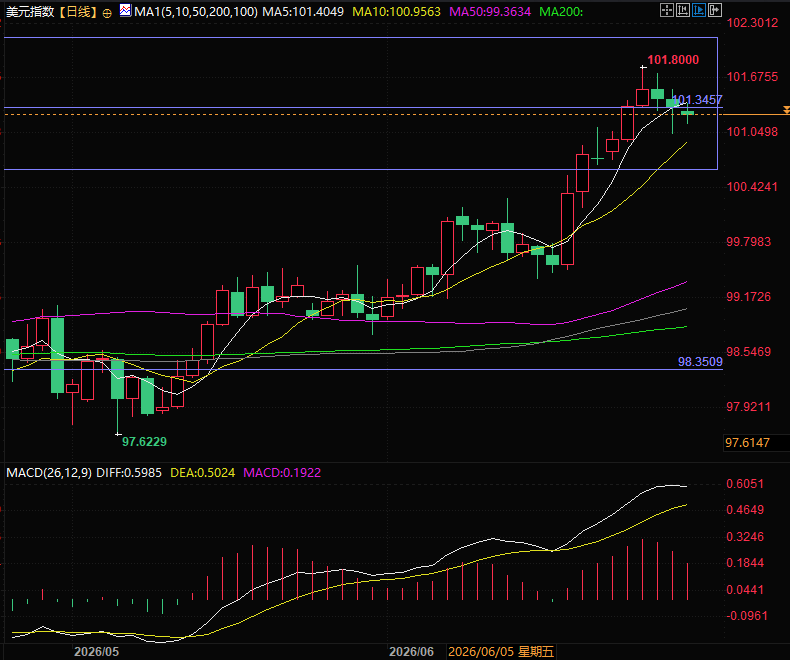
(US Dollar Index Daily Chart, Source: FX678)
At 17:53 Beijing time, the US dollar index is currently at 101.27.
However, from a short-term perspective, the US dollar index showed signs of weakening on Monday. Multiple positive factors have diminished, policy expectations are gradually being revised, and there is a need for technical correction. The US dollar is likely to enter a period of consolidation with a slightly weaker bias in the short term, and the strong monthly closing rally may see a temporary cooling down.
In conjunction with Thursday's non-farm payrolls data, regardless of whether it meets expectations, the US dollar index may experience a profit-taking trend.
The volatile geopolitical situation in the Gulf is a short-term positive for the US dollar, but its sustainability is limited.
The ongoing geopolitical conflict in the Gulf region this month has continued to disrupt global markets, becoming a key short-term factor supporting the demand for the US dollar as a safe haven.
The escalating tensions between the US and Iran have led to fluctuating risk aversion in the market, indirectly contributing to a temporary strengthening of the US dollar.
Last weekend, the US and Iran clashed again, with Iran launching missiles and drones at US military facilities in Kuwait and Bahrain, initiating military strikes. This followed a strong warning from Trump to Iran, further escalating regional tensions.
Amid escalating tensions, the Strait of Hormuz shipping route has been repeatedly attacked, disrupting global energy transport and pushing international oil prices higher on Monday.
Rising oil prices have further increased global inflation expectations, forcing the market to strengthen its expectations of a tighter monetary policy from the Federal Reserve, indirectly boosting safe-haven buying of the US dollar.
However, tensions have eased somewhat, with the US and Iran reaching an agreement to suspend military confrontations in the Gulf region and set to resume dispute talks in Qatar on Tuesday.
ActivTrades analyst Ricardo Ivangelista points out that the recurring geopolitical conflicts continue to weigh on gold prices, while providing temporary support for the US dollar.
However, objectively speaking, geopolitical benefits are highly short-term and volatile. Once the situation eases marginally, safe-haven funds will quickly retreat, and the dollar's gains previously driven by geopolitical sentiment will face room for retracement. This is one of the important reasons why the dollar weakened first on Monday.
Market pricing in hawkish Fed expectations weakens marginal support.
Aside from geopolitical factors, the reshaping of Federal Reserve policy expectations is the core fundamental logic behind the dollar's strength this month.
Newly appointed Federal Reserve Chairman Warsh removed commonly used dovish guidance terms from his first appearance this month, giving the Fed a more hawkish overall stance.
The large-scale sell-off in global technology-driven stock markets, coupled with the continued inflow of safe-haven funds back into dollar assets, provided solid support for the strong monthly performance of the US dollar index.
The market is currently focused on this week's key US employment data, including non-farm payrolls and the unemployment rate, which will directly verify the resilience of the US labor market and set the tone for the Fed's subsequent interest rate cycle.
Joseph Capelso, head of foreign exchange at Commonwealth Bank of Australia, said that the strength of the US economy relative to most economies in the world was originally intended to support a gradual strengthening of the US dollar in the medium to long term.
If employment data continues to be strong, the Federal Reserve's room for interest rate cuts will be significantly narrowed, and the high-interest-rate environment will continue to benefit the US dollar.
Meanwhile, the market is also closely watching the European Central Bank's annual forum, where Federal Reserve Chairman Warsh will participate in a major policy roundtable, with the market trying to understand its full policy inclinations.
However, the market had over-priced in Warsh's hawkish policies in the early stages, which is a key reason for the short-term downward pressure on the dollar.
The market had previously been concerned that Warsh, as the chairman nominated during the Trump era, with a strong political background and no formal economics background, might adjust monetary policy to align with the White House's demands and excessively strengthen the tightening stance.
However, judging from the Federal Reserve's operating mechanism, a single chairman cannot dictate the policy direction. The FOMC's monetary policy is decided by a joint vote of twelve members with voting rights. Warsh only holds one of the votes, and his legal authority is limited to procedural aspects such as meeting agenda arrangement and personnel administration. He cannot unilaterally change the policy tone.
Five special working groups have been established to strengthen Walsh's ability to formulate rational policies.
Compared to the market's one-sided hawkish predictions, Warsh's core reform measures after taking office highlighted his pursuit of objective and systematic interest rate policy formulation, effectively offsetting the market's extreme tightening expectations and limiting the further upside potential of the US dollar.
To restructure the Federal Reserve's monetary policy system and optimize the scientific nature of its decision-making, Warsh officially announced the establishment of five special working groups covering five core areas: Federal Reserve communication mechanisms, balance sheet management, data source verification, productivity and employment research, and inflation framework assessment.
The five working groups will integrate internal and external professional research resources of the Federal Reserve to systematically review and optimize the entire chain of monetary policy formulation.
On the one hand, the working group will re-examine the inflation measurement model and the criteria for judging employment data, abandon the reliance on single data, and conduct a comprehensive assessment in combination with the productivity of the real economy and the performance of assets and liabilities to avoid subjective policy biases.
On the other hand, the Federal Reserve's external communication mechanism has been optimized to correct the market lag problem in its previous forward guidance.
This systematic working mechanism compensates for Walsh's lack of market expertise due to his economics background, enabling him to formulate interest rate policies based on multi-dimensional professional research data and objective market fundamentals analysis, rather than simply relying on political stance to impose policies.
This means that Warsh's monetary policy will not fall into the trap of extreme hawkishness, and subsequent interest rate adjustments will be more in line with economic fundamentals. The market's previous over-consumption of sustained high interest rates and strong tightening expectations will gradually cool down, directly prompting dollar bulls to take profits and exit the market, causing the index to weaken in the short term.
Summary: With multiple positive factors implemented, the US dollar may enter a period of adjustment this week.
Considering both fundamentals and market trends, the US dollar's strong performance this month stemmed from the convergence of three core positive factors: geopolitical risk aversion, a reversal in policy expectations, and capital inflows. However, these multiple positive factors have gradually been absorbed and digested.
Geopolitical tensions have eased, leading to a decline in safe-haven buying. Market expectations of Warsh's extreme hawkish stance have been revised by his systematic reform measures, and tightening expectations have cooled marginally. Friday's non-farm payrolls report will provide a window for the market to realize these expectations.
The US dollar has shown signs of weakening technically, with insufficient bullish momentum, and a pullback is expected after a short period of consolidation.
Technical Analysis: The US dollar index has fallen below the 5-day moving average and the 50% Fibonacci retracement level of its trading range, suggesting a potential weakening trend. However, given the ongoing uncertainties surrounding the US-Iran issue and the possibility of actual clashes, the dollar may continue to fluctuate at high levels.
(US Dollar Index Daily Chart, Source: FX678)
At 17:53 Beijing time, the US dollar index is currently at 101.27.
- Risk Warning and Disclaimer
- The market involves risk, and trading may not be suitable for all investors. This article is for reference only and does not constitute personal investment advice, nor does it take into account certain users’ specific investment objectives, financial situation, or other needs. Any investment decisions made based on this information are at your own risk.